
Knowledge Management 20 years after The evolution and

- Slides: 26
Knowledge Management 20 years after. . . The evolution and increasing significance of Knowledge Management 2004 Karl M. Wiig Knowledge Research Institute, Inc. Arlington, TX 76016 -3517 phone: (817) 572 -6254 fax: (817) 478 -1048 e-mail: kmwiig@krii. com –– website: www. krii. com KM Past & Future 2004/ 1 Copyright © 2004 Knowledge Research Institute, Inc.
KM’s Role Is Changing The Early Focus: Strengthen Operations by Improving Knowledge and Its Availability The Emerging Focus: Make the Enterprise More Competitive from Strategic Perspectives “To Survive and Prosper You Need to Innovate Faster Than Your Competitors – It is Not Enough to Learn Faster!” KM Past & Future 2004/ 2 Copyright © 2004 Knowledge Research Institute, Inc.
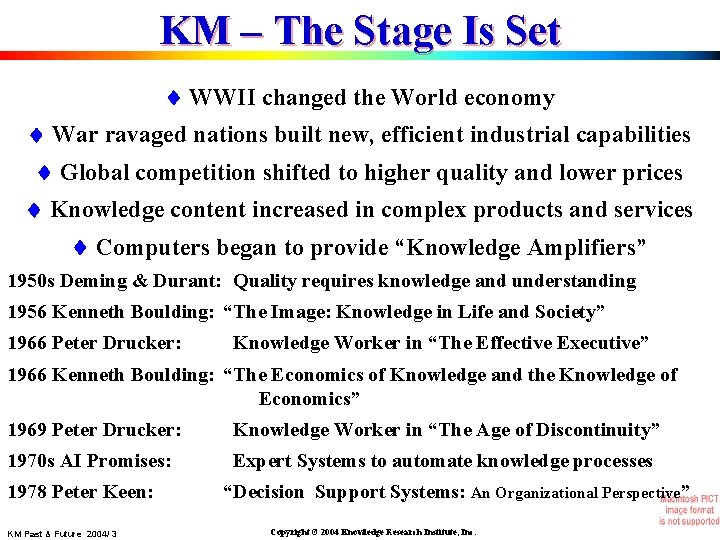
KM – The Stage Is Set WWII changed the World economy War ravaged nations built new, efficient industrial capabilities Global competition shifted to higher quality and lower prices Knowledge content increased in complex products and services Computers began to provide “Knowledge Amplifiers” 1950 s Deming & Durant: Quality requires knowledge and understanding 1956 Kenneth Boulding: “The Image: Knowledge in Life and Society” 1966 Peter Drucker: Knowledge Worker in “The Effective Executive” 1966 Kenneth Boulding: “The Economics of Knowledge and the Knowledge of Economics” 1969 Peter Drucker: Knowledge Worker in “The Age of Discontinuity” 1970 s AI Promises: Expert Systems to automate knowledge processes 1978 Peter Keen: KM Past & Future 2004/ 3 “Decision Support Systems: An Organizational Perspective” Copyright © 2004 Knowledge Research Institute, Inc.
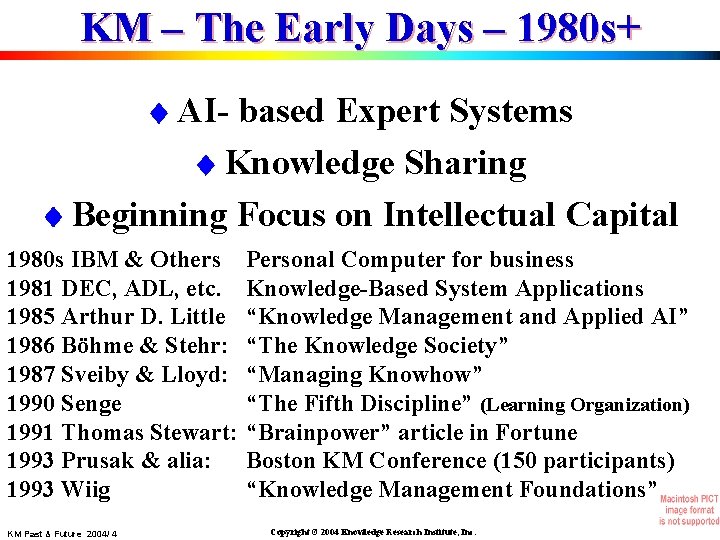
KM – The Early Days – 1980 s+ AI- based Expert Systems Knowledge Sharing Beginning Focus on Intellectual Capital 1980 s IBM & Others 1981 DEC, ADL, etc. 1985 Arthur D. Little 1986 Böhme & Stehr: 1987 Sveiby & Lloyd: 1990 Senge 1991 Thomas Stewart: 1993 Prusak & alia: 1993 Wiig KM Past & Future 2004/ 4 Personal Computer for business Knowledge-Based System Applications “Knowledge Management and Applied AI” “The Knowledge Society” “Managing Knowhow” “The Fifth Discipline” (Learning Organization) “Brainpower” article in Fortune Boston KM Conference (150 participants) “Knowledge Management Foundations” Copyright © 2004 Knowledge Research Institute, Inc.
Intellectual Capital Management (ICM) From <http: //www. sveiby. com/articles/icmmovement. htm> KM Past & Future 2004/ 5 Copyright © 2004 Knowledge Research Institute, Inc.
The Field Is Dynamic! We continue to learn about people and knowledge with profound consequences for KM Successful KM requires understanding of underlying knowledge-related mechanisms in people and organizations Much more than realized, decisions are made by tacit activation of mental reference models Mental models are often encoded stories of static scenes, dynamic episodes, procedures for work, and complex situations People learn / remember stories and concepts better than facts Expertise is a tacit and abstract personal capability to innovate, learn, blend mental models, see implications, and to act KM Past & Future 2004/ 6 Copyright © 2004 Knowledge Research Institute, Inc.
Situation Handling Requires Knowledge KM Past & Future 2004/ 7 Copyright 2004 Knowledge Research Institute, Inc. Copyright ©© 2003 Knowledge Research Institute, Inc.
KM – Its Basic Nature KM Ideally, KM governs knowledge-related activities and processes in all parts of society to: Improve effectiveness of personal actions – at work and at home Strengthen enterprise behavior to: Provide strong competitive position Increase value to customers Improve stakeholder relations Capability to be responsible societal citizen KM Past & Future 2004/ 8 Copyright © 2004 Knowledge Research Institute, Inc.
Effective Actions Are Needed at All Levels KM Past & Future 2004/ 9 Copyright © 2004 Knowledge Research Institute, Inc.
An Important Change Within the Knowledge-Vigilant enterprise most people possess an “Asset Management Mentality” to create, maintain, exchange, and utilize Intangible Capital to be as effective as possible in all their pursuits KM is cornerstone of Integral Management KM Past & Future 2004/ 10 Copyright © 2004 Knowledge Research Institute, Inc.
Remember – KM Covers Five Domains! KM Past & Future 2004/ 11 Copyright © 2004 Knowledge Research Institute, Inc.
Knowledge Management Counts! Progress and viability are driven by human capital Most studies have been inconclusive. . . However, long-term effects of improved knowledge indicate: 1 % literacy score increase leads to 2. 5 % personal productivity increase 1. 5 % increase in GDP Source: International Adult Literacy Survey: Literacy scores, human capital and growth across fourteen OECD countries Serge Coulombe, Jean-François Tremblay, and Sylvie Marchand - Statistics Canada - Human Resources and Skills Development KM Past & Future 2004/ 12 Copyright © 2004 Knowledge Research Institute, Inc.
Few Are Knowledge Vigilant! Qualitative Estimates Within the enterprise, KM often pursue separate and disjointed efforts like: KM/IT Applications Learning Organization Intellectual Capital Management Advanced enterprises pursue KM as part of Integrative Management KM Past & Future 2004/ 13 Copyright © 2004 Knowledge Research Institute, Inc.
KM – Its Significance Personal: Improved earnings potentials More effective personal decision making Raised quality of life Industrial: Greater competitive effectiveness Better products and services Beneficial for customers and consumers Societal: Increased progress from better educated citizenry Improved social and economic environments More desirable society KM Past & Future 2004/ 14 Copyright © 2004 Knowledge Research Institute, Inc.
KM Scope Shifts to Wider Focus Relative Frequency Knowledge Scope Qualitative Estimates KM Past & Future 2004/ 15 Copyright © 2004 Knowledge Research Institute, Inc.
KM – Its Real Significance Being Informed IS NOT Being Knowledgeable! KM provides opportunities for people and organizations to make more effective and knowledgeable decisions You must be knowledgeable to see the implications of situations described by information Success in today’s global society requires being Knowledgeable and Informed – Both! KM Past & Future 2004/ 16 Copyright © 2004 Knowledge Research Institute, Inc.
KM – Societal Significance Strategic goal for 2010 set for Europe at the Lisbon European Council – March 2000: "to become the most competitive and dynamic knowledge-based economy in the world, capable of sustainable economic growth with more and better jobs and greater social cohesion. " KM Past & Future 2004/ 17 Copyright © 2004 Knowledge Research Institute, Inc.
KM and Innovation Are Key “A Focus on Cost-Cutting and Efficiency Has Helped Many Organizations Weather the Downturn, But This Approach Will Ultimately Render Them Obsolete. Only the Constant Pursuit of Innovation Can Ensure Long-Term Success. ” DF Muzyka, FT Sep 17, 2004 Knowledge Management Is the Innovation Enabler by Providing the Driving Intellectual Capital Resources! KM Past & Future 2004/ 18 Copyright © 2004 Knowledge Research Institute, Inc.
Extra Slides Added for Reference KM Past & Future 2004/ 19 Copyright © 2004 Knowledge Research Institute, Inc.
Our Work Is Becoming More Complex KM Past & Future 2004/ 20 Copyright © 2004 Knowledge Research Institute, Inc.
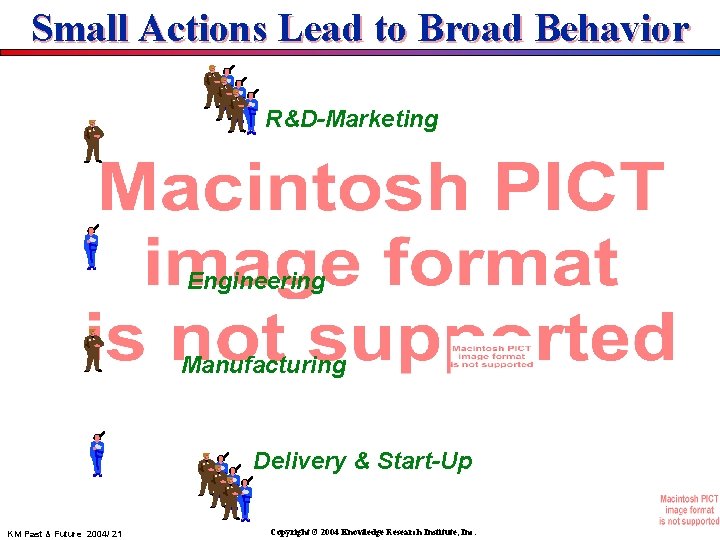
Small Actions Lead to Broad Behavior R&D-Marketing Engineering Manufacturing Delivery & Start-Up KM Past & Future 2004/ 21 Copyright © 2004 Knowledge Research Institute, Inc.
Most Decisions Are Nonconscious and Result from Activating Mental Reference Models! KM Past & Future 2004/ 22 Copyright © 2004 Knowledge Research Institute, Inc.
Some Inter-Domain Functions KM Past & Future 2004/ 23 Copyright © 2004 Knowledge Research Institute, Inc.
Examples of KM Domain Areas KM Past & Future 2004/ 24 Copyright © 2004 Knowledge Research Institute, Inc.
Knowledge-Based Business Diagnostics KM Past & Future 2004/ 25 Copyright © 2004 Knowledge Research Institute, Inc.
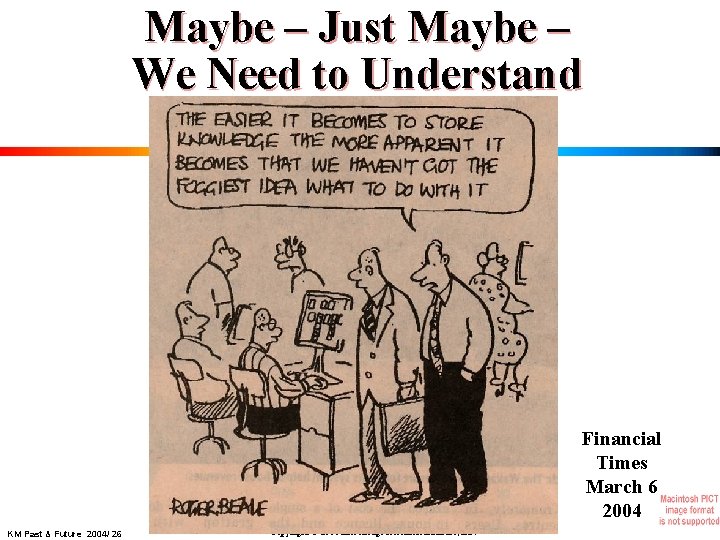
Maybe – Just Maybe – We Need to Understand Financial Times March 6 2004 KM Past & Future 2004/ 26 Copyright © 2004 Knowledge Research Institute, Inc.