
Knowledge into Action Using Technology to Get Knowledge

- Slides: 42
Knowledge into Action Using Technology to Get Knowledge into Practice. “The great end of life is not knowledge but action” T. H. Huxley 1825 -1895 NMAHP Leadership Programme: e. Health Applications in Healthcare Day 2 24 th February 2014
Before we start…. • Introductions • Using Web. Ex – Sliding menu with Chat and Participants – Using Chat – Raising your hand – *6 or Mute when you are not speaking – Introduce yourself before you speak • Recording the session.
Overview 1. Why? 2. What? 3. How? – Practical examples – Tools and skills – Measuring impact 4. What does this mean for you?
1. Why Knowledge into Action?
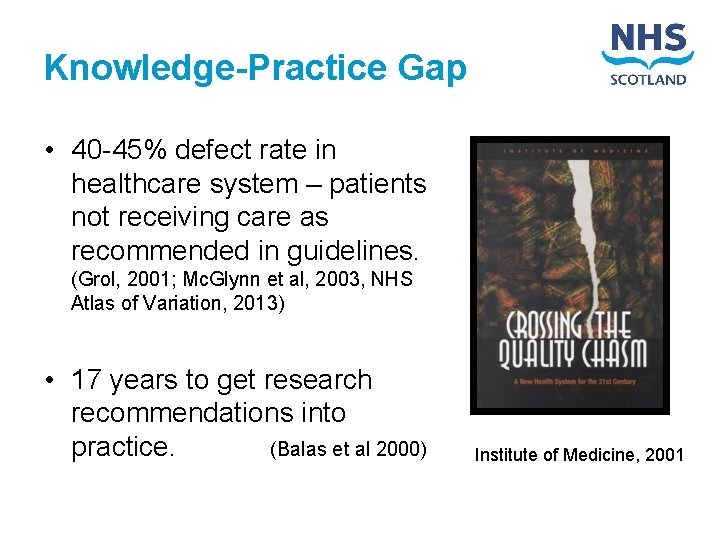
Knowledge-Practice Gap • 40 -45% defect rate in healthcare system – patients not receiving care as recommended in guidelines. (Grol, 2001; Mc. Glynn et al, 2003, NHS Atlas of Variation, 2013) • 17 years to get research recommendations into practice. (Balas et al 2000) Institute of Medicine, 2001
Knowledge-Practice Gap “Knowing is not enough; we must apply. Willing is not enough; we must do. ” - J. W. Goethe (1749 – 1832)
Think of an example in your workplace where knowledge could be translated into practice more effectively. Recent examples: • Learning from adverse events • Co-production • Diabetes care • Implementing guidelines – sepsis, psoriasis…. .
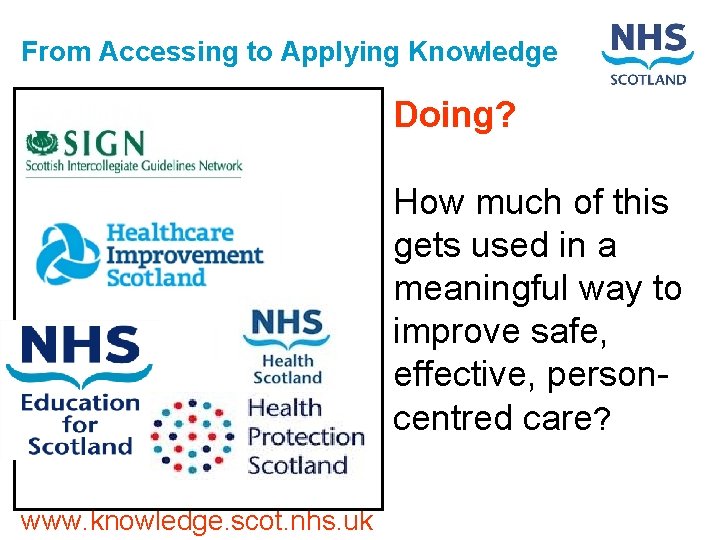
From Accessing to Applying Knowledge Doing? Knowing • Knowledge Network How much of this 12 million + resources • gets Knowledge products – used in a SIGN, HIS, HPS, meaningful way NES to as “knowledge improve safe, broker” organisations. effective, person • 66 libraries centred care ? • 116 library staff www. knowledge. scot. nhs. uk
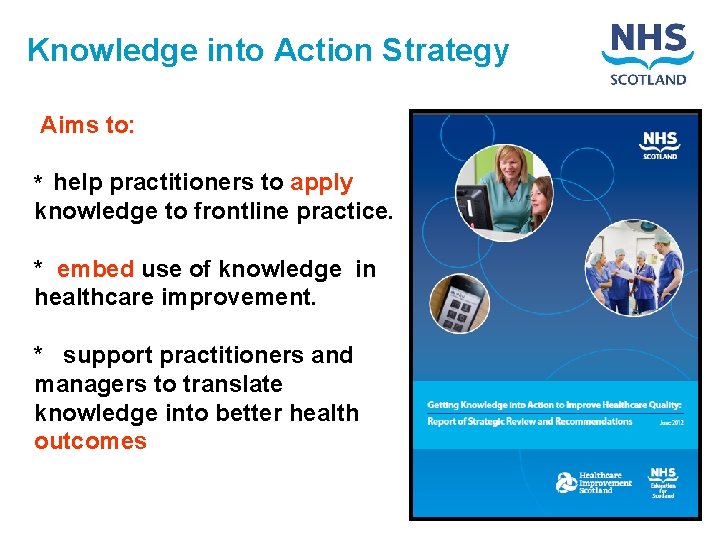
Knowledge into Action Strategy Aims to: help practitioners to apply knowledge to frontline practice. * * embed use of knowledge in healthcare improvement. * support practitioners and managers to translate knowledge into better health outcomes
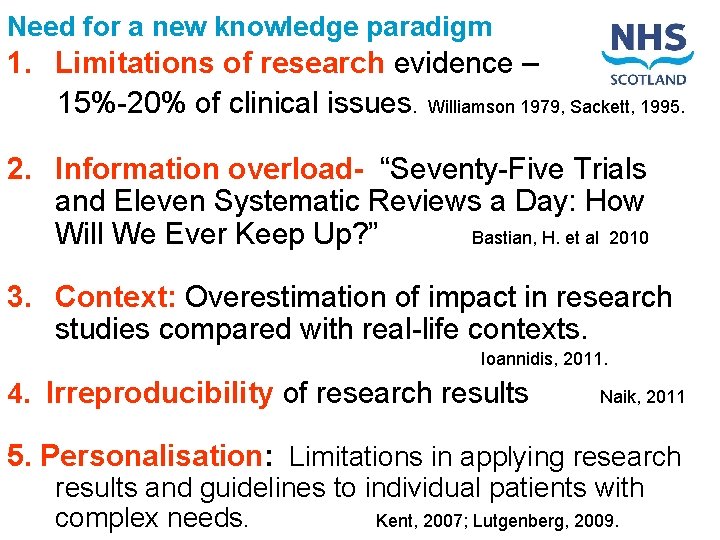
Need for a new knowledge paradigm 1. Limitations of research evidence – 15%-20% of clinical issues. Williamson 1979, Sackett, 1995. 2. Information overload- “Seventy-Five Trials and Eleven Systematic Reviews a Day: How Will We Ever Keep Up? ” Bastian, H. et al 2010 3. Context: Overestimation of impact in research studies compared with real-life contexts. Ioannidis, 2011. 4. Irreproducibility of research results Naik, 2011 5. Personalisation: Limitations in applying research results and guidelines to individual patients with complex needs. Kent, 2007; Lutgenberg, 2009.
2. What is Knowledge into Action?
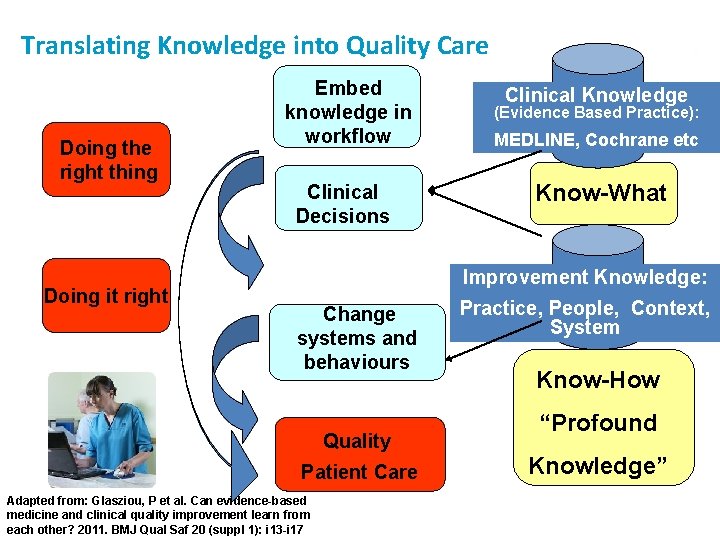
Translating Knowledge into Quality Care Doing the right thing Doing it right Embed knowledge in workflow Clinical Decisions Clinical Knowledge (Evidence Based Practice): MEDLINE, Cochrane etc Know-What Improvement Knowledge: Change systems and behaviours Quality Patient Care Adapted from: Glasziou, P et al. Can evidence-based medicine and clinical quality improvement learn from each other? 2011. BMJ Qual Saf 20 (suppl 1): i 13 -i 17 Practice, People, Context, System Know-How “Profound Knowledge”
Can you think of examples of “know-what” and “know-how” in your day to day work? Example: Diabetes care in NHS Tayside: • “Know-what” in national guidelines. • “Know-how” in local protocols and the experience of clinicians supporting patients with multiple conditions – outwith guideline recommendations. Example: Developing co-production in NHS GGC: • Staff drawing upon know-how of service users and communities.
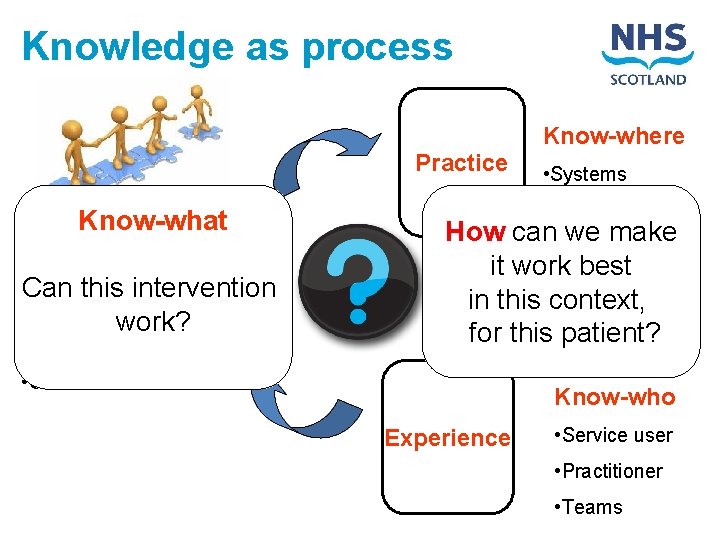
Knowledge as process Know-where Practice Know-what Research Can this intervention • Journals work? • MEDLINE • Systems • Processes How can we make • Variation it work best in this context, for this patient? • Cochrane Know-who Experience • Service user • Practitioner • Teams
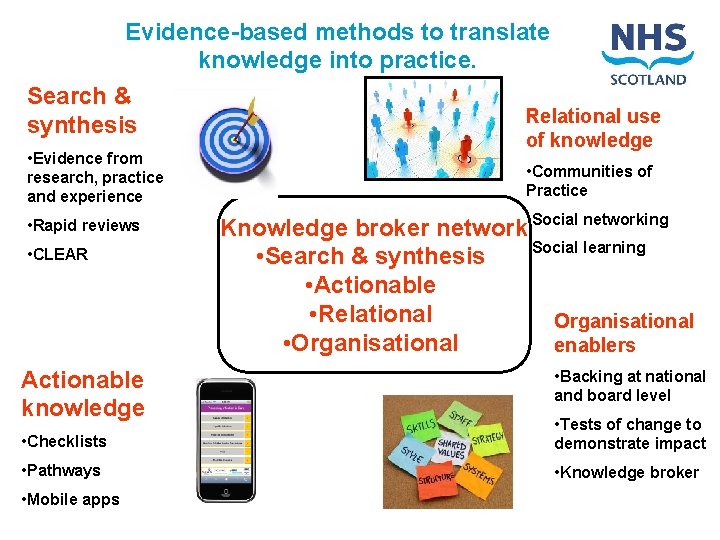
Evidence-based methods to translate knowledge into practice. Search & Relational use synthesis • Evidence from research, practice and experience • Rapid reviews • CLEAR Actionable knowledge of knowledge • Communities of Practice Knowledge broker network • Social networking • Social learning • Search & synthesis • Actionable • Relational Organisational • Organisational enablers • Backing at national and board level • Checklists • Tests of change to demonstrate impact • Pathways • Knowledge broker • Mobile apps
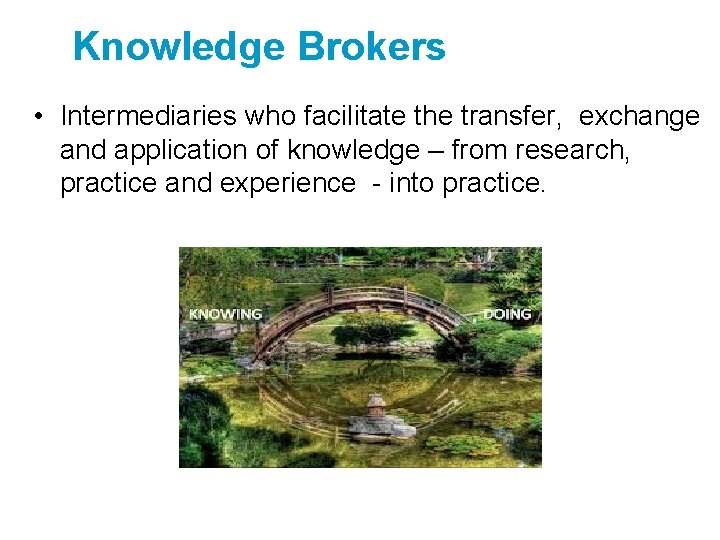
Knowledge Brokers • Intermediaries who facilitate the transfer, exchange and application of knowledge – from research, practice and experience - into practice.
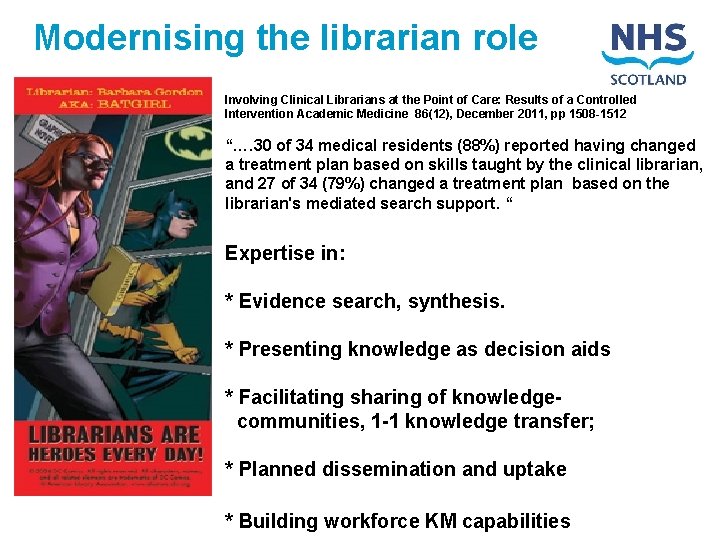
Modernising the librarian role Involving Clinical Librarians at the Point of Care: Results of a Controlled Intervention Academic Medicine 86(12), December 2011, pp 1508 -1512 “…. 30 of 34 medical residents (88%) reported having changed a treatment plan based on skills taught by the clinical librarian, and 27 of 34 (79%) changed a treatment plan based on the librarian's mediated search support. “ Expertise in: * Evidence search, synthesis. * Presenting knowledge as decision aids * Facilitating sharing of knowledgecommunities, 1 -1 knowledge transfer; * Planned dissemination and uptake * Building workforce KM capabilities
Menu of knowledge support from national knowledge broker network • Search and synthesis – Know what – Know how • Actionable knowledge • Social use of knowledge • Training in knowledge management skills
3. How to Make Knowledge into Action Real: Examples
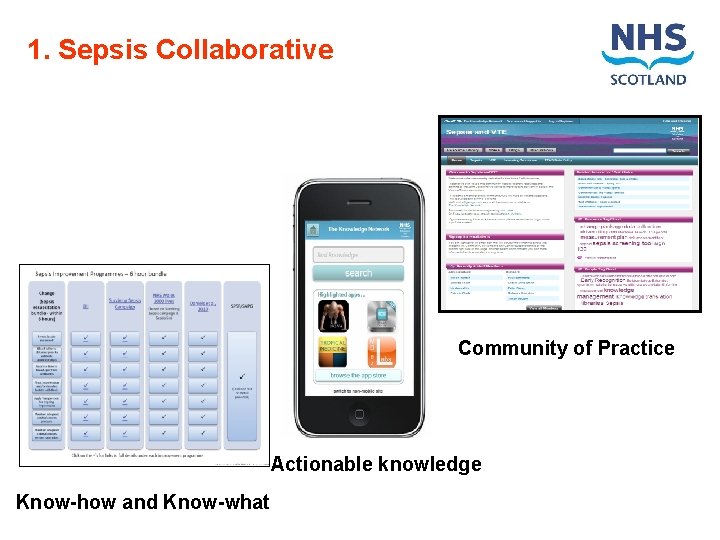
1. Sepsis Collaborative Community of Practice Actionable knowledge Know-how and Know-what
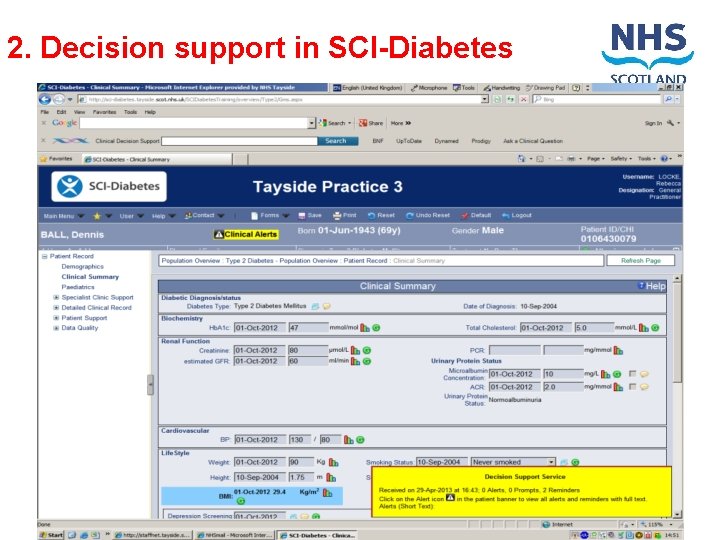
2. Decision support in SCI-Diabetes
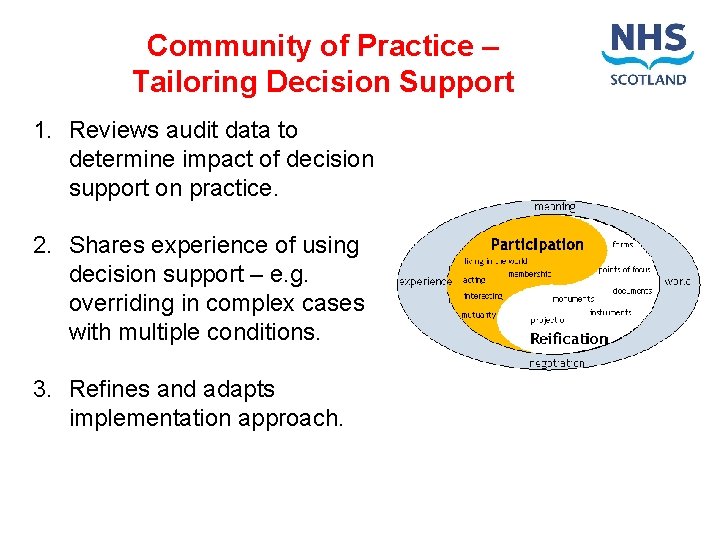
Community of Practice – Tailoring Decision Support 1. Reviews audit data to determine impact of decision support on practice. 2. Shares experience of using decision support – e. g. overriding in complex cases with multiple conditions. 3. Refines and adapts implementation approach.
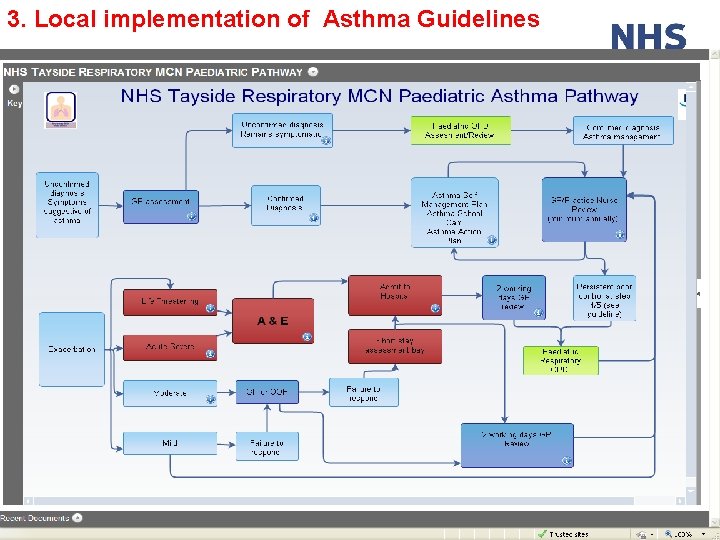
3. Local implementation of Asthma Guidelines
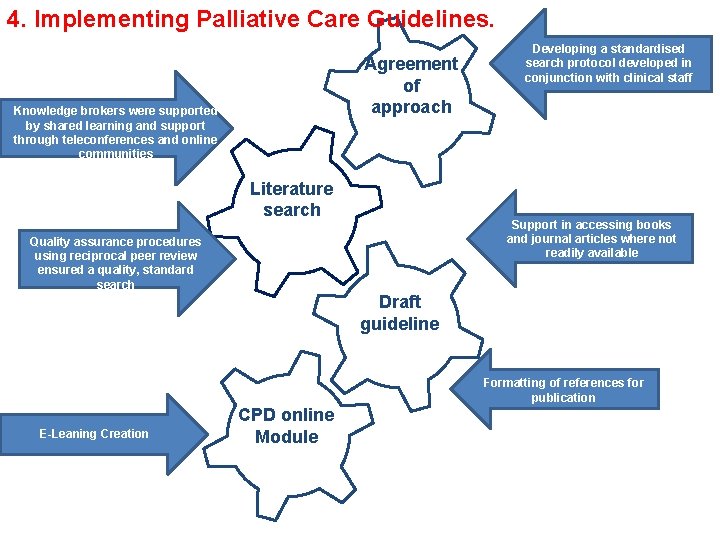
4. Implementing Palliative Care Guidelines. Agreement of approach Knowledge brokers were supported by shared learning and support through teleconferences and online communities Quality assurance procedures Literature search Developing a standardised search protocol developed in conjunction with clinical staff Support in accessing books and journal articles where not readily available Quality assurance procedures using reciprocal peer review ensured a quality, standard search Draft guideline Formatting of references for publication E-Leaning Creation CPD online Module
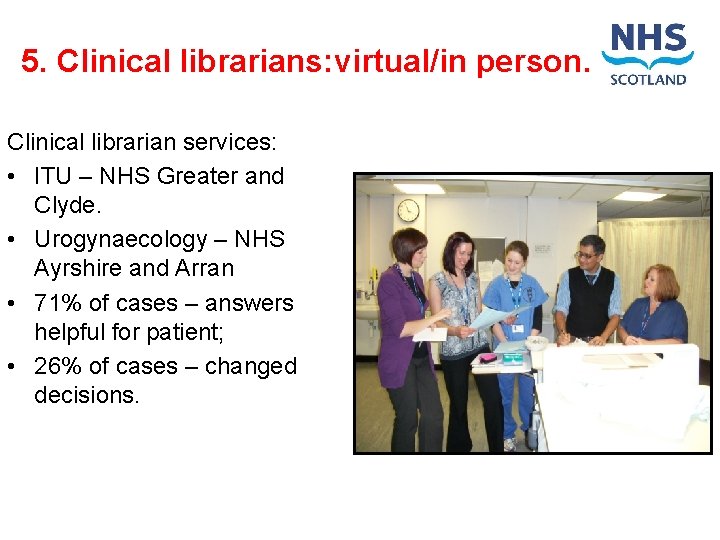
5. Clinical librarians: virtual/in person. Clinical librarian services: • ITU – NHS Greater and Clyde. • Urogynaecology – NHS Ayrshire and Arran • 71% of cases – answers helpful for patient; • 26% of cases – changed decisions.
6. Practice based small group learning • CPD module for GPs on cervical screening • 15 knowledge gaps identified • Knowledge brokers conducted literature searches & produced evidence summaries • Summaries directly incorporated into module • Model extended to community pharmacists http: //www. gpcpd. nes. scot. nhs. uk/pbsgl. aspx
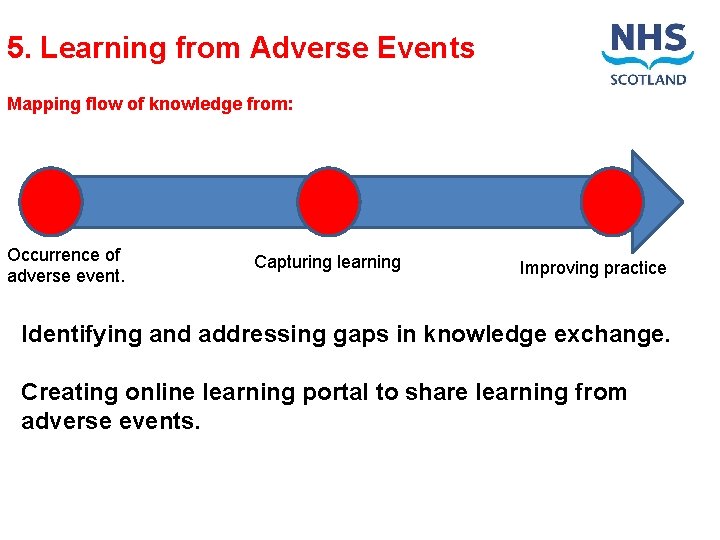
5. Learning from Adverse Events Mapping flow of knowledge from: Occurrence of adverse event. Capturing learning Improving practice Identifying and addressing gaps in knowledge exchange. Creating online learning portal to share learning from adverse events.
Can you relate to any of these examples – to help translate knowledge into practice in your workplace? Examples of spread: • • • Decision support for diabetes care in NHS Tayside spreading to West Lothian. Evidence search and synthesis for practice-based small group learning transferring from general practice to community pharmacy. Online packages to support guideline implementation – spread to polypharmacy and psoriasis guidelines.
4. Practical Tools and Support for you and your team
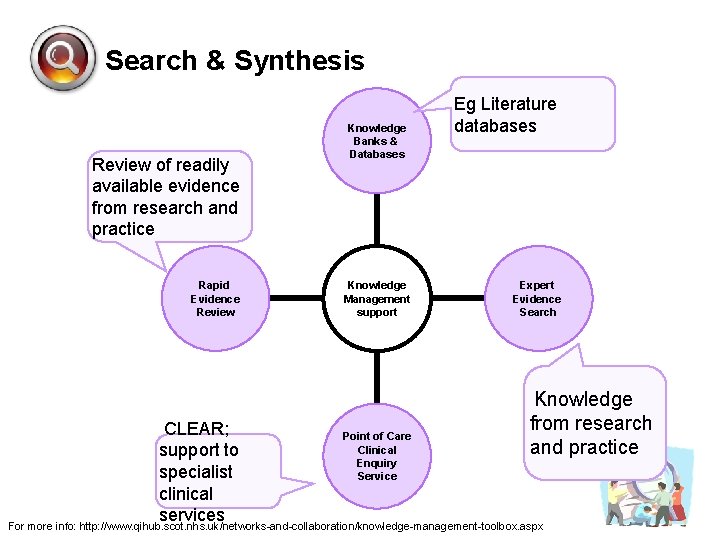
Search & Synthesis Review of readily available evidence from research and practice Rapid Evidence Review CLEAR; support to specialist clinical services Knowledge Banks & Databases Knowledge Management support Point of Care Clinical Enquiry Service Eg Literature databases Expert Evidence Search Knowledge from research and practice For more info: http: //www. qihub. scot. nhs. uk/networks-and-collaboration/knowledge-management-toolbox. aspx
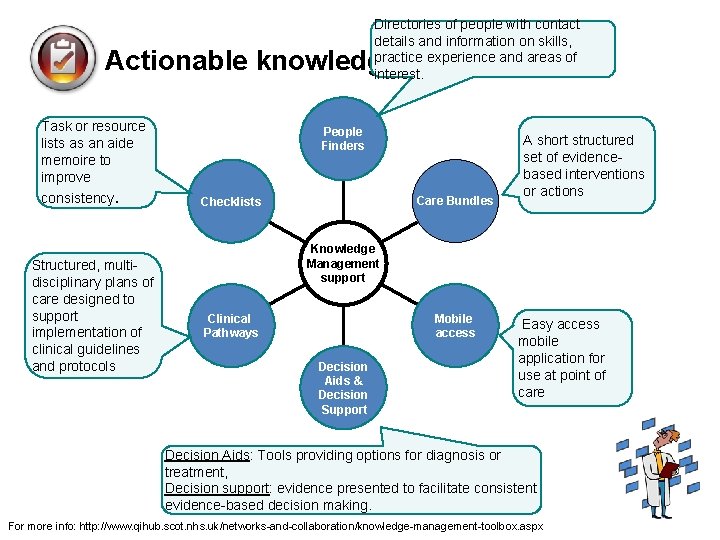
Directories of people with contact details and information on skills, practice experience and areas of interest. Actionable knowledge Task or resource lists as an aide memoire to improve consistency. Structured, multidisciplinary plans of care designed to support implementation of clinical guidelines and protocols People Finders Care Bundles Checklists A short structured set of evidencebased interventions or actions Knowledge Management support Mobile access Clinical Pathways Decision Aids & Decision Support Easy access mobile application for use at point of care Decision Aids: Tools providing options for diagnosis or treatment, Decision support: evidence presented to facilitate consistent evidence-based decision making. For more info: http: //www. qihub. scot. nhs. uk/networks-and-collaboration/knowledge-management-toolbox. aspx
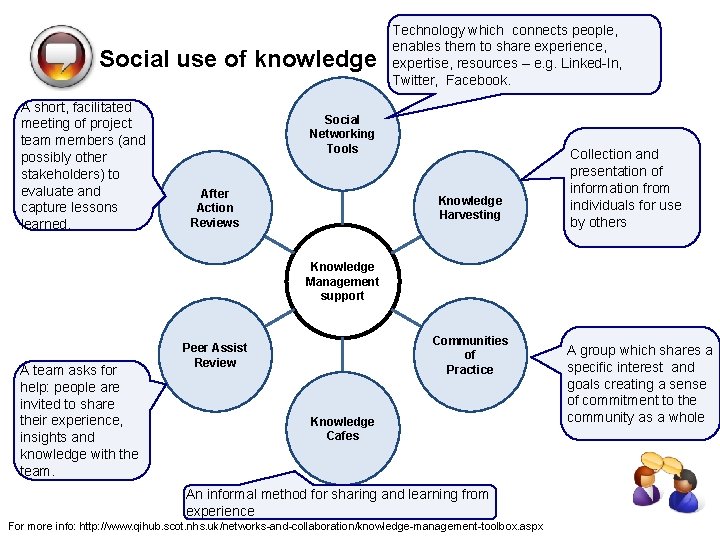
Social use of knowledge A short, facilitated meeting of project team members (and possibly other stakeholders) to evaluate and capture lessons learned. Technology which connects people, enables them to share experience, expertise, resources – e. g. Linked-In, Twitter, Facebook. Social Networking Tools After Action Reviews Knowledge Harvesting Collection and presentation of information from individuals for use by others Knowledge Management support A team asks for help: people are invited to share their experience, insights and knowledge with the team. Communities of Practice Peer Assist Review Knowledge Cafes An informal method for sharing and learning from experience For more info: http: //www. qihub. scot. nhs. uk/networks-and-collaboration/knowledge-management-toolbox. aspx A group which shares a specific interest and goals creating a sense of commitment to the community as a whole
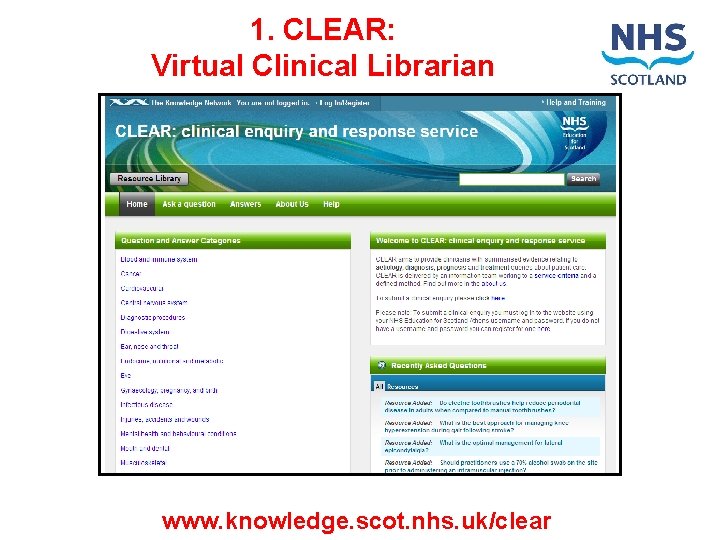
1. CLEAR: Virtual Clinical Librarian www. knowledge. scot. nhs. uk/clear
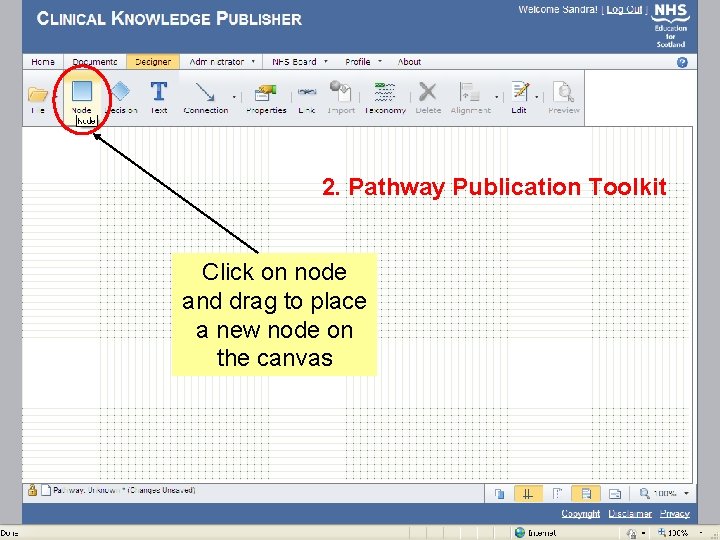
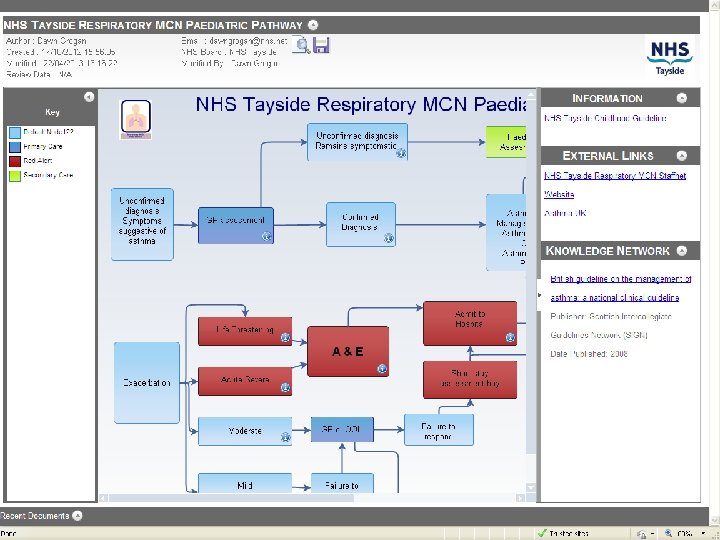
2. Pathway Publication Toolkit Click on node and drag to place a new node on the canvas
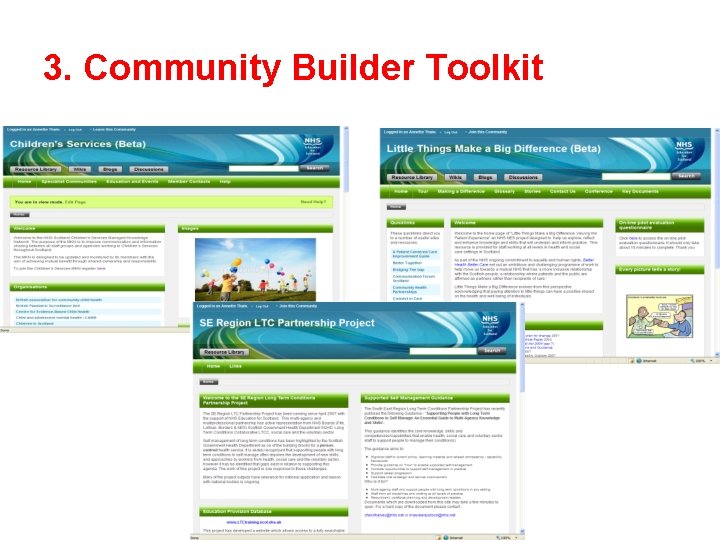
3. Community Builder Toolkit
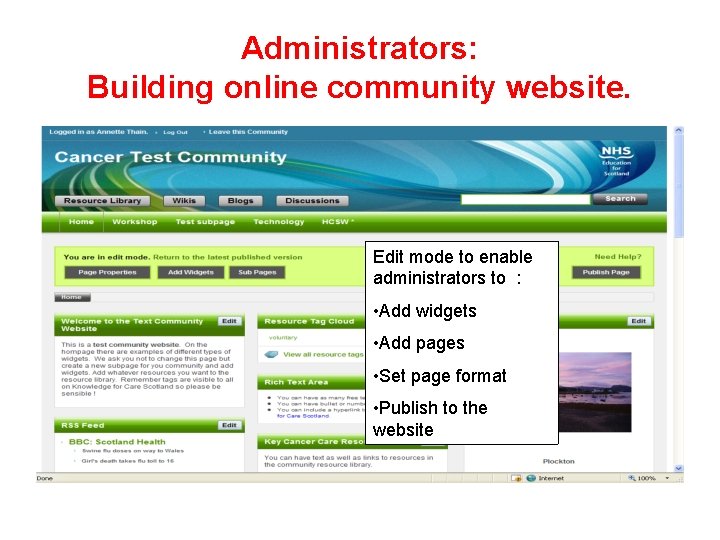
Administrators: Building online community website. Edit mode to enable administrators to : • Add widgets • Add pages • Set page format • Publish to the website
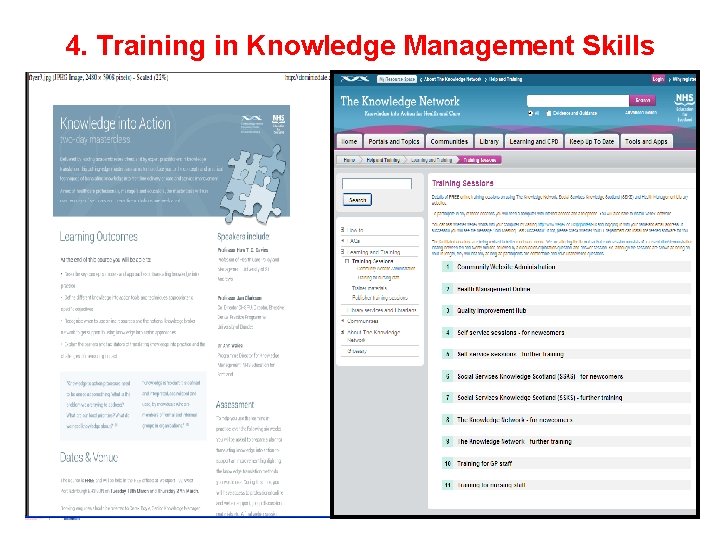
4. Training in Knowledge Management Skills
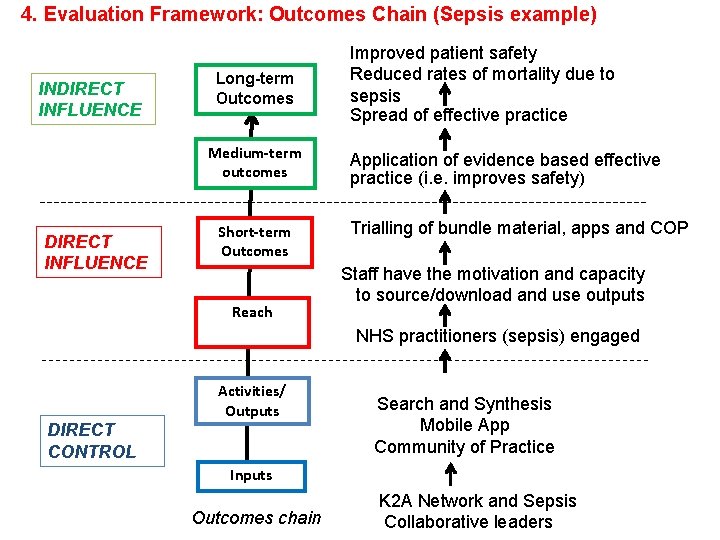
4. Evaluation Framework: Outcomes Chain (Sepsis example) INDIRECT INFLUENCE Long-term Outcomes Medium-term outcomes DIRECT INFLUENCE Short-term Outcomes Reach Improved patient safety Reduced rates of mortality due to sepsis Spread of effective practice Application of evidence based effective practice (i. e. improves safety) Trialling of bundle material, apps and COP Staff have the motivation and capacity to source/download and use outputs NHS practitioners (sepsis) engaged Activities/ Outputs DIRECT CONTROL Search and Synthesis Mobile App Community of Practice Inputs Outcomes chain K 2 A Network and Sepsis Collaborative leaders
Looking to the Future 1. New e. Health Strategy will contain Knowledge into Action element – consultation from April 2014, 2. Opportunities for you to use technology to translate knowledge into action? • Your resolution for 2014 -15? • What will you do by next Tuesday?
Summing up “The transfer of knowledge is care. ” Crossing the Quality Chasm, 2001 1. Using technology to bridge the knowledge-practice gap. 2. Evidence-based knowledge into action support available to all to help: • Solve problems • Spread and create knowledge through communities and networks • Transform organisational culture to embed use of knowledge in day to day practice and improvement.
Knowledge into Action Using Technology to Get Knowledge into Practice. Ann. wales@nes. scot. nhs. uk Dr Ann Wales, Programme Director for Knowledge Management, NES NMAHP Leadership Programme: e. Health Applications in Healthcare Day 2 24 th February 2014