
Knowledge Institute of Technology Salem Department of Civil

- Slides: 30
Knowledge Institute of Technology , Salem Department of Civil Engineering CE 6701 –Structural Dynamics and Earthquake Engineering Introduction to Structural Dynamics and Earthquake Engineering Prof. Pradeep Kumar S CIVIL / KIOT 1
Why to carry out dynamic analysis ?
Importance of dynamic analysis Concepts discussed in courses related to structural engineering that you have studied till now is based on the basic assumption that the either the load (mainly gravity) is either already present or applied very slowly on the structures. This assumption work well most of the time as long no acceleration is produced due to applied forces. However, in case of structures/ systems subjected to dynamics loads due to rotating machines, winds, suddenly applied gravity load, blasts, earthquakes, using the afore mentioned assumption provide misleading results and may result in structures/ systems with poor performance that can sometime fail. This course is designed to provide you fundamental knowledge about how the dynamic forces influences the structural/systems response CE-412: MODULE 1 ( Fall 2015) 3
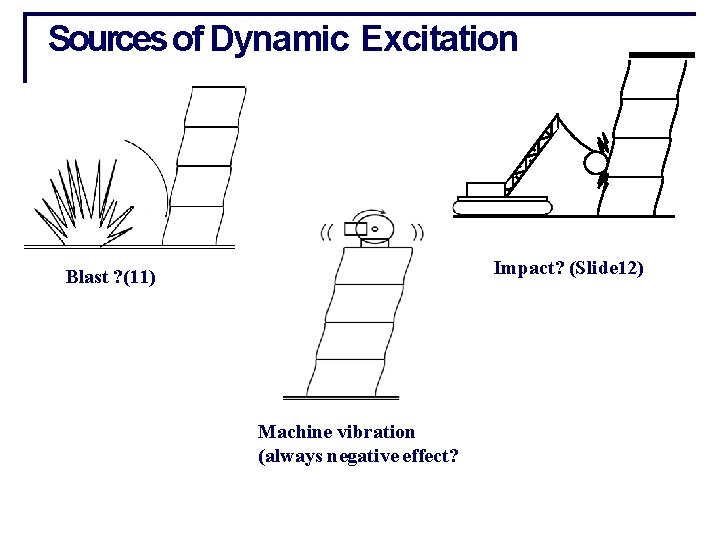
Sources of Dynamic Excitation Impact? (Slide 12) Blast ? (11) Machine vibration (always negative effect?
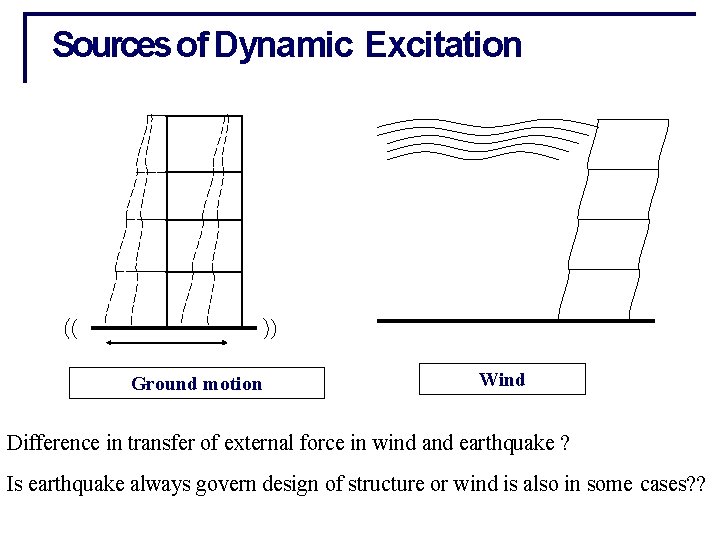
Sources of Dynamic Excitation Ground motion Wind Difference in transfer of external force in wind and earthquake ? Is earthquake always govern design of structure or wind is also in some cases? ?
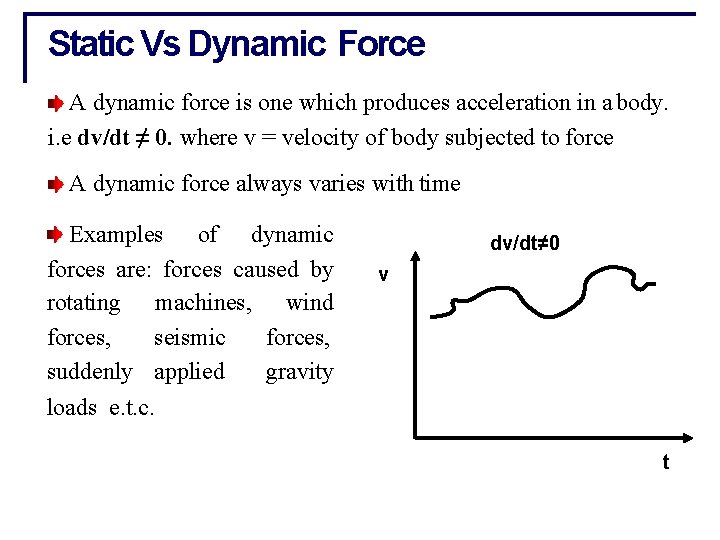
Static Vs Dynamic Force A dynamic force is one which produces acceleration in a body. i. e dv/dt ≠ 0. where v = velocity of body subjected to force A dynamic force always varies with time Examples of dynamic forces are: forces caused by rotating machines, wind forces, seismic forces, suddenly applied gravity loads e. t. c. dv/dt≠ 0 v t
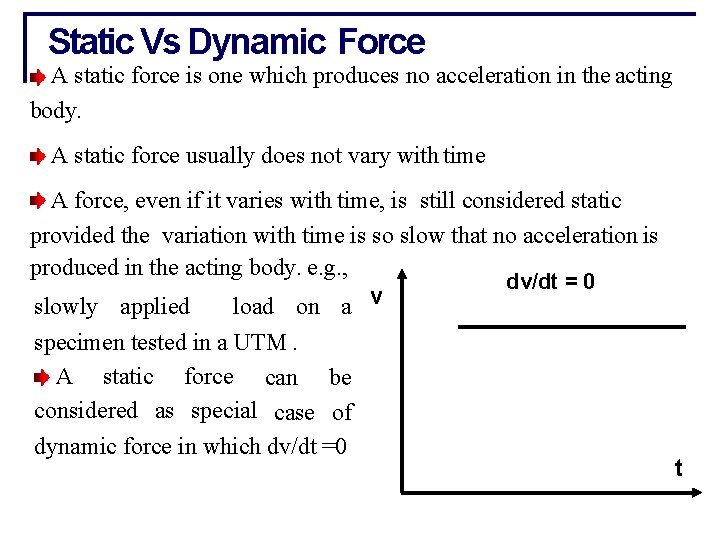
Static Vs Dynamic Force A static force is one which produces no acceleration in the acting body. A static force usually does not vary with time A force, even if it varies with time, is still considered static provided the variation with time is so slow that no acceleration is produced in the acting body. e. g. , dv/dt = 0 slowly applied load on a v specimen tested in a UTM. A static force can be considered as special case of dynamic force in which dv/dt =0 t
Implications of dynamic forces
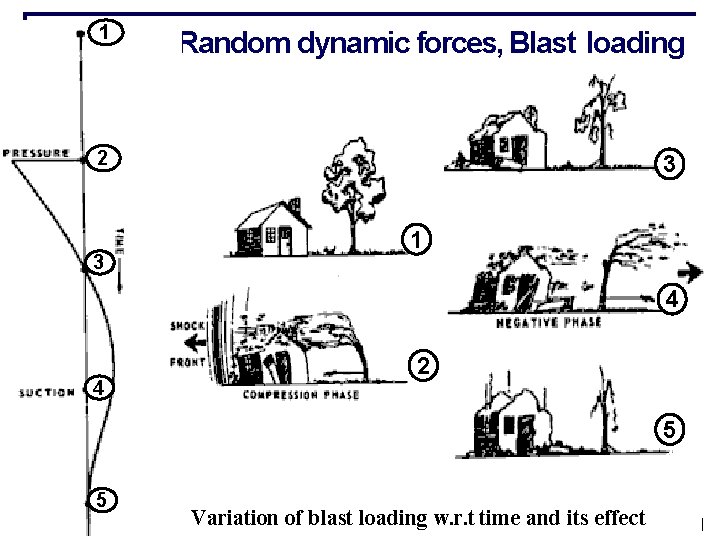
1 Random dynamic forces, Blast loading 2 3 3 1 1 4 4 2 1 5 5 1 Variation of blast w. r. t time and its effect MODULE 1 (loading Fall 2015) CE-412: 1
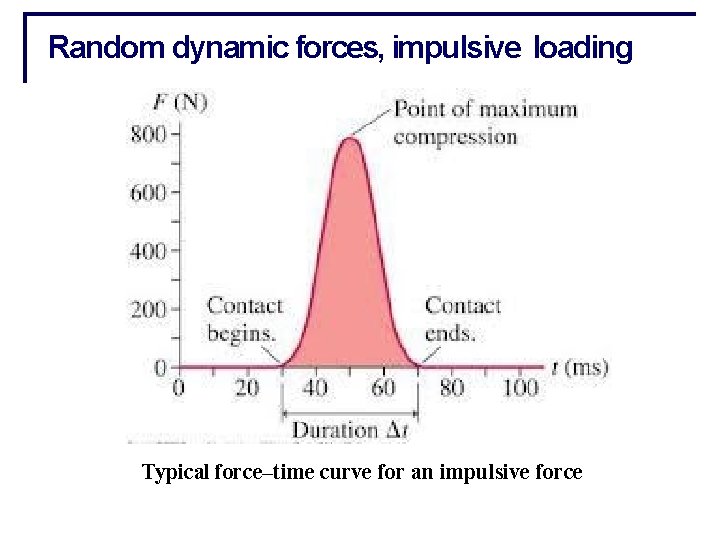
Random dynamic forces, impulsive loading Typical force–time curve for an impulsive force
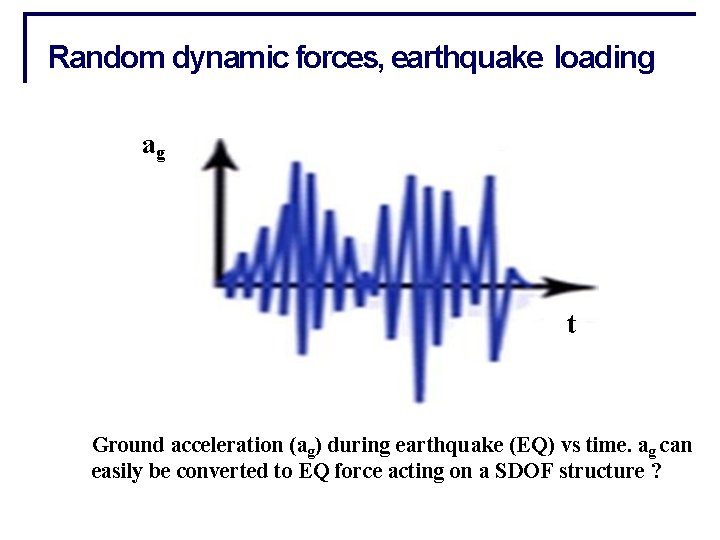
Random dynamic forces, earthquake loading ag t Ground acceleration (ag) during earthquake (EQ) vs time. ag can easily be converted to EQ force acting on a SDOF structure ?
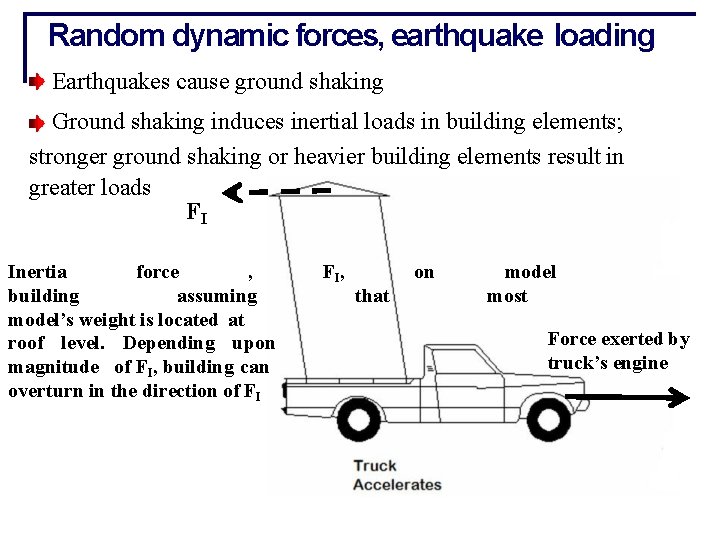
Random dynamic forces, earthquake loading Earthquakes cause ground shaking Ground shaking induces inertial loads in building elements; stronger ground shaking or heavier building elements result in greater loads FI Inertia force , building assuming model’s weight is located at roof level. Depending upon magnitude of FI, building can overturn in the direction of FI FI, on that model most Force exerted by truck’s engine
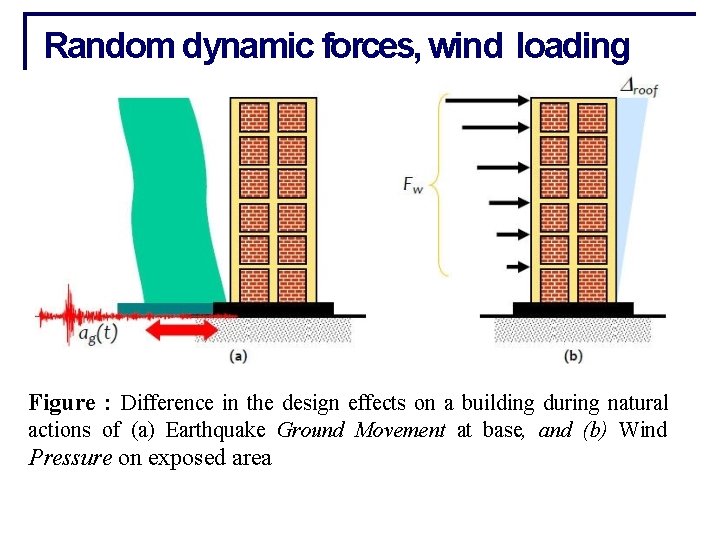
Random dynamic forces, wind loading Dynamic actions are caused on buildings by both wind and earthquakes. But, design for wind forces and for earthquake effects are distinctly different. The intuitive philosophy of structural design uses force as the basis, which is consistent in wind design, wherein the building is subjected to a pressure on its exposed surface area; this is force-type loading. However, in earthquake design, the building is subjected to random motion of the ground at its base (Figure on next slide), which induces inertia forces in the building that in turn cause stresses; this is displacement-type loading
Random dynamic forces, wind loading Figure : Difference in the design effects on a building during natural actions of (a) Earthquake Ground Movement at base, and (b) Wind Pressure on exposed area
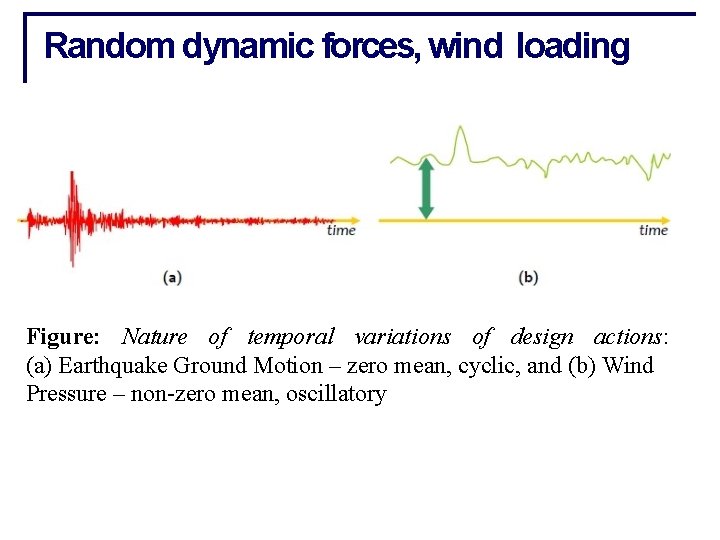
Random dynamic forces, wind loading Wind force on the building has a non-zero mean component superposed with a relatively small oscillating component (Figure on next slide). Thus, under wind forces, the building may experience small fluctuations in the stress field, but reversal of stresses occurs only when the direction of wind reverses, which happens only over a large duration of time. On the other hand, the motion of the ground during the earthquake is cyclic about the neutral position of the structure. Thus, the stresses in the building due to seismic actions undergo many complete reversals and that too over the small duration of earthquake.
Random dynamic forces, wind loading Figure: Nature of temporal variations of design actions: (a) Earthquake Ground Motion – zero mean, cyclic, and (b) Wind Pressure – non-zero mean, oscillatory
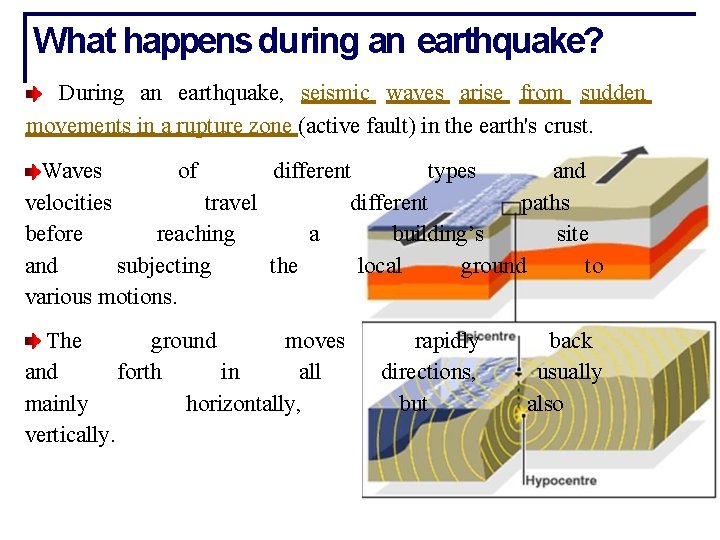
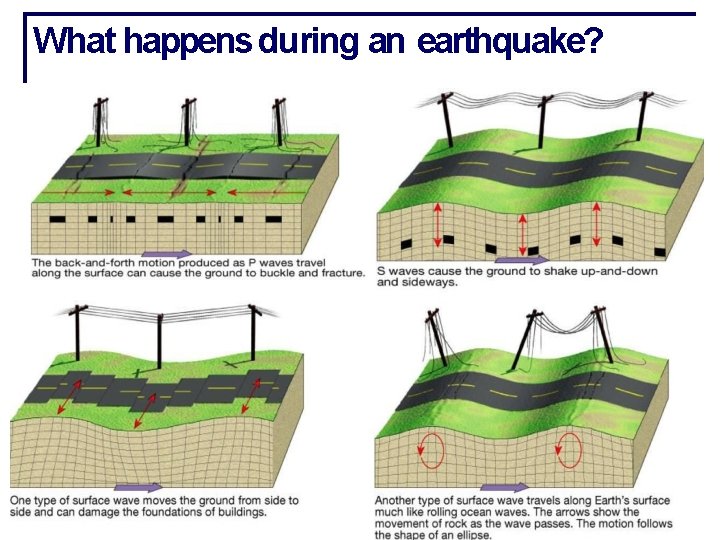
What happens during an earthquake? During an earthquake, seismic waves arise from sudden movements in a rupture zone (active fault) in the earth's crust. Waves of different types and velocities travel different paths before reaching a building’s site and subjecting the local ground to various motions. The ground moves and forth in all mainly horizontally, vertically. rapidly directions, but back usually also
What happens during an earthquake? CE-412: MODULE 1 ( Fall 2015)
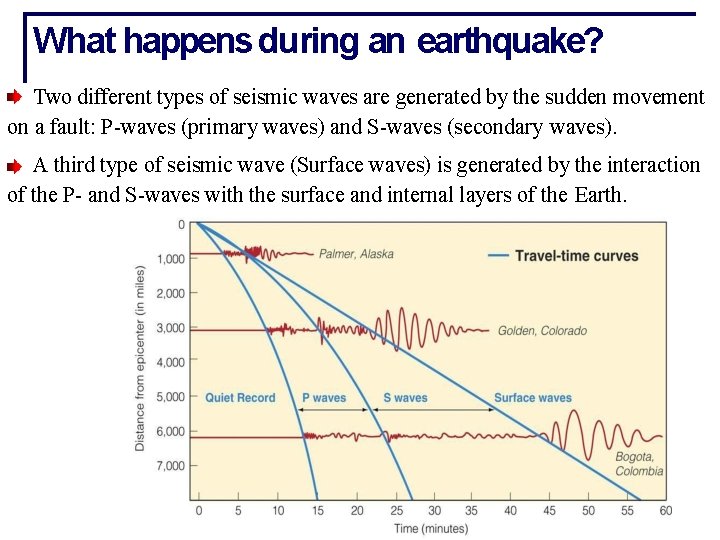
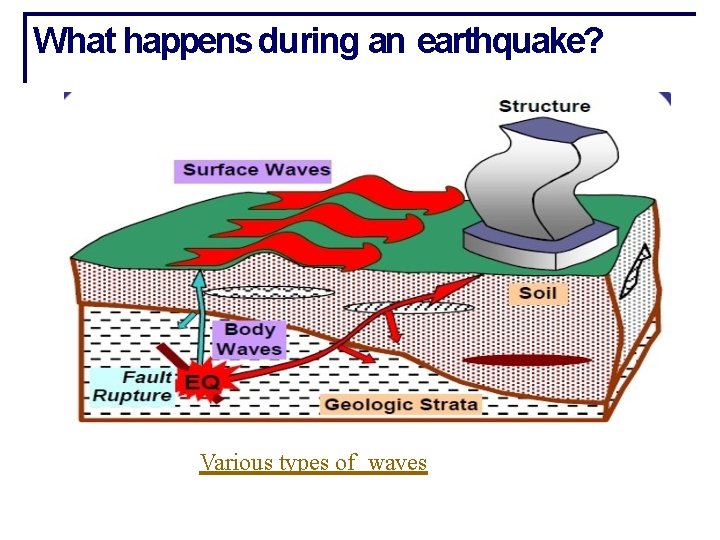
What happens during an earthquake? Two different types of seismic waves are generated by the sudden movement on a fault: P-waves (primary waves) and S-waves (secondary waves). A third type of seismic wave (Surface waves) is generated by the interaction of the P- and S-waves with the surface and internal layers of the Earth. CE-412: MODULE 1 ( Fall 2015)
What happens during an earthquake? Various types of waves
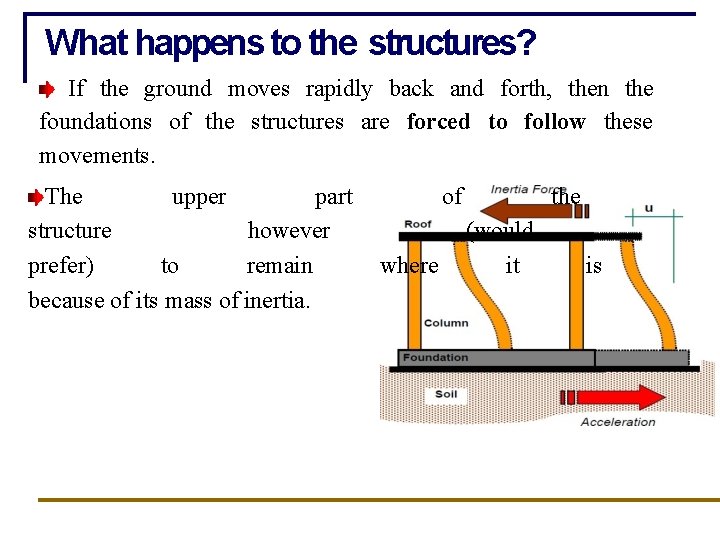
What happens to the structures? If the ground moves rapidly back and forth, then the foundations of the structures are forced to follow these movements. The upper part structure however prefer) to remain because of its mass of inertia. of where the (would it is
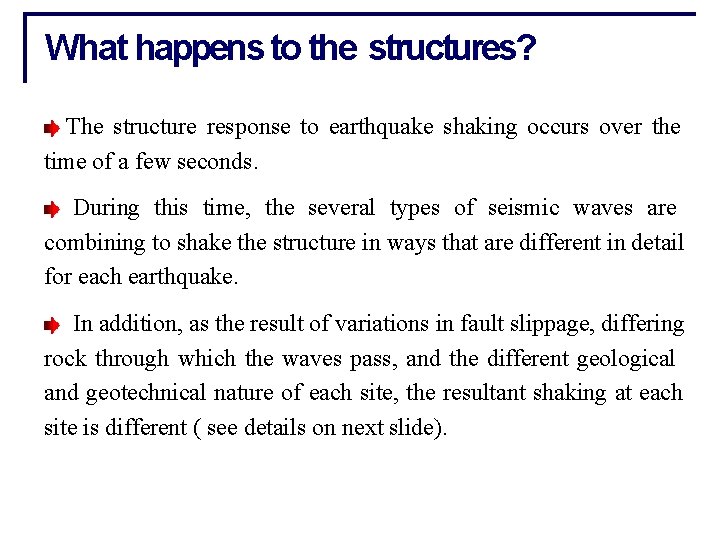
What happens to the structures? The structure response to earthquake shaking occurs over the time of a few seconds. During this time, the several types of seismic waves are combining to shake the structure in ways that are different in detail for each earthquake. In addition, as the result of variations in fault slippage, differing rock through which the waves pass, and the different geological and geotechnical nature of each site, the resultant shaking at each site is different ( see details on next slide).
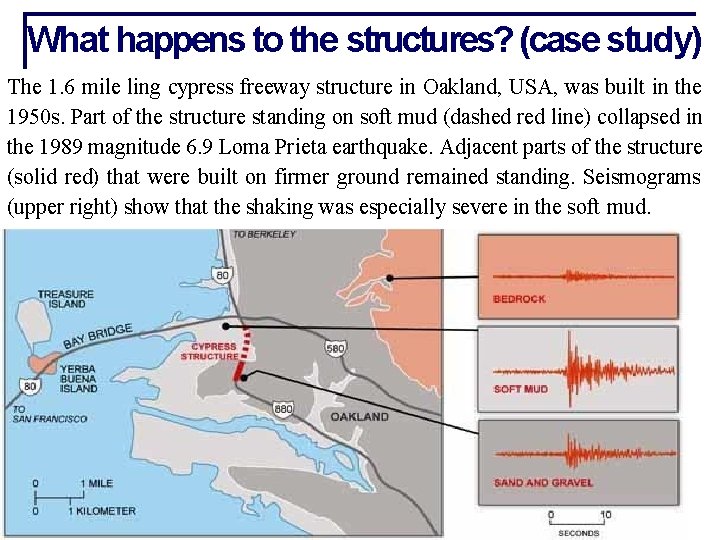
What happens to the structures? (case study) The 1. 6 mile ling cypress freeway structure in Oakland, USA, was built in the 1950 s. Part of the structure standing on soft mud (dashed red line) collapsed in the 1989 magnitude 6. 9 Loma Prieta earthquake. Adjacent parts of the structure (solid red) that were built on firmer ground remained standing. Seismograms (upper right) show that the shaking was especially severe in the soft mud. CE-412: MODULE 1 ( Fall 2015)
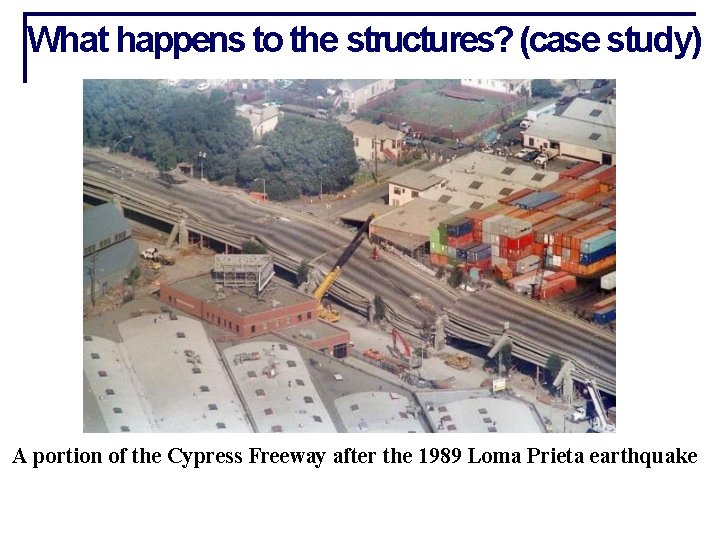
What happens to the structures? (case study) A portion of the Cypress Freeway after the 1989 Loma Prieta earthquake
What happens to the structures? (Additional aspects affecting response) The characteristics of each structure are different, whether in size, configuration, material, structural system, age, or quality of construction: each of these characteristics affects the structural response. In spite of the complexity of the interactions between the structures and the ground during the few seconds of shaking there is broad understanding of how different building types will perform under different shaking conditions.
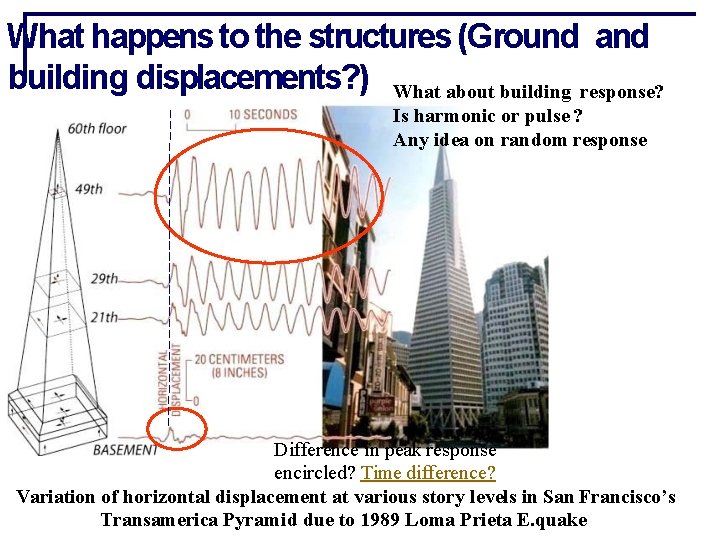
What happens to the structures (Ground and building displacements? ) What about building response? Is harmonic or pulse ? Any idea on random response Difference in peak response encircled? Time difference? Variation of horizontal displacement at various story levels in San Francisco’s CE-412: MODULE 1 (1989 Fall 2015) Transamerica Pyramid due to Loma Prieta E. quake
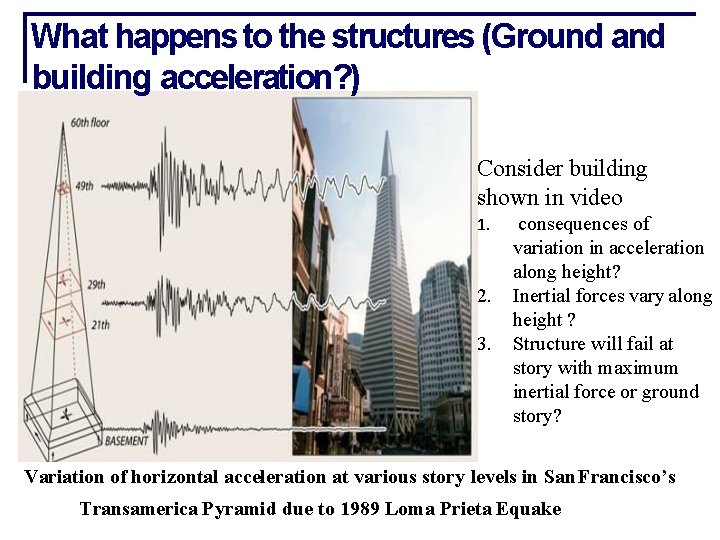
What happens to the structures (Ground and building acceleration? ) Consider building shown in video 1. 2. 3. consequences of variation in acceleration along height? Inertial forces vary along height ? Structure will fail at story with maximum inertial force or ground story? Variation of horizontal acceleration at various story levels in San Francisco’s Transamerica Pyramid due to 1989 Loma Prieta Equake
What happens to the structures? Higher inertial forces in structural system with inadeqequate detailing or inferior quality of material or both can cause substantial damage with local failures and, in extreme cases, collapse. Is the video answers question asked on previous slide? The ground motion parameters and other characteristic values at a location due to an earthquake of a given magnitude may vary strongly. They depend on numerous factors, such as the distance, direction, depth, and mechanism of the fault zone in the earth's crust (epicenter), as well as, in particular, the local soil characteristics (layer thickness, shear wave velocity).
The Mexico 1985 Earthquake: Effects of Site Conditions on Ground Motion Local The Mexico City earthquake (MS = 8. 1) occurred in 1985. Mexico City itself lies in a broad basin formed approximately 30 million years ago by faulting of an uplifted plateau. Volcanic activity closed the basin and resulted in the formation of Lake Texcoco. The Aztecs chose an island in this lake as an easily defended location for their capital. The expansion of the capitol (Mexico City) and the gradual draining of the lake left the world's largest population center located largely on unconsolidated lake-bed sediments.
The Mexico 1985 Earthquake: Effects of Site Conditions on Ground Motion Local The interesting phenomenon about this earthquake, which generated worldwide interest, is that it caused only moderate damage in the vicinity of its epicenter (near the Pacific coast) but resulted in extensive damage further afield, some 350– 360 km from the epicenter, in Mexico City. Fortunately ground motions were recorded at two sites, UNAM (Universidad Nacional Autonoma de Mexico) and SCT (Secretary of Communications and Transportation)