
KNOWLEDGE INSTITUTE OF TECHNOLOGY FOURIER SERIES Prepared by

KNOWLEDGE INSTITUTE OF TECHNOLOGY FOURIER SERIES Prepared by R. Kavitha AP/MAT KIO
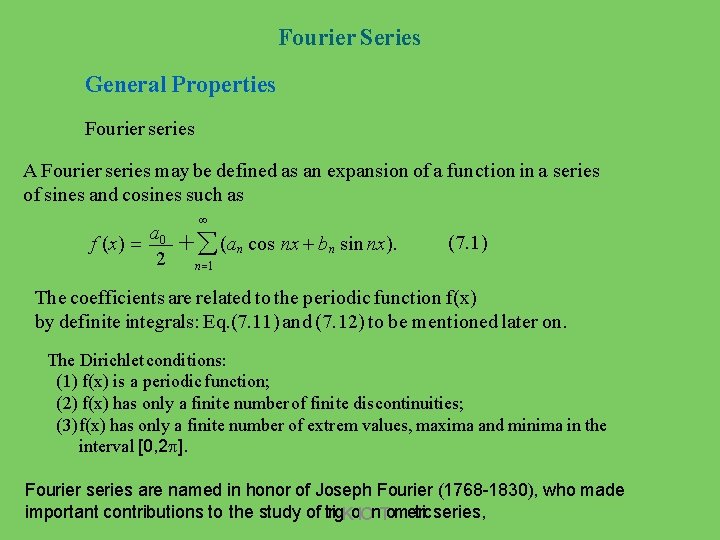
Fourier Series General Properties Fourier series A Fourier series may be defined as an expansion of a function in a series of sines and cosines such as f (x) a 0 2 (a n cos nx b n sin nx). (7. 1) n 1 The coefficients are related to the periodic function f(x) by definite integrals: Eq. (7. 11) and (7. 12) to be mentioned later on. The Dirichlet conditions: (1) f(x) is a periodic function; (2) f(x) has only a finite number of finite discontinuities; (3) f(x) has only a finite number of extrem values, maxima and minima in the interval [0, 2 ]. Fourier series are named in honor of Joseph Fourier (1768 -1830), who made important contributions to the study of trig. Ko. IOn. Tometric series,
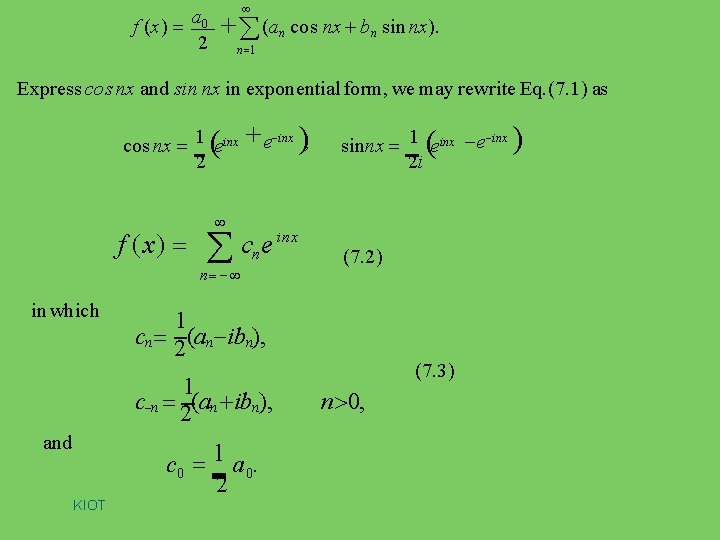
a f (x) 0 2 (a n cos nx b n sin nx). n 1 Express cos nx and sin nx in exponential form, we may rewrite Eq. (7. 1) as e , cos nx 1 e inx 2 f (x) inx c e n n in which KIOT (7. 2) 1 cn (an ibn), 2 1 c n (an ibn), 2 and sinnx 1 e inx 2 i c 0 1 a 0. 2 (7. 3) n 0,
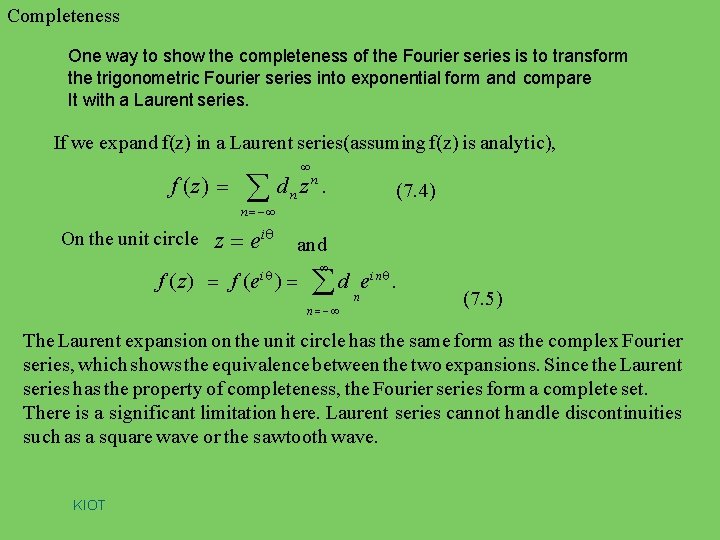
Completeness One way to show the completeness of the Fourier series is to transform the trigonometric Fourier series into exponential form and compare It with a Laurent series. If we expand f(z) in a Laurent series(assuming f(z) is analytic), f (z) n d z n. (7. 4) n On the unit circle z ei and f (z) f (e ) i d n n ein . (7. 5) The Laurent expansion on the unit circle has the same form as the complex Fourier series, which shows the equivalence between the two expansions. Since the Laurent series has the property of completeness, the Fourier series form a complete set. There is a significant limitation here. Laurent series cannot handle discontinuities such as a square wave or the sawtooth wave. KIOT
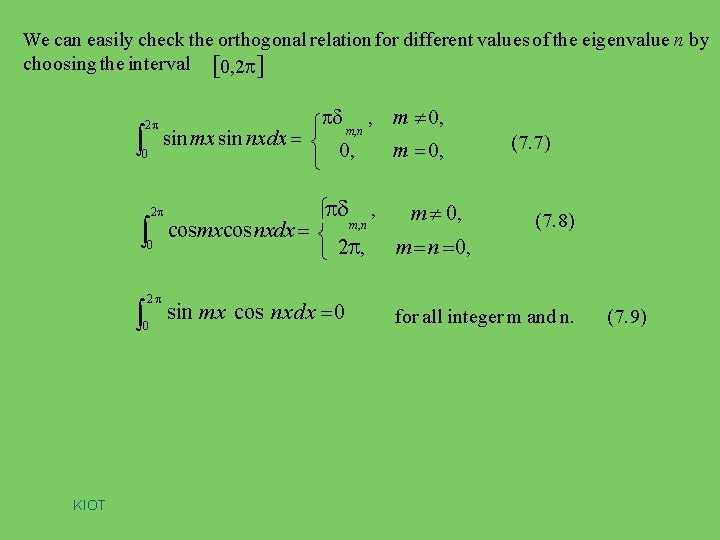
We can easily check the orthogonal relation for different values of the eigenvalue n by choosing the interval 0, 2 2 0 m, n , m 0, sin mx sin nxdx 0, m 0, 2 0 2 0 KIOT , m 0, m, n cosmxcos nxdx 2 , m n 0, sin mx cos nxdx 0 (7. 7) (7. 8) for all integer m and n. (7. 9)
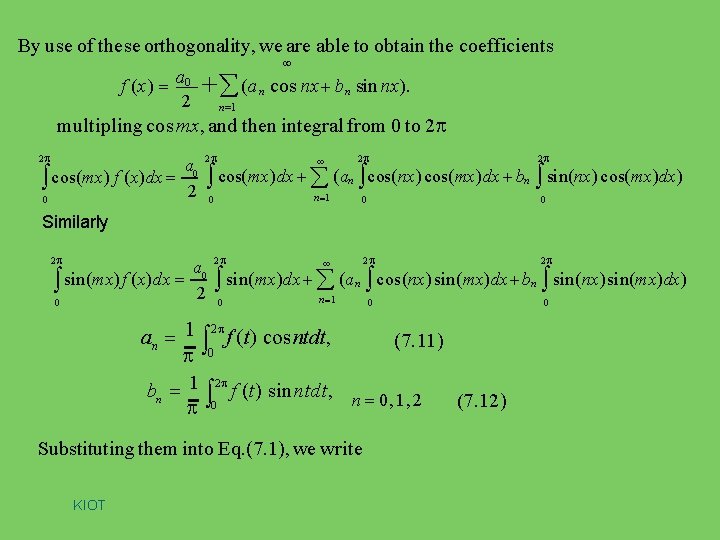
By use of these orthogonality, we are able to obtain the coefficients f (x) a 0 (a n cos nx bn sin nx). 2 n 1 multipling cos mx, and then integral from 0 to 2 2 a 0 cos(mx) f (x)dx 2 0 2 2 2 cos(mx)dx (a cos(nx) cos(mx)dx b sin(nx) cos(mx)dx) n n n 1 0 0 0 2 2 Similarly 2 2 a 0 sin(mx) f (x)dx 2 0 an 1 bn 1 sin(mx)dx (a cos(nx)sin(mx)dx b sin(nx)sin(mx)dx) n n 1 0 2 0 f (t) cos ntdt, 2 0 0 0 (7. 11) f (t) sin ntdt, n 0, 1, 2 Substituting them into Eq. (7. 1), we write KIOT n (7. 12)
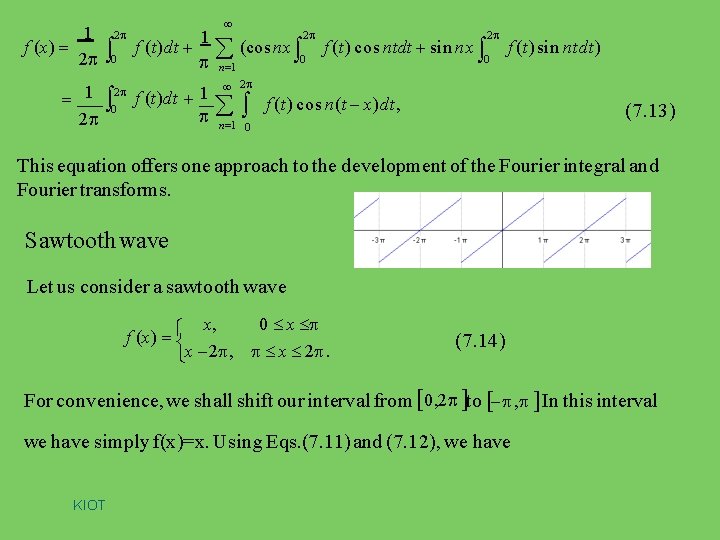
1 f (x) 2 2 1 2 2 0 0 f (t)dt 1 (cos nx 0 n 1 1 f (t)dt 2 f (t) cos ntdt sin nx 2 0 f (t) sin ntdt) 2 n 1 f (t) cos n(t x)dt, (7. 13) 0 This equation offers one approach to the development of the Fourier integral and Fourier transforms. Sawtooth wave Let us consider a sawtooth wave x, f (x) x 2 , 0 x x 2 . (7. 14) For convenience, we shall shift our interval from 0, 2 to , . In this interval we have simply f(x)=x. Using Eqs. (7. 11) and (7. 12), we have KIOT
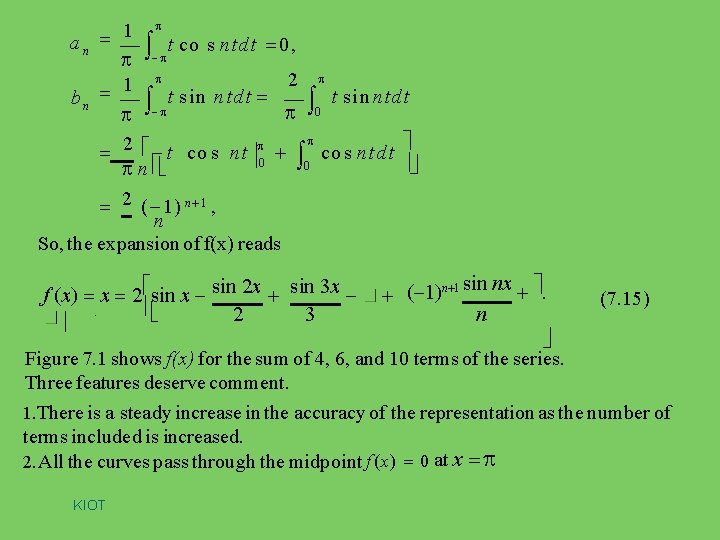
an 1 1 bn t co s n t d t 0 , 2 t sin n t d t 2 t co s n t n 0 0 0 t sin n t d t co s n t d t 2 ( 1) n 1 , n So, the expansion of f(x) reads sin nx . ( 1)n 1 (7. 15) n Figure 7. 1 shows f(x) for the sum of 4, 6, and 10 terms of the series. Three features deserve comment. 1. There is a steady increase in the accuracy of the representation as the number of terms included is increased. 2. All the curves pass through the midpoint f (x) 0 at x f (x) x 2 sin x sin 2 x sin 3 x . 2 3 KIOT
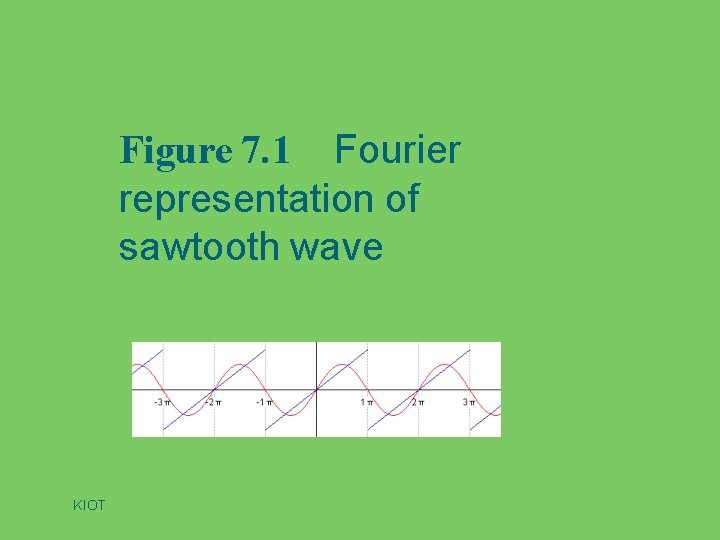
Figure 7. 1 Fourier representation of sawtooth wave KIOT
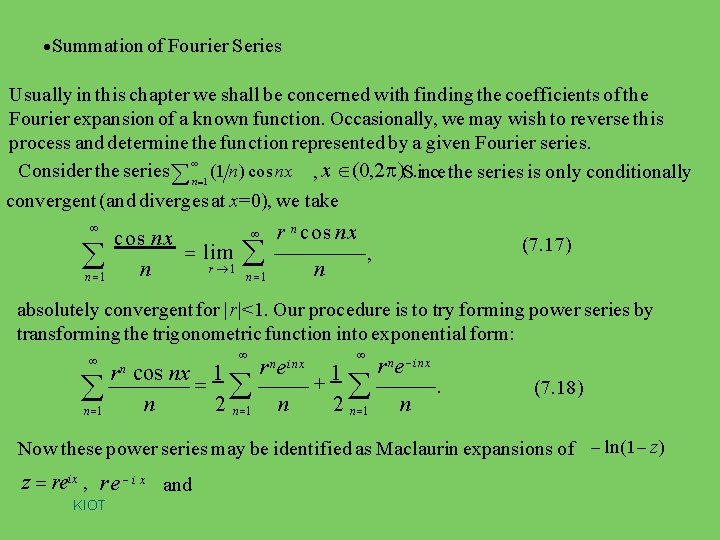
Summation of Fourier Series Usually in this chapter we shall be concerned with finding the coefficients of the Fourier expansion of a known function. Occasionally, we may wish to reverse this process and determine the function represented by a given Fourier series. Consider the series n 1 (1 n) cos nx , x (0, 2 )S. ince the series is only conditionally convergent (and diverges at x=0), we take n 1 r n cos nx lim , r 1 n n n 1 (7. 17) absolutely convergent for |r|<1. Our procedure is to try forming power series by transforming the trigonometric function into exponential form: re r n cos nx 1 n 2 n 1 n inx r n e inx 1 . 2 n 1 n (7. 18) Now these power series may be identified as Maclaurin expansions of ln(1 z) z reix , re i x and KIOT
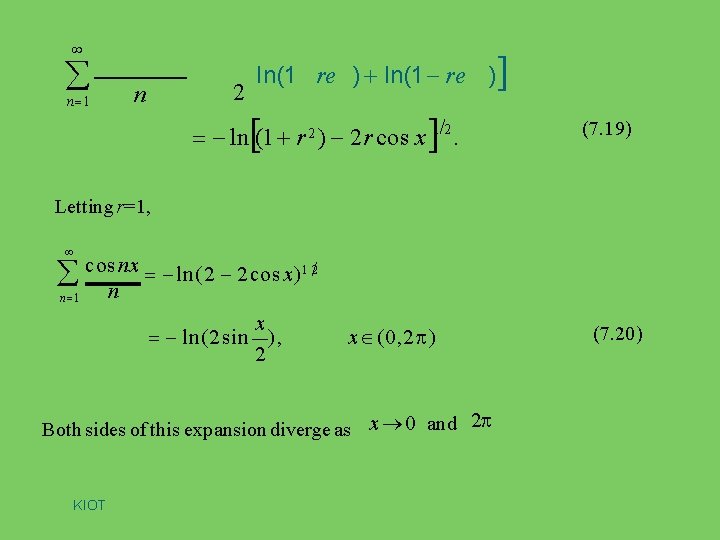
n 1 2 n ln(1 re ) ln(1 re ) ln (1 r 2 ) 2 r cos x 1 2. (7. 19) Letting r=1, cosnnx ln(2 2 cos x) 12 n 1 x ln(2 sin ), 2 x (0, 2 ) Both sides of this expansion diverge as x 0 and 2 KIOT (7. 20)
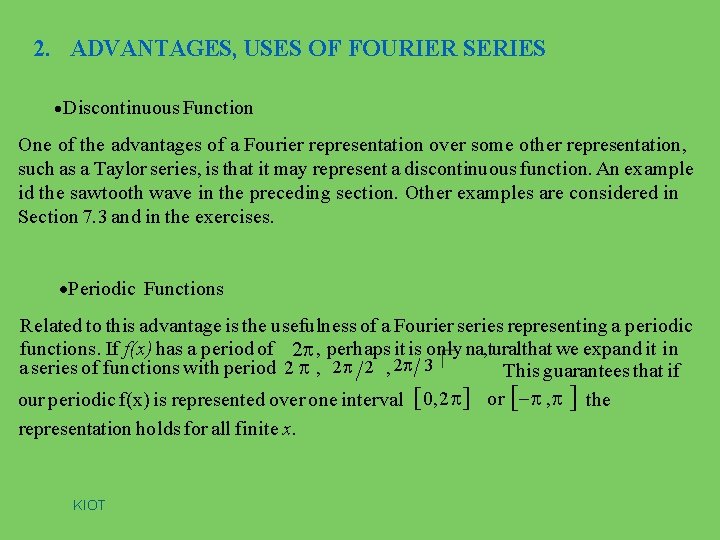
2. ADVANTAGES, USES OF FOURIER SERIES Discontinuous Function One of the advantages of a Fourier representation over some other representation, such as a Taylor series, is that it may represent a discontinuous function. An example id the sawtooth wave in the preceding section. Other examples are considered in Section 7. 3 and in the exercises. Periodic Functions Related to this advantage is the usefulness of a Fourier series representing a periodic functions. If f(x) has a period of 2 , perhaps it is only na, tural that we expand it in a series of functions with period 2 , 2 2 , 2 3 This guarantees that if our periodic f(x) is represented over one interval 0, 2 or , the representation holds for all finite x. KIOT
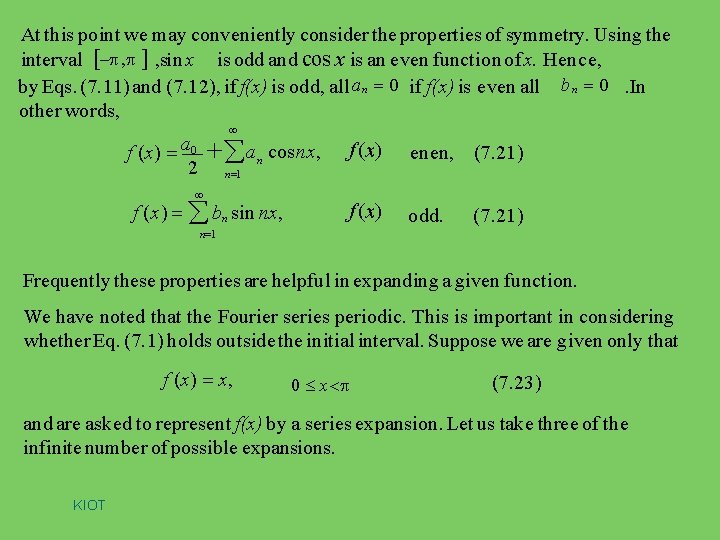
At this point we may conveniently consider the properties of symmetry. Using the interval , , sin x is odd and cos x is an even function of x. Hence, by Eqs. (7. 11) and (7. 12), if f(x) is odd, all an 0 if f(x) is even all b n 0. In other words, a f (x) a 0 2 n cos nx, f (x) enen, (7. 21) f (x) odd. n 1 f (x) bn sin nx, (7. 21) n 1 Frequently these properties are helpful in expanding a given function. We have noted that the Fourier series periodic. This is important in considering whether Eq. (7. 1) holds outside the initial interval. Suppose we are given only that f (x) x, 0 x (7. 23) and are asked to represent f(x) by a series expansion. Let us take three of the infinite number of possible expansions. KIOT
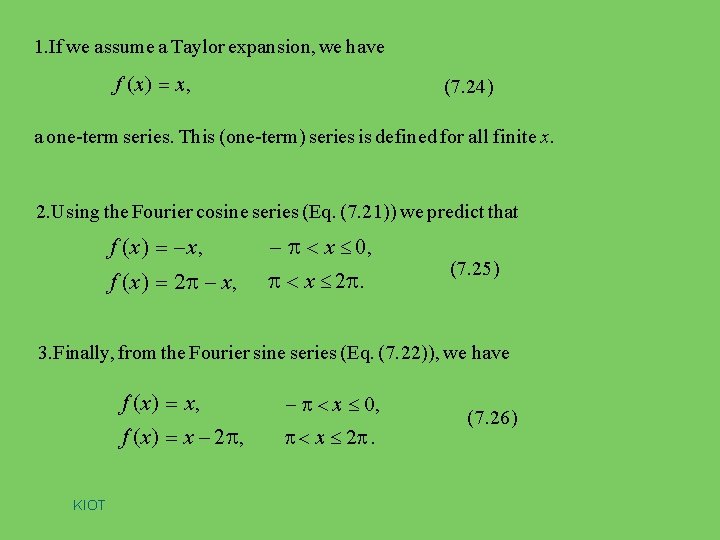
1. If we assume a Taylor expansion, we have f (x) x, (7. 24) a one-term series. This (one-term) series is defined for all finite x. 2. Using the Fourier cosine series (Eq. (7. 21)) we predict that f (x) x, x 0, f (x) 2 x, x 2. (7. 25) 3. Finally, from the Fourier sine series (Eq. (7. 22)), we have KIOT f (x) x, x 0, f (x) x 2 , x 2 . (7. 26)
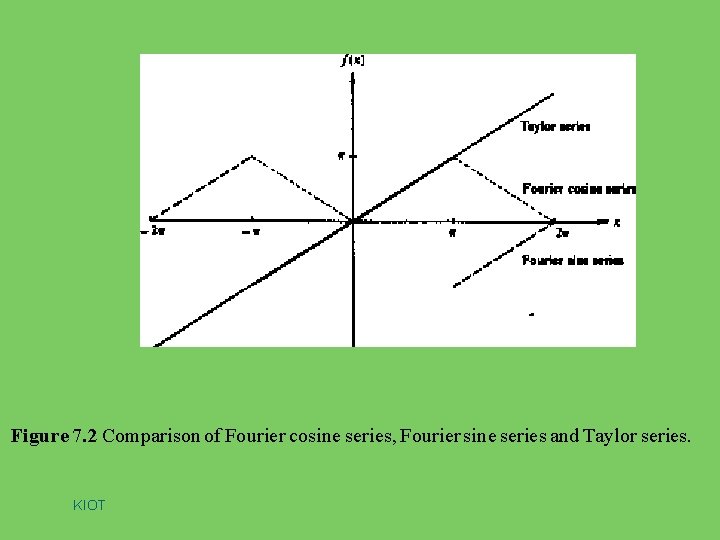
Figure 7. 2 Comparison of Fourier cosine series, Fourier sine series and Taylor series. KIOT
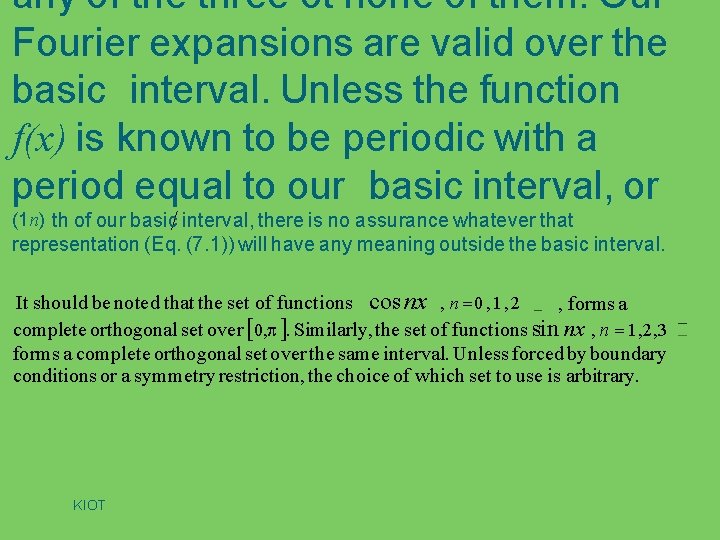
any of the three ot none of them. Our Fourier expansions are valid over the basic interval. Unless the function f(x) is known to be periodic with a period equal to our basic interval, or (1 n) th of our basic interval, there is no assurance whatever that representation (Eq. (7. 1)) will have any meaning outside the basic interval. It should be noted that the set of functions cos nx , n 0 , 1 , 2 , forms a complete orthogonal set over 0, . Similarly, the set of functions sin nx , n 1, 2, 3 forms a complete orthogonal set over the same interval. Unless forced by boundary conditions or a symmetry restriction, the choice of which set to use is arbitrary. KIOT
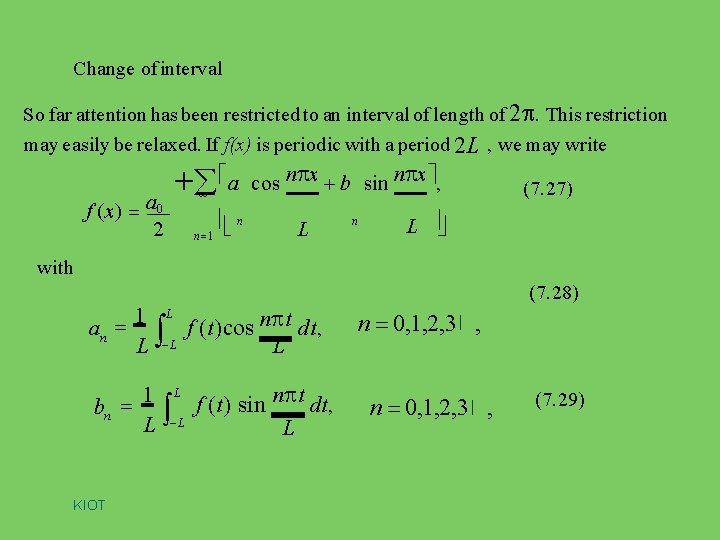
Change of interval So far attention has been restricted to an interval of length of 2. This restriction may easily be relaxed. If f(x) is periodic with a period 2 L , we may write a f (x) a 0 2 n n 1 cos n x b sin n x , L n (7. 27) L with L 1 an f (t) cos n t dt, L L L 1 bn L KIOT L L f (t) sin n t dt, L (7. 28) n 0, 1, 2, 3 , (7. 29)
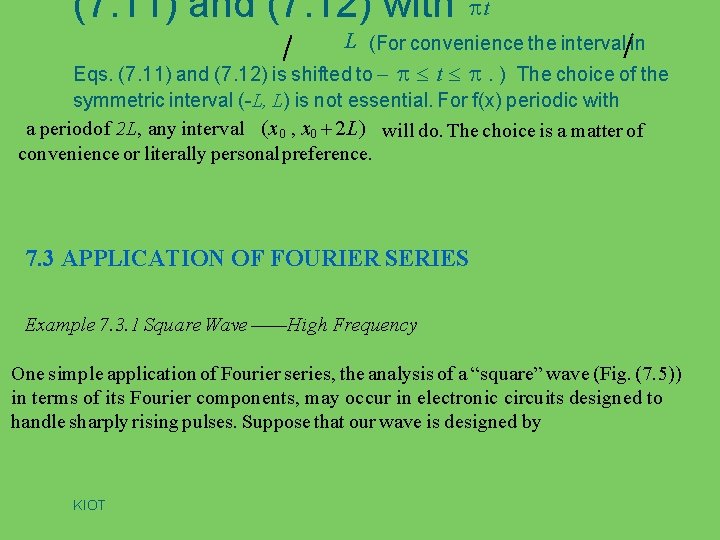
(7. 11) and (7. 12) with t L (For convenience the interval in Eqs. (7. 11) and (7. 12) is shifted to t . ) The choice of the symmetric interval (-L, L) is not essential. For f(x) periodic with a period of 2 L, any interval (x 0 , x 0 2 L) will do. The choice is a matter of convenience or literally personal preference. 7. 3 APPLICATION OF FOURIER SERIES Example 7. 3. 1 Square Wave ——High Frequency One simple application of Fourier series, the analysis of a “square” wave (Fig. (7. 5)) in terms of its Fourier components, may occur in electronic circuits designed to handle sharply rising pulses. Suppose that our wave is designed by KIOT
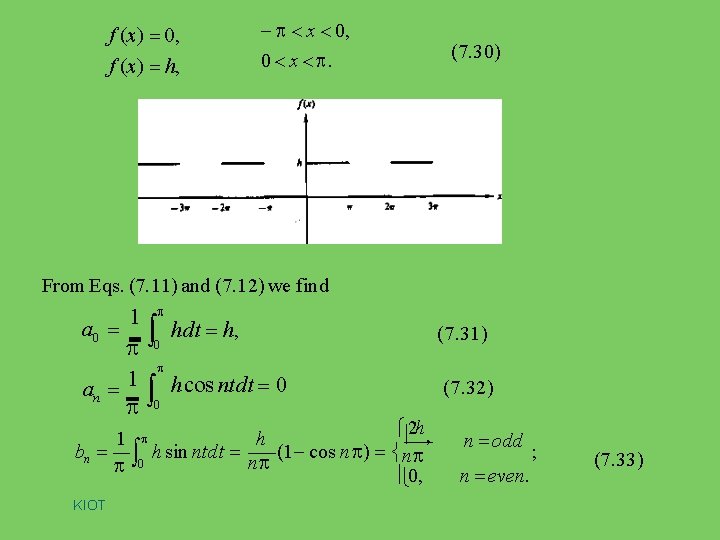
f (x) 0, f (x) h, x 0, 0 x . (7. 30) From Eqs. (7. 11) and (7. 12) we find a 0 1 0 an 1 bn KIOT 1 0 0 hdt h, (7. 31) h cos ntdt 0 (7. 32) 2 h , h h sin ntdt (1 cos n ) n n 0, n odd n even. ; (7. 33)
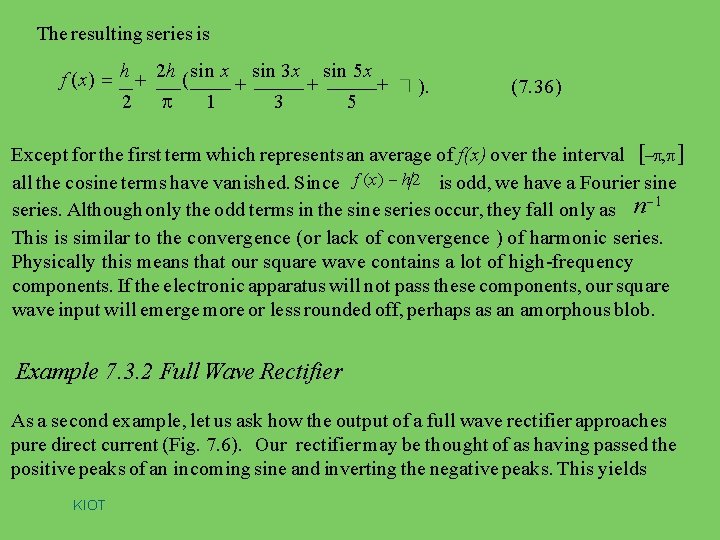
The resulting series is f (x) h 2 h ( sin x sin 3 x sin 5 x 2 1 3 5 ). (7. 36) Except for the first term which represents an average of f(x) over the interval , all the cosine terms have vanished. Since f (x) h 2 is odd, we have a Fourier sine 1 series. Although only the odd terms in the sine series occur, they fall only as n This is similar to the convergence (or lack of convergence ) of harmonic series. Physically this means that our square wave contains a lot of high-frequency components. If the electronic apparatus will not pass these components, our square wave input will emerge more or less rounded off, perhaps as an amorphous blob. Example 7. 3. 2 Full Wave Rectifier As a second example, let us ask how the output of a full wave rectifier approaches pure direct current (Fig. 7. 6). Our rectifier may be thought of as having passed the positive peaks of an incoming sine and inverting the negative peaks. This yields KIOT
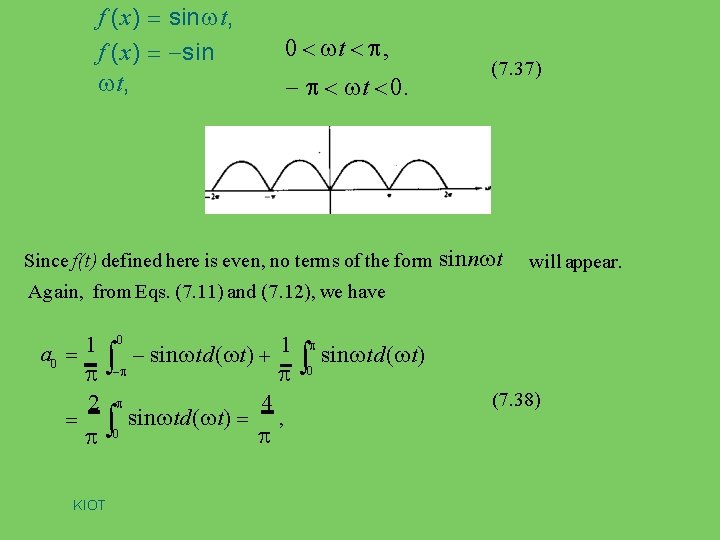
f (x) sin t, 0 t , t 0. (7. 37) Since f(t) defined here is even, no terms of the form sinn t will appear. Again, from Eqs. (7. 11) and (7. 12), we have a 0 1 1 sin td ( t) 4 2 sin td ( t) , 0 KIOT 0 0 sin td ( t) (7. 38)
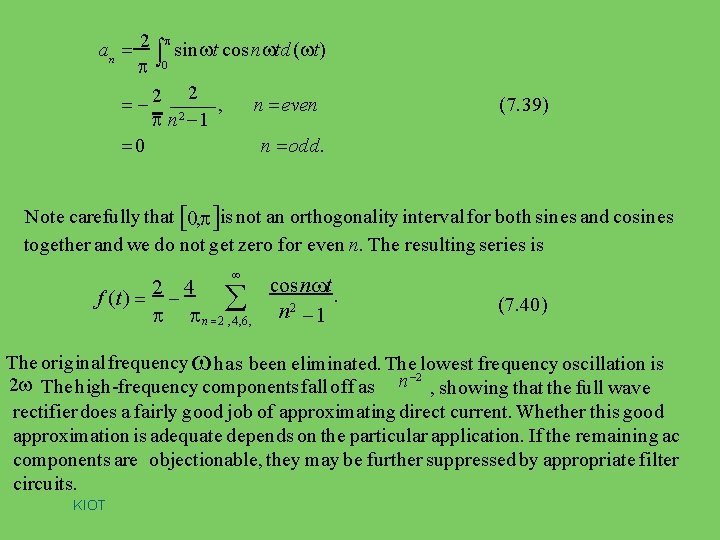
an 2 0 sin t cos n td ( t) 2 2 2 , n 1 0 n even (7. 39) n odd. Note carefully that 0, is not an orthogonality interval for both sines and cosines together and we do not get zero for even n. The resulting series is cosn t. 2 4 f (t) n 2 , 4, 6, n 2 1 (7. 40) The original frequency has been eliminated. The lowest frequency oscillation is 2 The high-frequency components fall off as n 2 , showing that the full wave rectifier does a fairly good job of approximating direct current. Whether this good approximation is adequate depends on the particular application. If the remaining ac components are objectionable, they may be further suppressed by appropriate filter circuits. KIOT
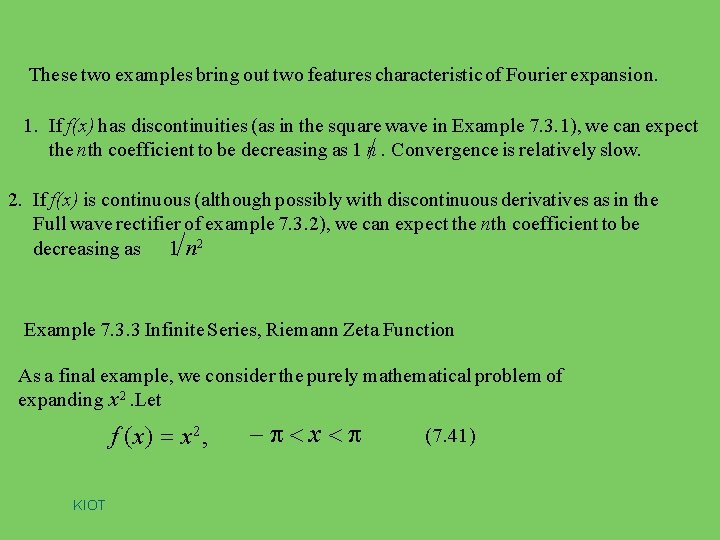
These two examples bring out two features characteristic of Fourier expansion. 1. If f(x) has discontinuities (as in the square wave in Example 7. 3. 1), we can expect the nth coefficient to be decreasing as 1 n. Convergence is relatively slow. 2. If f(x) is continuous (although possibly with discontinuous derivatives as in the Full wave rectifier of example 7. 3. 2), we can expect the nth coefficient to be decreasing as 1 n 2 Example 7. 3. 3 Infinite Series, Riemann Zeta Function As a final example, we consider the purely mathematical problem of expanding x 2. Let f (x) x 2 , KIOT x (7. 41)
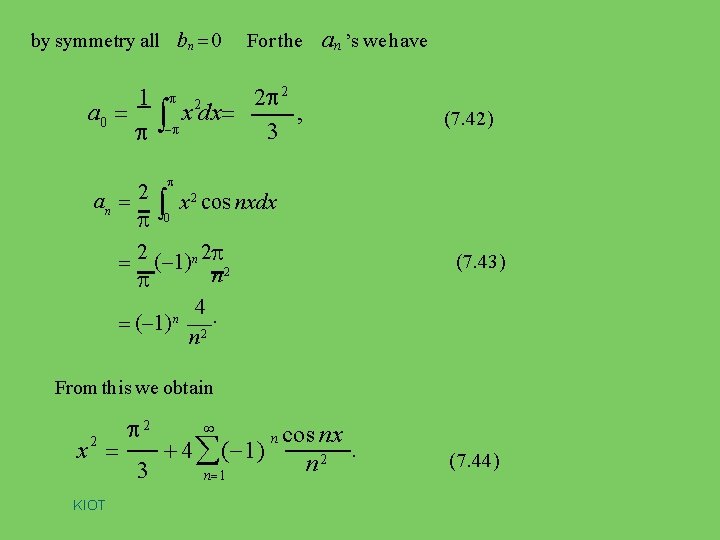
by symmetry all bn 0 1 a 0 For the an ’s we have 2 2 2 x dx 3 , (7. 42) an 2 x 2 cos nxdx 0 2 ( 1)n 2 2 n 4. n ( 1) 2 n (7. 43) From this we obtain 2 cos nx. 4 ( 1) x 2 n 3 n 1 2 KIOT n (7. 44)
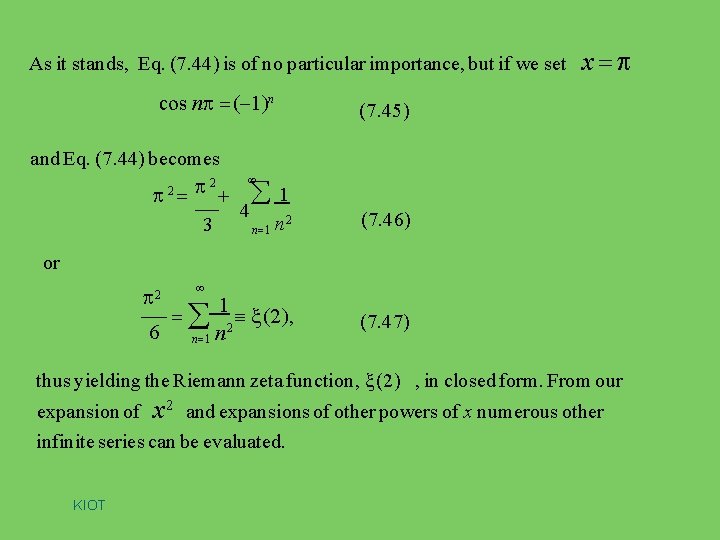
As it stands, Eq. (7. 44) is of no particular importance, but if we set cos n ( 1)n and Eq. (7. 44) becomes 2 2 (7. 45) 1 4 n 2 (7. 46) 1 (2), 2 n 1 n (7. 47) 3 x n 1 or 2 6 thus yielding the Riemann zeta function, (2) , in closed form. From our expansion of x 2 and expansions of other powers of x numerous other infinite series can be evaluated. KIOT
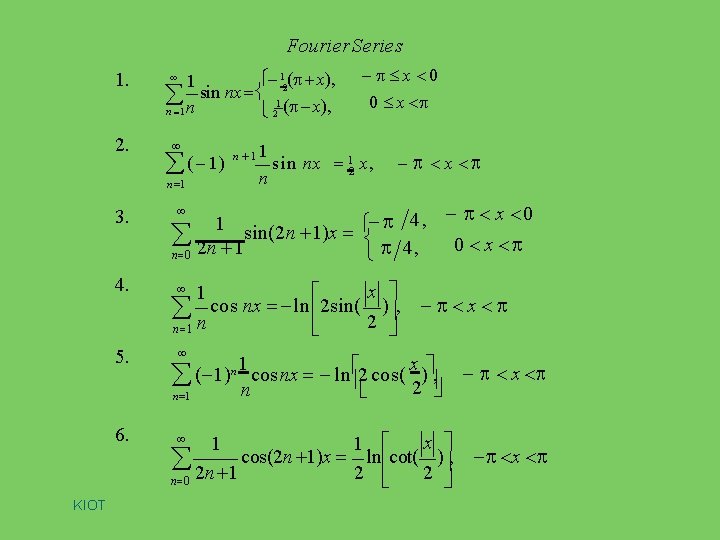
Fourier Series 1. 2. 12( x), 1 sin nx 1 n 2 ( x), ( 1) n 1 x 0 0 x 1 sin nx 12 x, n x 3. 1 sin(2 n 1)x 4, x 0 2 n 1 4, 0 x n 0 4. x 1 n cos nx ln 2 sin( 2 ) , x n 1 5. ( 1) 1 ncos nx ln 2 cos( x 2) , n x n 1 6. KIOT x 1 1 cos(2 n 1)x ln cot( ) , x 2 n 1 2 2 n 0
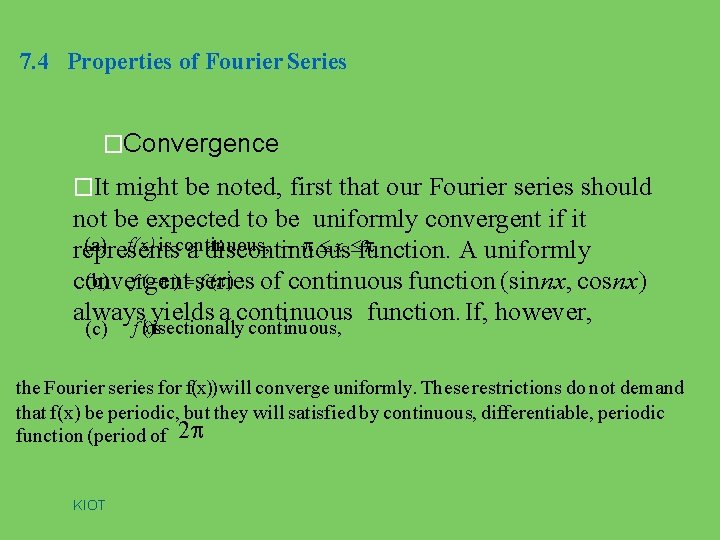
7. 4 Properties of Fourier Series �Convergence �It might be noted, first that our Fourier series should not be expected to be uniformly convergent if it (a) f(x) is continuous, x function. represents a discontinuous A uniformly (b) f ( ) series f ( ) of continuous function (sinnx, cosnx) convergent always yields a continuous function. If, however, (c) f (x)issectionally continuous, the Fourier series for f(x)) will converge uniformly. These restrictions do not demand that f(x) be periodic, but they will satisfied by continuous, differentiable, periodic function (period of 2 KIOT
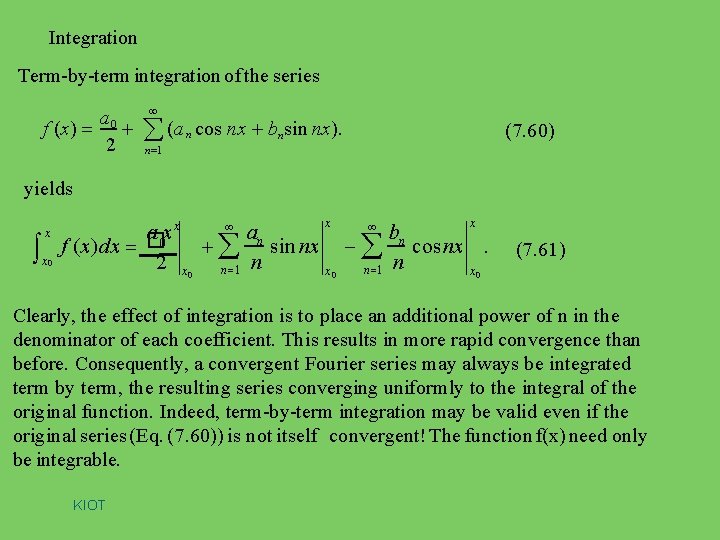
Integration Term-by-term integration of the series a f (x) 0 2 (a n cos nx bnsin nx). (7. 60) n 1 yields x x 0 x x x a bn n 0 � f (x)dx sin nx cos nx. 2 x 0 n 1 n x 0 (7. 61) Clearly, the effect of integration is to place an additional power of n in the denominator of each coefficient. This results in more rapid convergence than before. Consequently, a convergent Fourier series may always be integrated term by term, the resulting series converging uniformly to the integral of the original function. Indeed, term-by-term integration may be valid even if the original series (Eq. (7. 60)) is not itself convergent! The function f(x) need only be integrable. KIOT
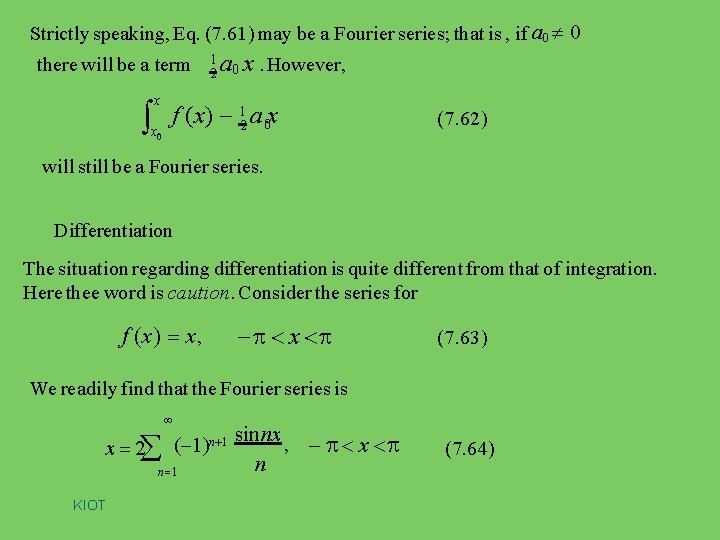
Strictly speaking, Eq. (7. 61) may be a Fourier series; that is , if a 0 0 there will be a term x x 0 1 2 a 0 x. However, f (x) 12 a 0 x (7. 62) will still be a Fourier series. Differentiation The situation regarding differentiation is quite different from that of integration. Here thee word is caution. Consider the series for f (x) x, x (7. 63) We readily find that the Fourier series is x 2 ( 1)n 1 KIOT sin nx , x n (7. 64)
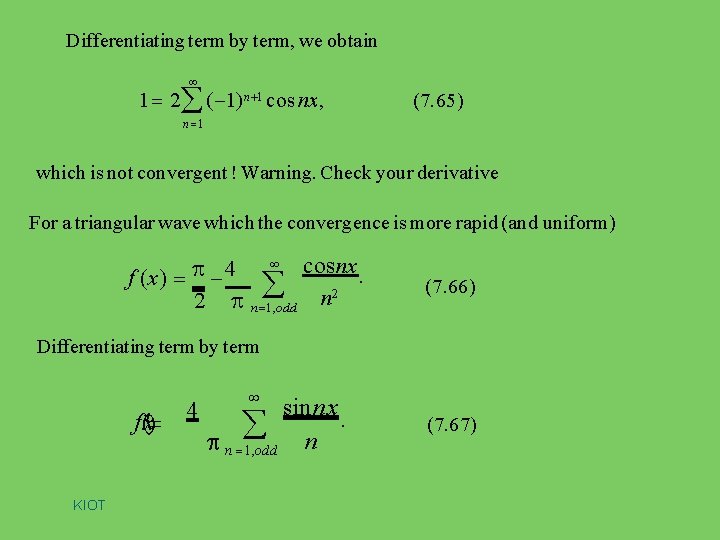
Differentiating term by term, we obtain 1 2 ( 1) n 1 cos nx, (7. 65) n 1 which is not convergent ! Warning. Check your derivative For a triangular wave which the convergence is more rapid (and uniform) f (x) 4 2 cosnx. 2 n n 1, odd (7. 66) Differentiating term by term f(x ) KIOT 4 sin nx. n 1, odd n (7. 67)
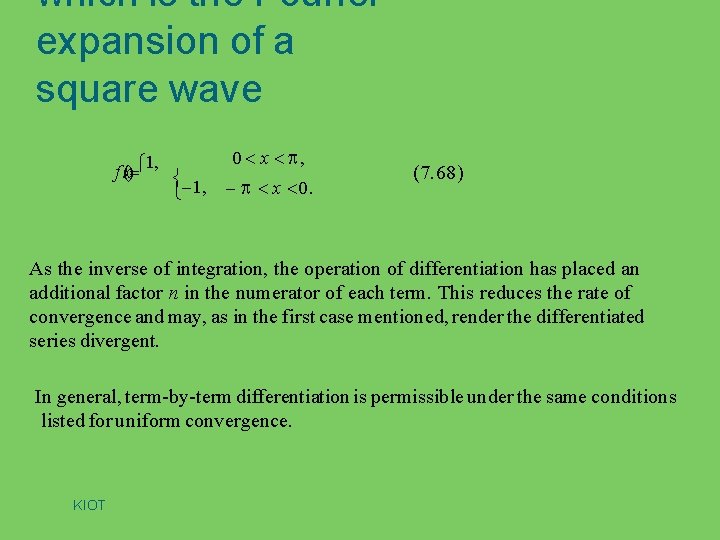
which is the Fourier expansion of a square wave 0 x , 1, f (x ) 1, x 0. (7. 68) As the inverse of integration, the operation of differentiation has placed an additional factor n in the numerator of each term. This reduces the rate of convergence and may, as in the first case mentioned, render the differentiated series divergent. In general, term-by-term differentiation is permissible under the same conditions listed for uniform convergence. KIOT
- Slides: 31