
Knowledge Flows between Multinational Enterprises and National Innovation
Knowledge Flows between Multinational Enterprises and National Innovation Systems 2 nd EUROFRAME Conference: Trade, FDI and relocation: challenges for the EU? Bernhard Dachs (ARC-sys), Bernd Ebersberger (Fh. G-ISI)
Introduction n Paper asks about knowledge and information transfer from the host country to affiliates of Multinational Enterprises (MNEs) n Policy relevance: Fears in Europe and the US that MNEs may relocate innovative activities because of cost advantages n If innovation is an interactive process. . . n A high degree of interactions between MNE and the host country may reduce the danger of relocation of MNE innovative activities © systems research & Fraunhofer ISI
Theoretical approaches There is no clear picture on this question in the literature: n international business literature n tries to explain FDI and exports in a common microeconomic framework (knowledge capital model, Markusen 2002) n Affiliates mostly exploit assets created by the partent company n approaches to „local embeddedness“ of affiliates n associated with the literature on local spillovers, innovative strategies of MNEs and global alliances n Affiliates actively increase the stock of knowledge of the MNE © systems research & Fraunhofer ISI
apporaches to local embeddedness n no coherent framework but some building blocks: n Internationalisation is a source, not a result of knowledge creation (‚home base augmenting‘ vs. ‚home base exploiting‘ – Kuemmerle 1997) n A reason for this is the partly tacit, context-specific, and local nature of knowledge and spillovers (Breschi and Lissoni 2001) n foreign affiliates act in many cases as ‚surveillance outposts‘, or ‚antennas‘ to benefit from local spillovers (Florida 1997, Almeida 1999) n MNEs give themselves a more decentralized organisational form (Zanfei 2000), where local affiliates enjoy wider mandates (Birkinshaw; Hakanson) © systems research & Fraunhofer ISI
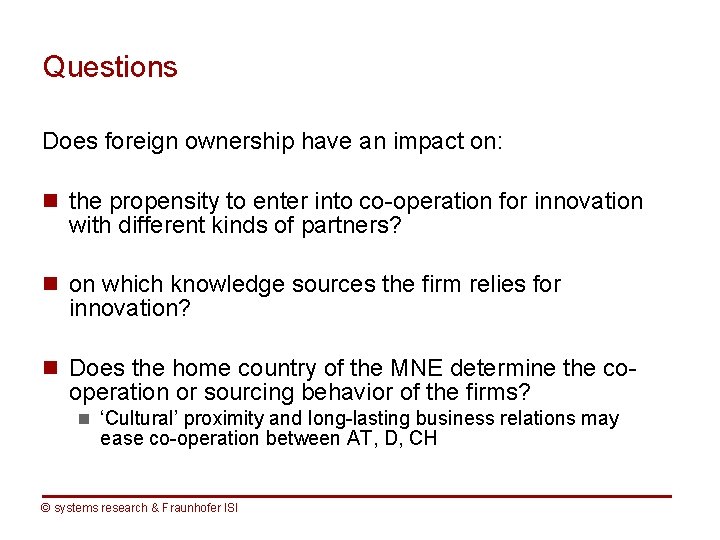
Questions Does foreign ownership have an impact on: n the propensity to enter into co-operation for innovation with different kinds of partners? n on which knowledge sources the firm relies for innovation? n Does the home country of the MNE determine the co- operation or sourcing behavior of the firms? n ‘Cultural’ proximity and long-lasting business relations may ease co-operation between AT, D, CH © systems research & Fraunhofer ISI
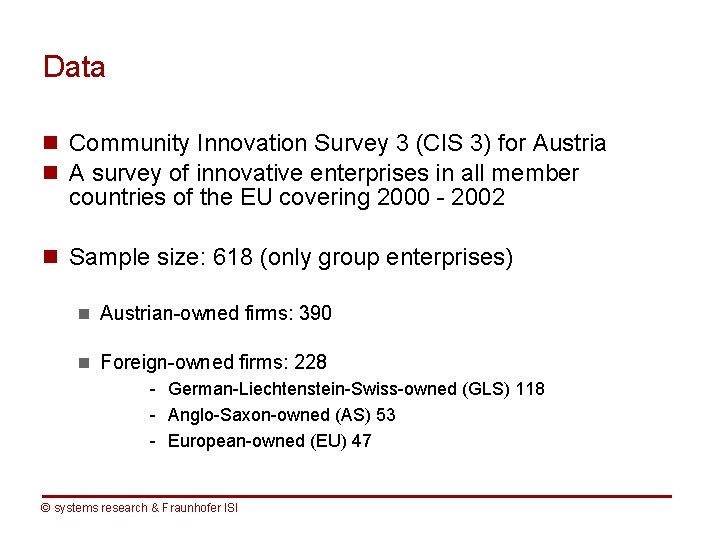
Data n Community Innovation Survey 3 (CIS 3) for Austria n A survey of innovative enterprises in all member countries of the EU covering 2000 - 2002 n Sample size: 618 (only group enterprises) n Austrian-owned firms: 390 n Foreign-owned firms: 228 - German-Liechtenstein-Swiss-owned (GLS) 118 - Anglo-Saxon-owned (AS) 53 - European-owned (EU) 47 © systems research & Fraunhofer ISI
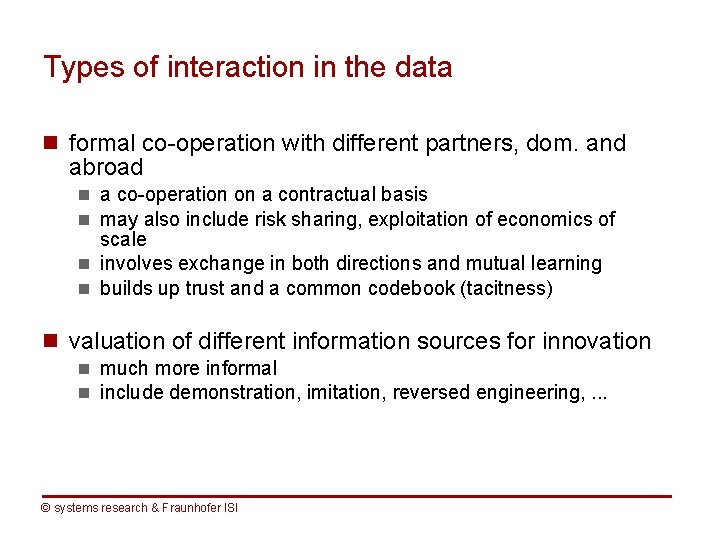
Types of interaction in the data n formal co-operation with different partners, dom. and abroad n a co-operation on a contractual basis n may also include risk sharing, exploitation of economics of scale n involves exchange in both directions and mutual learning n builds up trust and a common codebook (tacitness) n valuation of different information sources for innovation n much more informal n include demonstration, imitation, reversed engineering, . . . © systems research & Fraunhofer ISI
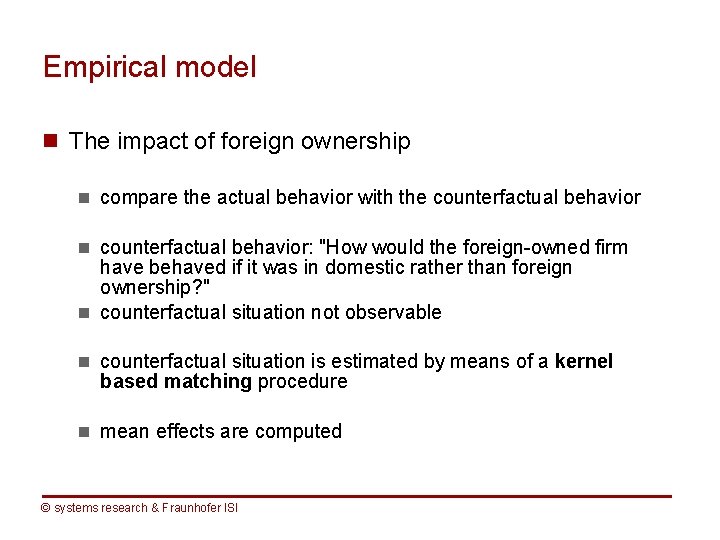
Empirical model n The impact of foreign ownership n compare the actual behavior with the counterfactual behavior n counterfactual behavior: "How would the foreign-owned firm have behaved if it was in domestic rather than foreign ownership? " n counterfactual situation not observable n counterfactual situation is estimated by means of a kernel based matching procedure n mean effects are computed © systems research & Fraunhofer ISI
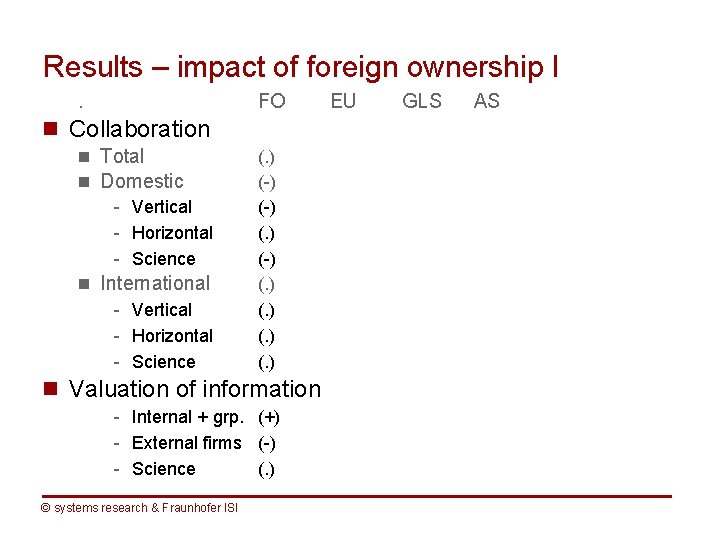
Results – impact of foreign ownership I. FO n Collaboration n Total n Domestic - Vertical - Horizontal - Science n International - Vertical - Horizontal - Science (. ) (-) (. ) n Valuation of information - Internal + grp. (+) - External firms (-) - Science (. ) © systems research & Fraunhofer ISI EU GLS AS
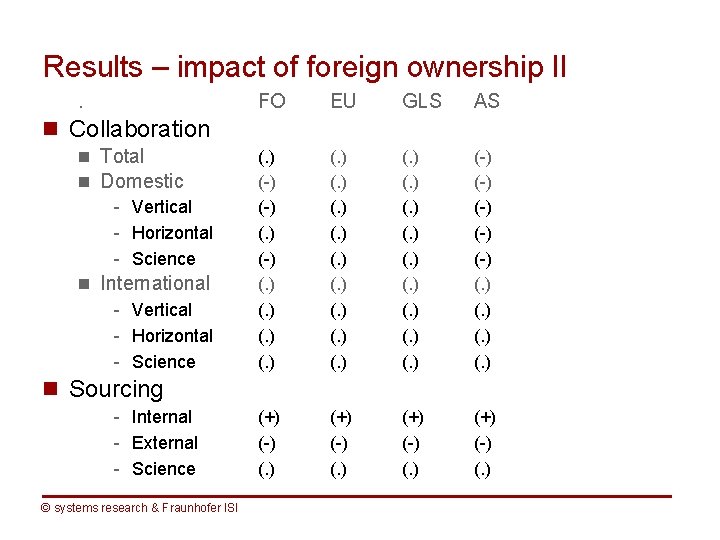
Results – impact of foreign ownership II. FO EU GLS AS (. ) (-) (. ) (. ) (-) (-) (-) (. ) (+) (-) (. ) n Collaboration n Total n Domestic - Vertical - Horizontal - Science n International - Vertical - Horizontal - Science n Sourcing - Internal - External - Science © systems research & Fraunhofer ISI
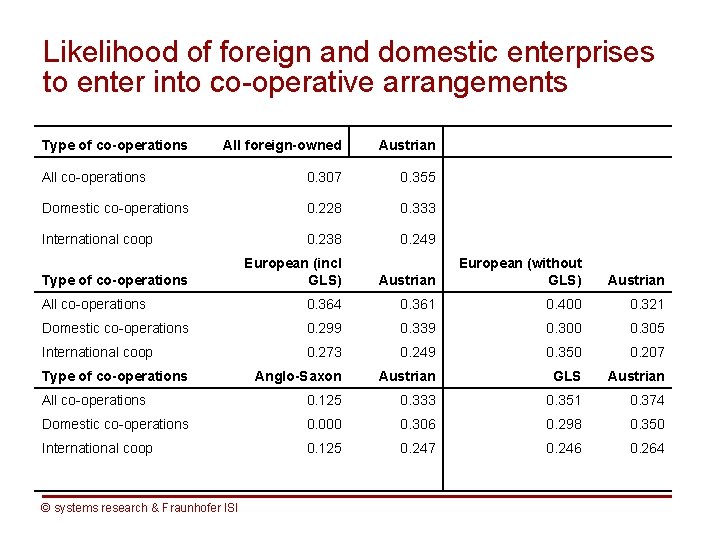
Likelihood of foreign and domestic enterprises to enter into co-operative arrangements Type of co-operations All foreign-owned Austrian All co-operations 0. 307 0. 355 Domestic co-operations 0. 228 0. 333 International coop 0. 238 0. 249 European (incl GLS) Austrian European (without GLS) Austrian All co-operations 0. 364 0. 361 0. 400 0. 321 Domestic co-operations 0. 299 0. 339 0. 300 0. 305 International coop 0. 273 0. 249 0. 350 0. 207 Anglo-Saxon Austrian GLS Austrian All co-operations 0. 125 0. 333 0. 351 0. 374 Domestic co-operations 0. 000 0. 306 0. 298 0. 350 International coop 0. 125 0. 247 0. 246 0. 264 Type of co-operations © systems research & Fraunhofer ISI
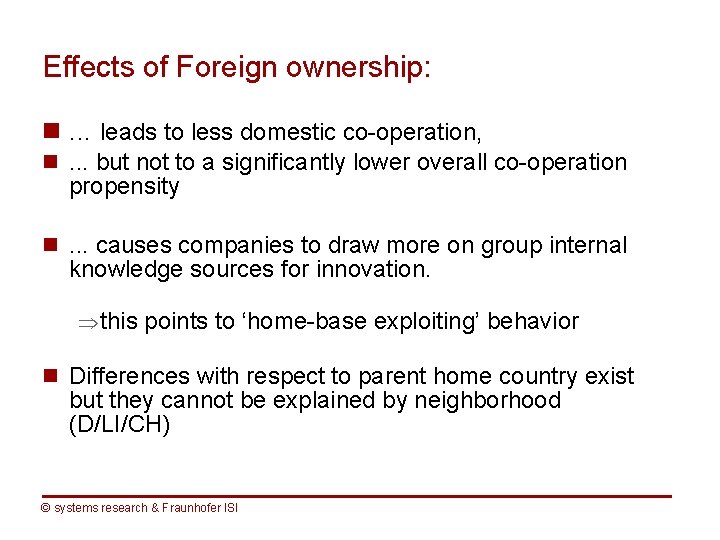
Effects of Foreign ownership: n. . . leads to less domestic co-operation, n. . . but not to a significantly lower overall co-operation propensity n. . . causes companies to draw more on group internal knowledge sources for innovation. Þ this points to ‘home-base exploiting’ behavior n Differences with respect to parent home country exist but they cannot be explained by neighborhood (D/LI/CH) © systems research & Fraunhofer ISI
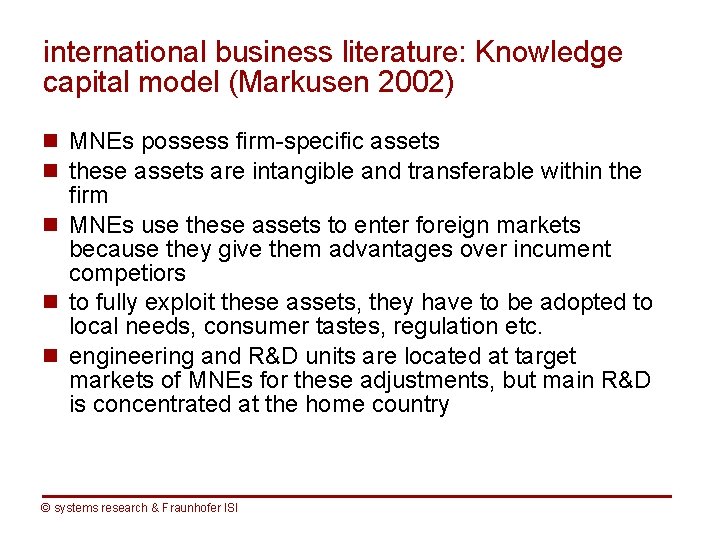
international business literature: Knowledge capital model (Markusen 2002) n MNEs possess firm-specific assets n these assets are intangible and transferable within the firm n MNEs use these assets to enter foreign markets because they give them advantages over incument competiors n to fully exploit these assets, they have to be adopted to local needs, consumer tastes, regulation etc. n engineering and R&D units are located at target markets of MNEs for these adjustments, but main R&D is concentrated at the home country © systems research & Fraunhofer ISI
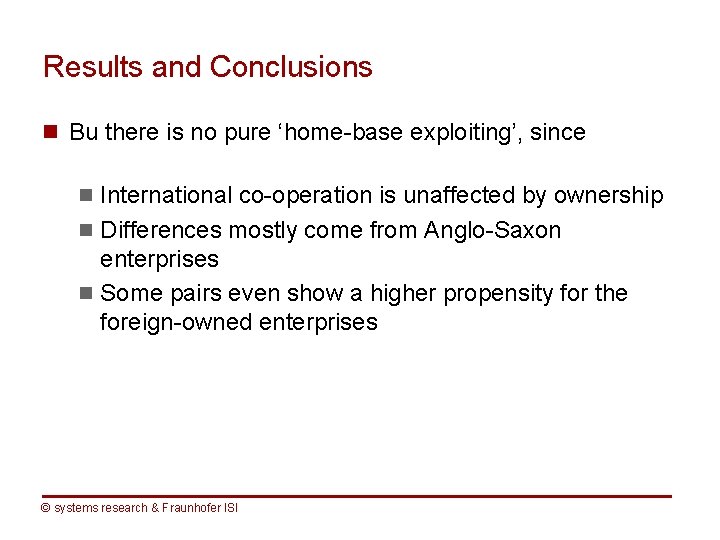
Results and Conclusions n Bu there is no pure ‘home-base exploiting’, since n International co-operation is unaffected by ownership n Differences mostly come from Anglo-Saxon enterprises n Some pairs even show a higher propensity for the foreign-owned enterprises © systems research & Fraunhofer ISI
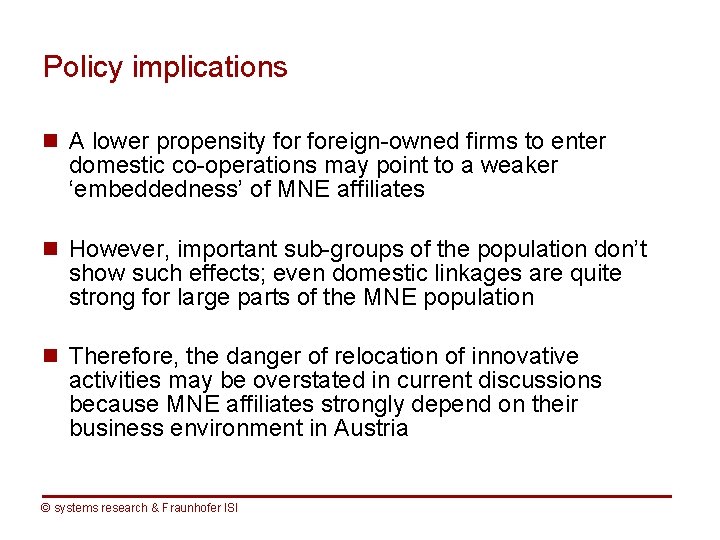
Policy implications n A lower propensity foreign-owned firms to enter domestic co-operations may point to a weaker ‘embeddedness’ of MNE affiliates n However, important sub-groups of the population don’t show such effects; even domestic linkages are quite strong for large parts of the MNE population n Therefore, the danger of relocation of innovative activities may be overstated in current discussions because MNE affiliates strongly depend on their business environment in Austria © systems research & Fraunhofer ISI

Thank you!
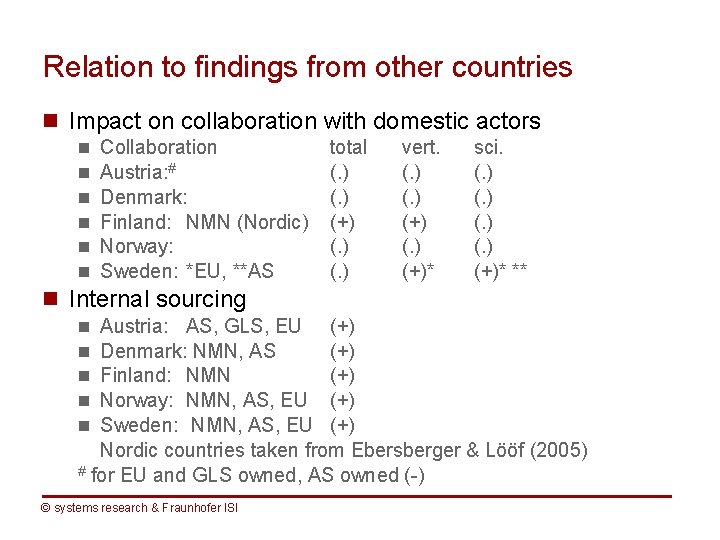
Relation to findings from other countries n Impact on collaboration with domestic actors n n n Collaboration Austria: # Denmark: Finland: NMN (Nordic) Norway: Sweden: *EU, **AS total (. ) (+) (. ) vert. (. ) (+)* sci. (. ) (+)* ** n Internal sourcing Austria: AS, GLS, EU (+) Denmark: NMN, AS (+) Finland: NMN (+) Norway: NMN, AS, EU (+) Sweden: NMN, AS, EU (+) Nordic countries taken from Ebersberger & Lööf (2005) # for EU and GLS owned, AS owned (-) n n n © systems research & Fraunhofer ISI
- Slides: 17