
KNOWLEDGE CREATION AND THE INTERACTION BETWEEN SOCIAL SPACE
KNOWLEDGE CREATION AND THE INTERACTION BETWEEN SOCIAL SPACE AND PHYSICAL PLACE Roel Rutten – Key note lecture IRS Spring School 4 June 2019 Understanding Society
Introduction Researcher Lecture outline • Tilburg University • ERAC • (European Regional Affairs Consultants) Expertise • Explaining geography of knowledge creation? • Geographically stretched knowledge creation • Why knowledge creation happens in some places rather than others • Interaction between social space and physical place • Geography of knowledge creation • Organization of knowledge creation • QCA (Qualitative Comparative Analysis) Recent papers • Builds a configurational argument • Outline for a configurational approach • Case-based rather than variable-based • QCA (Qualitative Comparative Analysis) • Beyond proximities (2017), Progress in Human Geography • Openness values and regional innovation (2018), Journal of Economic Geography • v • Aim • Appreciate the complexity of social reality and causality Slide 01
Knowledge creation • Defined • Interaction between individuals in a social context • Individuals are key agents of knowledge creation • Social context affect how individuals interact • Social context as social space: professional networks, communities of practice • Social space • Transcends organizational boundaries • Not necessarily territorialized • But connects to (one or more) physical places • Through the individuals occupying the social space Slide 02
Flawed notions of the geography of knowledge creation • Proximities approach • Reduces geography to imaginary formless landscapes • Territorial Innovation Models • Reduce social space to territorialized artefacts • My approach • Look at agents and their relationships • Social dynamics: connection between social space and physical place • Relational Economic Geography Slide 03
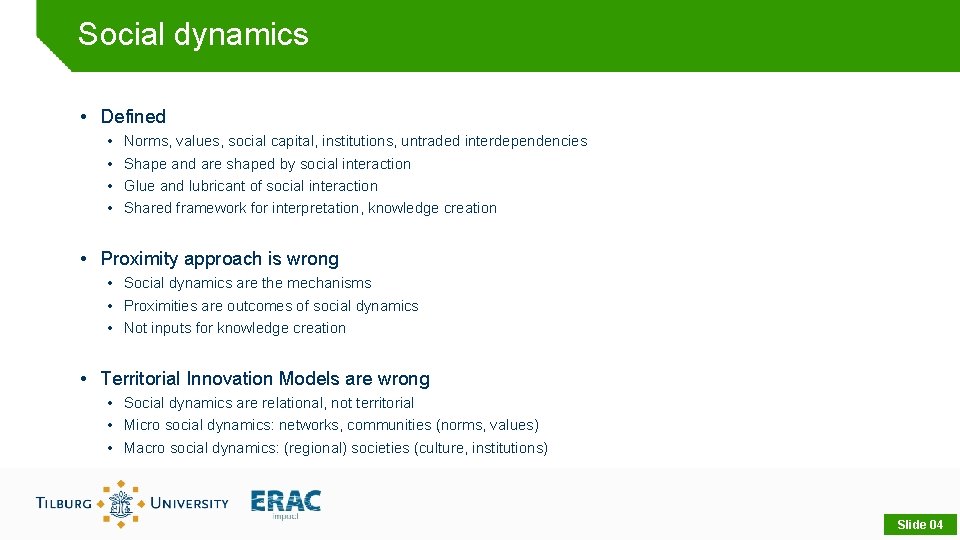
Social dynamics • Defined • • Norms, values, social capital, institutions, untraded interdependencies Shape and are shaped by social interaction Glue and lubricant of social interaction Shared framework for interpretation, knowledge creation • Proximity approach is wrong • Social dynamics are the mechanisms • Proximities are outcomes of social dynamics • Not inputs for knowledge creation • Territorial Innovation Models are wrong • Social dynamics are relational, not territorial • Micro social dynamics: networks, communities (norms, values) • Macro social dynamics: (regional) societies (culture, institutions) Slide 04
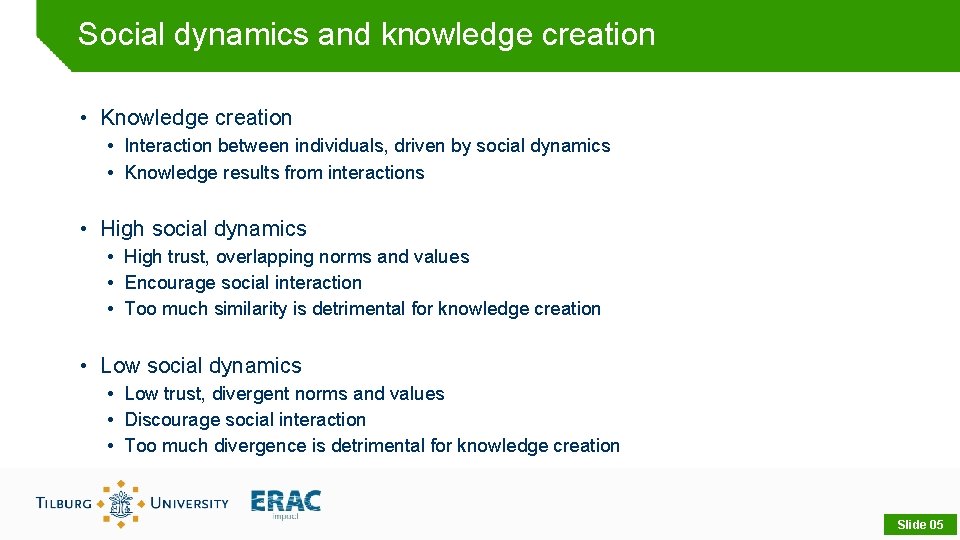
Social dynamics and knowledge creation • Knowledge creation • Interaction between individuals, driven by social dynamics • Knowledge results from interactions • High social dynamics • High trust, overlapping norms and values • Encourage social interaction • Too much similarity is detrimental for knowledge creation • Low social dynamics • Low trust, divergent norms and values • Discourage social interaction • Too much divergence is detrimental for knowledge creation Slide 05
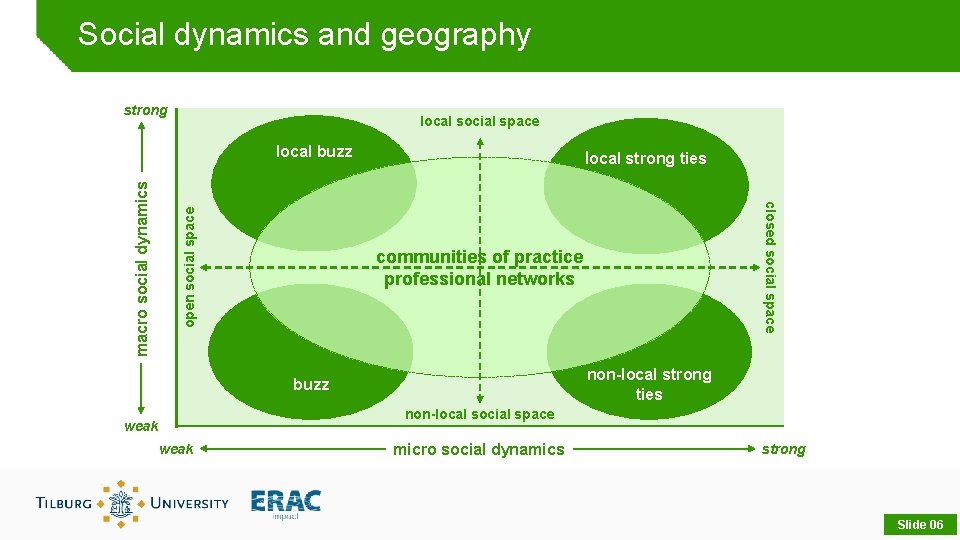
Social dynamics and geography strong local social space open social space local strong ties closed social space macro social dynamics local buzz communities of practice professional networks non-local strong ties buzz non-local social space weak micro social dynamics strong Slide 06
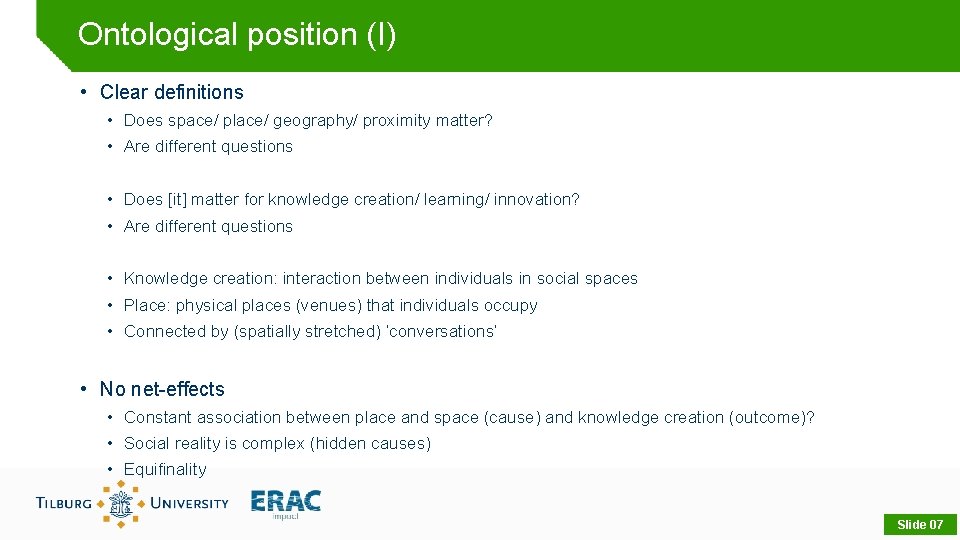
Ontological position (I) • Clear definitions • Does space/ place/ geography/ proximity matter? • Are different questions • Does [it] matter for knowledge creation/ learning/ innovation? • Are different questions • Knowledge creation: interaction between individuals in social spaces • Place: physical places (venues) that individuals occupy • Connected by (spatially stretched) ‘conversations’ • No net-effects • Constant association between place and space (cause) and knowledge creation (outcome)? • Social reality is complex (hidden causes) • Equifinality Slide 07

Ontological position (II) • Causality is an ‘enabler’ not a ‘forcing’ • Not about independent variables ‘doing something’ to a dependent variable • Not about predicting effects • Conditions present make outcomes possible • Willingness and ability of agents to achieve outcomes • Causality is contextualized • Take agency seriously • Variables are not agents • Agency is intentional and may defeat regularities Slide 08
Conversations defined • A social space where individuals create knowledge • Centred around a topic, problem, challenge • Informal, bottom-up, not organized • Local, non-local, virtual • Ambiguous, interpretative • Precedes or parallel to firm innovation • As input for innovation projects • Firms tap into conversations to access knowledge Slide 09
Examples of conversations • The electric car conversation • • • Builds on research on electric propulsion, batteries Engaged are technicians, engineers, designers, marketers Discuss the performance and appeal/ image of electric cars Input for car manufacturers Happens at universities, research centres, car plants • The privacy-on-social-media conversation • • • Recently initiated conversation Engaged are software developers, legal experts Discuss the technology, functionality and user-friendliness of social media Input for social media companies Happens at conferences, task forces, office meetings Slide 10
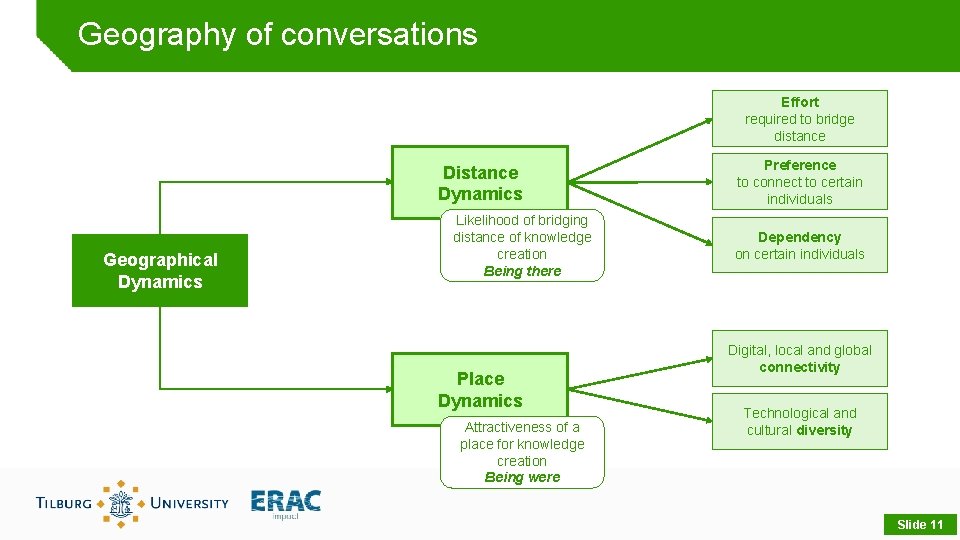
Geography of conversations Effort required to bridge distance Dynamics Geographical Dynamics Likelihood of bridging distance of knowledge creation Being there Place Dynamics Attractiveness of a place for knowledge creation Being were Preference to connect to certain individuals Dependency on certain individuals Digital, local and global connectivity Technological and cultural diversity Slide 11
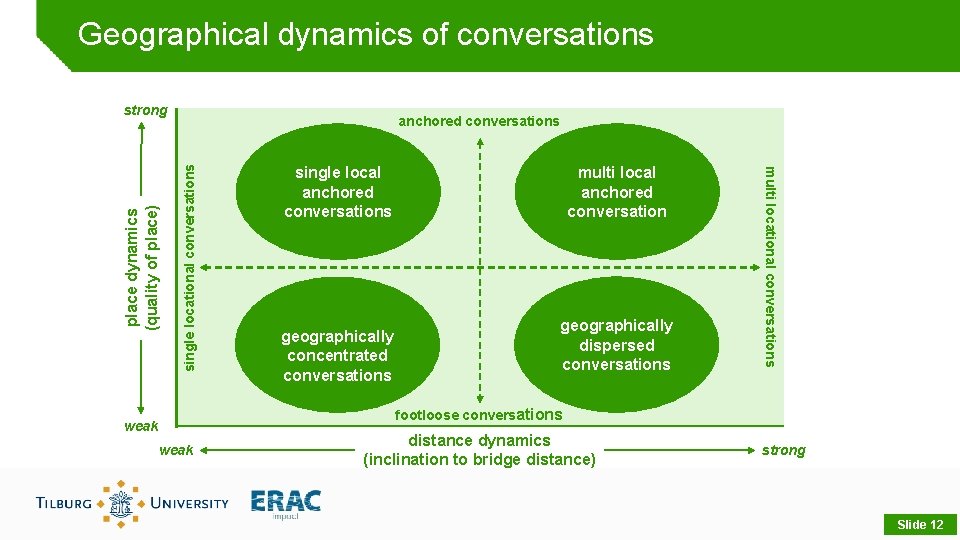
Geographical dynamics of conversations single locational conversations anchored conversations single local anchored conversations geographically concentrated conversations multi local anchored conversation geographically dispersed conversations multi locational conversations place dynamics (quality of place) strong footloose conversations weak distance dynamics (inclination to bridge distance) strong Slide 12
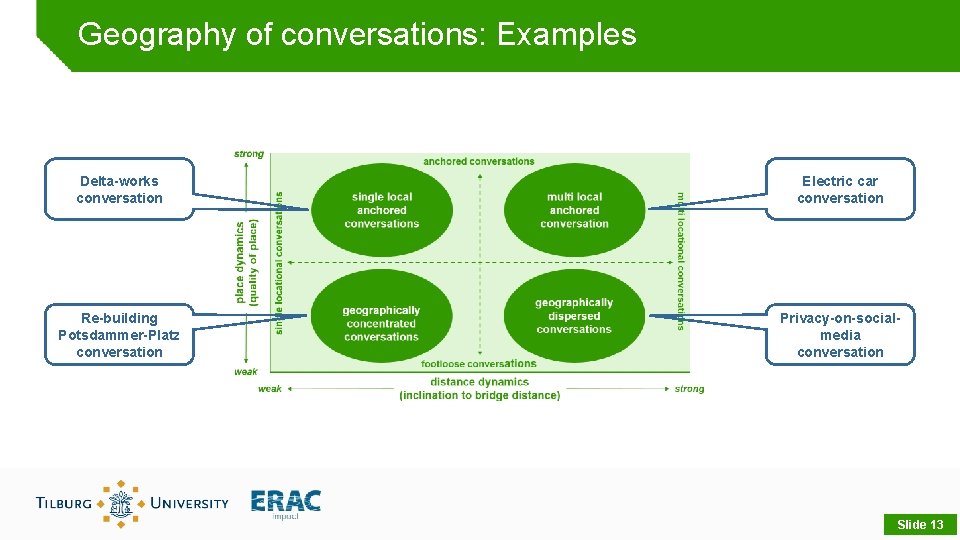
Geography of conversations: Examples Delta-works conversation Electric car conversation Re-building Potsdammer-Platz conversation Privacy-on-socialmedia conversation Slide 13

A configurational argument correlations set-relationships place dynamics distance dynamics RCK ~RCK regional knowledge creation RCK social dynamics RCK ~RCK social dynamics • • Correlational analyis, linear algebra RKC = βPla. Dyn+ βDis. Dyn+ βSoc. Dyn+ ε Pla. Dyn has an independent net effect on RCK Pla. Dyn increases the likelihood of RCK • • Set-analysis, Boolean algebra RKC = (PD AND DD) OR (PD AND SD) OR (DD AND SD) Pla. Dyn in conjunction with Dis. Dyn explains RCK The presence of Pla. Dyn makes RCK possible Slide 14
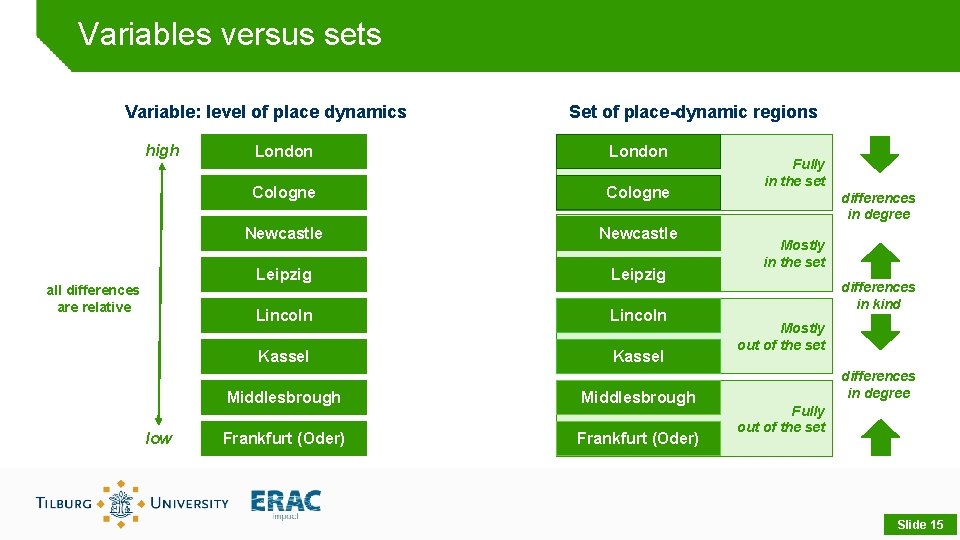
Variables versus sets Variable: level of place dynamics high all differences are relative low Set of place-dynamic regions London Cologne Newcastle Leipzig Lincoln Kassel Middlesbrough Frankfurt (Oder) Fully in the set differences in degree Mostly in the set differences in kind Mostly out of the set differences in degree Fully out of the set Slide 15
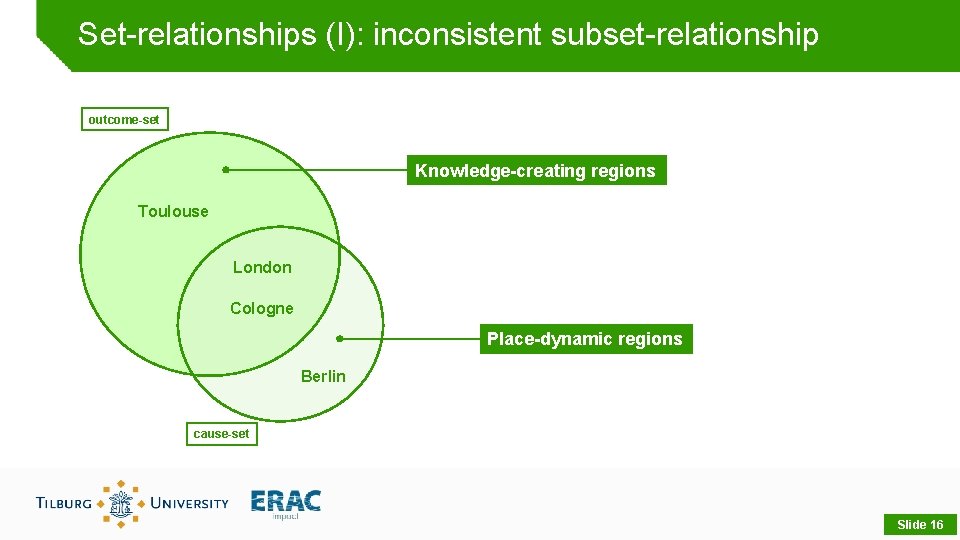
Set-relationships (I): inconsistent subset-relationship outcome-set Knowledge-creating regions Toulouse London Cologne Place-dynamic regions Berlin cause-set Slide 16
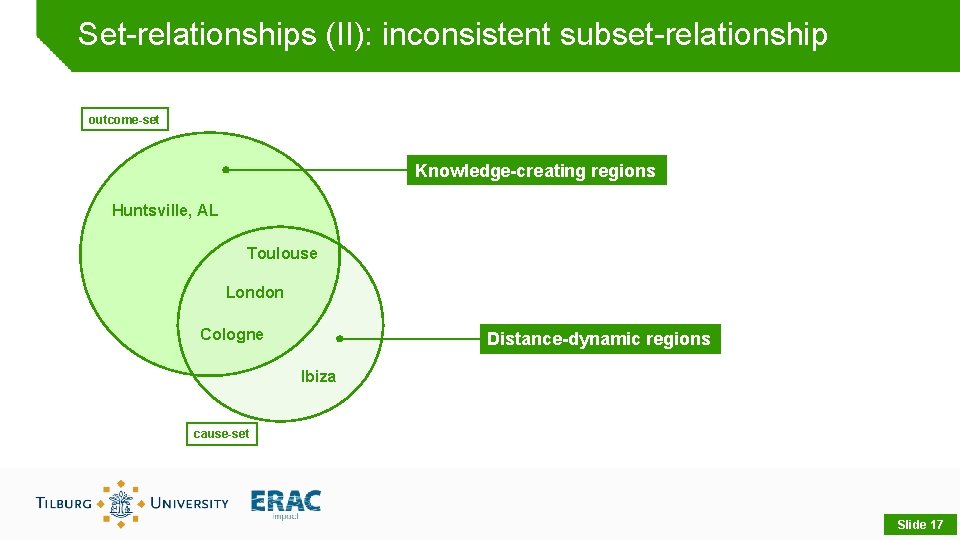
Set-relationships (II): inconsistent subset-relationship outcome-set Knowledge-creating regions Huntsville, AL Toulouse London Cologne Distance-dynamic regions Ibiza cause-set Slide 17
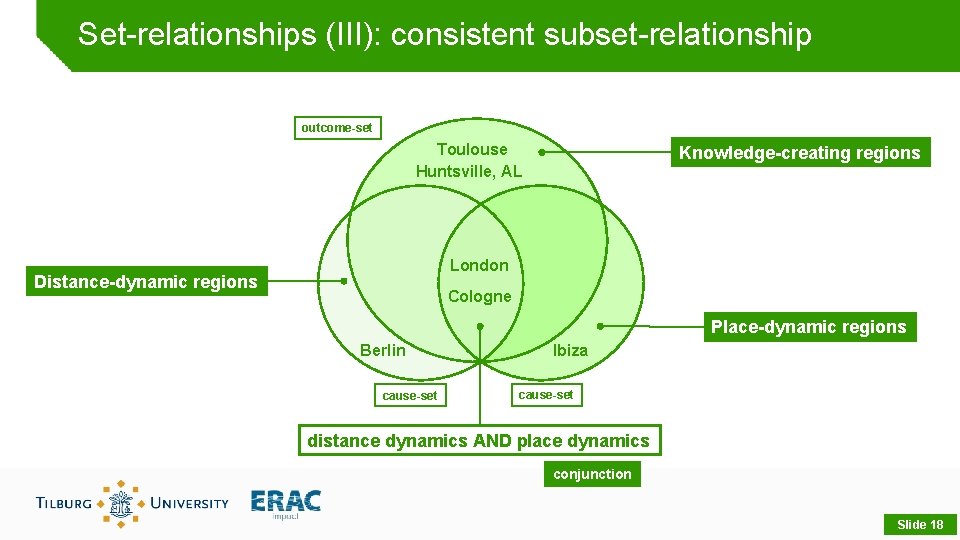
Set-relationships (III): consistent subset-relationship outcome-set Toulouse Huntsville, AL Knowledge-creating regions London Distance-dynamic regions Cologne Place-dynamic regions Berlin cause-set Ibiza cause-set distance dynamics AND place dynamics conjunction Slide 18
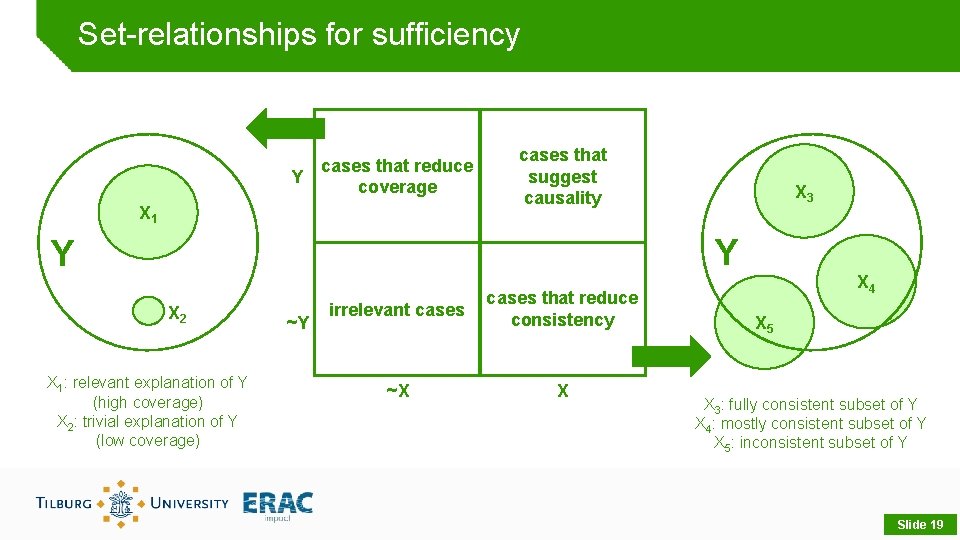
Set-relationships for sufficiency cases that reduce Y coverage X 1 cases that suggest causality X 3 Y Y X 2 X 1: relevant explanation of Y (high coverage) X 2: trivial explanation of Y (low coverage) ~Y irrelevant cases that reduce consistency ~X X X 4 X 5 X 3: fully consistent subset of Y X 4: mostly consistent subset of Y X 5: inconsistent subset of Y Slide 19
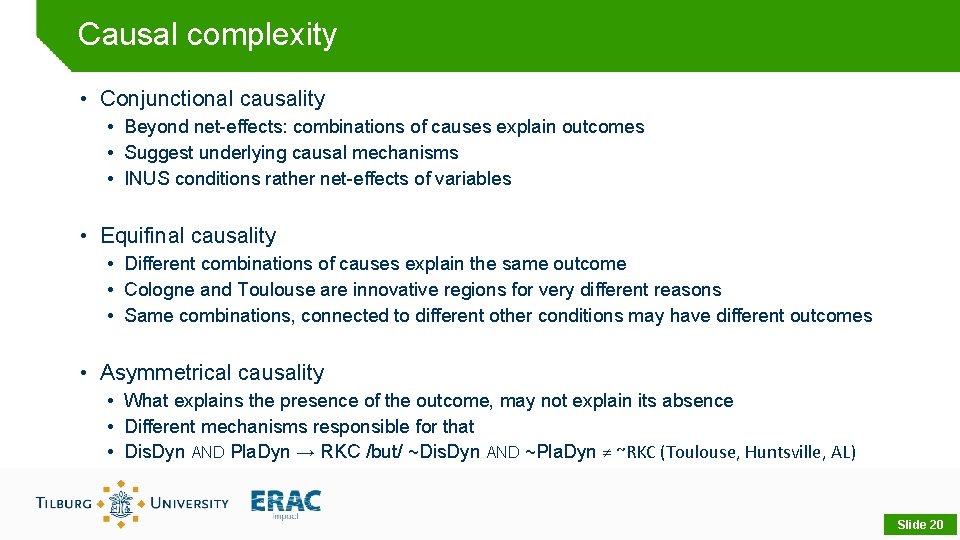
Causal complexity • Conjunctional causality • Beyond net-effects: combinations of causes explain outcomes • Suggest underlying causal mechanisms • INUS conditions rather net-effects of variables • Equifinal causality • Different combinations of causes explain the same outcome • Cologne and Toulouse are innovative regions for very different reasons • Same combinations, connected to different other conditions may have different outcomes • Asymmetrical causality • What explains the presence of the outcome, may not explain its absence • Different mechanisms responsible for that • Dis. Dyn AND Pla. Dyn → RKC /but/ ~Dis. Dyn AND ~Pla. Dyn ≠ ~RKC (Toulouse, Huntsville, AL) Slide 20
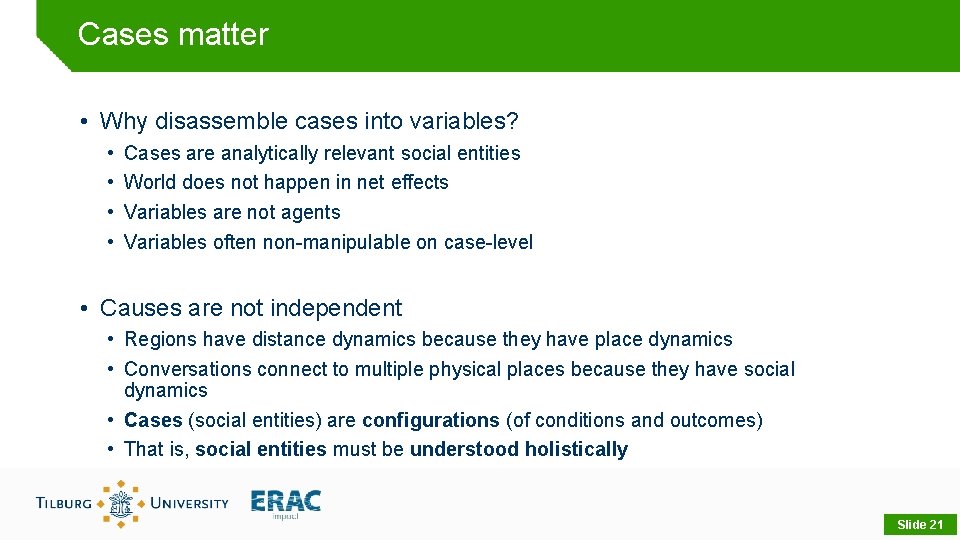
Cases matter • Why disassemble cases into variables? • • Cases are analytically relevant social entities World does not happen in net effects Variables are not agents Variables often non-manipulable on case-level • Causes are not independent • Regions have distance dynamics because they have place dynamics • Conversations connect to multiple physical places because they have social dynamics • Cases (social entities) are configurations (of conditions and outcomes) • That is, social entities must be understood holistically Slide 21
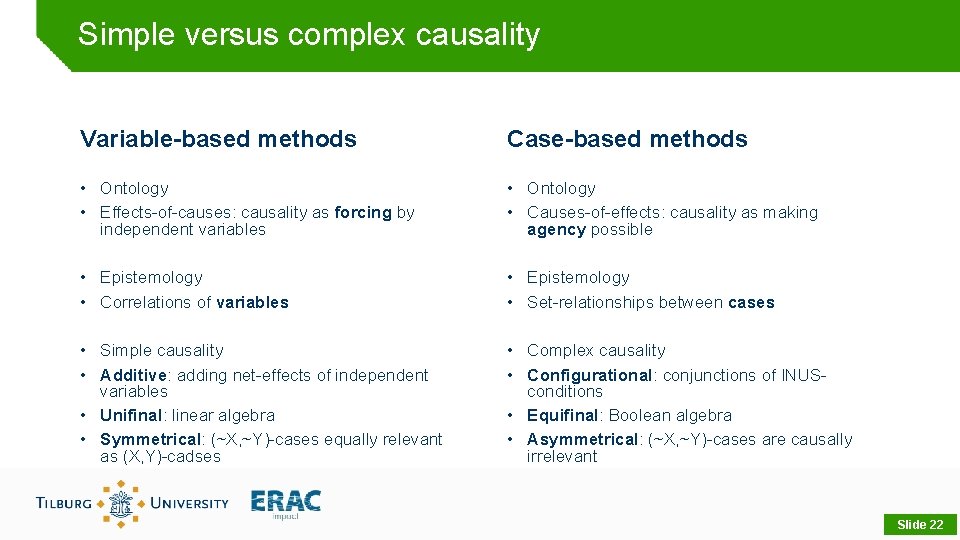
Simple versus complex causality Variable-based methods Case-based methods • Ontology • Effects-of-causes: causality as forcing by independent variables • Ontology • Causes-of-effects: causality as making agency possible • Epistemology • Correlations of variables • Epistemology • Set-relationships between cases • Simple causality • Additive: adding net-effects of independent variables • Unifinal: linear algebra • Symmetrical: (~X, ~Y)-cases equally relevant as (X, Y)-cadses • Complex causality • Configurational: conjunctions of INUSconditions • Equifinal: Boolean algebra • Asymmetrical: (~X, ~Y)-cases are causally irrelevant Slide 22
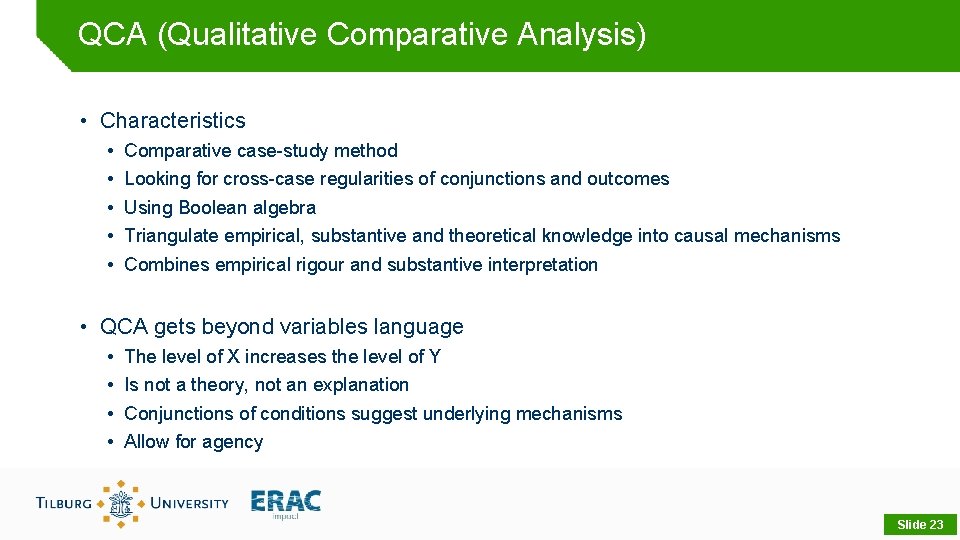
QCA (Qualitative Comparative Analysis) • Characteristics • • • Comparative case-study method Looking for cross-case regularities of conjunctions and outcomes Using Boolean algebra Triangulate empirical, substantive and theoretical knowledge into causal mechanisms Combines empirical rigour and substantive interpretation • QCA gets beyond variables language • • The level of X increases the level of Y Is not a theory, not an explanation Conjunctions of conditions suggest underlying mechanisms Allow for agency Slide 23

Drawing the argument together • The interaction of social space and physical place • Configurational argument: different combinations of Dis. Dyn, Pla. Dym, Soc. Dyn • Explain regional knowledge creation • Equifinality: different mechanisms at work • In different kinds of conversations (causality is contextualized) • Conversations: people doing stuff rather than variables • Qualitative Comparative Analysis • A configurational method (cross-case regularities) • Requires configurational theorizing (sufficiency) • More on QCA in my workshop Slide 24
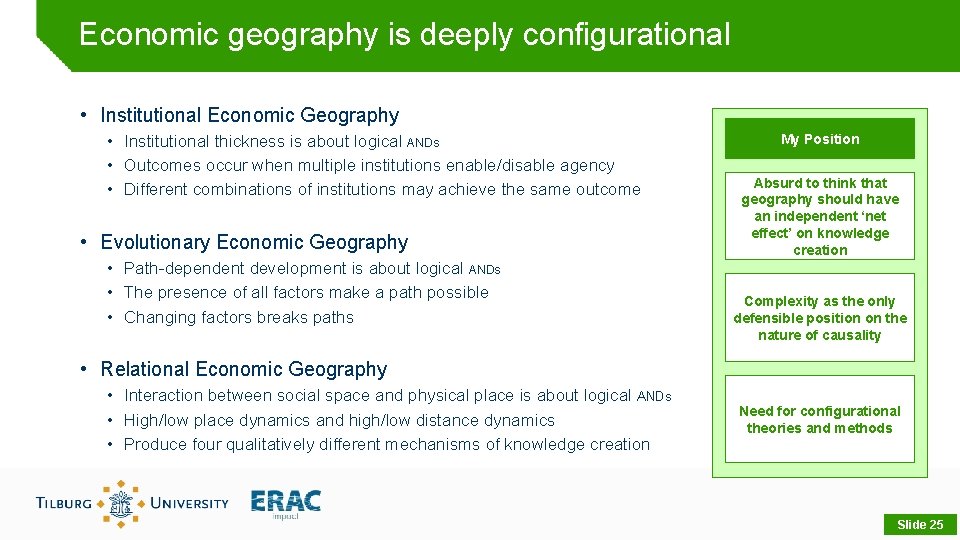
Economic geography is deeply configurational • Institutional Economic Geography • Institutional thickness is about logical ANDs • Outcomes occur when multiple institutions enable/disable agency • Different combinations of institutions may achieve the same outcome • Evolutionary Economic Geography • Path-dependent development is about logical ANDs • The presence of all factors make a path possible • Changing factors breaks paths My Position Absurd to think that geography should have an independent ‘net effect’ on knowledge creation Complexity as the only defensible position on the nature of causality • Relational Economic Geography • Interaction between social space and physical place is about logical ANDs • High/low place dynamics and high/low distance dynamics • Produce four qualitatively different mechanisms of knowledge creation Need for configurational theories and methods Slide 25

Thank you for your attention Questions? School of Social and Behavioural Sciences European Regional Affairs Consultants Slide 26
- Slides: 27