
Knowledge Construction Chapter Seven Educational Psychology Developing Learners


- Slides: 17
Knowledge Construction Chapter Seven Educational Psychology: Developing Learners 6 th edition Jeanne Ellis Ormrod
Constructive Processes Learning involves constructing one’s own knowledge from one’s experiences. Our current knowledge influences what we learned, what we expect to learn, what we can store, and what we can retrieve. Jeanne Ellis Ormrod Educational Psychology: Developing Learners, sixth edition Copyright © 2008 by Pearson Education, Inc. Upper Saddle River, New Jersey 07458 All rights reserved.
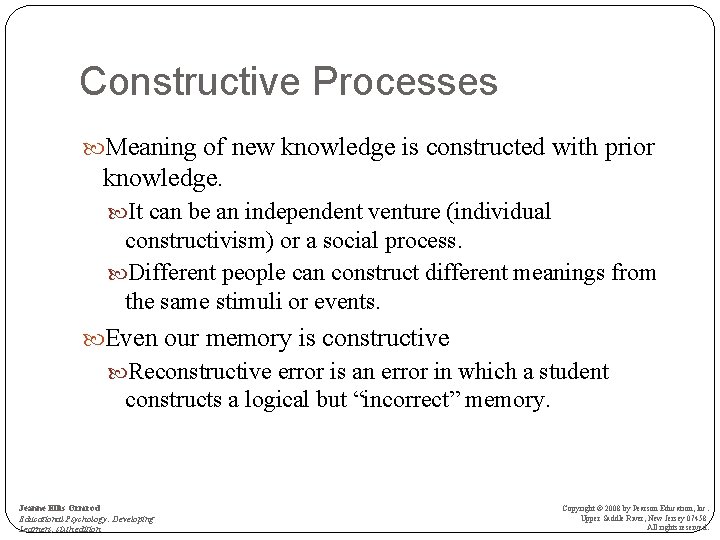
Constructive Processes Meaning of new knowledge is constructed with prior knowledge. It can be an independent venture (individual constructivism) or a social process. Different people can construct different meanings from the same stimuli or events. Even our memory is constructive Reconstructive error is an error in which a student constructs a logical but “incorrect” memory. Jeanne Ellis Ormrod Educational Psychology: Developing Learners, sixth edition Copyright © 2008 by Pearson Education, Inc. Upper Saddle River, New Jersey 07458 All rights reserved.
Social Constructivism Socially constructed knowledge: knowledge jointly constructed by two or more people Often leads to a better understanding of the subject matter E. g. , two students working together to better understand a homework assignment May be constructed by an entire culture Literature, music, fine arts Jeanne Ellis Ormrod Educational Psychology: Developing Learners, sixth edition Copyright © 2008 by Pearson Education, Inc. Upper Saddle River, New Jersey 07458 All rights reserved.
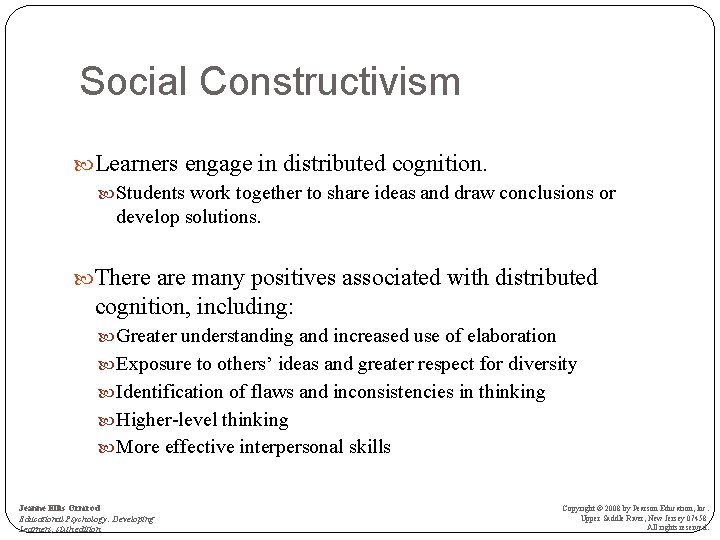
Social Constructivism Learners engage in distributed cognition. Students work together to share ideas and draw conclusions or develop solutions. There are many positives associated with distributed cognition, including: Greater understanding and increased use of elaboration Exposure to others’ ideas and greater respect for diversity Identification of flaws and inconsistencies in thinking Higher-level thinking More effective interpersonal skills Jeanne Ellis Ormrod Educational Psychology: Developing Learners, sixth edition Copyright © 2008 by Pearson Education, Inc. Upper Saddle River, New Jersey 07458 All rights reserved.
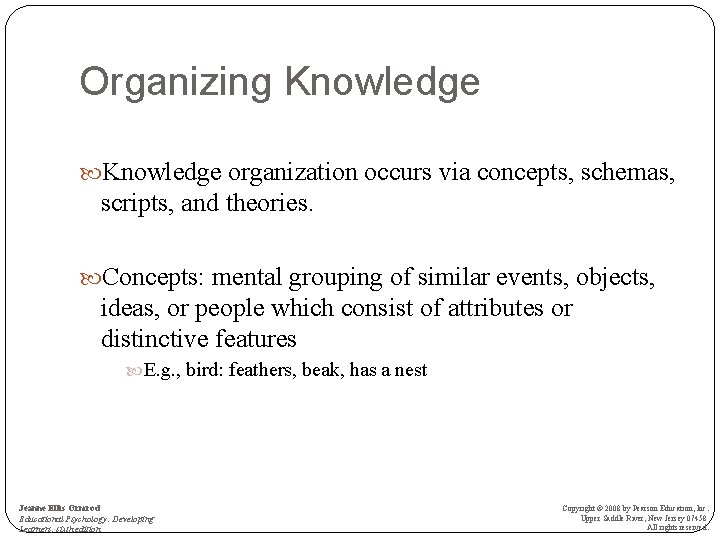
Organizing Knowledge organization occurs via concepts, schemas, scripts, and theories. Concepts: mental grouping of similar events, objects, ideas, or people which consist of attributes or distinctive features E. g. , bird: feathers, beak, has a nest Jeanne Ellis Ormrod Educational Psychology: Developing Learners, sixth edition Copyright © 2008 by Pearson Education, Inc. Upper Saddle River, New Jersey 07458 All rights reserved.
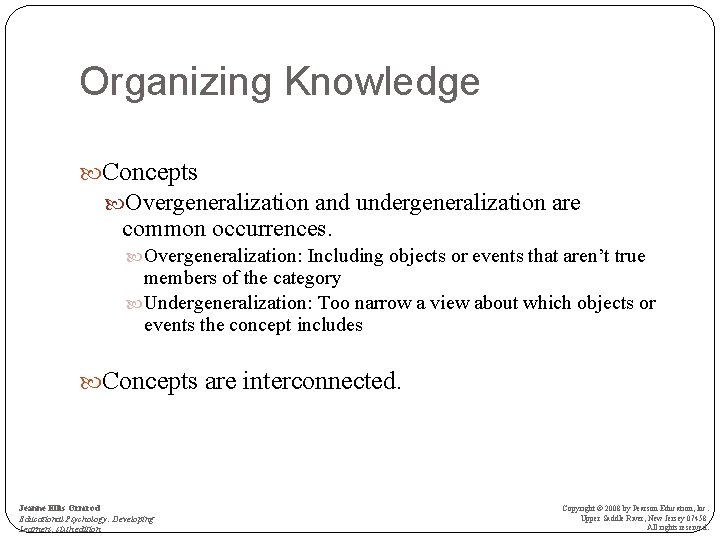
Organizing Knowledge Concepts Overgeneralization and undergeneralization are common occurrences. Overgeneralization: Including objects or events that aren’t true members of the category Undergeneralization: Too narrow a view about which objects or events the concept includes Concepts are interconnected. Jeanne Ellis Ormrod Educational Psychology: Developing Learners, sixth edition Copyright © 2008 by Pearson Education, Inc. Upper Saddle River, New Jersey 07458 All rights reserved.
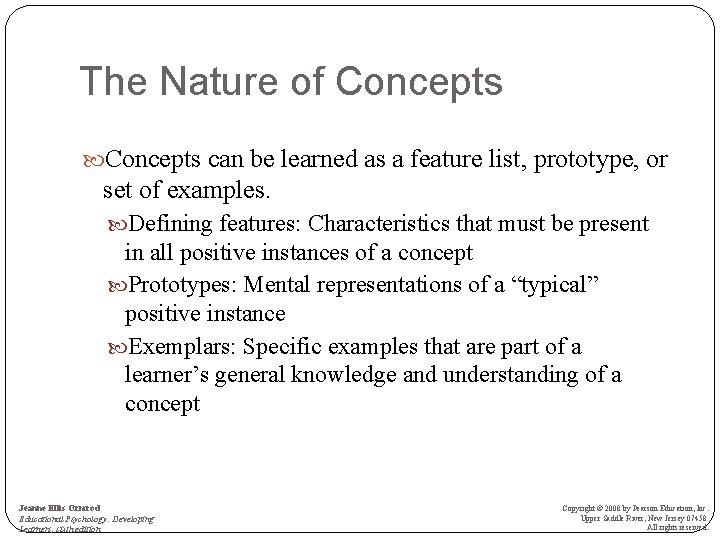
The Nature of Concepts can be learned as a feature list, prototype, or set of examples. Defining features: Characteristics that must be present in all positive instances of a concept Prototypes: Mental representations of a “typical” positive instance Exemplars: Specific examples that are part of a learner’s general knowledge and understanding of a concept Jeanne Ellis Ormrod Educational Psychology: Developing Learners, sixth edition Copyright © 2008 by Pearson Education, Inc. Upper Saddle River, New Jersey 07458 All rights reserved.
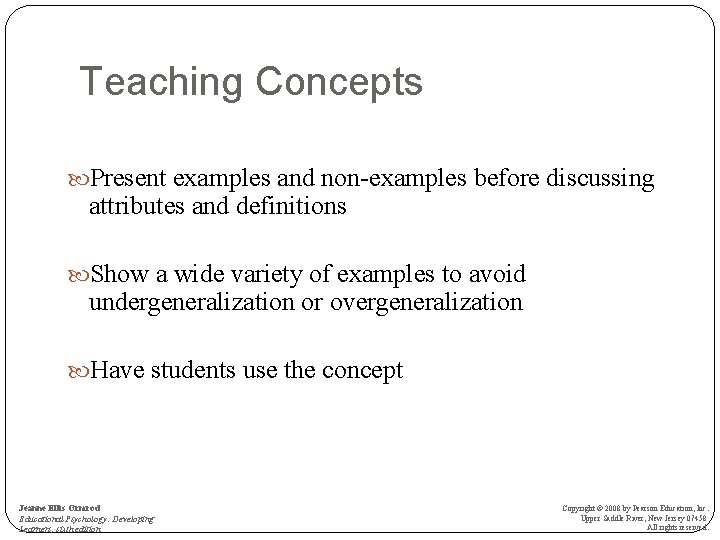
Teaching Concepts Present examples and non-examples before discussing attributes and definitions Show a wide variety of examples to avoid undergeneralization or overgeneralization Have students use the concept Jeanne Ellis Ormrod Educational Psychology: Developing Learners, sixth edition Copyright © 2008 by Pearson Education, Inc. Upper Saddle River, New Jersey 07458 All rights reserved.
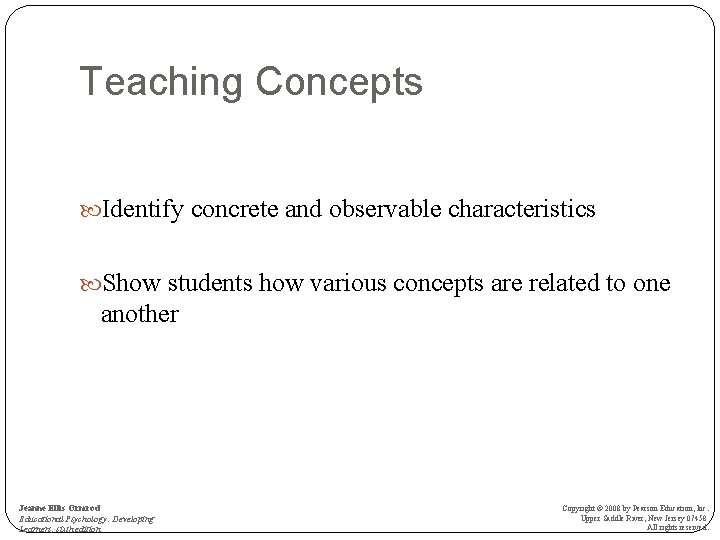
Teaching Concepts Identify concrete and observable characteristics Show students how various concepts are related to one another Jeanne Ellis Ormrod Educational Psychology: Developing Learners, sixth edition Copyright © 2008 by Pearson Education, Inc. Upper Saddle River, New Jersey 07458 All rights reserved.
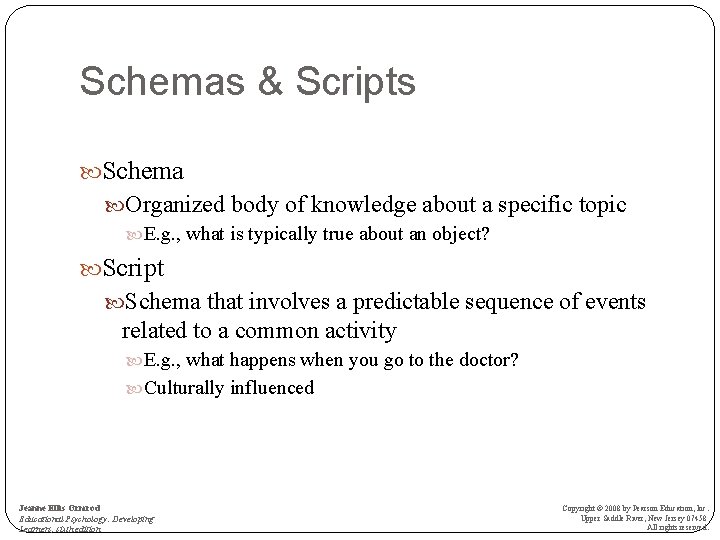
Schemas & Scripts Schema Organized body of knowledge about a specific topic E. g. , what is typically true about an object? Script Schema that involves a predictable sequence of events related to a common activity E. g. , what happens when you go to the doctor? Culturally influenced Jeanne Ellis Ormrod Educational Psychology: Developing Learners, sixth edition Copyright © 2008 by Pearson Education, Inc. Upper Saddle River, New Jersey 07458 All rights reserved.
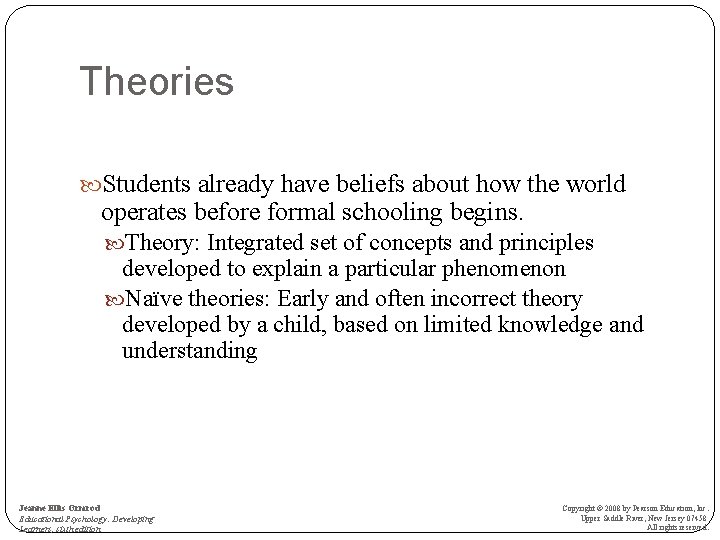
Theories Students already have beliefs about how the world operates before formal schooling begins. Theory: Integrated set of concepts and principles developed to explain a particular phenomenon Naïve theories: Early and often incorrect theory developed by a child, based on limited knowledge and understanding Jeanne Ellis Ormrod Educational Psychology: Developing Learners, sixth edition Copyright © 2008 by Pearson Education, Inc. Upper Saddle River, New Jersey 07458 All rights reserved.
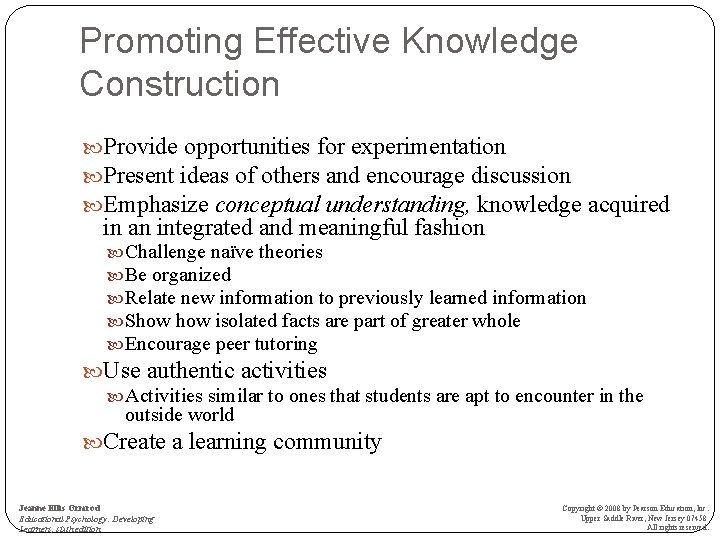
Promoting Effective Knowledge Construction Provide opportunities for experimentation Present ideas of others and encourage discussion Emphasize conceptual understanding, knowledge acquired in an integrated and meaningful fashion Challenge naïve theories Be organized Relate new information to previously learned information Show isolated facts are part of greater whole Encourage peer tutoring Use authentic activities Activities similar to ones that students are apt to encounter in the outside world Create a learning community Jeanne Ellis Ormrod Educational Psychology: Developing Learners, sixth edition Copyright © 2008 by Pearson Education, Inc. Upper Saddle River, New Jersey 07458 All rights reserved.
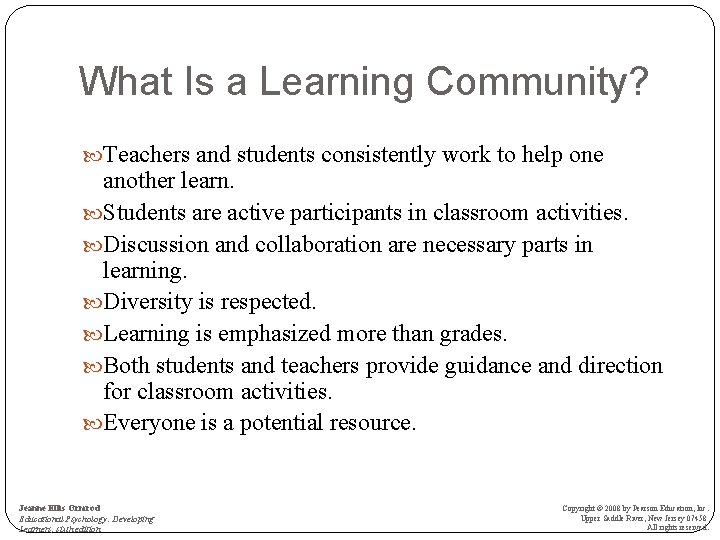
What Is a Learning Community? Teachers and students consistently work to help one another learn. Students are active participants in classroom activities. Discussion and collaboration are necessary parts in learning. Diversity is respected. Learning is emphasized more than grades. Both students and teachers provide guidance and direction for classroom activities. Everyone is a potential resource. Jeanne Ellis Ormrod Educational Psychology: Developing Learners, sixth edition Copyright © 2008 by Pearson Education, Inc. Upper Saddle River, New Jersey 07458 All rights reserved.
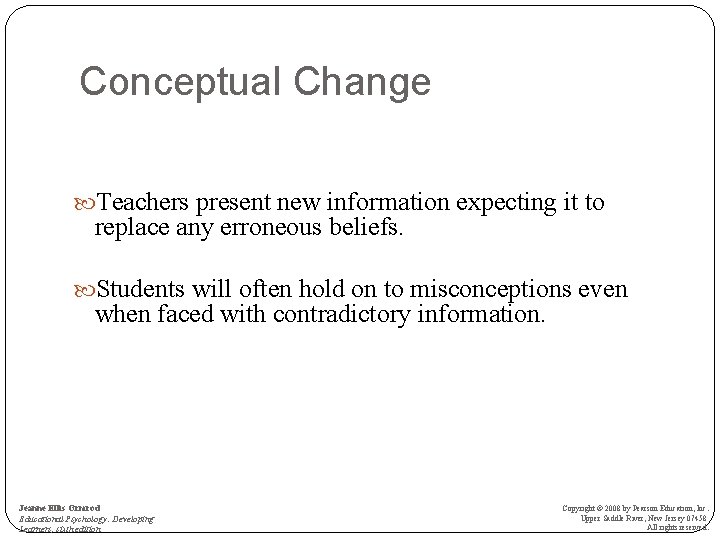
Conceptual Change Teachers present new information expecting it to replace any erroneous beliefs. Students will often hold on to misconceptions even when faced with contradictory information. Jeanne Ellis Ormrod Educational Psychology: Developing Learners, sixth edition Copyright © 2008 by Pearson Education, Inc. Upper Saddle River, New Jersey 07458 All rights reserved.
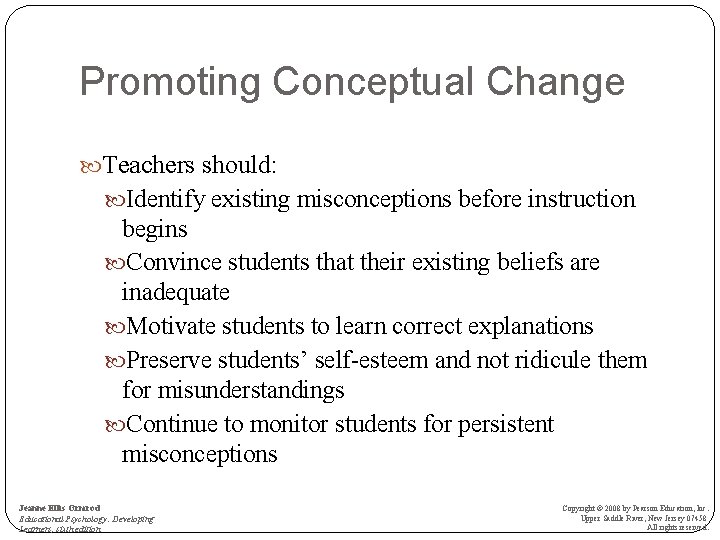
Promoting Conceptual Change Teachers should: Identify existing misconceptions before instruction begins Convince students that their existing beliefs are inadequate Motivate students to learn correct explanations Preserve students’ self-esteem and not ridicule them for misunderstandings Continue to monitor students for persistent misconceptions Jeanne Ellis Ormrod Educational Psychology: Developing Learners, sixth edition Copyright © 2008 by Pearson Education, Inc. Upper Saddle River, New Jersey 07458 All rights reserved.
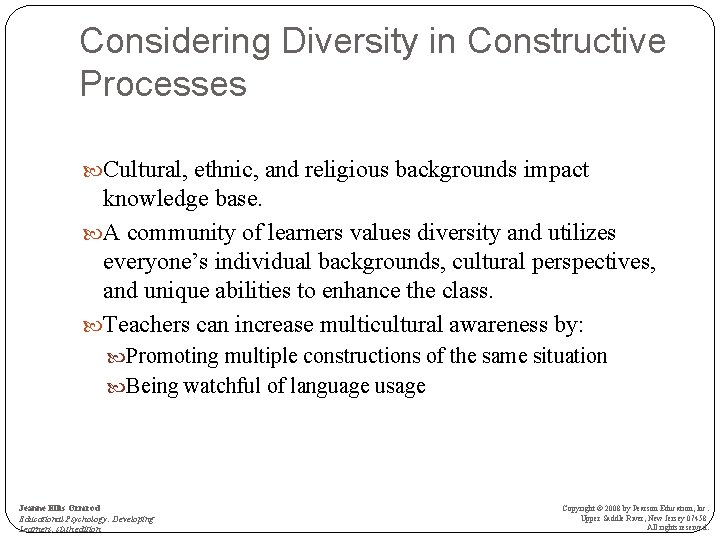
Considering Diversity in Constructive Processes Cultural, ethnic, and religious backgrounds impact knowledge base. A community of learners values diversity and utilizes everyone’s individual backgrounds, cultural perspectives, and unique abilities to enhance the class. Teachers can increase multicultural awareness by: Promoting multiple constructions of the same situation Being watchful of language usage Jeanne Ellis Ormrod Educational Psychology: Developing Learners, sixth edition Copyright © 2008 by Pearson Education, Inc. Upper Saddle River, New Jersey 07458 All rights reserved.