
KNOWLEDGE CLAIMS AND QUESTIONS The Approach to New
- Slides: 15
KNOWLEDGE CLAIMS AND QUESTIONS The Approach to New Knowledge
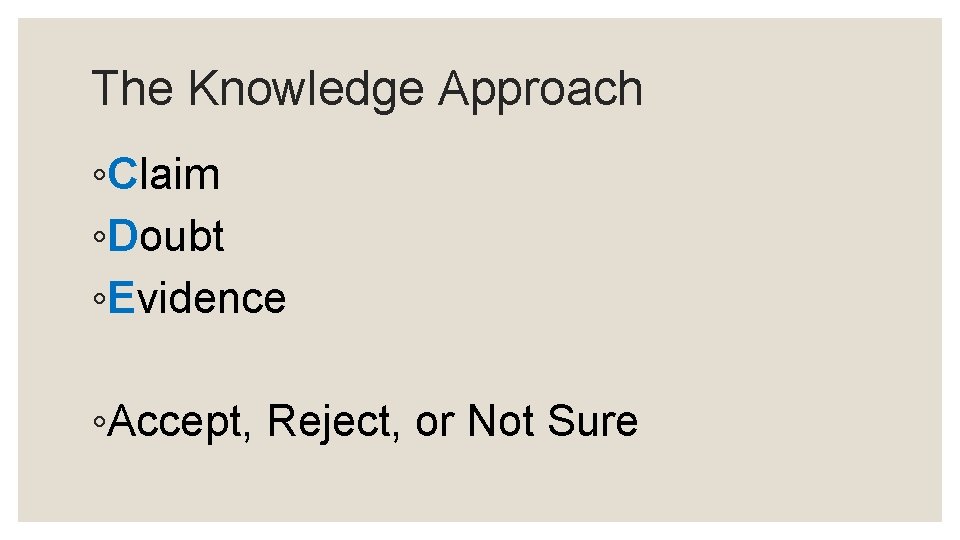
The Knowledge Approach ◦Claim ◦Doubt ◦Evidence ◦Accept, Reject, or Not Sure
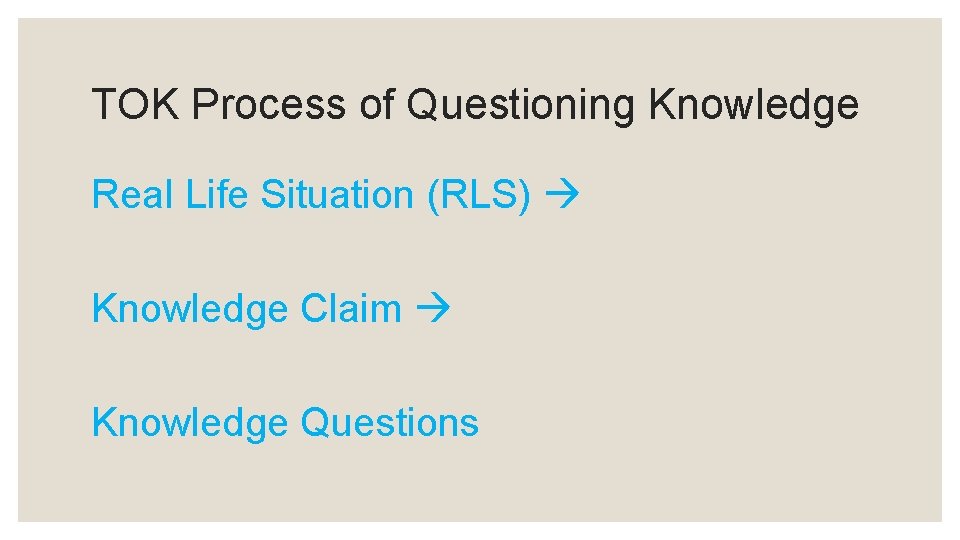
TOK Process of Questioning Knowledge Real Life Situation (RLS) Knowledge Claim Knowledge Questions
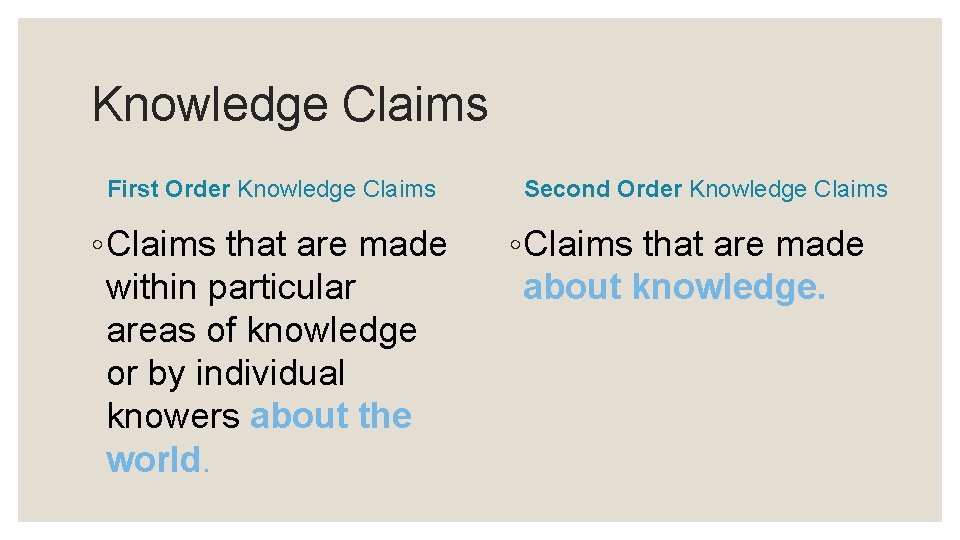
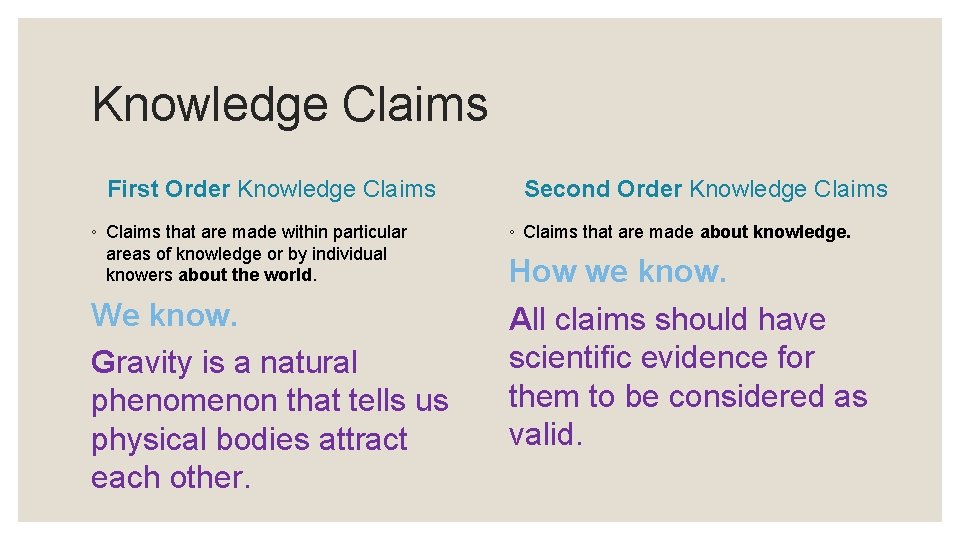
Knowledge Claims First Order Knowledge Claims ◦ Claims that are made within particular areas of knowledge or by individual knowers about the world. Second Order Knowledge Claims ◦ Claims that are made about knowledge.
Knowledge Claims First Order Knowledge Claims ◦ Claims that are made within particular areas of knowledge or by individual knowers about the world. We know. Gravity is a natural phenomenon that tells us physical bodies attract each other. Second Order Knowledge Claims ◦ Claims that are made about knowledge. How we know. All claims should have scientific evidence for them to be considered as valid.
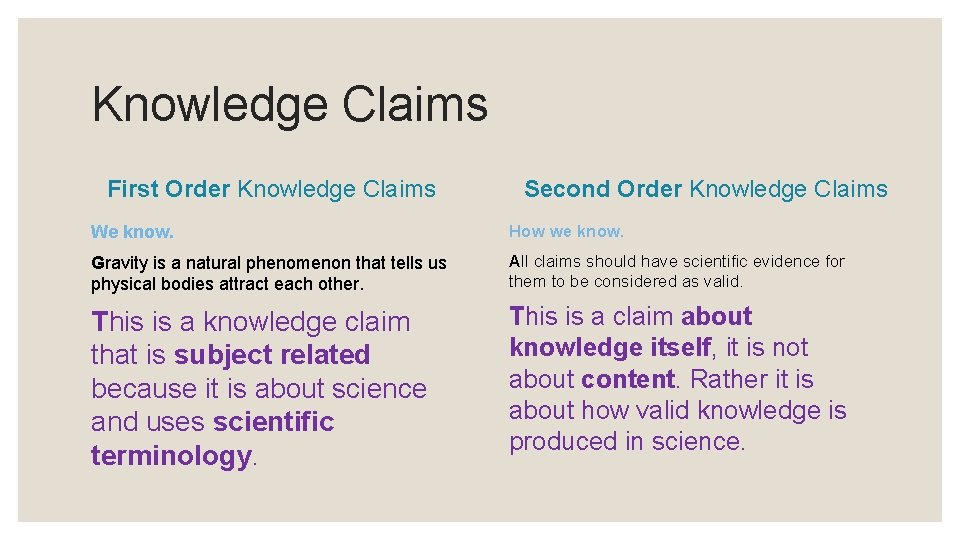
Knowledge Claims First Order Knowledge Claims Second Order Knowledge Claims We know. How we know. Gravity is a natural phenomenon that tells us physical bodies attract each other. All claims should have scientific evidence for them to be considered as valid. This is a knowledge claim that is subject related because it is about science and uses scientific terminology. This is a claim about knowledge itself, it is not about content. Rather it is about how valid knowledge is produced in science.
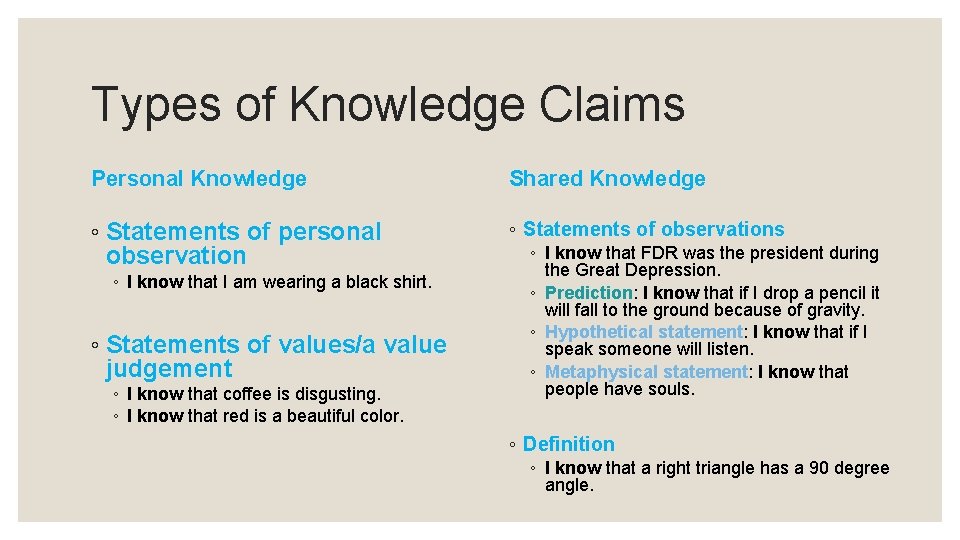
Types of Knowledge Claims Personal Knowledge Shared Knowledge ◦ Statements of personal observation ◦ Statements of observations ◦ I know that I am wearing a black shirt. ◦ Statements of values/a value judgement ◦ I know that coffee is disgusting. ◦ I know that red is a beautiful color. ◦ I know that FDR was the president during the Great Depression. ◦ Prediction: I know that if I drop a pencil it will fall to the ground because of gravity. ◦ Hypothetical statement: I know that if I speak someone will listen. ◦ Metaphysical statement: I know that people have souls. ◦ Definition ◦ I know that a right triangle has a 90 degree angle.
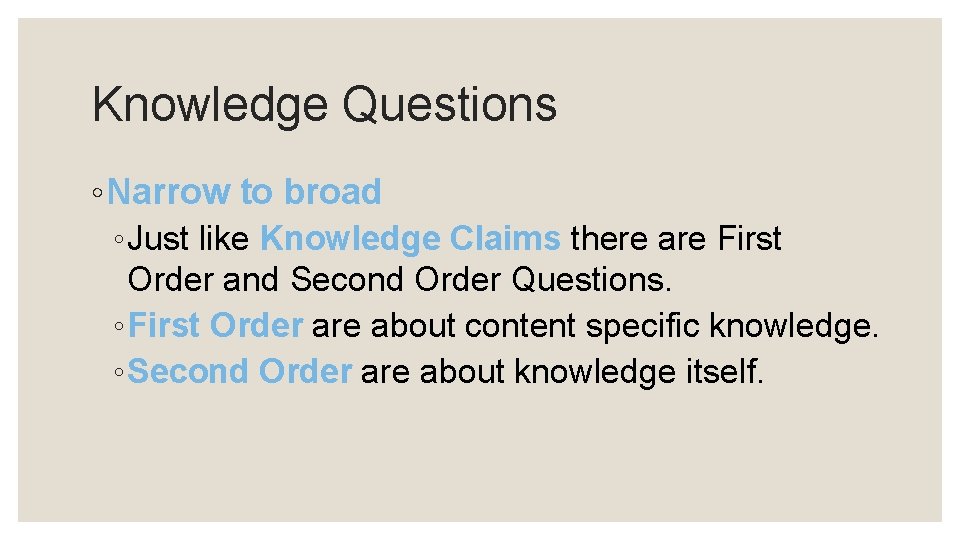
Knowledge Questions ◦ Narrow to broad ◦ Just like Knowledge Claims there are First Order and Second Order Questions. ◦ First Order are about content specific knowledge. ◦ Second Order are about knowledge itself.
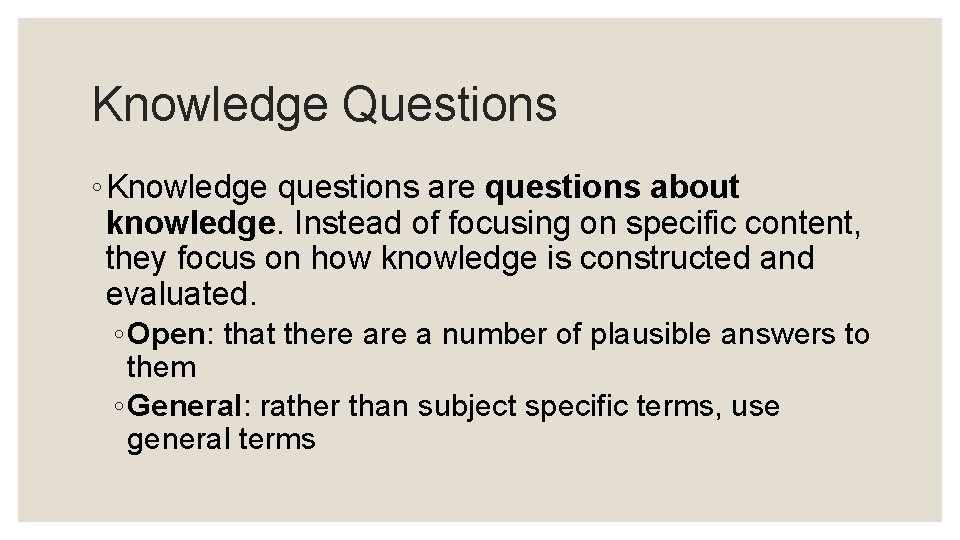
Knowledge Questions ◦ Knowledge questions are questions about knowledge. Instead of focusing on specific content, they focus on how knowledge is constructed and evaluated. ◦ Open: that there a number of plausible answers to them ◦ General: rather than subject specific terms, use general terms
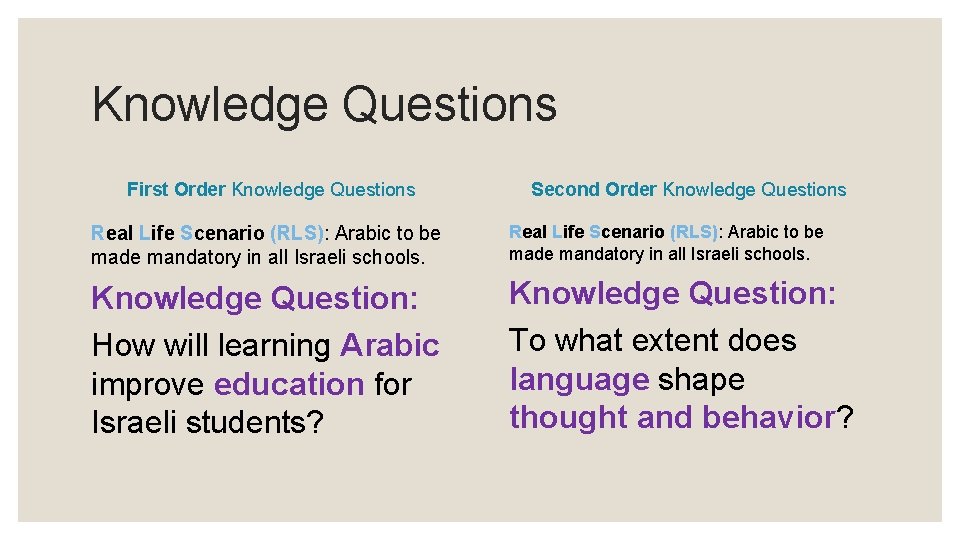
Knowledge Questions First Order Knowledge Questions Second Order Knowledge Questions Real Life Scenario (RLS): Arabic to be made mandatory in all Israeli schools. Knowledge Question: How will learning Arabic improve education for Israeli students? Knowledge Question: To what extent does language shape thought and behavior?
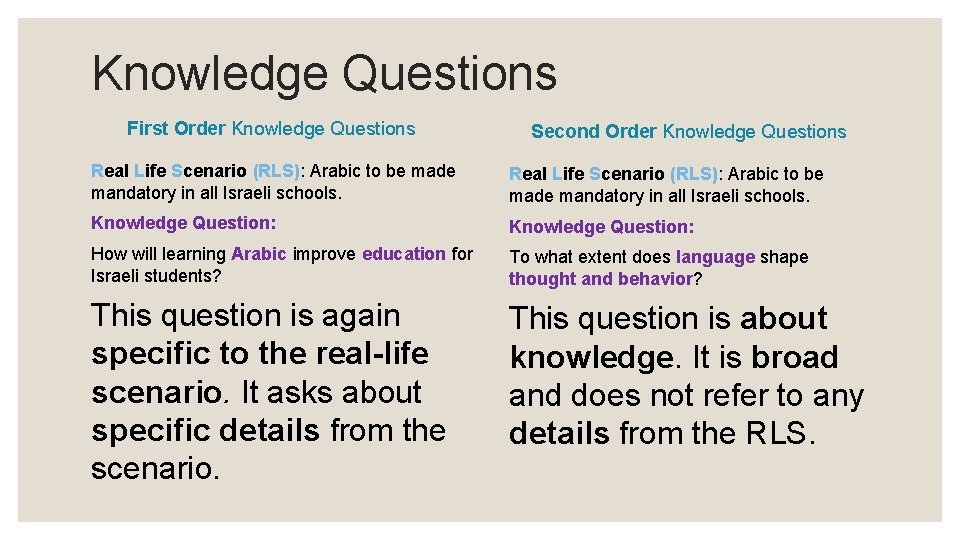
Knowledge Questions First Order Knowledge Questions Second Order Knowledge Questions Real Life Scenario (RLS): Arabic to be made mandatory in all Israeli schools. Knowledge Question: How will learning Arabic improve education for Israeli students? To what extent does language shape thought and behavior? This question is again specific to the real-life scenario. It asks about specific details from the scenario. This question is about knowledge. It is broad and does not refer to any details from the RLS.
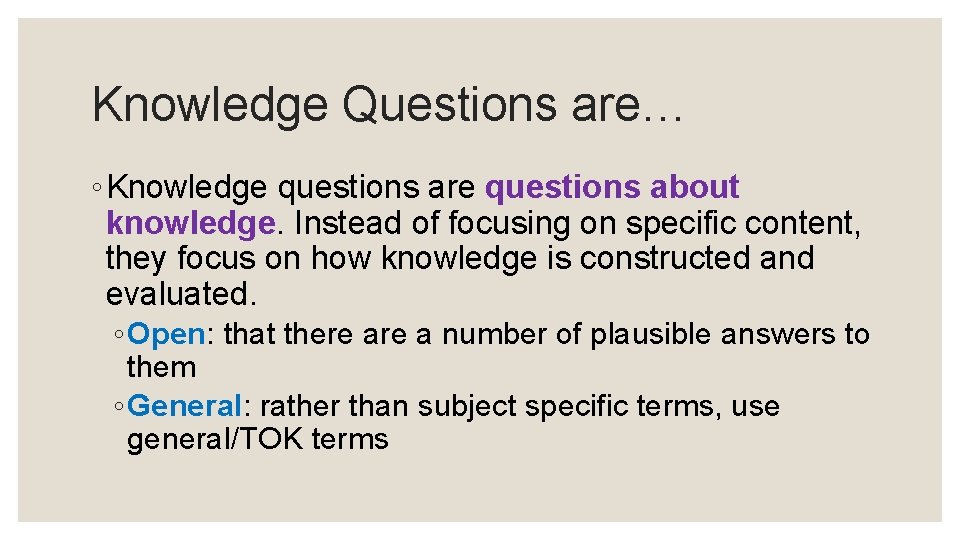
Knowledge Questions are… ◦ Knowledge questions are questions about knowledge. Instead of focusing on specific content, they focus on how knowledge is constructed and evaluated. ◦ Open: that there a number of plausible answers to them ◦ General: rather than subject specific terms, use general/TOK terms
Knowledge Questions: Model ◦ Freedom or Knowledge? ◦ Real life situation: The Wikileaks disclosures about Western governments’ foreign policy ◦ Knowledge question:
Knowledge Questions: Model ◦ Freedom or Knowledge? ◦ Real life situation: The Wikileaks disclosures about Western governments’ foreign policy ◦ First Order Knowledge question: Why should Wikileaks decide how much information should be shared with the public?
Knowledge Questions: Model ◦ Freedom or Knowledge? ◦ Real life situation: The Wikileaks disclosures about Western governments’ foreign policy ◦ Second Order Knowledge question: Who should decide about the amount of knowledge accessible to the general population?