
KNOWLEDGE BUILDING A FOUNDATION FOR LEADING CHANGE Michael
KNOWLEDGE BUILDING: A FOUNDATION FOR LEADING CHANGE Michael Fullan, 2001 Leading in a Culture of Change Donna M. Simon, Ed. D.

Information vs. Knowledge 2 Information is data Knowledge is people digesting data Information becomes knowledge through its socialization People …”ulitmately decide what it [information] all means and- Fullan, why 2001, it p. 78 matters. ” Knowledge Building - Fullan, 2001

3 Organizational Knowledge Creation Knowledge-Building must be a core value Offsite professional training and onsite consultants are not enough Ideas must be retained, shared, and discussed throughout the organization Organizational knowledge should permeate people, products, and processes Constantly convert tacit knowledge to explicit knowledge Knowledge Building - Fullan, 2001

4 Organizational Learning Environment Mutual trust Two-way Sharing Listening Non-judgmental when asking for help Ability to set up self-selected collaborative learning communities Courage Knowledge Building - Fullan, 2001
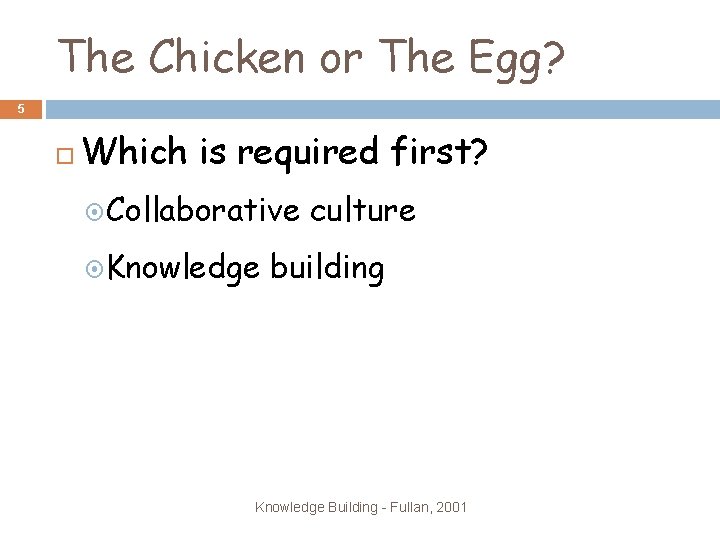
The Chicken or The Egg? 5 Which is required first? Collaborative Knowledge culture building Knowledge Building - Fullan, 2001

Ford Motors – Best Practice Replication 6 Company requires 5% production increase/yr. Sister plants share 5 -8 best practices/week 40% of the 5% increase now comes from shared best practices – 100% in some plants Meets a critical business need Ongoing exchange of successes has become a company culture, a learning culture Knowledge Building - Fullan, 2001
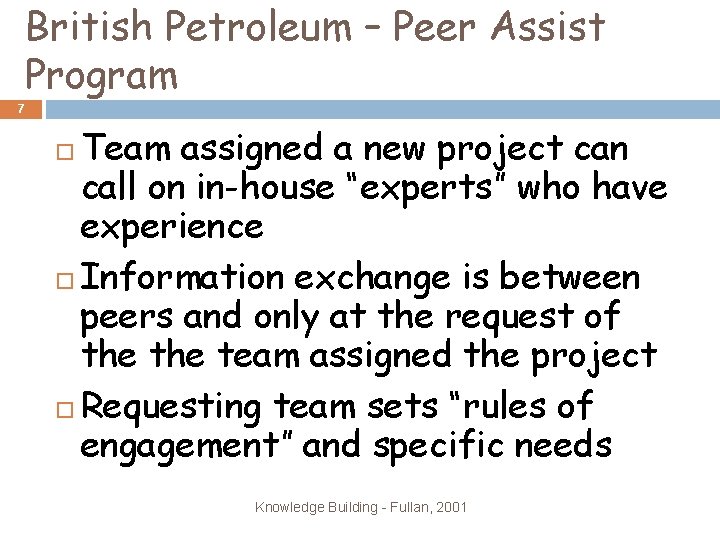
British Petroleum – Peer Assist Program 7 Team assigned a new project can call on in-house “experts” who have experience Information exchange is between peers and only at the request of the team assigned the project Requesting team sets “rules of engagement” and specific needs Knowledge Building - Fullan, 2001
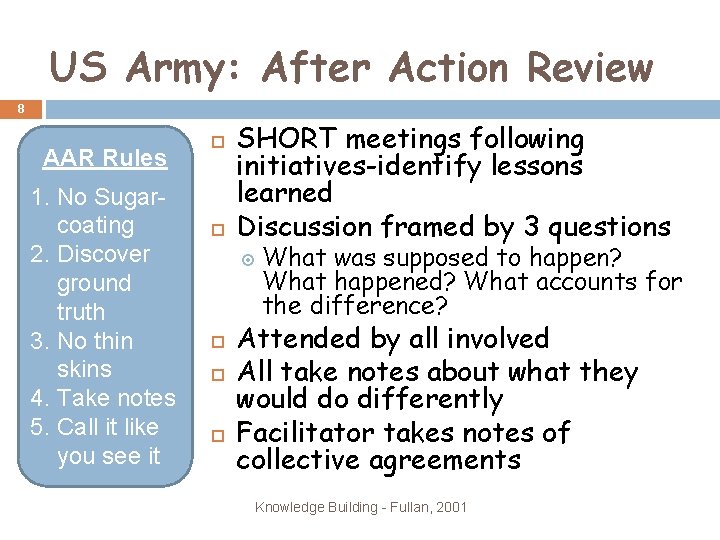
US Army: After Action Review 8 AAR Rules 1. No Sugarcoating 2. Discover ground truth 3. No thin skins 4. Take notes 5. Call it like you see it SHORT meetings following initiatives-identify lessons learned Discussion framed by 3 questions What was supposed to happen? What happened? What accounts for the difference? Attended by all involved All take notes about what they would do differently Facilitator takes notes of collective agreements Knowledge Building - Fullan, 2001

Internal Learning Communities 1. Focus on learning 2. Collaborative culture—learning is for all 3. Collective inquiry into best practice and current reality 4. Action orientation: learning by doing 5. A commitment to continuous learning Dufour, et al. , 6. Results orientation 2006 CONCERNS Superficiality Is this the latest innovation? Bias toward autonomy

10 Why Knowledge Communities Work Focus on users’ needs Brief, to the point, move on Allows sharing of tacit knowledge Learning/sharing in context Knowledge Building - Fullan, 2001
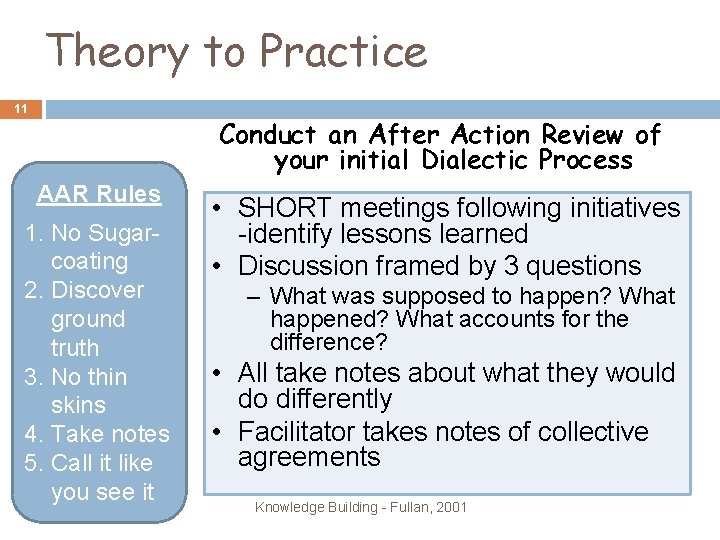
Theory to Practice 11 Conduct an After Action Review of your initial Dialectic Process AAR Rules 1. No Sugarcoating 2. Discover ground truth 3. No thin skins 4. Take notes 5. Call it like you see it • SHORT meetings following initiatives -identify lessons learned • Discussion framed by 3 questions – What was supposed to happen? What happened? What accounts for the difference? • All take notes about what they would do differently • Facilitator takes notes of collective agreements Knowledge Building - Fullan, 2001
- Slides: 11