
Knowledge Brokers A Promising Knowledge Mobilization Strategy AMANDA
Knowledge Brokers: A Promising Knowledge Mobilization Strategy AMANDA COOPER CSSE, OTTAWA, TUESDAY MAY 26, 2009
KM Guiding Principles What is the Purpose & Scope of KM? KM involves harnessing research in policy and practice for organizational improvement What knowledge does KM mobilize? evidence from systematic and formal processes of inquiry and from widely recognized bodies of empirical evidence What is the nature of KM Processes? complex, iterative, non-linear, social processes Who is involved in KM? collaboration among two or more dissimilar groups (researchers, policymakers, practitioners, knowledge brokers)
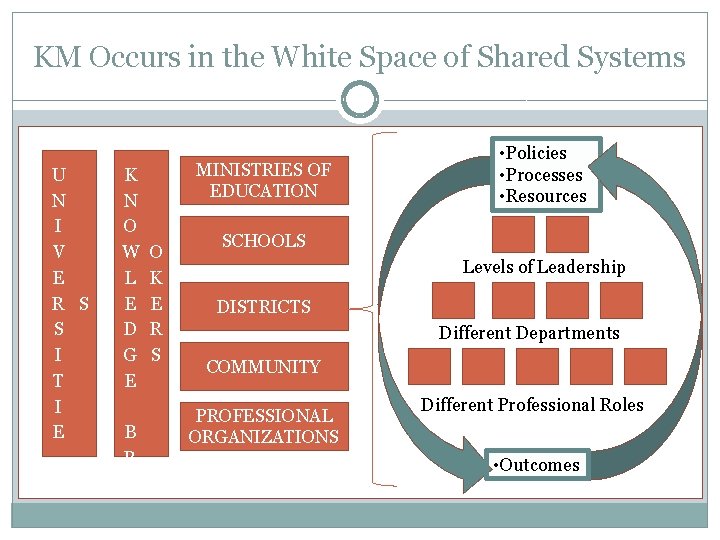
KM Occurs in the White Space of Shared Systems U N I V E R S S I T I E K N O W L E D G E B R MINISTRIES OF EDUCATION O K E R S • Policies • Processes • Resources SCHOOLS Levels of Leadership DISTRICTS Different Departments COMMUNITY PROFESSIONAL ORGANIZATIONS Different Professional Roles • Outcomes
Knowledge Brokers Significance Third parties increasingly involved in education, but rarely studied Who are they? What do they do? How do they do it? To what effect? Honig’s (2004) intermediaries as the “new middle management” Sin’s (2008) definition: “individuals or organizations that bridge the evidence and policy/practice divides” (p. 86)
Knowledge Brokers Have Different Functions Types of brokers (Sin, 2008): Cross-pollinators (across sectors, analogous lessons) Matchmakers (connect research producers and users) Translators and processors (interpret and adapt) Multiple dissemination routes (diverse formats) Articulators of user perspectives (convey needs of users to researchers)
CEA Study: Importance of Facilitation Recognition of a need for facilitation to increase KM “We are looking at ways of supporting teachers to access and utilize research…. hence…. the need for a facilitator, and I think for many of us, that’s still where we are at, is that [increasing research use] still requires that. For the most part, the majority of teachers will not seek [research] out on their own, unless there is someone there that prompts them to do so or facilitates it” (Principal) Skilled facilitator makes a greater impact of research “It is important to have a facilitator who will bring facilitation skills to keep people in the discussion” (Elementary Division Leader) Interesting Example: District with Knowledge Broker
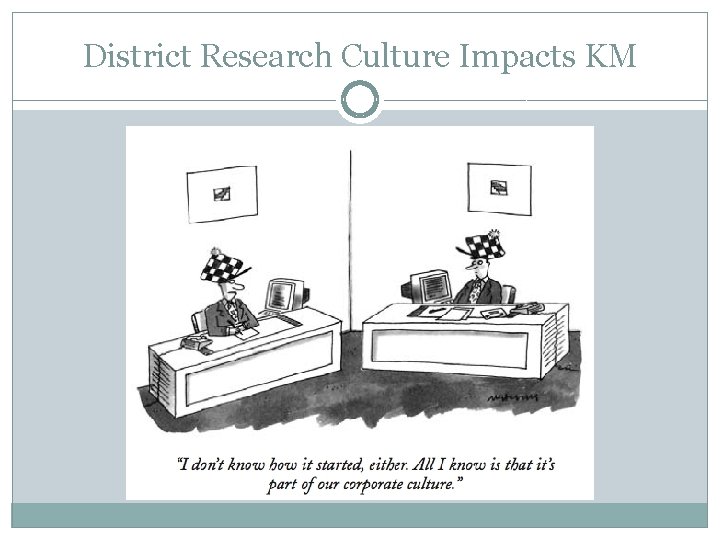
District Research Culture Impacts KM
Exemplary Practices in School Districts Adapt research to increase relevance to practitioners “Executive summaries work really well…it allows people a way in, and…when we unroll it more with teachers in classrooms , we’ll be looking for relevant snippets, more pieces, then giving people the website where they can continue to read and research” (Secondary School Principal) Guiding Questions as a “reflective lens” (Secondary School Principal) Embed research use in regular organization processes “We do have a central…. portal where we upload relevant research to make it available to people in the division” (Superintendent) “There are different venues…. places for people to engage in conversation and present those conversations to be facilitated in a structured way, and to provide avenues for research to be introduced” (Secondary School Principal) “You’ll always have the people who are keen…. and read it regardless of…. the meeting but, on the flip side, you’ll also have the people who wouldn’t read it unless there was a structure put in place that made that happen” (Secondary School Principal) Assign KM work to specific people (They have designated research departments, roles, and internal capacity)
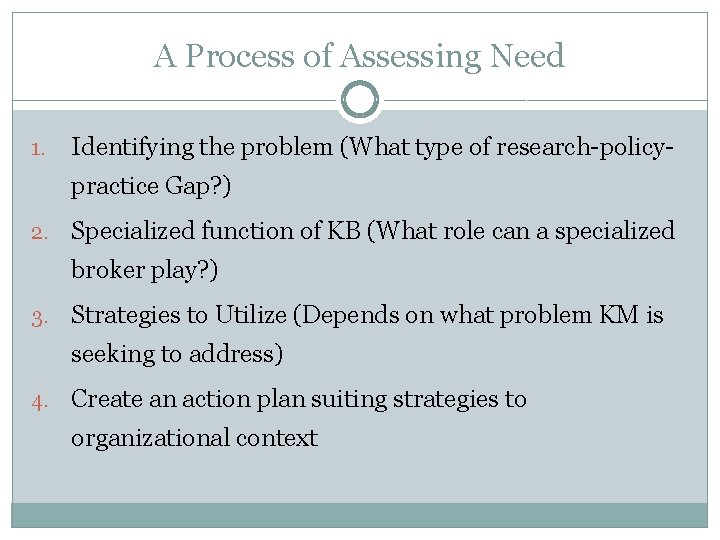
A Process of Assessing Need 1. Identifying the problem (What type of research-policypractice Gap? ) 2. Specialized function of KB (What role can a specialized broker play? ) 3. Strategies to Utilize (Depends on what problem KM is seeking to address) 4. Create an action plan suiting strategies to organizational context
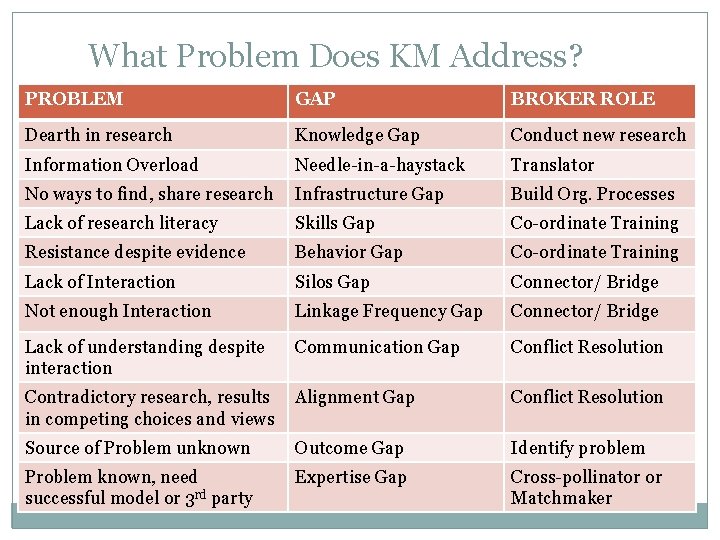
What Problem Does KM Address? PROBLEM GAP BROKER ROLE Dearth in research Knowledge Gap Conduct new research Information Overload Needle-in-a-haystack Translator No ways to find, share research Infrastructure Gap Build Org. Processes Lack of research literacy Skills Gap Co-ordinate Training Resistance despite evidence Behavior Gap Co-ordinate Training Lack of Interaction Silos Gap Connector/ Bridge Not enough Interaction Linkage Frequency Gap Connector/ Bridge Lack of understanding despite interaction Communication Gap Conflict Resolution Contradictory research, results in competing choices and views Alignment Gap Conflict Resolution Source of Problem unknown Outcome Gap Identify problem Problem known, need successful model or 3 rd party Expertise Gap Cross-pollinator or Matchmaker
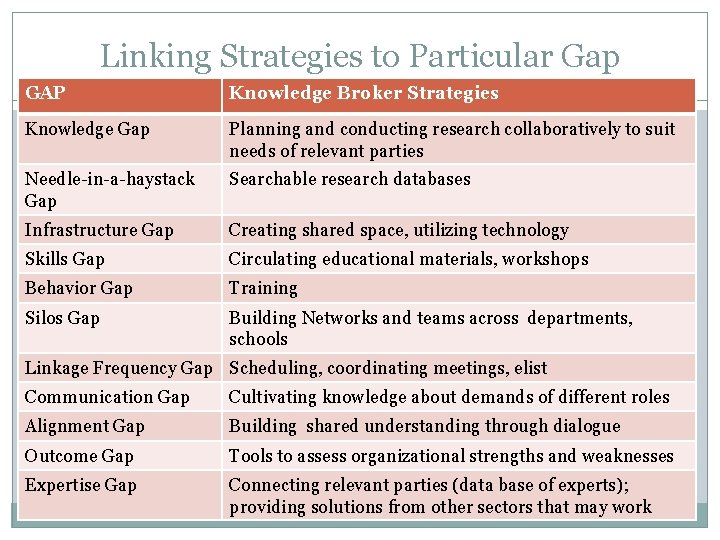
Linking Strategies to Particular Gap GAP Knowledge Broker Strategies Knowledge Gap Planning and conducting research collaboratively to suit needs of relevant parties Needle-in-a-haystack Gap Searchable research databases Infrastructure Gap Creating shared space, utilizing technology Skills Gap Circulating educational materials, workshops Behavior Gap Training Silos Gap Building Networks and teams across departments, schools Linkage Frequency Gap Scheduling, coordinating meetings, elist Communication Gap Cultivating knowledge about demands of different roles Alignment Gap Building shared understanding through dialogue Outcome Gap Tools to assess organizational strengths and weaknesses Expertise Gap Connecting relevant parties (data base of experts); providing solutions from other sectors that may work

Future Steps to Effectively Use Brokers Create Catalogue of Knowledge Brokers (Who exists? What do they do? And how can districts contact them? ) Create referral & support systems for Knowledge Brokers Create metrics for Knowledge Brokers Create tools for Knowledge Brokers to package information Create tools to monitor and evaluate the impact of Knowledge Brokers
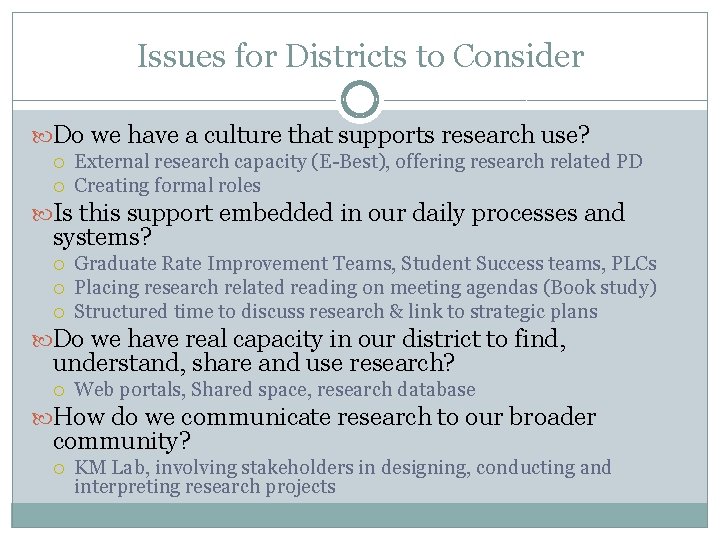
Issues for Districts to Consider Do we have a culture that supports research use? External research capacity (E-Best), offering research related PD Creating formal roles Is this support embedded in our daily processes and systems? Graduate Rate Improvement Teams, Student Success teams, PLCs Placing research related reading on meeting agendas (Book study) Structured time to discuss research & link to strategic plans Do we have real capacity in our district to find, understand, share and use research? Web portals, Shared space, research database How do we communicate research to our broader community? KM Lab, involving stakeholders in designing, conducting and interpreting research projects

Thank-You! ACOOPER@OISE. UTORONTO. CA
- Slides: 14