
Knowledge Brokers A Promising Knowledge Mobilization Strategy AMANDA
Knowledge Brokers: A Promising Knowledge Mobilization Strategy AMANDA COOPER AERA, DENVER, 2010
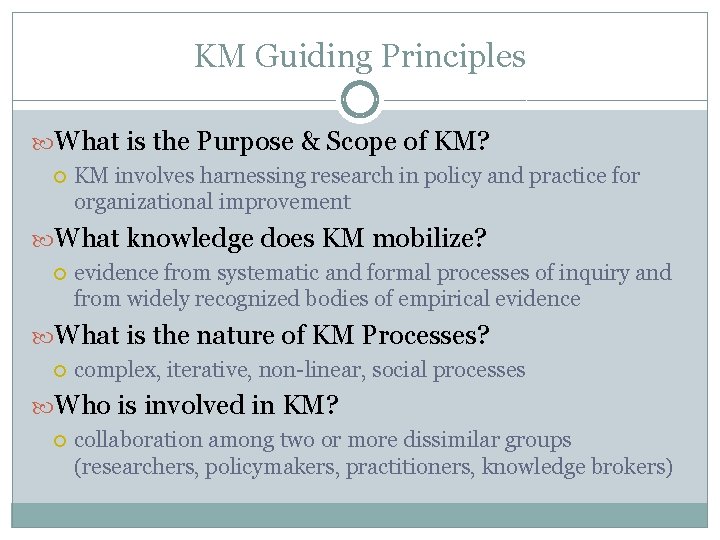
KM Guiding Principles What is the Purpose & Scope of KM? KM involves harnessing research in policy and practice for organizational improvement What knowledge does KM mobilize? evidence from systematic and formal processes of inquiry and from widely recognized bodies of empirical evidence What is the nature of KM Processes? complex, iterative, non-linear, social processes Who is involved in KM? collaboration among two or more dissimilar groups (researchers, policymakers, practitioners, knowledge brokers)
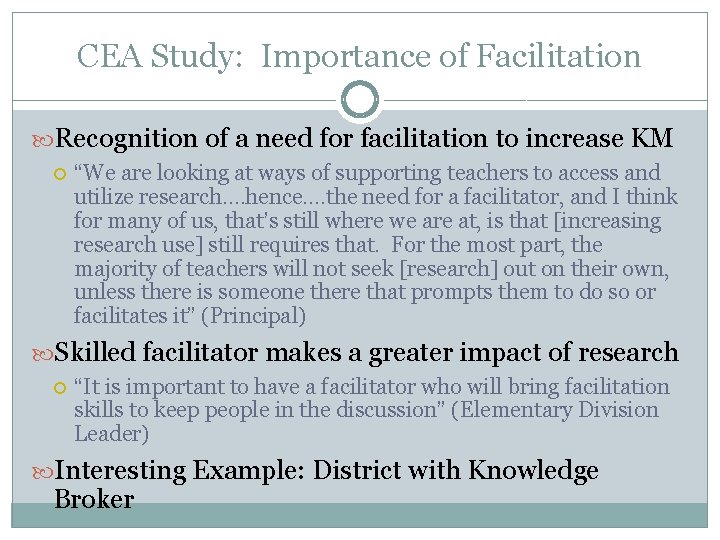
CEA Study: Importance of Facilitation Recognition of a need for facilitation to increase KM “We are looking at ways of supporting teachers to access and utilize research…. hence…. the need for a facilitator, and I think for many of us, that’s still where we are at, is that [increasing research use] still requires that. For the most part, the majority of teachers will not seek [research] out on their own, unless there is someone there that prompts them to do so or facilitates it” (Principal) Skilled facilitator makes a greater impact of research “It is important to have a facilitator who will bring facilitation skills to keep people in the discussion” (Elementary Division Leader) Interesting Example: District with Knowledge Broker
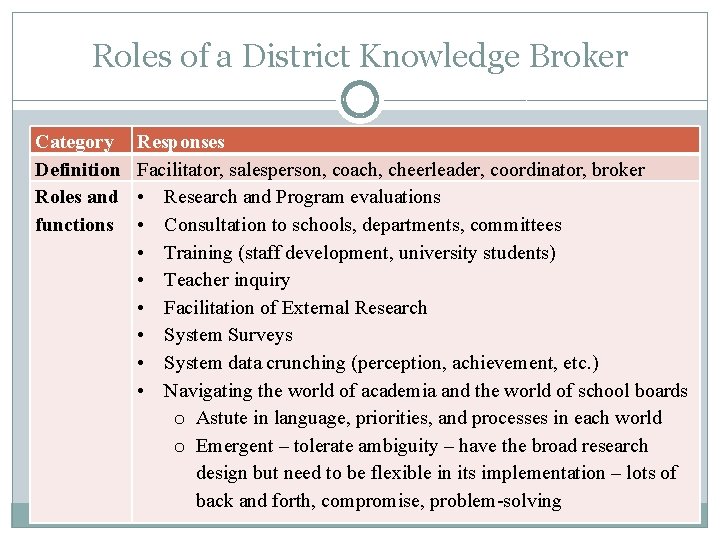
Roles of a District Knowledge Broker Category Definition Roles and functions Responses Facilitator, salesperson, coach, cheerleader, coordinator, broker • Research and Program evaluations • Consultation to schools, departments, committees • Training (staff development, university students) • Teacher inquiry • Facilitation of External Research • System Surveys • System data crunching (perception, achievement, etc. ) • Navigating the world of academia and the world of school boards o Astute in language, priorities, and processes in each world o Emergent – tolerate ambiguity – have the broad research design but need to be flexible in its implementation – lots of back and forth, compromise, problem-solving

Skills of Knowledge Brokers & Leverage Points Category Responses Necessary skills Leverage points • Understanding of research methodology (critical appraisal skills, research synthesis techniques, design, ethics, etc. ) • Knowledge of the literature in education • Track record within academia, track record within districts • Interpersonal skills – intuitive, flexible, organized, articulate • Ability to translate complex information into the bottom-line that is relevant for the knowledge user (and take practice-based evidence to researchers in a credible manner) • Alignment of research with current priority initiatives • Tap into existing PD – infuse (or at least pepper) with research • Senior administration interest and support of research • Grassroots interest and support of research • Federation interest and support of research – this is huge.

Knowledge Brokers Operate in the White Space of the Broader Education System F U N D I I N E G S A G E N C U N I V E R S I T I E S K N O W L E D G E B R O MINISTRIES OF EDUCATION • Policies • Processes • Resources SCHOOLS K E R S DISTRICTS COMMUNITY Levels of Leadership Different Departments PROFESSIONAL ORGANIZATIONS Different Professional Roles MEDIA • Outcomes
Knowledge Brokers Significance Third parties increasingly involved in education, but rarely studied Who are they? What do they do? How do they do it? To what effect? Honig’s (2004) intermediaries as the “new middle management” Sin’s (2008) definition: “individuals or organizations that bridge the evidence and policy/practice divides” (p. 86)
Knowledge Brokers Have Different Functions Types of brokers (Sin, 2008): Cross-pollinators (across sectors, analogous lessons) Matchmakers (connect research producers and users) Translators and processors (interpret and adapt) Multiple dissemination routes (diverse formats) Articulators of user perspectives (convey needs of users to researchers)
Research Questions What is the nature and impact of the work of intermediaries in knowledge mobilization in education? What types of intermediaries exist in education in Canada? How do intermediaries’ organizational features influence their ability to facilitate KM in the education sector (KM capacity)? What is the nature of intermediaries’ involvement in knowledge mobilization processes in education? What kinds of impacts do intermediaries have on the way research is incorporated into policy and practice in education?
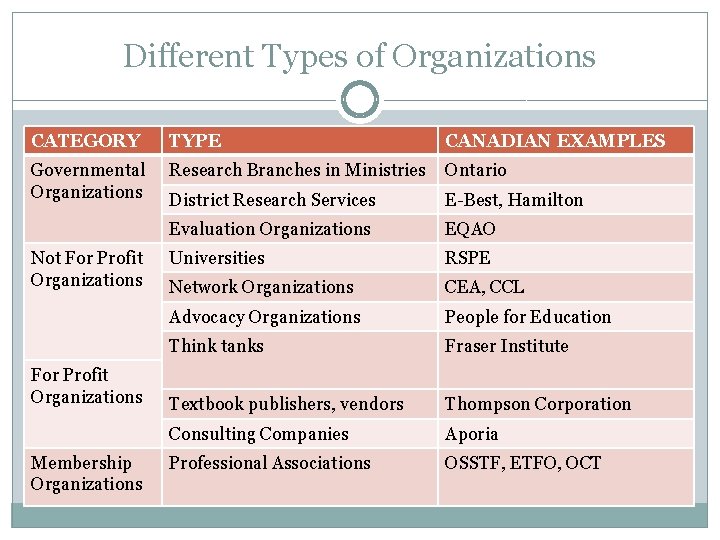
Different Types of Organizations CATEGORY TYPE CANADIAN EXAMPLES Governmental Organizations Research Branches in Ministries Ontario District Research Services E-Best, Hamilton Evaluation Organizations EQAO Universities RSPE Network Organizations CEA, CCL Advocacy Organizations People for Education Think tanks Fraser Institute Textbook publishers, vendors Thompson Corporation Consulting Companies Aporia Professional Associations OSSTF, ETFO, OCT Not For Profit Organizations Membership Organizations
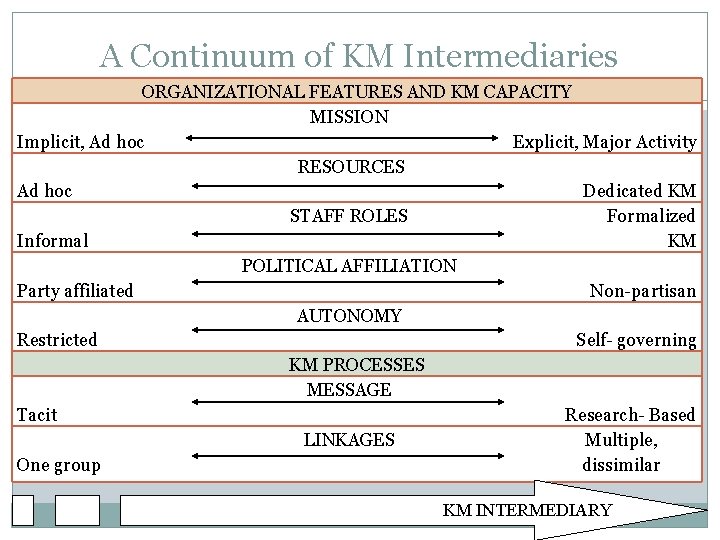
A Continuum of KM Intermediaries ORGANIZATIONAL FEATURES AND KM CAPACITY MISSION Implicit, Ad hoc Explicit, Major Activity RESOURCES Ad hoc Dedicated KM STAFF ROLES Formalized Informal KM POLITICAL AFFILIATION Party affiliated Non-partisan AUTONOMY Restricted Self- governing KM PROCESSES MESSAGE Tacit Research- Based LINKAGES Multiple, One group dissimilar KM INTERMEDIARY
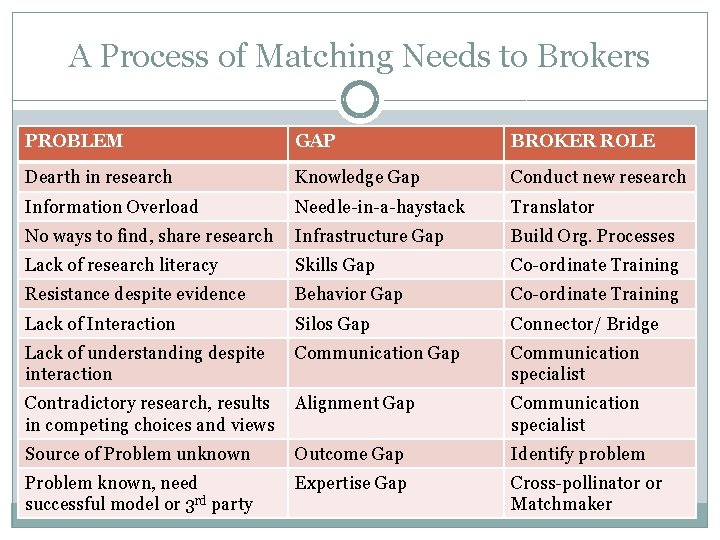
A Process of Matching Needs to Brokers PROBLEM GAP BROKER ROLE Dearth in research Knowledge Gap Conduct new research Information Overload Needle-in-a-haystack Translator No ways to find, share research Infrastructure Gap Build Org. Processes Lack of research literacy Skills Gap Co-ordinate Training Resistance despite evidence Behavior Gap Co-ordinate Training Lack of Interaction Silos Gap Connector/ Bridge Lack of understanding despite interaction Communication Gap Communication specialist Contradictory research, results in competing choices and views Alignment Gap Communication specialist Source of Problem unknown Outcome Gap Identify problem Problem known, need successful model or 3 rd party Expertise Gap Cross-pollinator or Matchmaker
References Boulton, M. (2007). White space. Graphic Design, 230. Retrieved March 21, 2009 from http: //www. alistapart. com/articles/whitespace Honig, M. (2004). The new middle management: Intermediary organizations in education policy implementation. Educational Evaluation and Policy Analysis, 26(1), 65 -87. Nutley, S. , Walter, I. , & Davies, H. (2007). Using evidence: How research can inform public services. Bristol: Policy Press. Rummler, G. A. , & Brache, A. P. (1995). Improving Performance: How to Manage the White Space in the Organization Chart. Jossey Bass Business and Management Series. Jossey-Bass. Sin, C. H. (2008). The role of intermediaries in getting evidence into policy and practice: some useful lessons from examining consultancy- client relationships. Evidence & Policy, 4 (1), 85103.
Thank-You! AMANDA. COOPER@UTORONTO. CA RESEARCH SUPPORTING PRACTICE IN EDUCATION PROGRAM (RSPE) WWW. OISE. UTORONTO. CA/RSPE
- Slides: 14