
Knowledge as a Duty A New Philosophical Responsibility
Knowledge as a Duty A New Philosophical Responsibility Department of Humanities, Philosophy Section and Computational Philosophy Laboratory University of Pavia, Italy
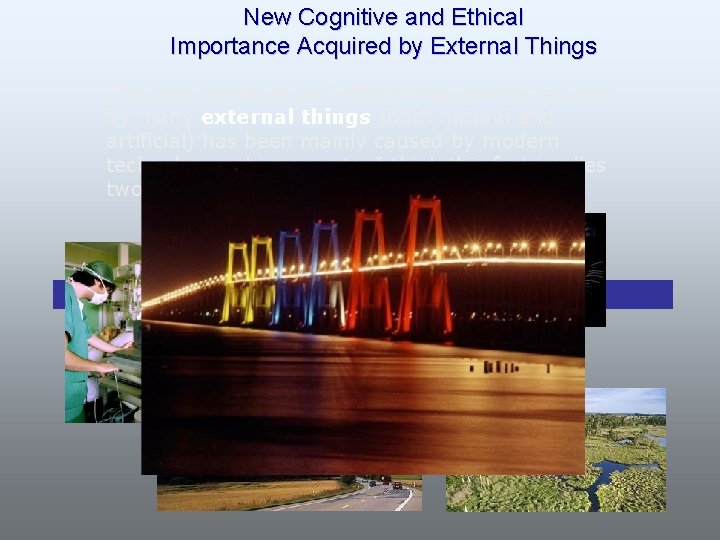
New Cognitive and Ethical Importance Acquired by External Things The new cognitive and ethical importance acquired by many external things (both natural and artificial) has been mainly caused by modern technology achievements. I think this fact implies two philosophical consequences.
TWO PHILOSOPHICAL CONSEQUENCES 1. We need to appropriately re-project onto people moral values we have already attributed to external things (I say we have to “respect people as things” ) 2. A new role of knowledge (scientific and ethical) is being delineating. I suggest that in our technological world, aiming both at “respecting people as things” and “treating people as ends” involves a massive and skillful exploitation of knowledge.
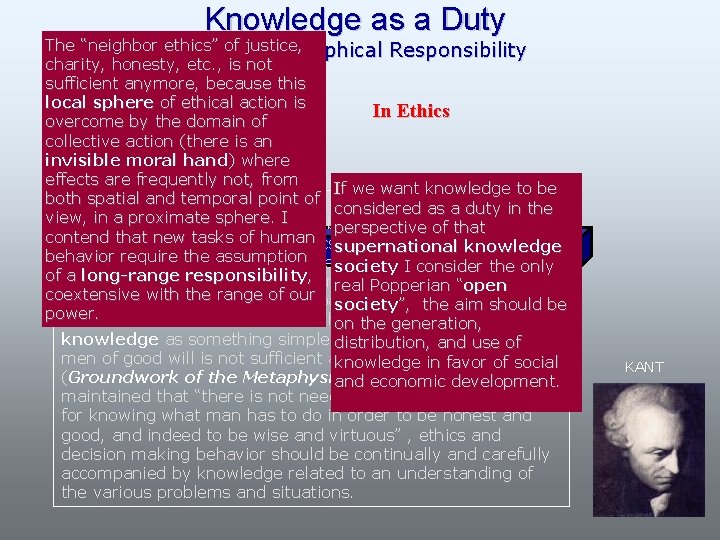
Knowledge as a Duty The “neighbor ethics” of justice, A New Philosophical Responsibility charity, honesty, etc. , is not sufficient anymore, because this local sphere of ethical action is In Ethics overcome by the domain of collective action (there is an invisible moral hand) where effects are frequently not, from If we want knowledge to be both spatial and temporal point of Modern technology has brought about consequences of in such considered as a duty the view, in a proximate sphere. I magnitude on external things (both natural and artificial) perspective of that contend that new tasks of human that the framework of older ethicssupernational and policies canknowledge no longer behavior require the assumption contain them. For example, modern technology has made society I consider the only ofnature a long-range responsibility , an object of human responsibility with the“open real Popperian coextensive with thewe range ofapproach our consequence that must her not onlyaim with society ”, the should be power. cleverness but also with ethics. The of moral onidea the generation, knowledge as something simple distribution, and readily available to all and use of men of good will is not sufficient anymore. Contrary knowledge in favorto of. Kant social (Groundwork of the Metaphysics Morals , 1785), who andofeconomic development. maintained that “there is not need of science or philosophy for knowing what man has to do in order to be honest and good, and indeed to be wise and virtuous” , ethics and decision making behavior should be continually and carefully accompanied by knowledge related to an understanding of the various problems and situations. KANT

Knowledge as a Duty From this perspective human beings Responsibility A New Philosophical are “natural things” whose behavior is a priori difficult to be tracked and predicted. For instance, how can we In Science track human intentions? Indeed when we “morally” aim at the ownership of our own destinies think it isto through the to everyday, we Iexpect be able reach philosophical, and – especially scientific knowledge about phenomena of the natural and artificial objectives chosen through world (and through the related technologies), that human beings have consciousness, free will, and been able to give themselves that wide range of possibilities for choosing and acting they currently have. intentionality. Unfortunately we can. Mankind has developed consciousness and everyday and scientific knowledge about obtain results only if we can “count” phenomena of the natural and artificial world in such a way that on “better some brains” regularity of the behavior (and thus better degrees of consciousness) have in turn made possibleagents. better levels of knowledge. So consciousness, with of other human the help of its stronger endowments of intentionality and free will, have nourished, enhanced, produced, and also “externalized” knowledge. Everyday and scientific knowledge – through “tracking the natural and artificial world” – have provided the “elbow room” (Dennett) necessary to build a deliberative agent. But one of the main obstacles to “fruitfully” exercise free will is the behavior of other human beings. LAPLACE
Dissemination and Distribution of Knolwedge Interdisciplinary Issues If knowledge has to be considered a duty the problem its dissemination and • of creative, model-based and manipulative distribution is central. I am at rational introducingethical some argumentations) transdisciplinary issues related to this problem, that only a philosophical reflection that adopts a new responsibility can clarify. thinking (problem of They are able to reshape ethical worth of human beings and collectives. • external cognitive structures and moral mediators • interplay between unexpressed and superexpressed knowledge, knowledge management, knowledge communities

The Moral Significance of the Interest in Knowledge The lack of appropriate and situated knowledge content is a negative bias in concrete I contend that, if a lot of moral deliberations and an knowledge is incorporated in obstacle in undertaking • flourishing life a(bad faith) external artificial things (and responsible behavior. In this we need knowledge to deal light also aim at emphasizing • Ienhancing freedom, autonomy, free choice with external things - both the role of the so-called new natural and artificial), human • enhancing humanand beings as cognitive carriers (cognitive beings are so intertwined “knowledge communities” with those external things the privileged status of humans capacities) that their "visibility" can be beings as “knowledge carriers”. excessive and dangerous. • does all knowledge have intrinsic value? • ownership of our destinies • knowledge and information retention (cyberprivacy, free choice, ownership of our destinies)
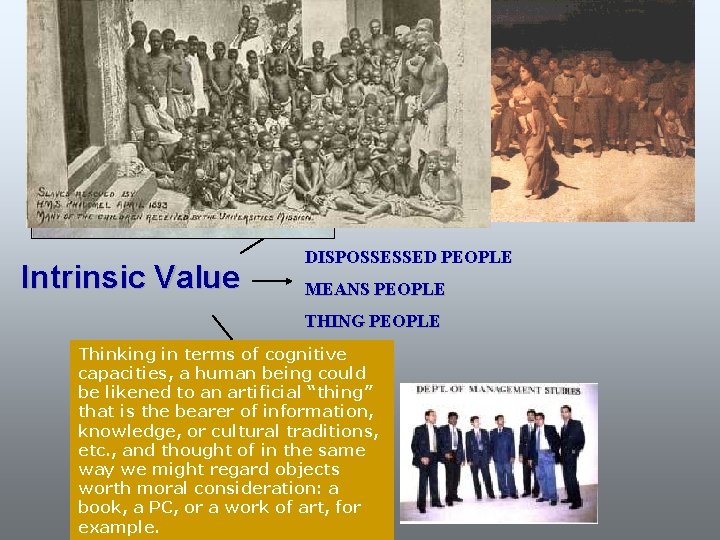
MORAL AGENTS Intrinsic Value DISPOSSESSED PEOPLE MEANS PEOPLE THING PEOPLE Thinking in terms of cognitive capacities, a human being could be likened to an artificial “thing” that is the bearer of information, knowledge, or cultural traditions, PATIENTS etc. , MORAL and thought of in the same way we might regard objects worth moral consideration: a book, a PC, or a work of art, for example.
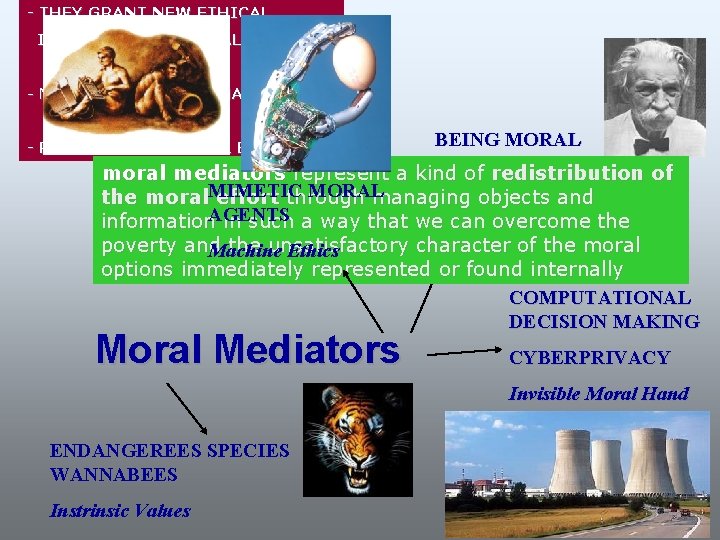
- THEY GRANT NEW ETHICAL INFORMATION AND VALUES - MORALLY AFFECT HUMAN AGENTS BEING MORAL THROUGH DOING moral mediators represent a kind of redistribution of MORAL the moral. MIMETIC effort through managing and making Moralobjects Action (also information. AGENTS in such a way that weartifacts) can overcome the poverty and the unsatisfactory character of the moral Machine Ethics options immediately represented or found internally COMPUTATIONAL DECISION MAKING - REDISTRIBUTE MORAL EFFORT Moral Mediators CYBERPRIVACY Invisible Moral Hand ENDANGEREES SPECIES WANNABEES Instrinsic Values
- Slides: 9