
Knowing Your Customer Achieving Sustainable Growth Effective Risk
Knowing Your Customer & Achieving Sustainable Growth Effective Risk Strategy for Energy Suppliers Using Credit Reference Agency Data 331 CONSULTANCY
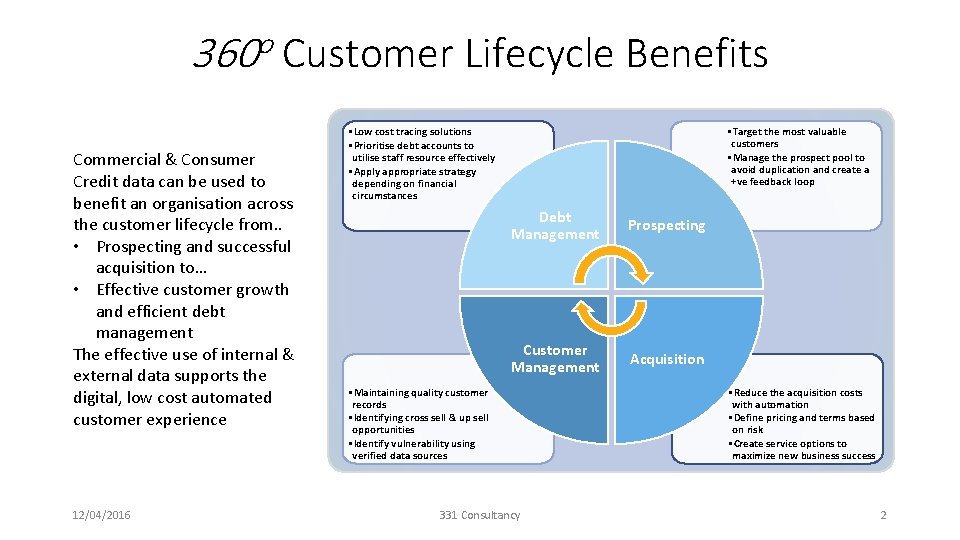
360 o Customer Lifecycle Benefits Commercial & Consumer Credit data can be used to benefit an organisation across the customer lifecycle from. . • Prospecting and successful acquisition to… • Effective customer growth and efficient debt management The effective use of internal & external data supports the digital, low cost automated customer experience 12/04/2016 • Low cost tracing solutions • Prioritise debt accounts to utilise staff resource effectively • Apply appropriate strategy depending on financial circumstances • Target the most valuable customers • Manage the prospect pool to avoid duplication and create a +ve feedback loop Debt Management Prospecting Customer Management Acquisition • Maintaining quality customer records • Identifying cross sell & up sell opportunities • Identify vulnerability using verified data sources 331 Consultancy • Reduce the acquisition costs with automation • Define pricing and terms based on risk • Create service options to maximize new business success 2
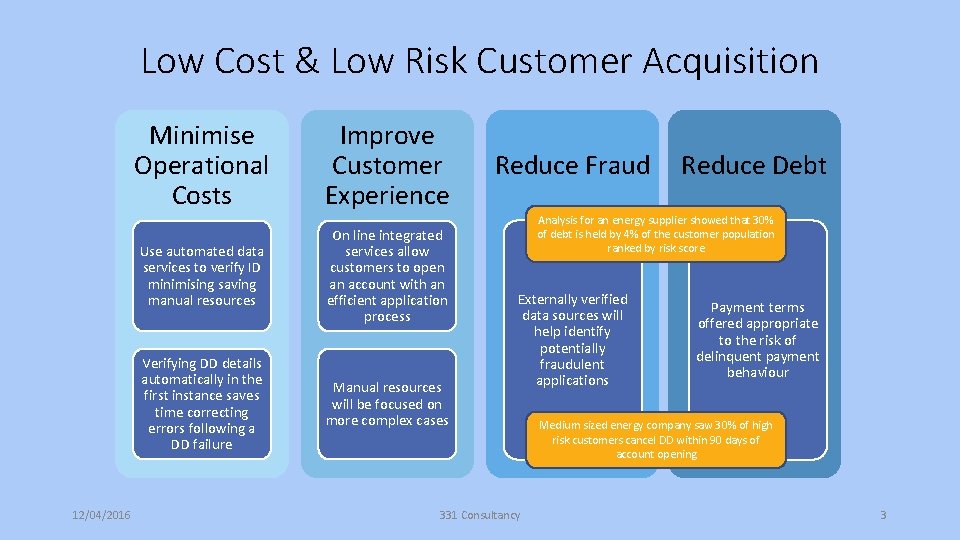
Low Cost & Low Risk Customer Acquisition Minimise Operational Costs 12/04/2016 Improve Customer Experience Use automated data services to verify ID minimising saving manual resources On line integrated services allow customers to open an account with an efficient application process Verifying DD details automatically in the first instance saves time correcting errors following a DD failure Manual resources will be focused on more complex cases Reduce Fraud Reduce Debt Analysis for an energy supplier showed that 30% of debt is held by 4% of the customer population ranked by risk score Externally verified data sources will help identify potentially fraudulent applications 331 Consultancy Payment terms offered appropriate to the risk of delinquent payment behaviour Medium sized energy company saw 30% of high risk customers cancel DD within 90 days of account opening 3
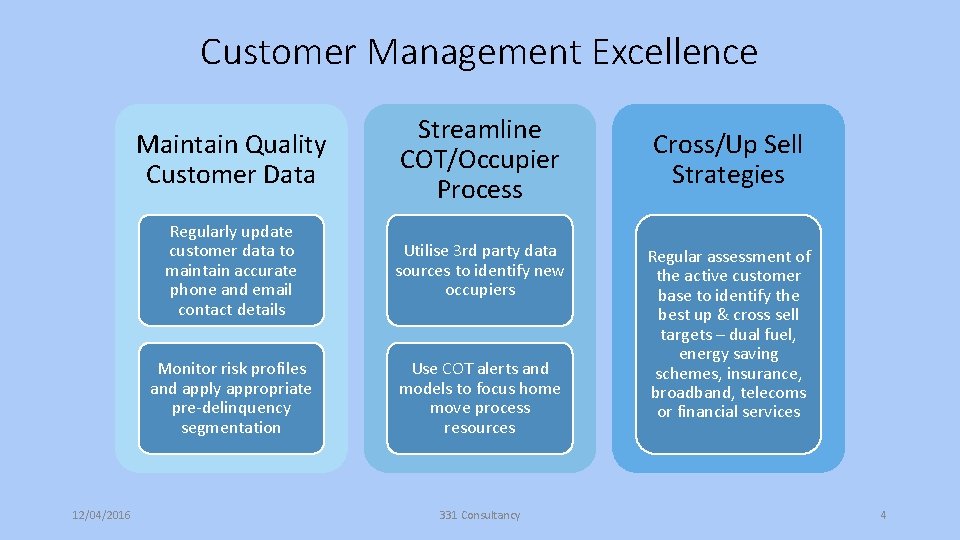
Customer Management Excellence 12/04/2016 Maintain Quality Customer Data Streamline COT/Occupier Process Regularly update customer data to maintain accurate phone and email contact details Utilise 3 rd party data sources to identify new occupiers Monitor risk profiles and apply appropriate pre-delinquency segmentation Use COT alerts and models to focus home move process resources 331 Consultancy Cross/Up Sell Strategies Regular assessment of the active customer base to identify the best up & cross sell targets – dual fuel, energy saving schemes, insurance, broadband, telecoms or financial services 4
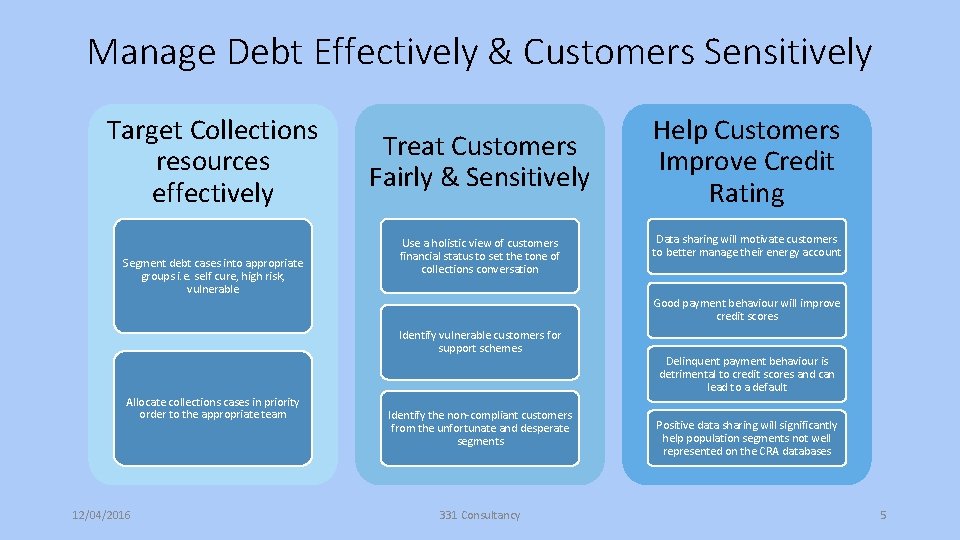
Manage Debt Effectively & Customers Sensitively Target Collections resources effectively Segment debt cases into appropriate groups i. e. self cure, high risk, vulnerable Treat Customers Fairly & Sensitively Use a holistic view of customers financial status to set the tone of collections conversation Help Customers Improve Credit Rating Data sharing will motivate customers to better manage their energy account Good payment behaviour will improve credit scores Identify vulnerable customers for support schemes Allocate collections cases in priority order to the appropriate team 12/04/2016 Identify the non-compliant customers from the unfortunate and desperate segments 331 Consultancy Delinquent payment behaviour is detrimental to credit scores and can lead to a default Positive data sharing will significantly help population segments not well represented on the CRA databases 5
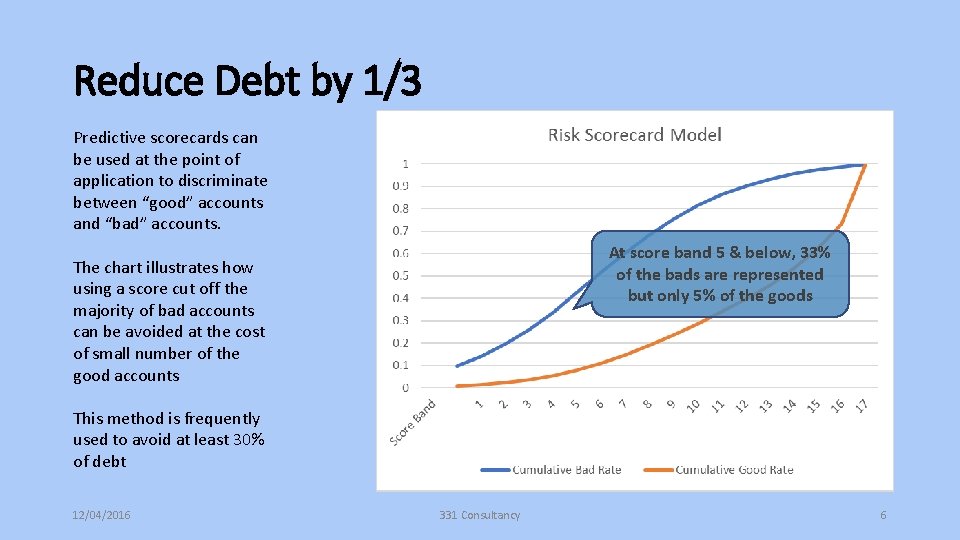
Reduce Debt by 1/3 Predictive scorecards can be used at the point of application to discriminate between “good” accounts and “bad” accounts. At score band 5 & below, 33% of the bads are represented but only 5% of the goods The chart illustrates how using a score cut off the majority of bad accounts can be avoided at the cost of small number of the good accounts This method is frequently used to avoid at least 30% of debt 12/04/2016 331 Consultancy 6
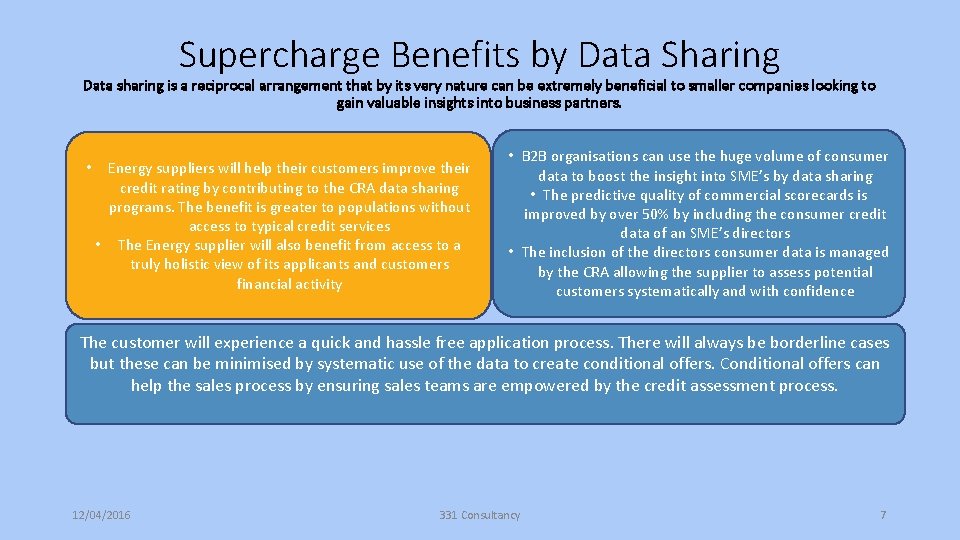
Supercharge Benefits by Data Sharing Data sharing is a reciprocal arrangement that by its very nature can be extremely beneficial to smaller companies looking to gain valuable insights into business partners. • Energy suppliers will help their customers improve their credit rating by contributing to the CRA data sharing programs. The benefit is greater to populations without access to typical credit services • The Energy supplier will also benefit from access to a truly holistic view of its applicants and customers financial activity • B 2 B organisations can use the huge volume of consumer data to boost the insight into SME’s by data sharing • The predictive quality of commercial scorecards is improved by over 50% by including the consumer credit data of an SME’s directors • The inclusion of the directors consumer data is managed by the CRA allowing the supplier to assess potential customers systematically and with confidence The customer will experience a quick and hassle free application process. There will always be borderline cases but these can be minimised by systematic use of the data to create conditional offers. Conditional offers can help the sales process by ensuring sales teams are empowered by the credit assessment process. 12/04/2016 331 Consultancy 7
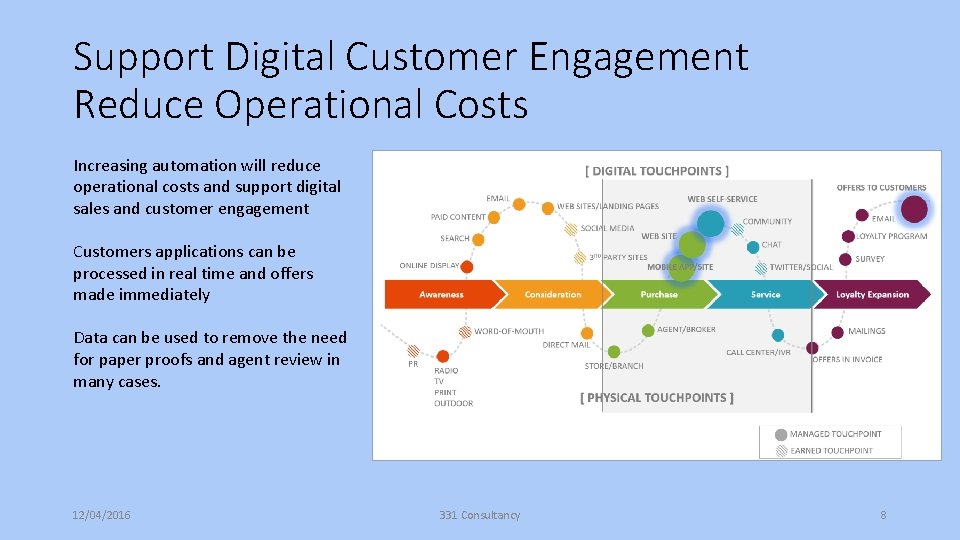
Support Digital Customer Engagement Reduce Operational Costs Increasing automation will reduce operational costs and support digital sales and customer engagement Customers applications can be processed in real time and offers made immediately Data can be used to remove the need for paper proofs and agent review in many cases. 12/04/2016 331 Consultancy 8
Business Survey Questions How do you currently attract new customers? What sales channels do you have? What is the mix between the sales channels? Can you give a decision on an application immediately? How does the commercial sales process differ from the consumer? What is the minimum data characteristics you need to complete an application? How do you verify the accuracy of the information provided by the applicant? How many DD failures occur each month? How many DD failures are related to cancelled instructions versus avoidable technical failures? How do you obtain the MPAN numbers associated with an address? Do you have a strategy for maintaining accurate customer contact data? 12/04/2016 What different payment methods do you offer? How do you decide what payment method to offer? What is your collections process? Do you have different collections paths? How do you decide what path a customer should be on? How do you manage moving a customer from one path to another? What %age of TO is the total value of debt? Is there a recognizable trend in this value? Do you segment the debt into groups i. e. tenants vs homeowners, COT vs COS, broker vs web vs phone, campaign code? Is the age of debt growing? What proportion of debt do you write off? Do you use DCA’s to collect debt on your behalf? What is your debt sale strategy? What are your plans to improve operational efficiency? 331 Consultancy 9
- Slides: 9