
Knowing Semantic memory 1 Semantic Memory n Memory
- Slides: 40
Knowing Semantic memory 1
Semantic Memory n Memory of the general knowledge of the world n While episodic memory is personal – events that happened to you – semantic memory is more general – information that everyone can learn about the world 2
Two basic questions asked n 1. What is the structure and content of semantic memory? q n Current perspective is that semantic memory is a network of nodes each representing a basic concept and nodes are linked together 2. How do we access the information in semantic memory? q Accessing or retrieving information from the network involves spreading activation 3
Semantic memory models n Quillen and Collins network model n Smith’s feature comparison model 4
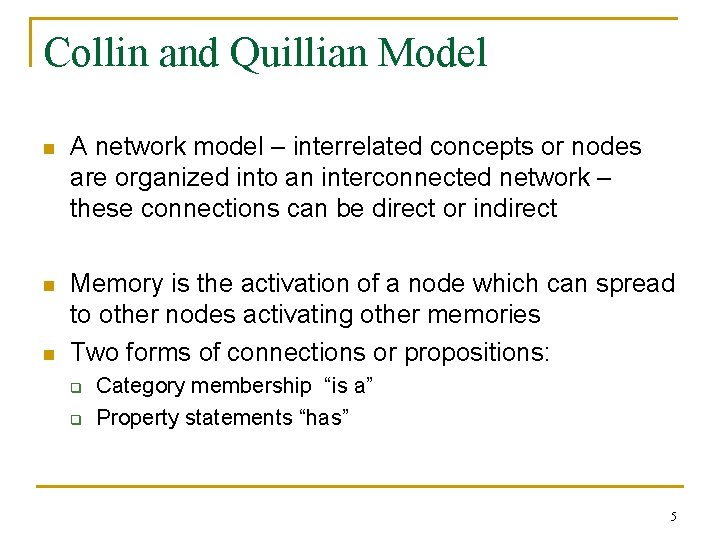
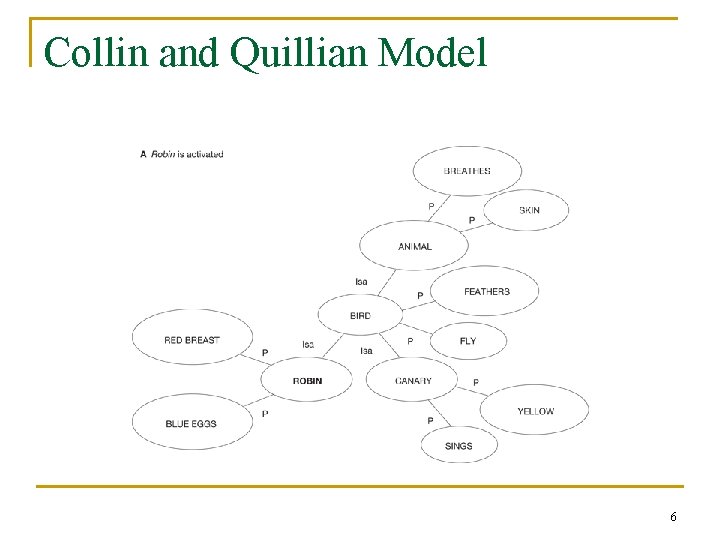
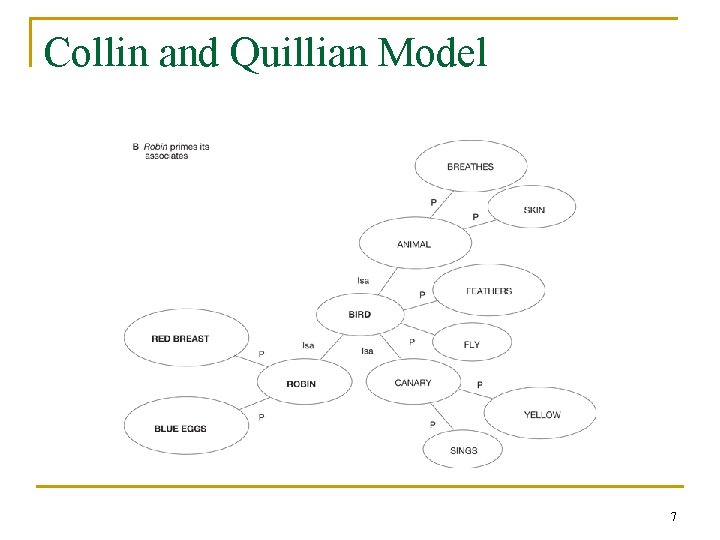
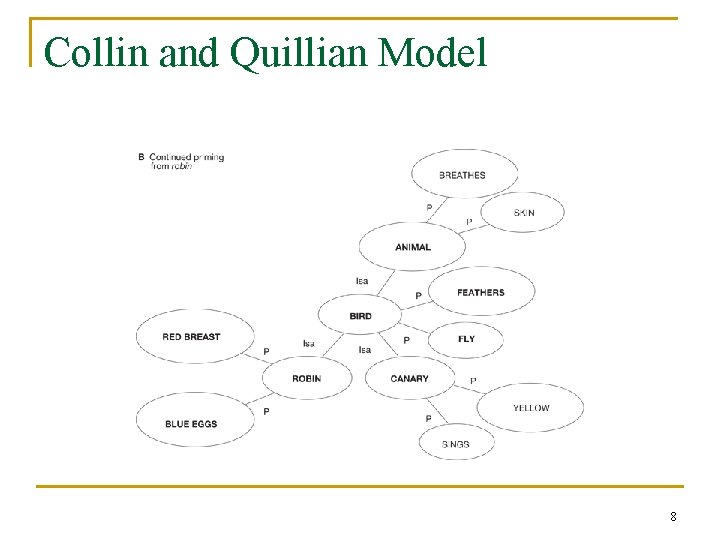
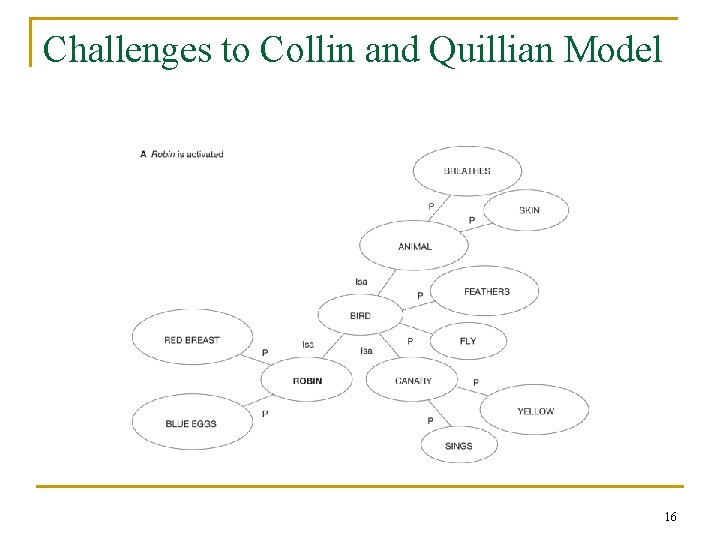
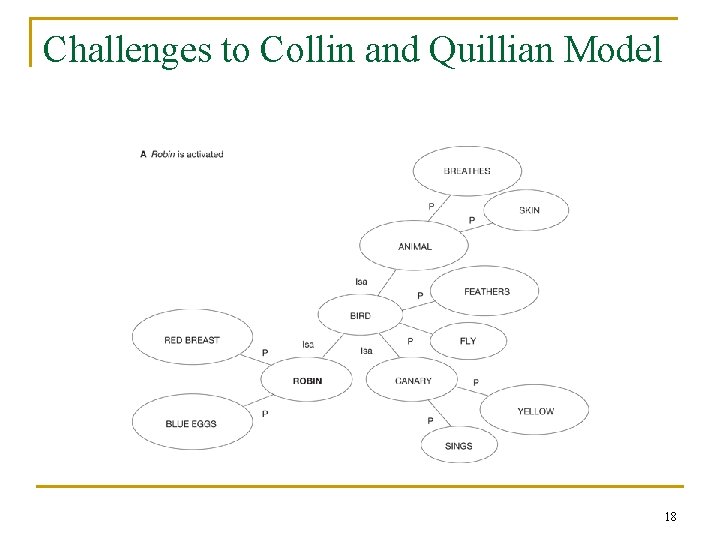
Collin and Quillian Model n A network model – interrelated concepts or nodes are organized into an interconnected network – these connections can be direct or indirect n Memory is the activation of a node which can spread to other nodes activating other memories Two forms of connections or propositions: n q q Category membership “is a” Property statements “has” 5
Collin and Quillian Model 6
Collin and Quillian Model 7
Collin and Quillian Model 8
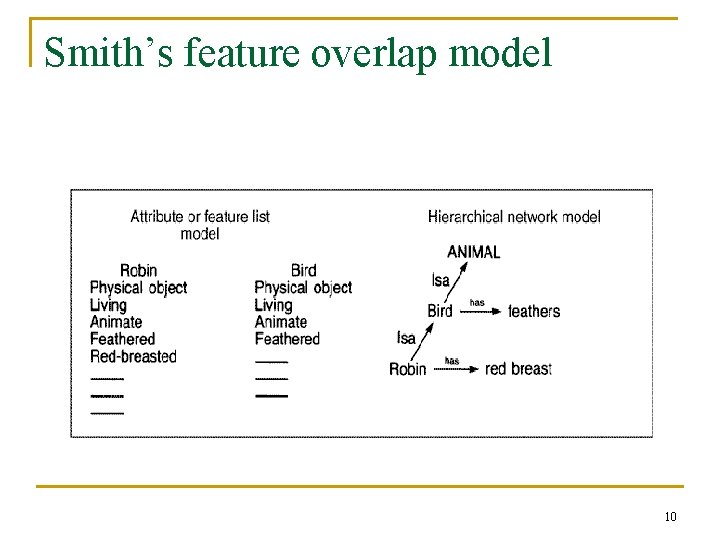
Smith’s feature overlap model n Showed significant problems of the Quillen and Collins model n Used lists of characteristics instead of a network n Concepts are defined by a list of features. These features are stored in a redundant manner n The decision of whether one concept is an example of an another depends upon the level of overlap 9
Smith’s feature overlap model 10
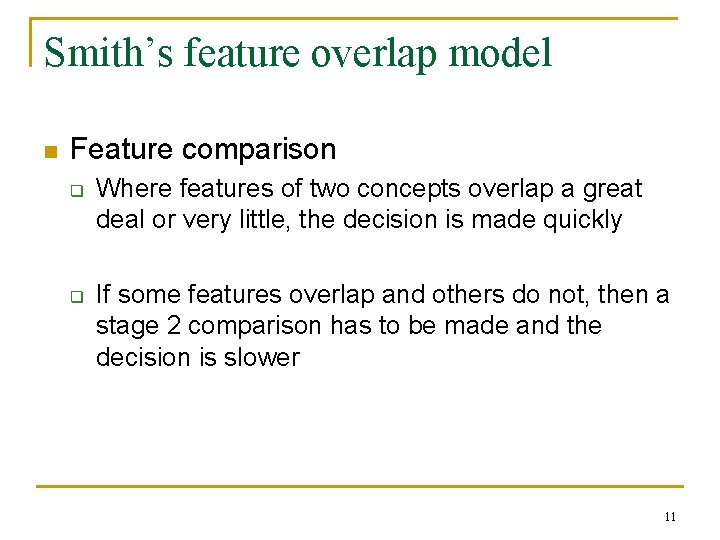
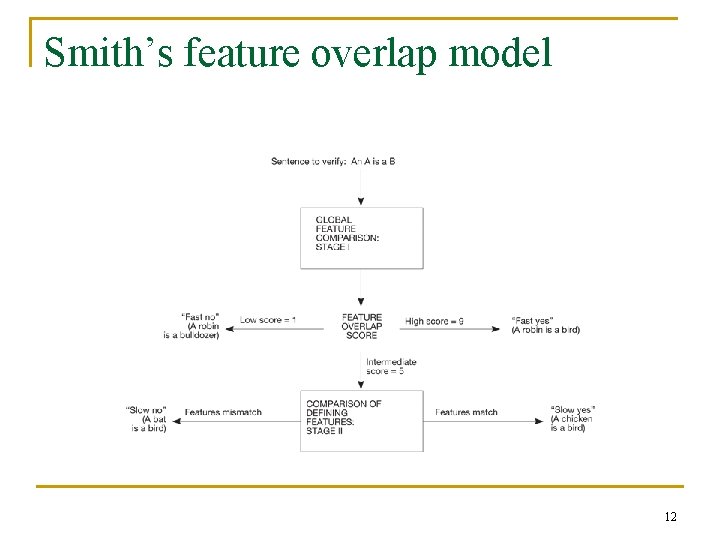
Smith’s feature overlap model n Feature comparison q q Where features of two concepts overlap a great deal or very little, the decision is made quickly If some features overlap and others do not, then a stage 2 comparison has to be made and the decision is slower 11
Smith’s feature overlap model 12
Empirical Tests of Semantic Memory Models n Sentence Verification Task: Simple sentences are presented for the subjects’ yes/no decisions. n Most early tests of semantic memory models adopted the sentence verification task. 13
Challenges to Collin and Quillian Model n Support for Collin and Quillian was cognitive economy – only nonredundant facts stored in memory. Conrad (1972) found that high frequency properties were stored in a redundant fashion 14
Challenges to Collin and Quillian Model n Conrad (1972) found that high frequency properties were more highly associated with the concepts and are verified faster than low frequency properties – not shown in network model 15
Challenges to Collin and Quillian Model 16
Challenges to Collin and Quillian Model n Typicality: The degree to which items are viewed as typical, central members of a category. n Typicality Effect: Typical members of a category can be judged more rapidly than atypical members. 17
Challenges to Collin and Quillian Model 18
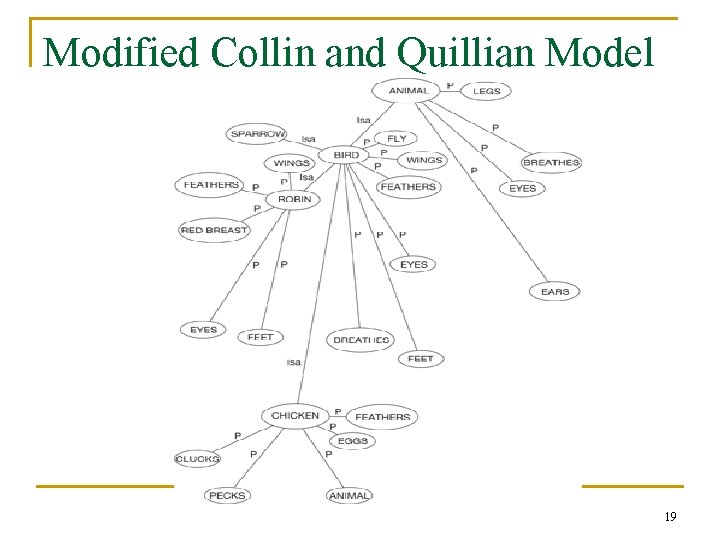
Modified Collin and Quillian Model 19
Semantic Relatedness n Semantic Relatedness Effect: Concepts that are more highly interrelated can be retrieved and judged true more rapidly than those with a lower degree of relatedness. n Resulted in a third revision of the model which required a 3 -dimensional model 20
Knowing Categorization, classification, and prototypes 21
Knowledge n Knowledge is the acquisition of concepts and categories – your mental representations that contain information about objects, events, etc. 22
Categorization n Concepts usually involve the creation of categories n Categories – grouping things into groups based upon similar characteristics n Categories help organize information so that you do not have learn about every new thing you expereince 23
Concepts and Categories n Two basic questions: q q n What is the nature of concepts? How do we form concepts and categories? Three approaches to these questions, classical, prototype, and exemplar 24
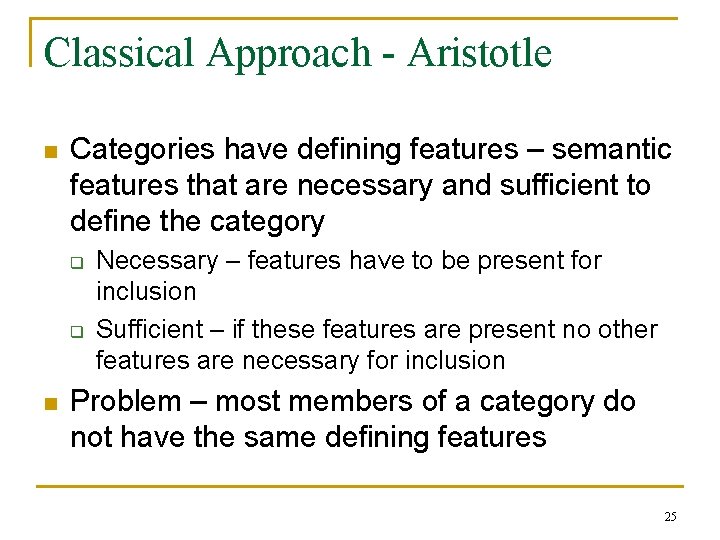
Classical Approach - Aristotle n Categories have defining features – semantic features that are necessary and sufficient to define the category q q n Necessary – features have to be present for inclusion Sufficient – if these features are present no other features are necessary for inclusion Problem – most members of a category do not have the same defining features 25
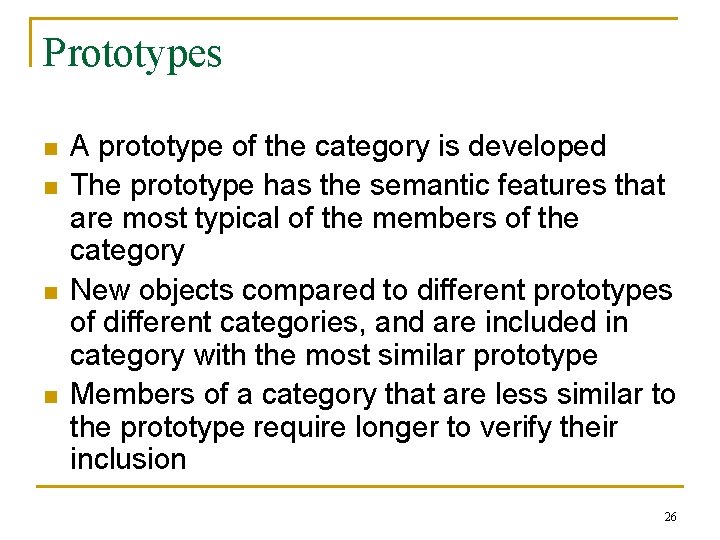
Prototypes n n A prototype of the category is developed The prototype has the semantic features that are most typical of the members of the category New objects compared to different prototypes of different categories, and are included in category with the most similar prototype Members of a category that are less similar to the prototype require longer to verify their inclusion 26
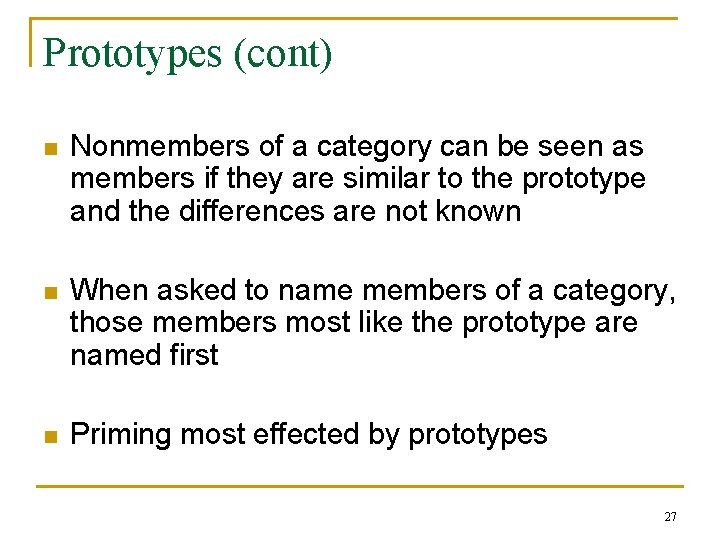
Prototypes (cont) n Nonmembers of a category can be seen as members if they are similar to the prototype and the differences are not known n When asked to name members of a category, those members most like the prototype are named first n Priming most effected by prototypes 27
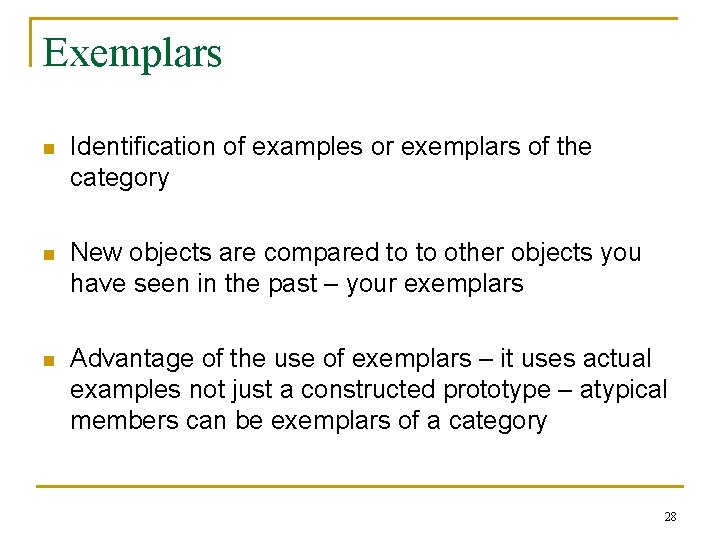
Exemplars n Identification of examples or exemplars of the category n New objects are compared to to other objects you have seen in the past – your exemplars n Advantage of the use of exemplars – it uses actual examples not just a constructed prototype – atypical members can be exemplars of a category 28
Prototypes and Exemplars n Evidence supports both models of categorization n One possibility is that we use prototypes in large categories and exemplars in defining smaller categories 29
Feature comparison theory of determining category membership n This model focuses on the strategy used to decide whether an exemplar (i. e. a canary) is a member of a larger category (i. e. bird) n This strategy consists of two rules: q q If the feature associated with the exemplar (canary has feathers) is found to be associated with the larger category (birds have feathers), it provides positive proof the exemplar is a member of the larger category If the feature is not associated with the category (bats have fur), they are not members of the category (a bat is not a bird) 30
Support for Feature comparison model n Consistent with typicality effects – typical exemplars have extensive overlap of features; atypical exemplars have less overlap and require more time to determine their membership n Consistent with the false relatedness effect- subjects respond faster when the exemplar is unrelated to the category than when it is somewhat related n Also consistent with levels effects 31
Level effects n Categories are organized in a hierarchy – one category is part of a larger category which is part of an even larger category n Superordinate category – largest and most abstract – animal n Subordinate category – smallest and least level of abstraction – a canary n Base level category – in the middle and at an intermediate level of abstraction - bird 32
Base level categories n Most useful and most likely to come to mind and tend to be the most important n Children develop base categories before superordinate or subordinate categories n When asked to identify pictures, people more likely to give base level category 33
Category levels n When asked for common attributes of superordinate category, people give very few (vehicle) n When asked about attributes of base level categories, many more given (car) n When asked about attributes of base level categories, not many more than those given at the base level are added (SUV) n Movement from a superordinate category to a base level category results in a great increase in information, but movement to a subordinate category adds very little information 34
Base level thinking n n n Humans prefer to think a the base level of categorization because it provides the most useful information for predicting membership in a category Superordinate members of a category maybe very different with few similarities – fruit Base level share many common features – apples Subordinate categories are more informative , but are poor discriminators – Mc. Intosh apples share many features of other apples Subordinate level thinking most important in areas of expertise. Choosing wine for dinner 35
Knowing Connectionism 36
Importance of context n Context can act as a prime to understanding correct meaning q q I saw a man eating fish. Visiting relatives can be boring n Context can activate the meaning meant to be conveyed n By understanding the context of a communication, you can understand remember the material better 37
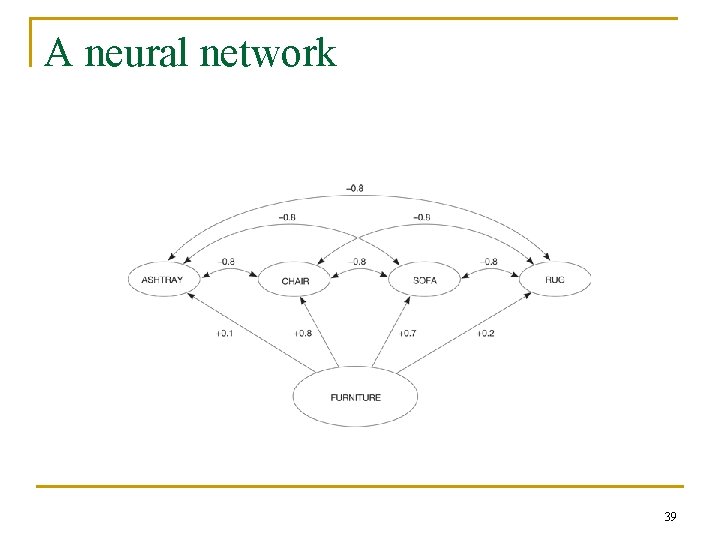
Connectionist model of semantic memory n Involves a network of interconnected nodes each node connected with specific information n The connections between nodes vary in strength – referred to as connection weights n Nodes that are more strongly connected have greater connection weights n Learning involves strengthening the connection by increasing connection weights 38
A neural network 39
A neural network example 40