
Know your rights What to consider before you
Know your rights What to consider before you submit to a journal and sign a copyright transfer agreement Jessica Lange | Scholarly Communications Librarian Alexandra Kohn Head | Head, Office of Copyright Compliance Please note that all logos, screenshots and publisher content are used here under fair dealing and do not fall under the terms of the Creative Commons licence
Objectives § Identify and compare copyright transfer agreements in academic journals § Evaluate journals based on their author rights agreements § Describe which rights are retained/revoked in these agreements § Determine whether a journal’s policies allow you to comply with the Tri-Agency Open Access Policy on Publications
Disclaimer Content in this presentation is provided for informational purposes only and should not be relied on for legal advice
Workshop Outline § Introduction + background § Brainstorming activity § Key terminology and phrasing in agreements § Group activity § Copyright transfer agreements § Debrief § Wrap-up and discussion
Introduction § What are copyright transfer agreements? § Why do they matter? § Shifting landscape § Open access movement § Funding requirements

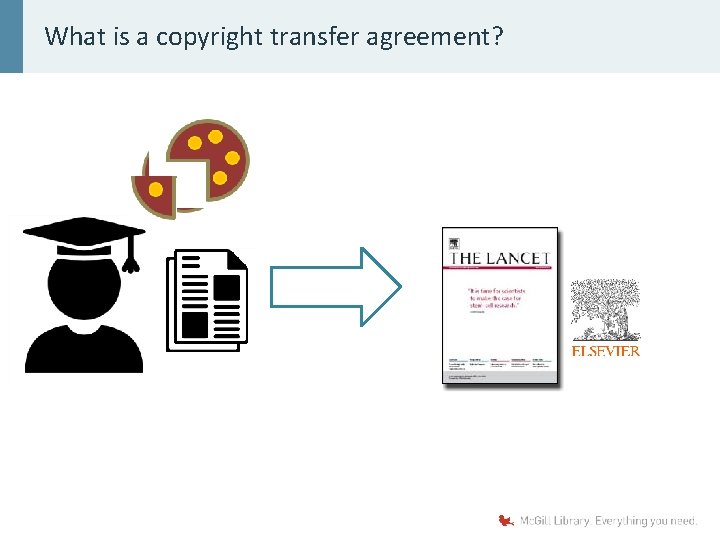
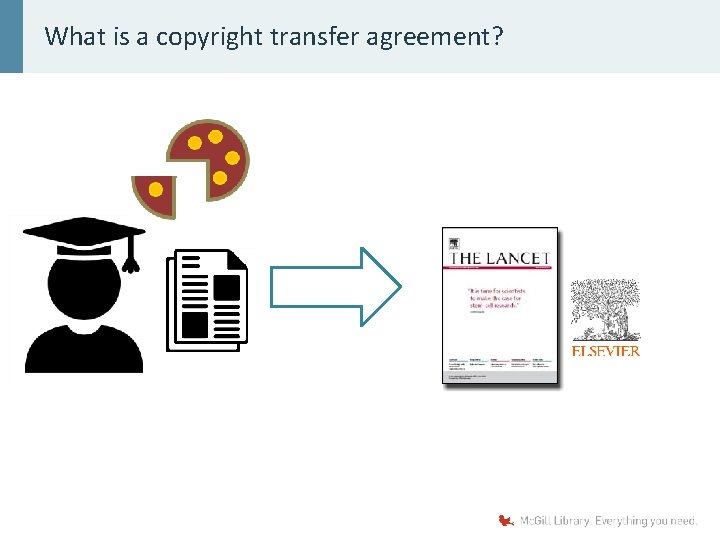
What is a copyright transfer agreement? 1 1 Right to publish, copy, translate, and distribute the work…and authorize others to do so
What is a copyright transfer agreement?
What is a copyright transfer agreement?
Brainstorming activity What kinds of activities do you want to know if you can do with your article (e. g. share with colleagues, post to a website etc. )?
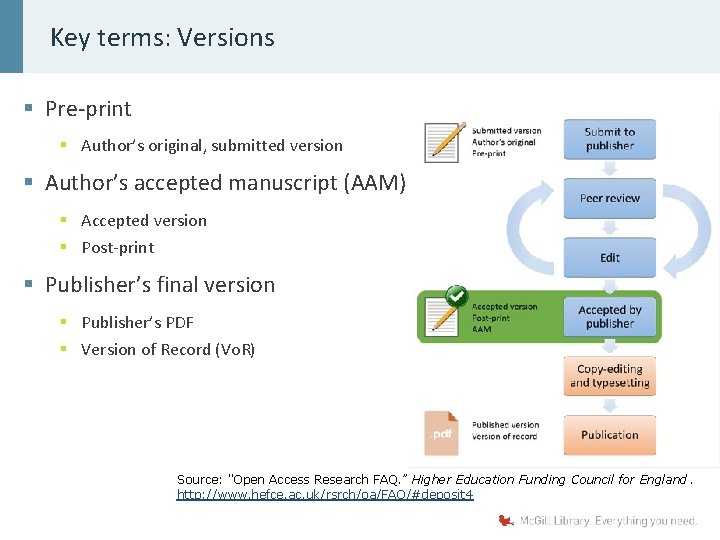
Key terms: Versions § Pre-print § Author’s original, submitted version § Author’s accepted manuscript (AAM) § Accepted version § Post-print § Publisher’s final version § Publisher’s PDF § Version of Record (Vo. R) Source: "Open Access Research FAQ. ” Higher Education Funding Council for England. http: //www. hefce. ac. uk/rsrch/oa/FAQ/#deposit 4
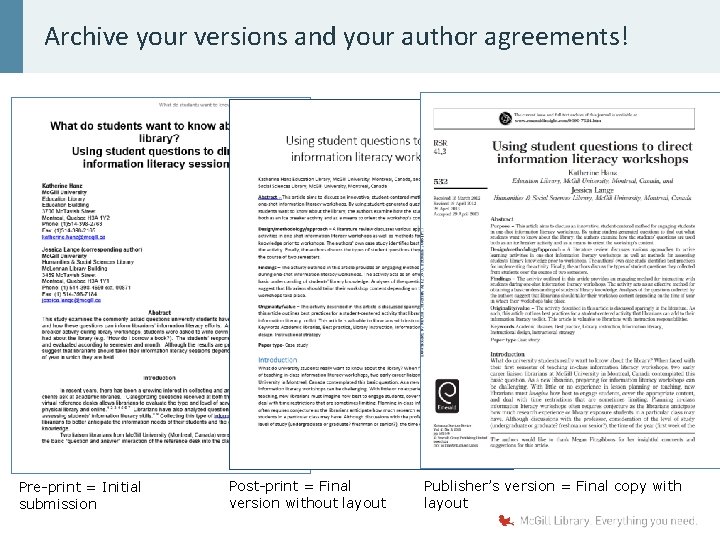
Archive your versions and your author agreements! Pre-print = Initial submission 11 Post-print = Final version without layout Publisher’s version = Final copy with layout
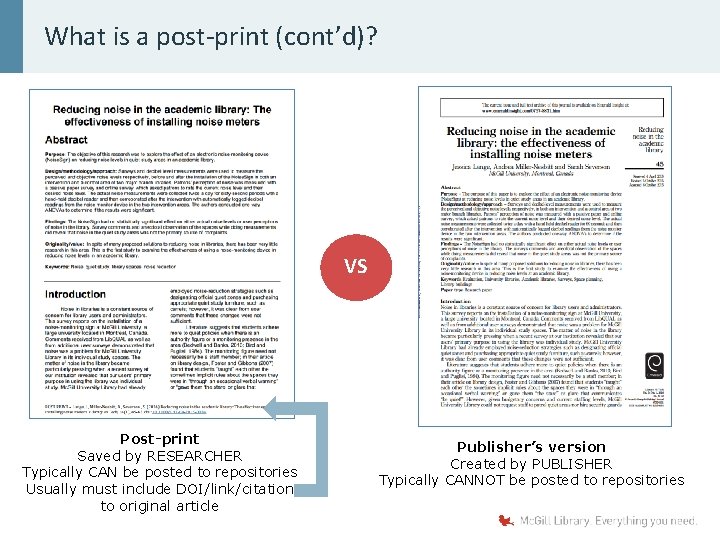
What is a post-print (cont’d)? VS Post-print Saved by RESEARCHER Typically CAN be posted to repositories Usually must include DOI/link/citation to original article Publisher’s version Created by PUBLISHER Typically CANNOT be posted to repositories

Key terms: Assigning vs. licensing § Assignment/transfer § Transfer of some or all of your rights to another party (e. g. a publisher). § License § Permission for another party to use your work under certain conditions § You maintain copyright ownership Note: In many agreements, you transfer copyright to the publisher and they license certain rights back to you.
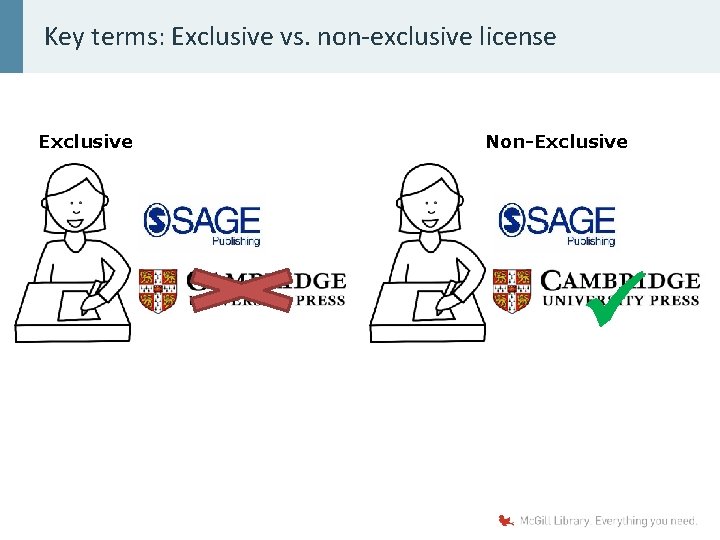
Key terms: Exclusive vs. non-exclusive license Exclusive Non-Exclusive
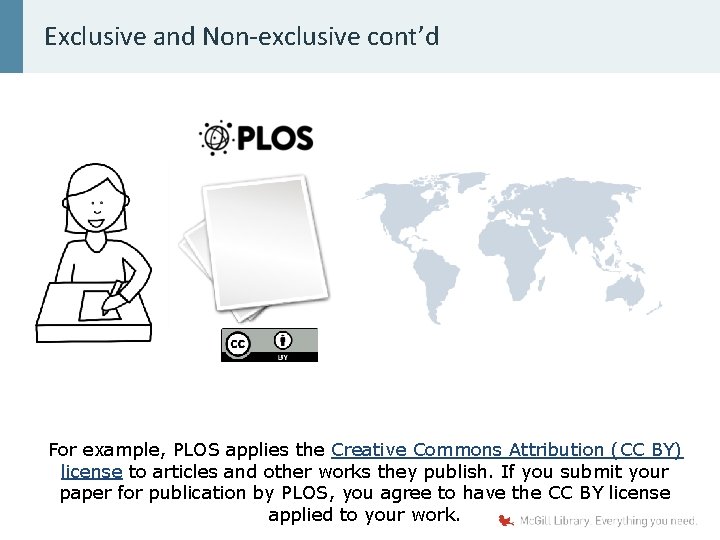
Exclusive and Non-exclusive cont’d For example, PLOS applies the Creative Commons Attribution (CC BY) license to articles and other works they publish. If you submit your paper for publication by PLOS, you agree to have the CC BY license applied to your work.
Group Activity: Copyright Transfer Agreements § At your table, review the copyright transfer agreements provided (~5 -10 minutes) § Highlight anything that’s unclear/confusing § Fill in the chart on your handout
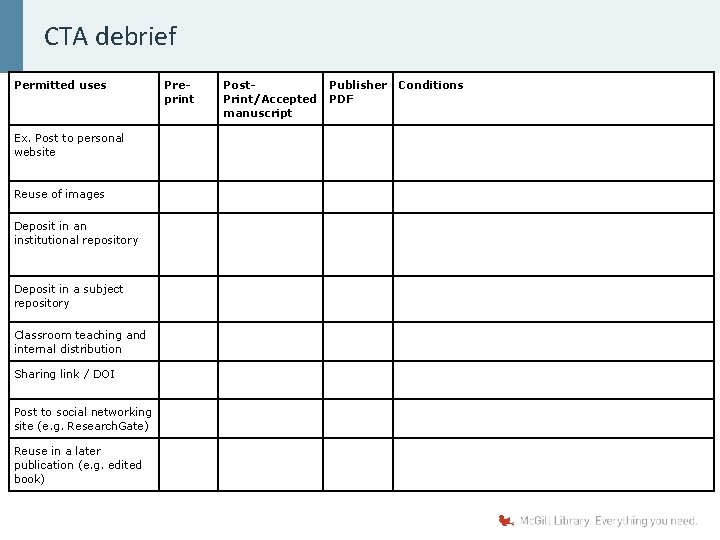
CTA debrief Permitted uses Ex. Post to personal website Reuse of images Deposit in an institutional repository Deposit in a subject repository Classroom teaching and internal distribution Sharing link / DOI Post to social networking site (e. g. Research. Gate) Reuse in a later publication (e. g. edited book) Preprint Post. Print/Accepted manuscript Publisher PDF Conditions
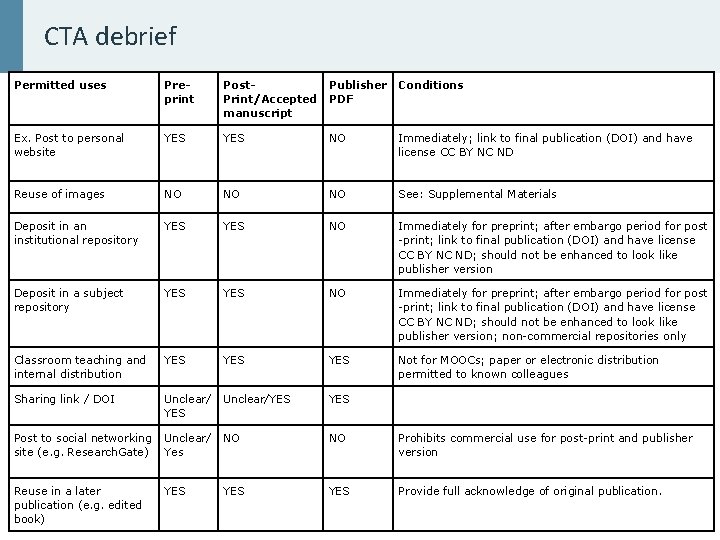
CTA debrief Permitted uses Preprint Post. Print/Accepted manuscript Publisher PDF Conditions Ex. Post to personal website YES NO Immediately; link to final publication (DOI) and have license CC BY NC ND Reuse of images NO NO NO See: Supplemental Materials Deposit in an institutional repository YES NO Immediately for preprint; after embargo period for post -print; link to final publication (DOI) and have license CC BY NC ND; should not be enhanced to look like publisher version Deposit in a subject repository YES NO Immediately for preprint; after embargo period for post -print; link to final publication (DOI) and have license CC BY NC ND; should not be enhanced to look like publisher version; non-commercial repositories only Classroom teaching and internal distribution YES YES Not for MOOCs; paper or electronic distribution permitted to known colleagues Sharing link / DOI Unclear/ YES Unclear/YES Post to social networking site (e. g. Research. Gate) Unclear/ Yes NO NO Prohibits commercial use for post-print and publisher version Reuse in a later publication (e. g. edited book) YES YES Provide full acknowledge of original publication.
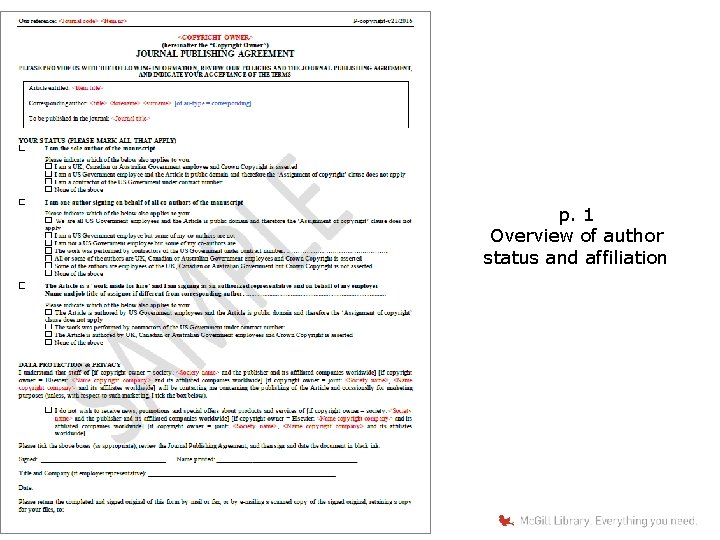
p. 1 Overview of author status and affiliation
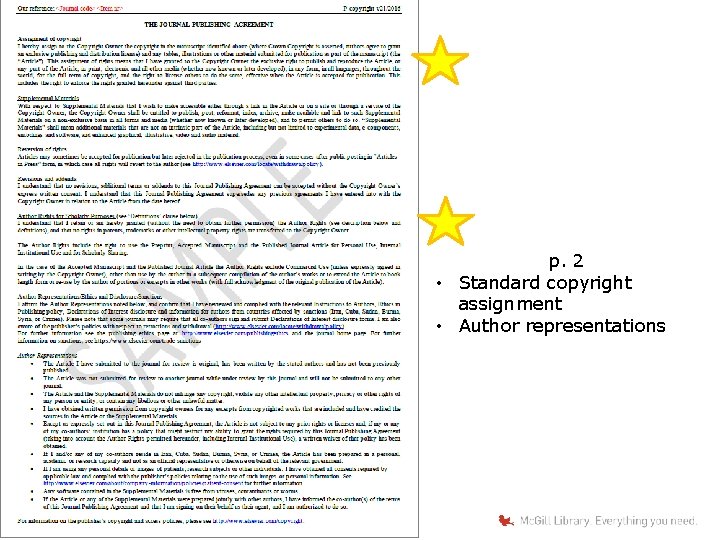
p. 2 • Standard copyright assignment • Author representations
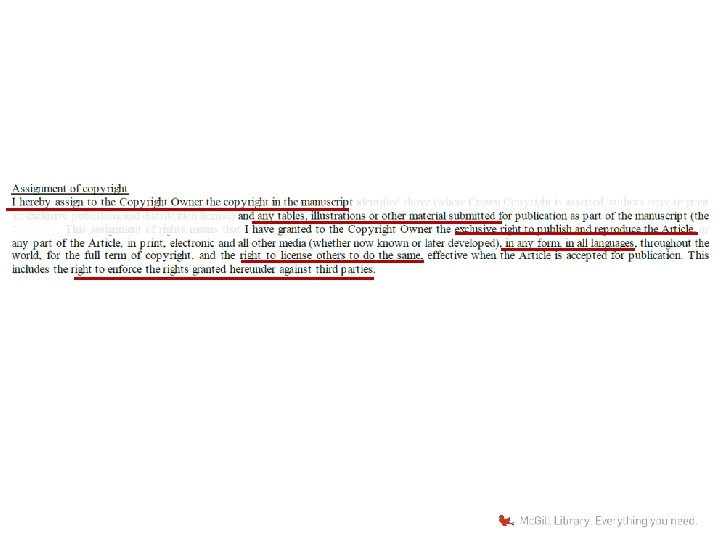
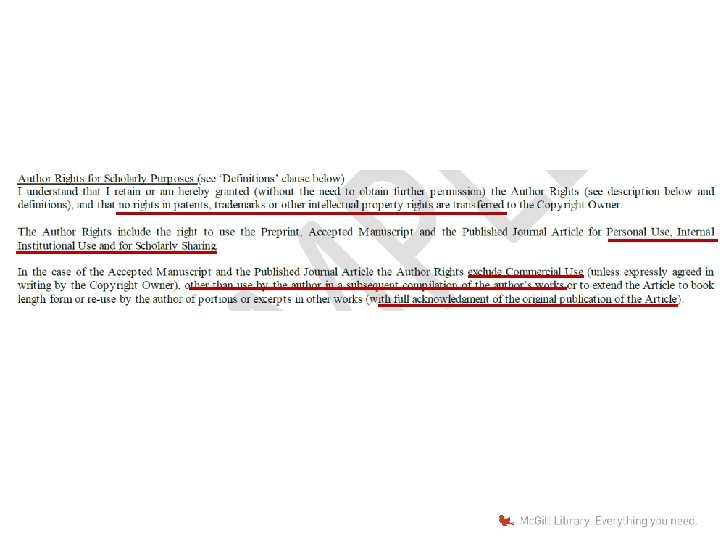
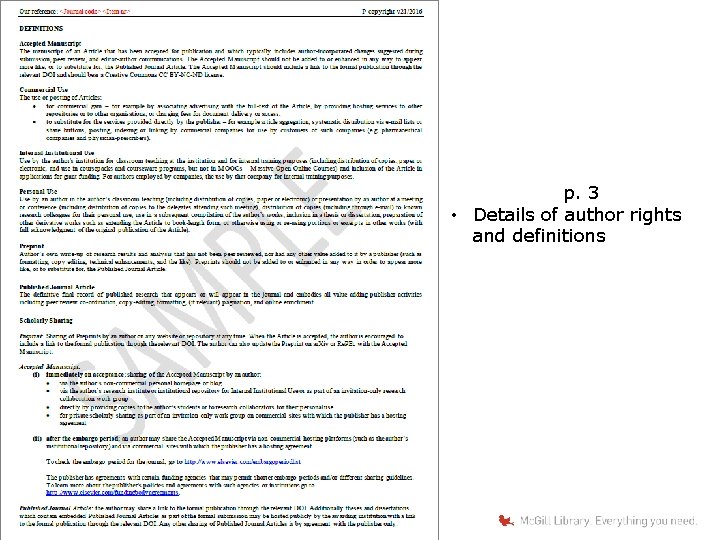
p. 3 • Details of author rights and definitions
Lots of variation (Springer article) The copyright to this article, including any graphic elements therein (e. g. illustrations, charts, moving images), is hereby assigned for good and valuable consideration to Springer effective if and when the article is accepted for publication… Authors may self-archive the Author’s accepted manuscript of their articles on their own websites. Authors may also deposit this version of the article in any repository, provided it is only made publicly available 12 months after official publication or later. He/she may not use the publisher‘s version (the final article)…
Lots of variation (book) Author retains, in addition to uses permitted by law, the right to communicate the content of the Contribution to other research colleagues, to share the Contribution with them in manuscript form, to perform or present the Contribution or to use the content for non-commercial internal and educational purposes, provided the original source of publication is cited according to current citation standards.
Lots of variation “Contributors may re-use figures, tables, artwork, and selected text up to 250 words from their Contributions” (Wiley) “. . agreement. . does not allow full articles to be posted on SSRN, or other such commercial networks. ” (Cambridge University Press) “…you agree to have the CC BY license applied to your work…you as the author agree that anyone can reuse your article. . . even for commercial purposes. Anyone may copy, distribute, or reuse the content as long as the author and original source are properly cited” (PLOS)
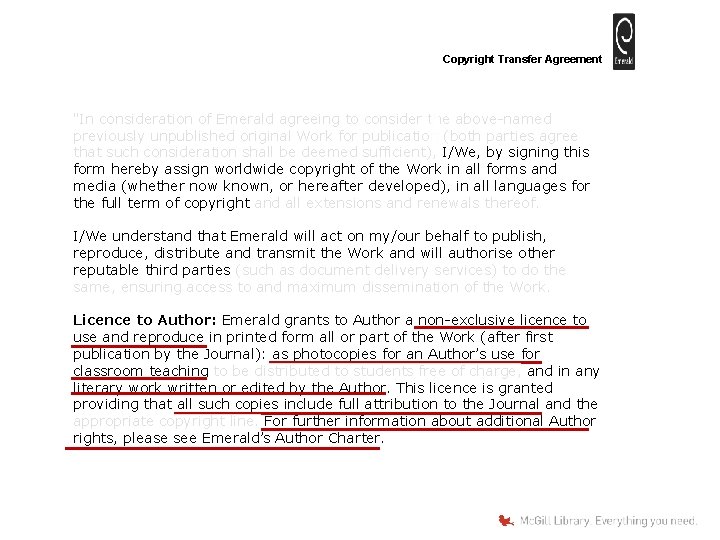
Copyright Transfer Agreement "In consideration of Emerald agreeing to consider the above-named previously unpublished original Work for publication (both parties agree that such consideration shall be deemed sufficient), I/We, by signing this form hereby assign worldwide copyright of the Work in all forms and media (whether now known, or hereafter developed), in all languages for the full term of copyright and all extensions and renewals thereof. I/We understand that Emerald will act on my/our behalf to publish, reproduce, distribute and transmit the Work and will authorise other reputable third parties (such as document delivery services) to do the same, ensuring access to and maximum dissemination of the Work. Licence to Author: Emerald grants to Author a non-exclusive licence to use and reproduce in printed form all or part of the Work (after first publication by the Journal): as photocopies for an Author’s use for classroom teaching to be distributed to students free of charge, and in any literary work written or edited by the Author. This licence is granted providing that all such copies include full attribution to the Journal and the appropriate copyright line. For further information about additional Author rights, please see Emerald’s Author Charter.
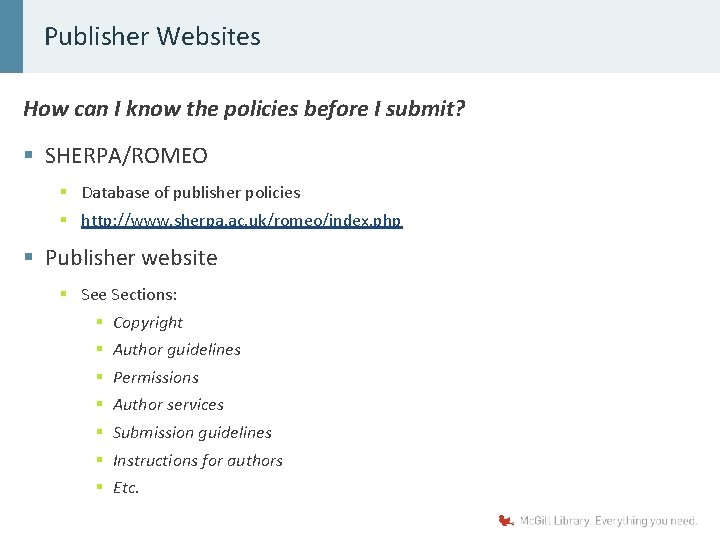
Publisher Websites How can I know the policies before I submit? § SHERPA/ROMEO § Database of publisher policies § http: //www. sherpa. ac. uk/romeo/index. php § Publisher website § See Sections: § Copyright § Author guidelines § Permissions § Author services § Submission guidelines § Instructions for authors § Etc.
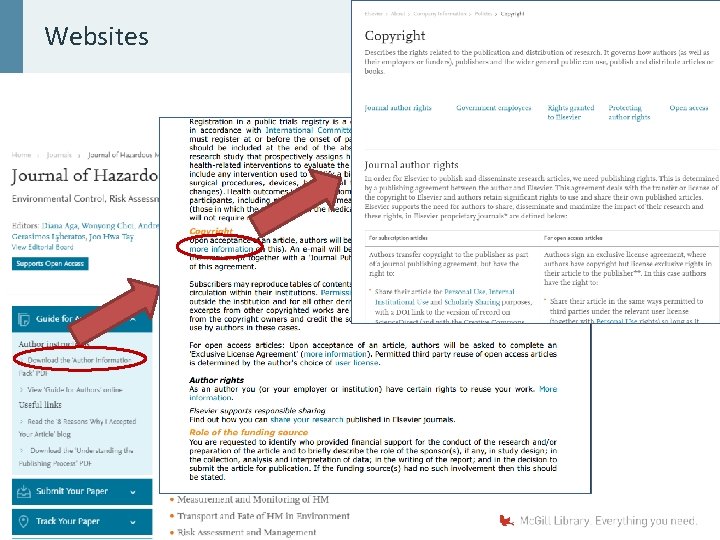
Websites
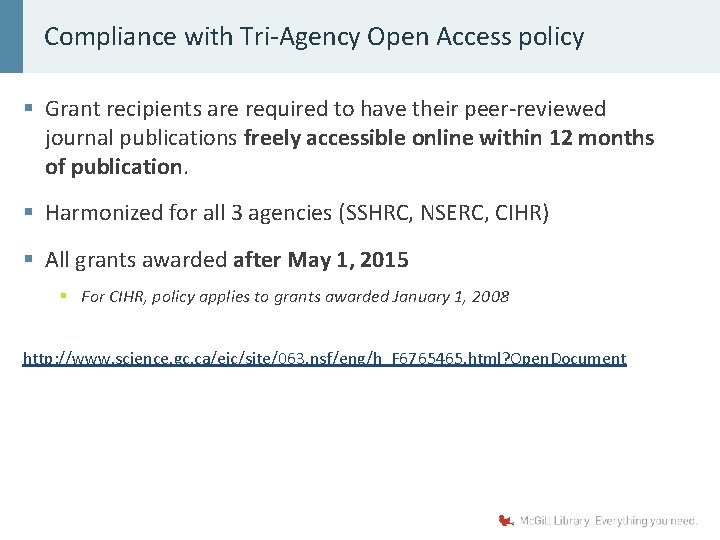
Compliance with Tri-Agency Open Access policy § Grant recipients are required to have their peer-reviewed journal publications freely accessible online within 12 months of publication. § Harmonized for all 3 agencies (SSHRC, NSERC, CIHR) § All grants awarded after May 1, 2015 § For CIHR, policy applies to grants awarded January 1, 2008 http: //www. science. gc. ca/eic/site/063. nsf/eng/h_F 6765465. html? Open. Document
Compliance with FRQ Open Access policy § Grant recipients are required to have their peer-reviewed journal publications freely accessible online within 12 months of publication. § All grants awarded after April 1, 2019 § Applies to all peer-reviewed article publications § Applies to student grants http: //www. frqsc. gouv. qc. ca/en/science-ouverte
Option 1: Deposit in a repository Example: § You publish in Molecular Astrophysics. § Email accepted manuscript to escholarship. library@mcgill. ca § A second copy now lives in the repository (after 12 month embargo)
Option 2: Publish in an open access journal Example: § You publish in International Journal of Qualitative Methods. § Pay $1300 APC (Canadian dollars) § Article is now freely available to everyone on the journal’s website.
Negotiation tips § Determine what matters to you § E. g. Reusing images; depositing in a repository, etc. § Engage in back and forth with publisher/ editor § Send an email ; provide an addendum ; strike out material, etc. § Same as negotiating for any other matter § e. g. mortgage, car etc. § Negotiation Resources § § Arizona State Negotiation Guide SPARC author addendum Science Commons sample addendums Quilter, Laura, "2 I Negotiating Author Agreements" (2015). New England Copyright Boot Camp. Paper 14. http: //scholarworks. umass. edu/cbc/14
See the guide! http: //libraryguides. mcgill. ca/authorrights
FAQs § The lead author signed the agreement without telling me about the license conditions. Am I bound to those conditions? § What if I want to do something that’s not permitted by my agreement? § What if the copyright transfer agreement doesn’t match what’s on the publisher’s website? § What happens if I breach the agreement?
Questions?
Contact
Image Credits Resume by Nicholas Menghini from the Noun Project: https: //thenounproject. com/ student by Mourad Mokrane from the Noun Project: https: //thenounproject. com/
- Slides: 39