
Know Your Audience Demographics Age Background Education Cultural
Know Your Audience: Demographics • Age • Background • Education • Cultural • Socioeconomic • Attitude
Organizing Speech • Determine your purpose • Craft a thesis statement • Identify main points of support
Outline Your Speech • Formal outline: short skeleton of a speech that provides an overview of organization and structure as well as the relationship of ideas • Why make an outline? • • Helps to test the strength of your ideas and the logic of your structure Helps to organize your information Helps you rehearse your speech Provides a base for good speaker notes
How to Create an Outline • Use Roman Numerals to indicate main points • Write in complete sentences • Write main points in parallel language • One idea for each point • Keep main points to less than five
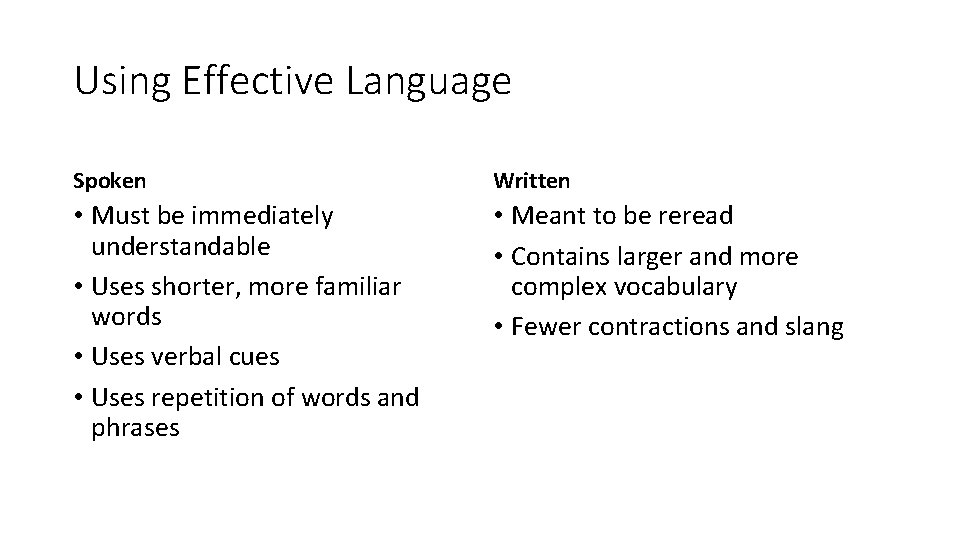
Using Effective Language Spoken Written • Must be immediately understandable • Uses shorter, more familiar words • Uses verbal cues • Uses repetition of words and phrases • Meant to be reread • Contains larger and more complex vocabulary • Fewer contractions and slang
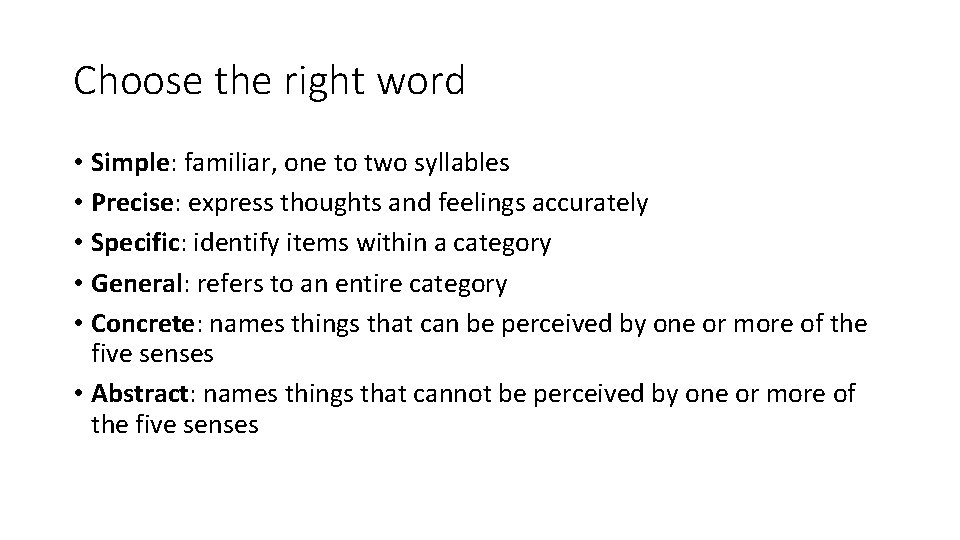
Choose the right word • Simple: familiar, one to two syllables • Precise: express thoughts and feelings accurately • Specific: identify items within a category • General: refers to an entire category • Concrete: names things that can be perceived by one or more of the five senses • Abstract: names things that cannot be perceived by one or more of the five senses
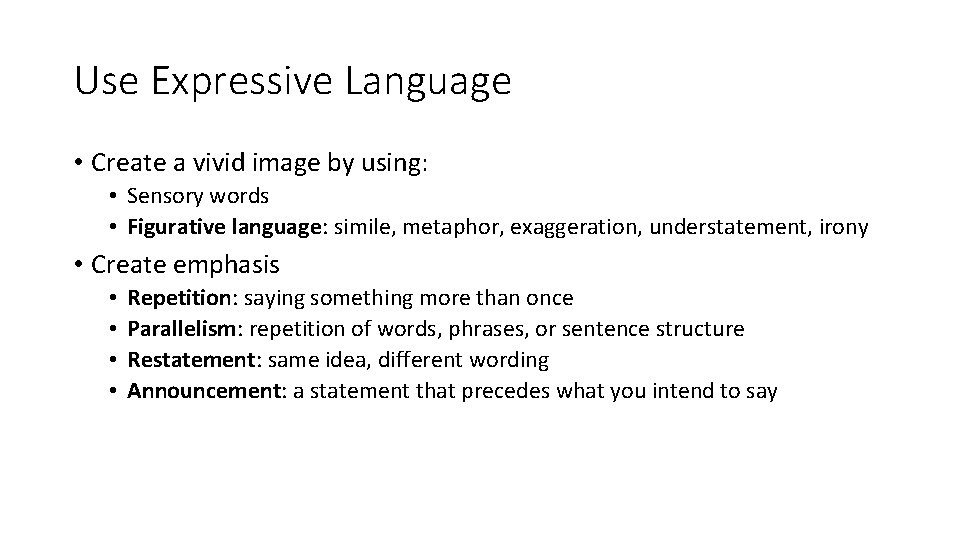
Use Expressive Language • Create a vivid image by using: • Sensory words • Figurative language: simile, metaphor, exaggeration, understatement, irony • Create emphasis • • Repetition: saying something more than once Parallelism: repetition of words, phrases, or sentence structure Restatement: same idea, different wording Announcement: a statement that precedes what you intend to say
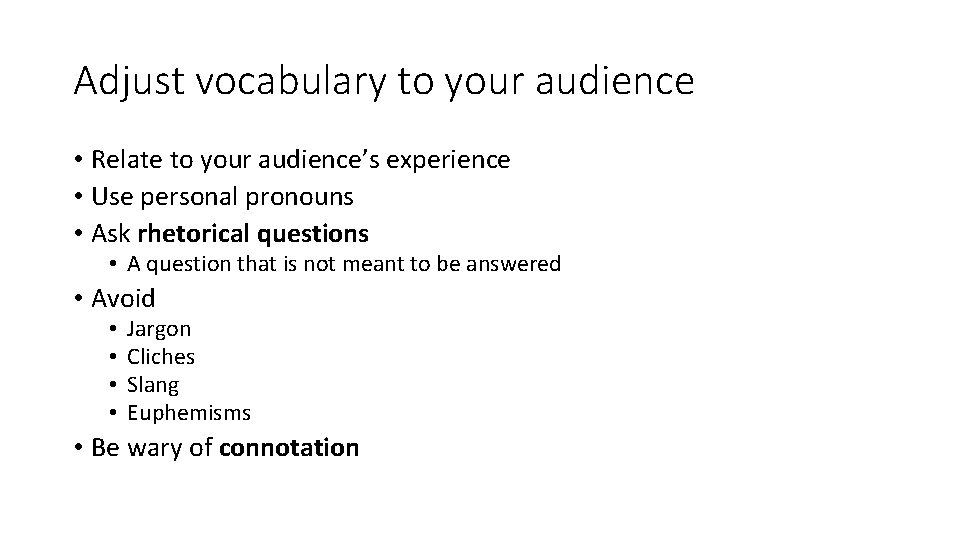
Adjust vocabulary to your audience • Relate to your audience’s experience • Use personal pronouns • Ask rhetorical questions • A question that is not meant to be answered • Avoid • • Jargon Cliches Slang Euphemisms • Be wary of connotation
- Slides: 8