
Know Mode of Action Groups to Manage Insecticide
- Slides: 47
Know Mode of Action Groups to Manage Insecticide Resistance in the Florida Landscape James F. Price and Curtis Nagle University of Florida Gulf Coast Research and Education Center Wimauma
Today we shall learn: • What is resistance • That insecticide Active Ingredients (AIs) have Modes of Action (Mo. A) • That understanding Mo. A and managing can reduce resistance • How to identify Mo. A • How to make an insect control plan based on Mo. A
This is how resistance happens: • Populations have a very few that are tolerant to the insecticide • The insecticide kills others • Survivors breed tolerant offspring • Overuse creates population with many tolerant to the insecticide
So resistance is … • a change from a susceptible population to a tolerant one. • caused by breeding among survivors. • driven by repeated use of the same Mo. A.
Mode of Action (Mo. A) is a chemical action that disrupts a specific life process. Example: Moth larvae outgrow their “skin” and make a new one. Mo. A group 15 (inhibitors of chitin synthesis) prevent new skin formation.
For ornamentals in Florida there are: • About 200 insecticide trade marked products • About 63 Active ingredients (AIs) • About 23 Mo. A groupings
To delay resistance get rid of resistant genes: • Include other control methods (cultural, biological, etc. ) • Rotate insecticide Modes of Action (Mo. A)
Rotation plan: • Observe label restrictions • Can repeat use of the same Mo. A group up to 1 life cycle • Rotate through 3 or more Mo. A groups
How does an applicator know the Mo. A group of an insecticide? • • • Sometimes indicated on label See: http: //edis. ifas. ufl. edu/IN 714 Read label active ingredient (AI) then go to http: //www. iraconline. org/Crop_Protection/Mo. A. asp and select “Mo. A Classification Scheme”
Rotation Methods “Drawers of similar Mo. A insecticides” rotation method
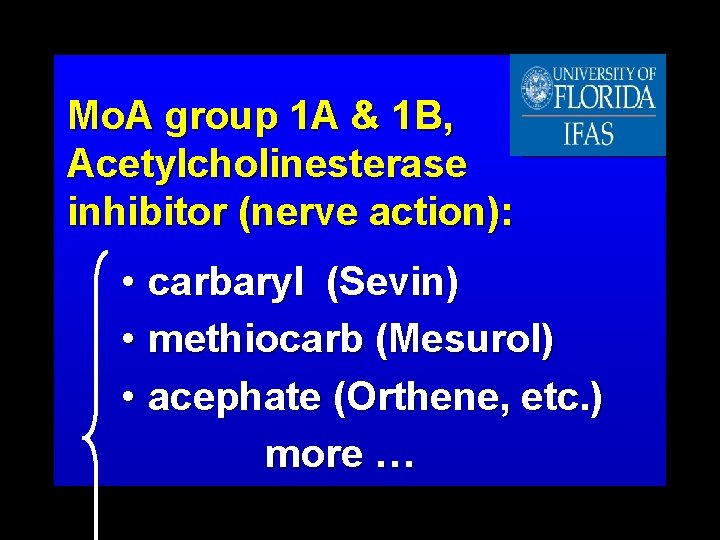
Mo. A group 1 A & 1 B, Acetylcholinesterase inhibitor (nerve action): • carbaryl (Sevin) • methiocarb (Mesurol) • acephate (Orthene, etc. ) more …
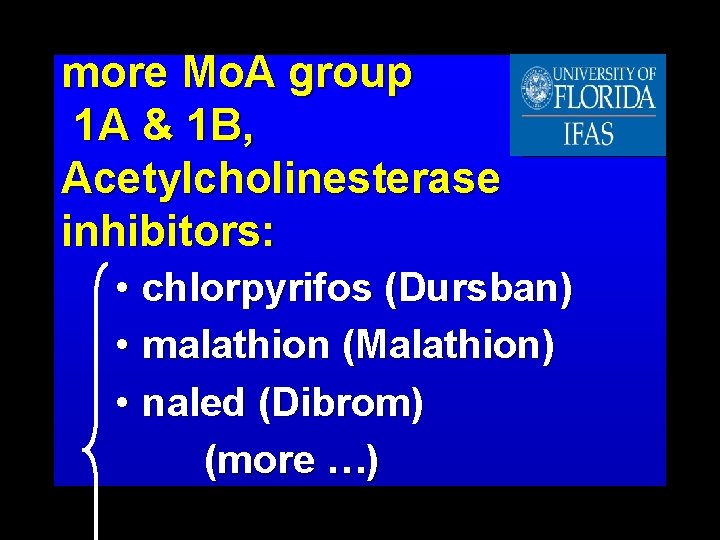
more Mo. A group 1 A & 1 B, Acetylcholinesterase inhibitors: • chlorpyrifos (Dursban) • malathion (Malathion) • naled (Dibrom) (more …)
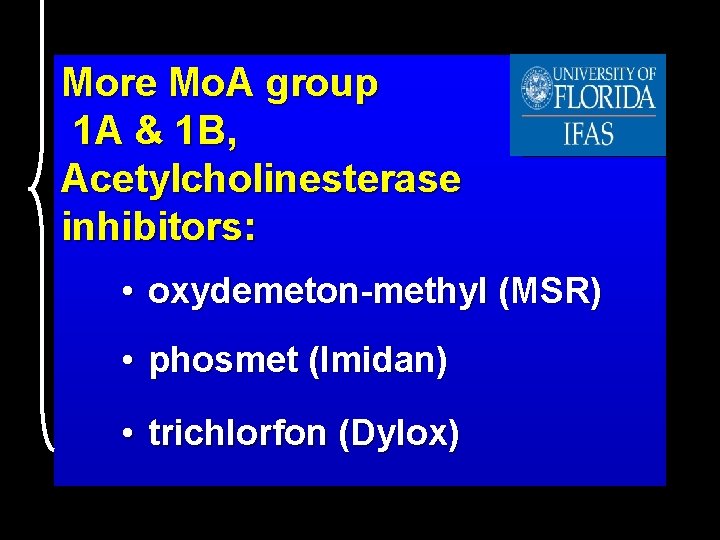
More Mo. A group 1 A & 1 B, Acetylcholinesterase inhibitors: • oxydemeton-methyl (MSR) • phosmet (Imidan) • trichlorfon (Dylox)
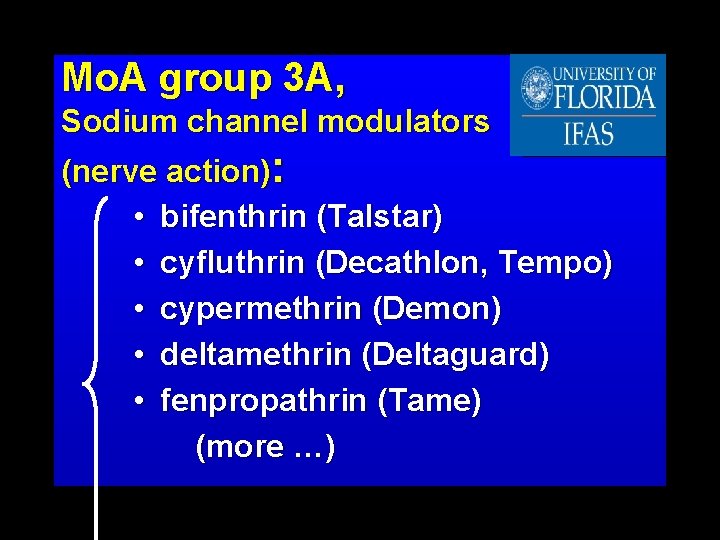
Mo. A group 3 A, Sodium channel modulators (nerve action): • bifenthrin (Talstar) • cyfluthrin (Decathlon, Tempo) • cypermethrin (Demon) • deltamethrin (Deltaguard) • fenpropathrin (Tame) (more …)
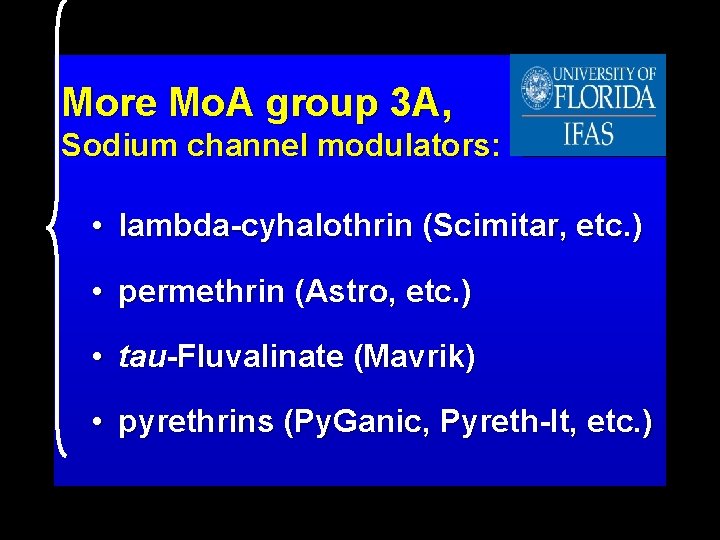
More Mo. A group 3 A, Sodium channel modulators: • lambda-cyhalothrin (Scimitar, etc. ) • permethrin (Astro, etc. ) • tau-Fluvalinate (Mavrik) • pyrethrins (Py. Ganic, Pyreth-It, etc. )
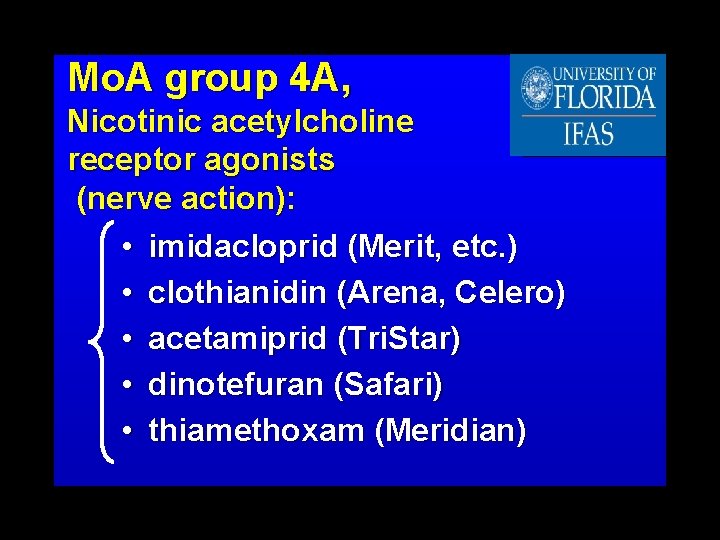
Mo. A group 4 A, Nicotinic acetylcholine receptor agonists (nerve action): • imidacloprid (Merit, etc. ) • clothianidin (Arena, Celero) • acetamiprid (Tri. Star) • dinotefuran (Safari) • thiamethoxam (Meridian)
Mo. A group 7 A, 7 B & 7 C, Juvenile hormone mimics (growth regulation): • 7 A s-methoprene (Extinguish) • 7 B fenoxycarb (Award) • 7 C pyriproxyfen (Distance)
Mo. A group 9 B & 9 C, Selective homopteran feeding blockers: • 9 B pymetrozine (Endeavor) • 9 C flonicamid (Aria)
Mo. A group 10 A & 10 B, Mite growth inhibitors (growth regulation): • 10 A hexythiazox (Hexygon) • 10 B etoxazole (Tetrasan)
Mo. A group 18, Ecdysone receptor agonists (growth regulation): • tebufenozide (Mimic) • halofenozide (Mach 2)
Mo. A group 20 A & 20 B, Mitochondrial complex III electron transport inhibitors (energy metabolism): • 20 A hydramethylnon (Amdro) • 20 B acequinocyl (Shuttle)
Each of the following AIs is alone in its Mo. A group. EACH can be used in the same plan! (Each gets is own “drawer”)
Mo. A group 2 B, GABA-gated chloride channel antagonists (nerve action): • fipronil (Chipco Choice, etc. )
Mo. A group 5, Nicotinic acetylcholine receptor allosteric activators (nerve action): • spinosad (Conserve, Justice)
Mo. A group 6, Chloride channel activators (nerve and muscle action): • abamectin (Avid, Lucid)
Mo. A group 11, Microbial disruptors of insect midgut membranes: • Bacillus thuringiensis and its sub-species
Mo. A group 12 B, Inhibitors of mitochondrial ATP synthase (energy metabolism): • fenbutatin-oxide (Pro. Mite)
Mo. A group 15, Inhibitors of chitin biosynthesis type 0 (growth regulation): • diflubenzuron (Dimilin)
Mo. A group 16, Inhibitors of chitin biosynthesis type 1 (growth regulation): • buprofezin (Talus)
Mo. A group 17, Moulting disruptor, dipteran (growth regulation): • cyromazine (Citation)
Mo. A group 22 A, Voltage dependent sodium channel blockers (nerve action): • indoxacarb (Advion, Provaunt)
Mo. A group 23, Inhibitors of acetyl Co. A carboxylase (lipid synthesis, growth regulation): • spiromesifen (Forbid)
Mo. A group 28, Ryanodine receptor modulators (nerve & muscle action): • chlorantraniliprole (Acelepryn)
Mo. A group un, compounds of unknown or uncertain mode of action (seperate drawers ? ): • • azadirachtin (Azatin, Ornazin, etc. ) bifenazate (Floramite) cryolite (Kryocide) dicofol (Kelthane)
But some do not need a Mo. A group code … No code: • • • Beauveria bassiana (Naturalis, Botanigard) metaldehyde (Deadline, Trails End) neem oil (Triact) petroleum oils (Pure. Spray Green, Ultra-Fine oil, etc. ) soaps (DES-X, M-Pede) Steinernema spp. –nematodes (Bio. Vector, Millenium, Nematac)
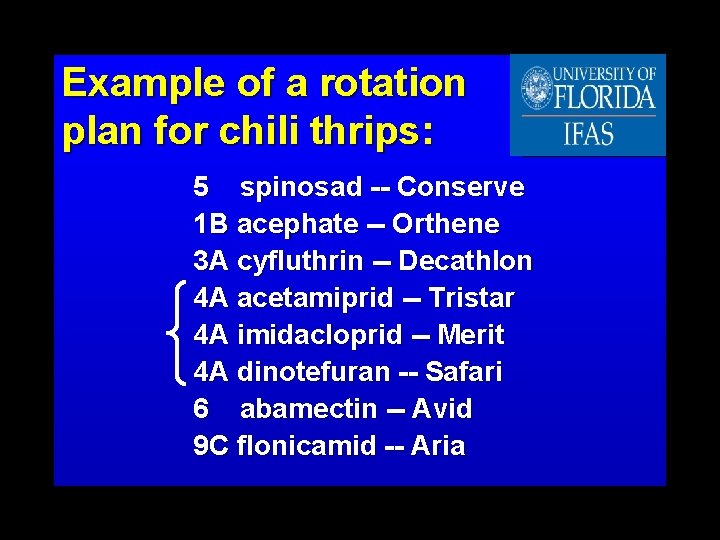
Example of a rotation plan for chili thrips: 5 spinosad -- Conserve 1 B acephate -- Orthene 3 A cyfluthrin -- Decathlon 4 A acetamiprid -- Tristar 4 A imidacloprid -- Merit 4 A dinotefuran -- Safari 6 abamectin -- Avid 9 C flonicamid -- Aria
Summary: • Resistance is from overuse of an insecticide Mo. A • Delay resistance by using all control methods and rotating among Mo. A • Mo. A listed at http: //www. irac-online. org/ Crop_Protection/Mo. A. asp (look for “Mo. A Classification Scheme”)
Phytotoxicity Red Flags among Ornamental Insecticides
Some Common Phytotoxicity Manifestations: • • Leaf/petal/bract specking, spotting, necrosis Leaf/petal/bract marginal “burn” Leaf blade/bract thickening Leaf blade/bract “crinkling” Leaf blade loss of shine Stem internode length reduction Dead plant
Learn from pesticide labels (Labels are your friends!)
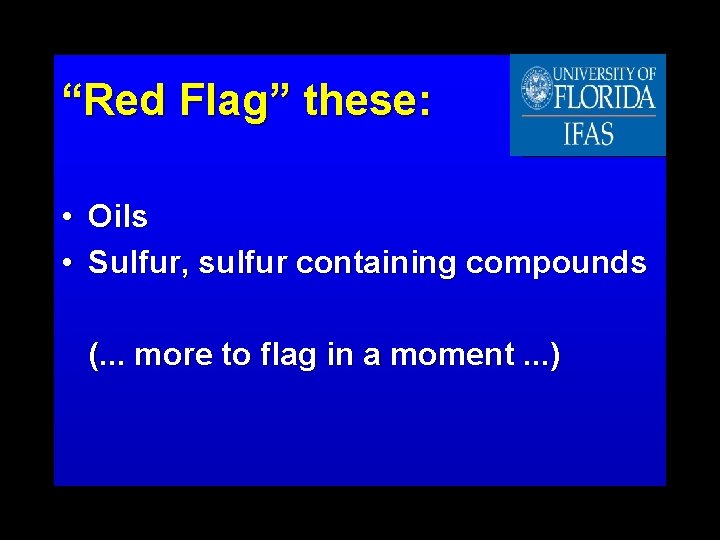
“Red Flag” these: • Oils • Sulfur, sulfur containing compounds (. . . more to flag in a moment. . . )
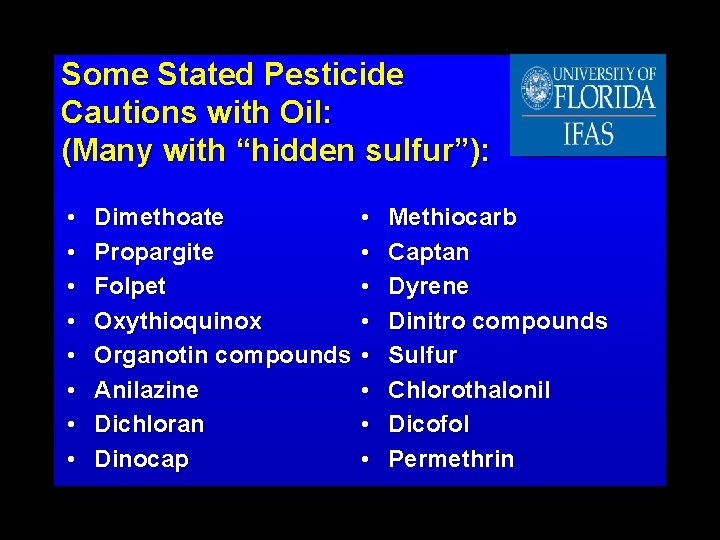
Some Stated Pesticide Cautions with Oil: (Many with “hidden sulfur”): • • Dimethoate Propargite Folpet Oxythioquinox Organotin compounds Anilazine Dichloran Dinocap • • Methiocarb Captan Dyrene Dinitro compounds Sulfur Chlorothalonil Dicofol Permethrin
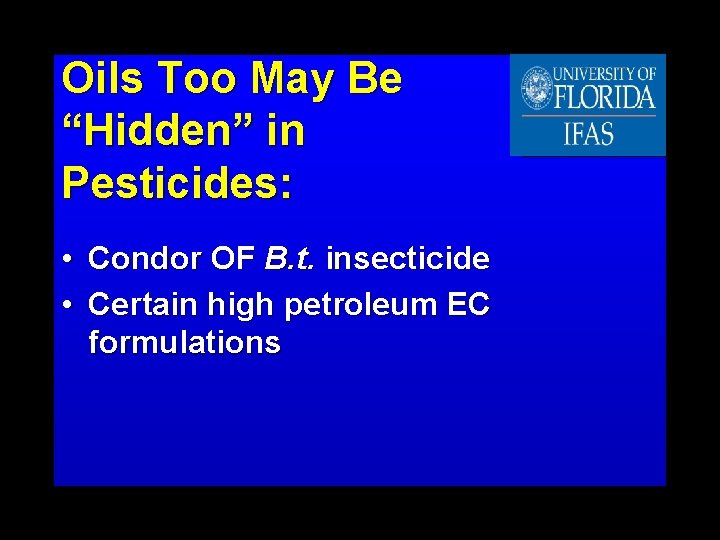
Oils Too May Be “Hidden” in Pesticides: • Condor OF B. t. insecticide • Certain high petroleum EC formulations
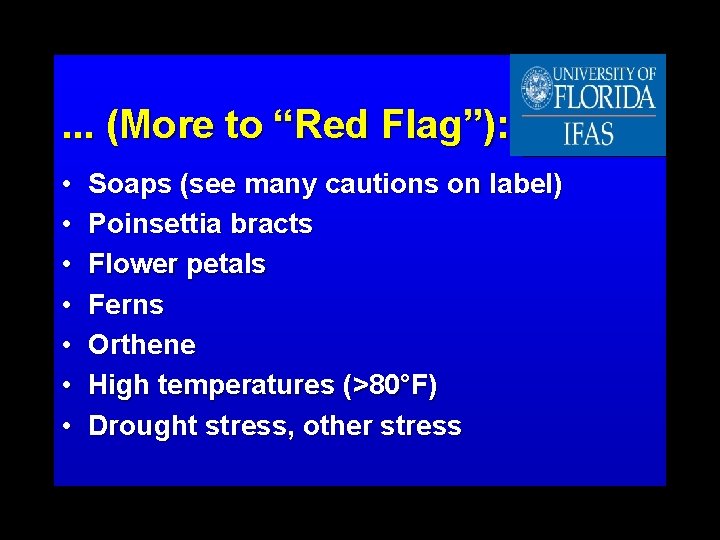
. . . (More to “Red Flag”): • • Soaps (see many cautions on label) Poinsettia bracts Flower petals Ferns Orthene High temperatures (>80°F) Drought stress, other stress
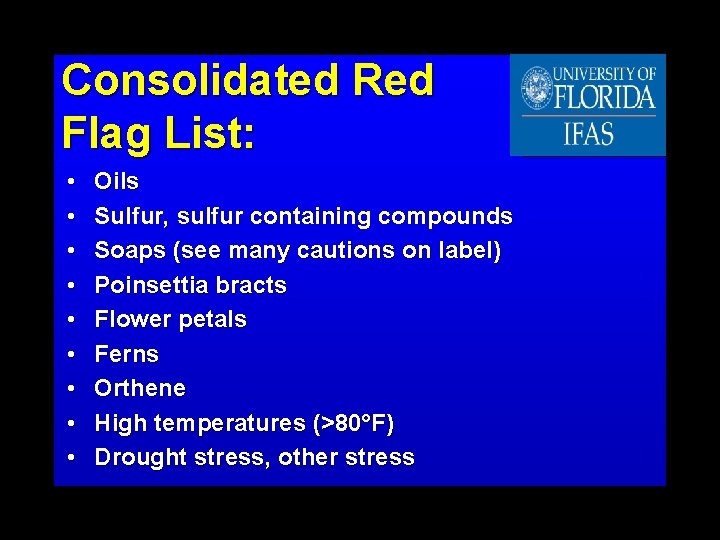
Consolidated Red Flag List: • • • Oils Sulfur, sulfur containing compounds Soaps (see many cautions on label) Poinsettia bracts Flower petals Ferns Orthene High temperatures (>80°F) Drought stress, other stress
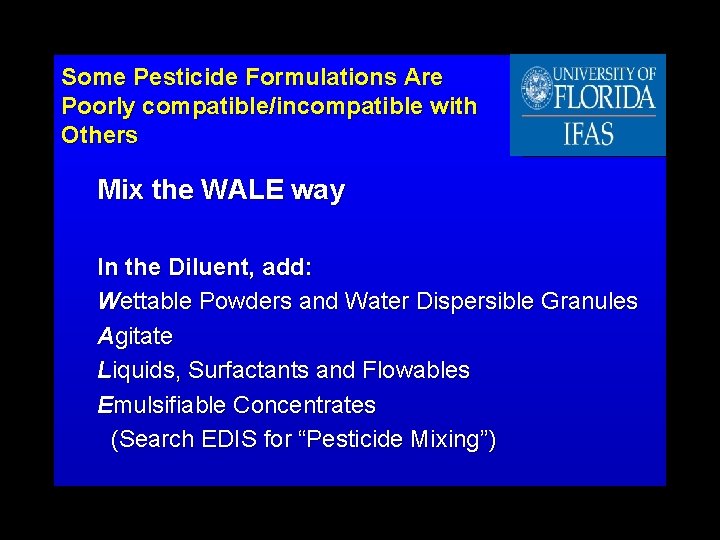
Some Pesticide Formulations Are Poorly compatible/incompatible with Others Mix the WALE way In the Diluent, add: Wettable Powders and Water Dispersible Granules Agitate Liquids, Surfactants and Flowables Emulsifiable Concentrates (Search EDIS for “Pesticide Mixing”)
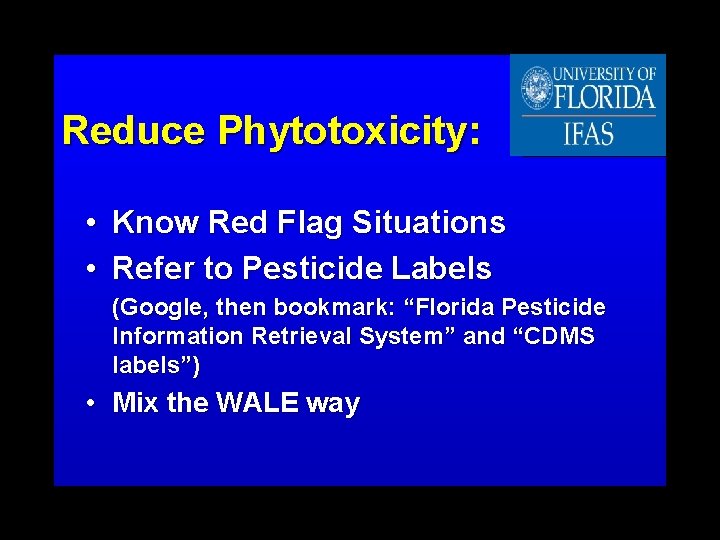
Reduce Phytotoxicity: • Know Red Flag Situations • Refer to Pesticide Labels (Google, then bookmark: “Florida Pesticide Information Retrieval System” and “CDMS labels”) • Mix the WALE way