
Knee Joint Loading in People with a Unilateral
- Slides: 1
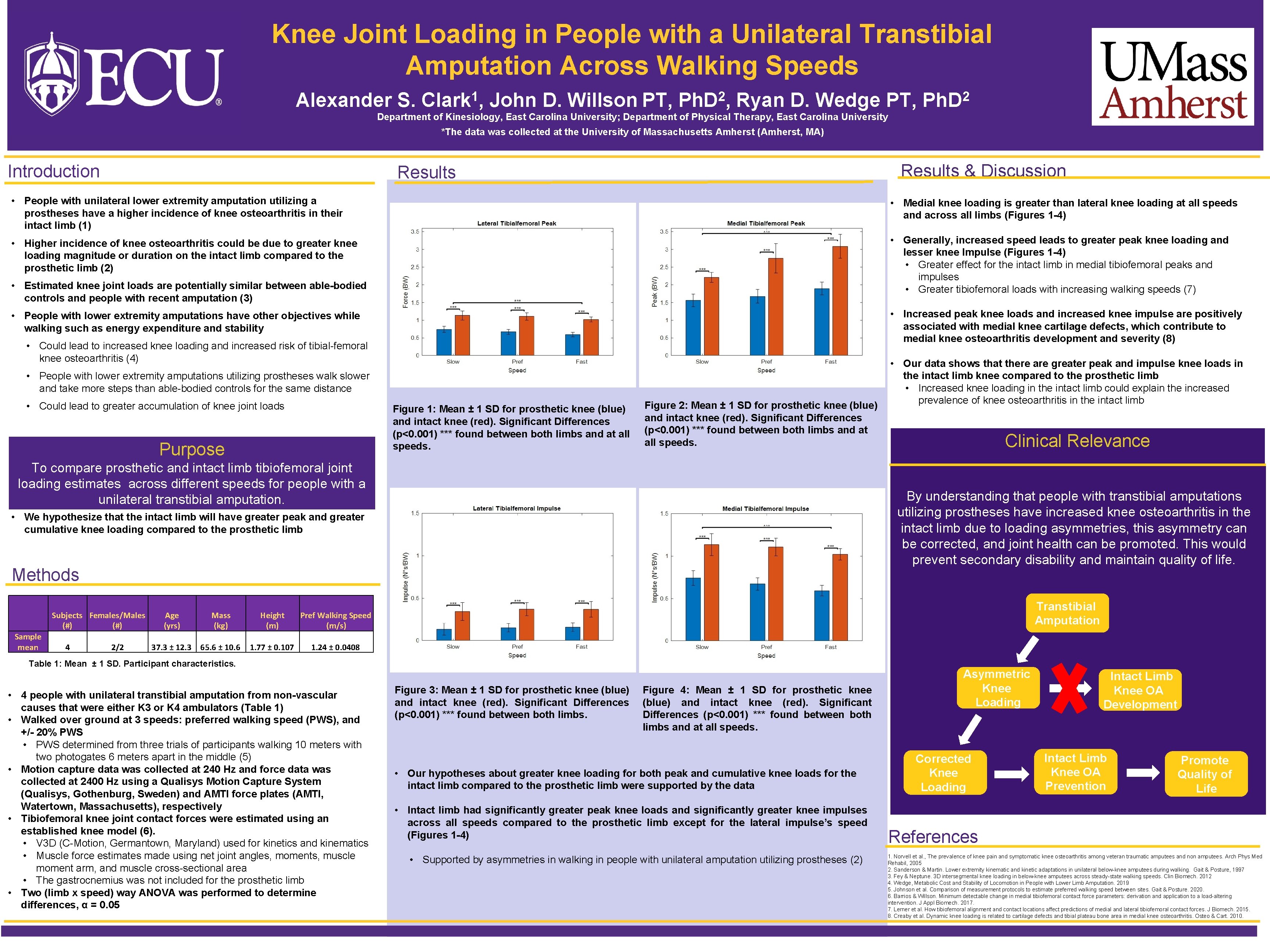
Knee Joint Loading in People with a Unilateral Transtibial Amputation Across Walking Speeds Alexander S. 1 Clark , John D. Willson PT, 2 Ph. D , Ryan D. Wedge PT, 2 Ph. D Department of Kinesiology, East Carolina University; Department of Physical Therapy, East Carolina University *The data was collected at the University of Massachusetts Amherst (Amherst, MA) Introduction Results & Discussion Results • People with unilateral lower extremity amputation utilizing a prostheses have a higher incidence of knee osteoarthritis in their intact limb (1) • Medial knee loading is greater than lateral knee loading at all speeds and across all limbs (Figures 1 -4) • Higher incidence of knee osteoarthritis could be due to greater knee loading magnitude or duration on the intact limb compared to the prosthetic limb (2) • Generally, increased speed leads to greater peak knee loading and lesser knee Impulse (Figures 1 -4) • Greater effect for the intact limb in medial tibiofemoral peaks and impulses • Greater tibiofemoral loads with increasing walking speeds (7) • Estimated knee joint loads are potentially similar between able-bodied controls and people with recent amputation (3) • Increased peak knee loads and increased knee impulse are positively associated with medial knee cartilage defects, which contribute to medial knee osteoarthritis development and severity (8) • People with lower extremity amputations have other objectives while walking such as energy expenditure and stability • Could lead to increased knee loading and increased risk of tibial-femoral knee osteoarthritis (4) • People with lower extremity amputations utilizing prostheses walk slower and take more steps than able-bodied controls for the same distance • Could lead to greater accumulation of knee joint loads Figure 1: Mean ± 1 SD for prosthetic knee (blue) and intact knee (red). Significant Differences (p<0. 001) *** found between both limbs and at all speeds. Purpose Figure 2: Mean ± 1 SD for prosthetic knee (blue) and intact knee (red). Significant Differences (p<0. 001) *** found between both limbs and at all speeds. To compare prosthetic and intact limb tibiofemoral joint loading estimates across different speeds for people with a unilateral transtibial amputation. Methods Sample mean 4 2/2 Age (yrs) Mass (kg) Height (m) Pref Walking Speed (m/s) 37. 3 ± 12. 3 65. 6 ± 10. 6 1. 77 ± 0. 107 1. 24 ± 0. 0408 Transtibial Amputation Table 1: Mean ± 1 SD. Participant characteristics. • 4 people with unilateral transtibial amputation from non-vascular causes that were either K 3 or K 4 ambulators (Table 1) • Walked over ground at 3 speeds: preferred walking speed (PWS), and +/- 20% PWS • PWS determined from three trials of participants walking 10 meters with two photogates 6 meters apart in the middle (5) • Motion capture data was collected at 240 Hz and force data was collected at 2400 Hz using a Qualisys Motion Capture System (Qualisys, Gothenburg, Sweden) and AMTI force plates (AMTI, Watertown, Massachusetts), respectively • Tibiofemoral knee joint contact forces were estimated using an established knee model (6). • V 3 D (C-Motion, Germantown, Maryland) used for kinetics and kinematics • Muscle force estimates made using net joint angles, moments, muscle moment arm, and muscle cross-sectional area • The gastrocnemius was not included for the prosthetic limb • Two (limb x speed) way ANOVA was performed to determine differences, α = 0. 05 Clinical Relevance By understanding that people with transtibial amputations utilizing prostheses have increased knee osteoarthritis in the intact limb due to loading asymmetries, this asymmetry can be corrected, and joint health can be promoted. This would prevent secondary disability and maintain quality of life. • We hypothesize that the intact limb will have greater peak and greater cumulative knee loading compared to the prosthetic limb Subjects Females/Males (#) • Our data shows that there are greater peak and impulse knee loads in the intact limb knee compared to the prosthetic limb • Increased knee loading in the intact limb could explain the increased prevalence of knee osteoarthritis in the intact limb Figure 3: Mean ± 1 SD for prosthetic knee (blue) and intact knee (red). Significant Differences (p<0. 001) *** found between both limbs. Figure 4: Mean ± 1 SD for prosthetic knee (blue) and intact knee (red). Significant Differences (p<0. 001) *** found between both limbs and at all speeds. • Our hypotheses about greater knee loading for both peak and cumulative knee loads for the intact limb compared to the prosthetic limb were supported by the data • Intact limb had significantly greater peak knee loads and significantly greater knee impulses across all speeds compared to the prosthetic limb except for the lateral impulse’s speed (Figures 1 -4) • Supported by asymmetries in walking in people with unilateral amputation utilizing prostheses (2) Asymmetric Knee Loading Corrected Knee Loading Intact Limb Knee OA Development Intact Limb Knee OA Prevention Promote Quality of Life References 1. Norvell et al. , The prevalence of knee pain and symptomatic knee osteoarthritis among veteran traumatic amputees and non amputees. Arch Phys Med Rehabil, 2005 2. Sanderson & Martin. Lower extremity kinematic and kinetic adaptations in unilateral below-knee amputees during walking. Gait & Posture, 1997 3. Fey & Neptune. 3 D intersegmental knee loading in below-knee amputees across steady-state walking speeds. Clin Biomech. 2012 4. Wedge, Metabolic Cost and Stability of Locomotion in People with Lower Limb Amputation. 2019 5. Johnson et al. Comparison of measurement protocols to estimate preferred walking speed between sites. Gait & Posture. 2020. 6. Barrios & Willson. Minimum detectable change in medial tibiofemoral contact force parameters: derivation and application to a load-altering intervention. J Appl Biomech. 2017. 7. Lerner et al. How tibiofemoral alignment and contact locations affect predictions of medial and lateral tibiofemoral contact forces. J Biomech. 2015. 8. Creaby et al. Dynamic knee loading is related to cartilage defects and tibial plateau bone area in medial knee osteoarthritis. Osteo & Cart. 2010.