
KNEE JOINT AND ITS CLINICAL ANATOMY BY DR
KNEE JOINT AND ITS CLINICAL ANATOMY BY DR. VINEETA WALDIA ASSISTANT PROFESSOR DEPT. OF SHARIR RACHNA H. A. M. C. H. , DEHRADUN, UK. CONTACT NO. - 8006969188 KNEE JOINT AND ITS CLINICAL ANATOMY 1/30
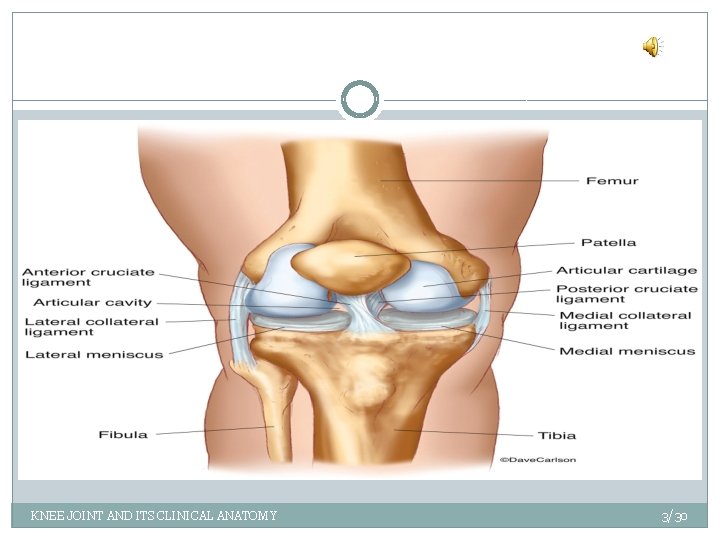
INTRODUCTION �Knee joint is the largest compound synovial joint in the body. v It has a. Tibiofemoral joint. 1) Medial Condylar Joint : Between the medial condyle of the femur & the medial condyle of the tibia. 2) Lateral Condylar Joint : Between the lateral condyle of the femur & the lateral condyle of the tibia. b. Patellofemoral Joint : Between the patella & the intercondylar groove of distal femur. �The fibula is NOT directly involved in the joint. KNEE JOINT AND ITS CLINICAL ANATOMY 2/30
KNEE JOINT AND ITS CLINICAL ANATOMY 3/30
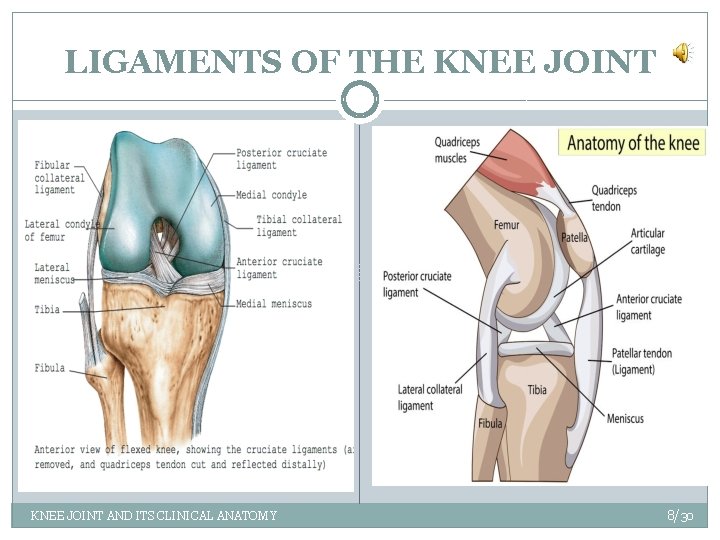
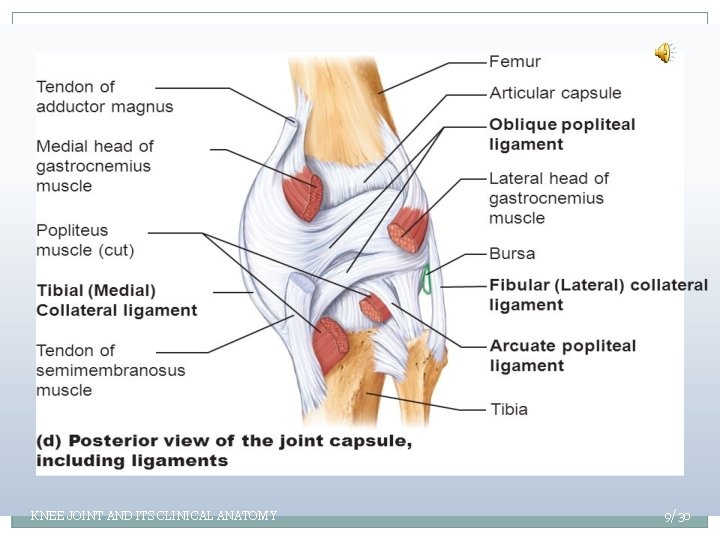
LIGAMENTS OF THE KNEE JOINT 1. EXTRACAPSULAR LIGAMENTS (5) 1. Patellar Ligament 2. Fibular Collateral Ligament 3. Tibial Collateral Ligament 4. Oblique Popliteal Ligament 5. Arcuate Popliteal Ligament. KNEE JOINT AND ITS CLINICAL ANATOMY 4/30
Extracapsular Ligaments of the KNEE JOINT 1. Patellar Ligament This is the central portion of the common tendon of insertion of the quadriceps femoris. It is attached above to the apex of the patella and below to the upper part of tibial tuberosity. 2. Fibular collateral ligament ( lateral collateral ligament) q A cord-like extra-capsular ligament. q It extends inferiorly from the lateral epicondyle of the femur to the lateral surface of the fibular head. KNEE JOINT AND ITS CLINICAL ANATOMY 5555555/30
Contd… 3. The tibial collateral ligament (TCL; medial collateral ligament) 1. It is a strong, flat, band that extends from the medial epicondyle of the femur to the medial condyle and the superior part of the medial surface of the tibia. 2. The TCL, weaker than the FCL, is more often damaged. 4. Oblique popliteal ligament It is a recurrent expansion of the tendon of the semimembranosus. The ligament arises posterior to the medial tibial condyle and passes superolaterally toward the lateral femoral condyle. KNEE JOINT AND ITS CLINICAL ANATOMY 6/30
Contd… 5. Arcuate popliteal ligament �It also strengthens the joint capsule posterolaterally. �It arises from the posterior aspect of the fibular head, passes superomedially over the tendon of the popliteus, and is attached to the posterior border of the intercondylar area of the tibia. KNEE JOINT AND ITS CLINICAL ANATOMY 7/30
LIGAMENTS OF THE KNEE JOINT AND ITS CLINICAL ANATOMY 8/30
` KNEE JOINT AND ITS CLINICAL ANATOMY 9/30
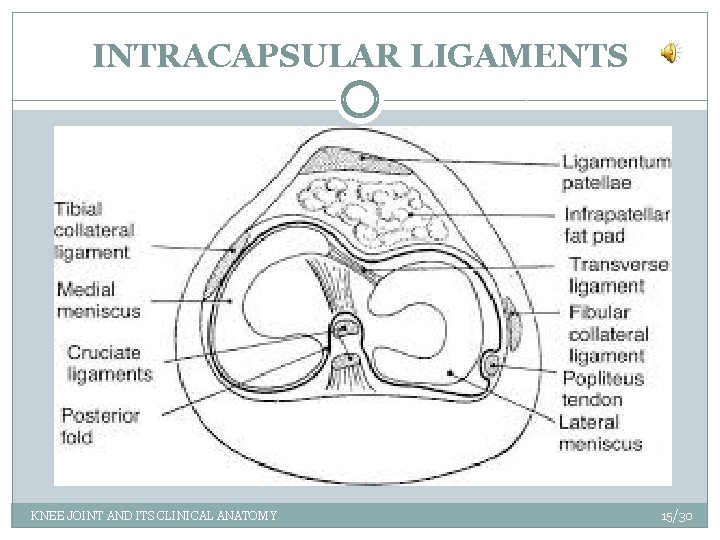
Intra-Articular Ligaments INTRA ARTICULAR LIGAMENTS (5) 1. Anterior cruciate ligament 2. Posterior cruciate ligament 3. Medial menisci 4. Lateral menisci 5. Transverse ligament KNEE JOINT AND ITS CLINICAL ANATOMY 10/30
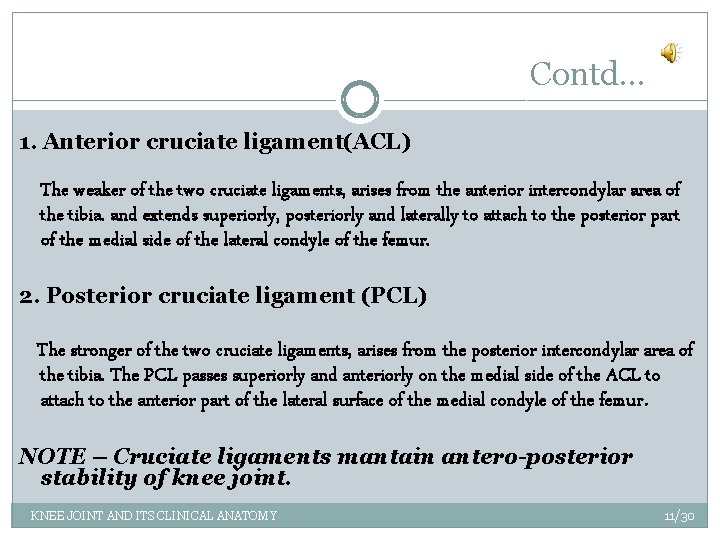
Contd… 1. Anterior cruciate ligament(ACL) The weaker of the two cruciate ligaments, arises from the anterior intercondylar area of the tibia. and extends superiorly, posteriorly and laterally to attach to the posterior part of the medial side of the lateral condyle of the femur. 2. Posterior cruciate ligament (PCL) The stronger of the two cruciate ligaments, arises from the posterior intercondylar area of the tibia. The PCL passes superiorly and anteriorly on the medial side of the ACL to attach to the anterior part of the lateral surface of the medial condyle of the femur. NOTE – Cruciate ligaments mantain antero-posterior stability of knee joint. KNEE JOINT AND ITS CLINICAL ANATOMY 11/30
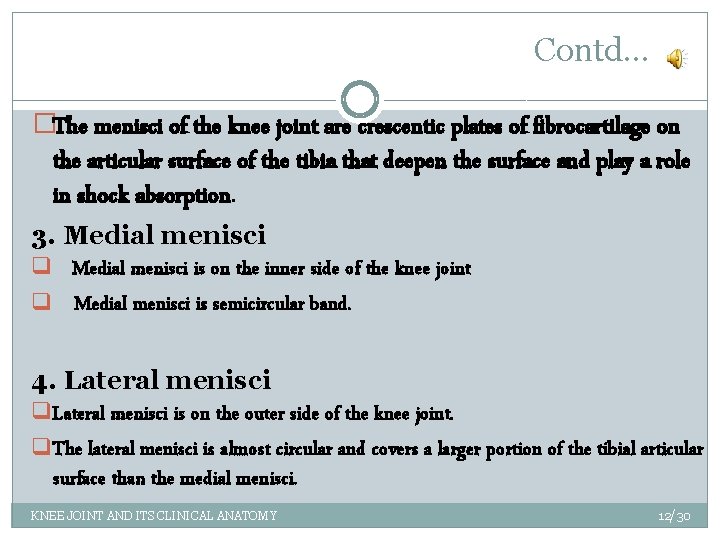
Contd… �The menisci of the knee joint are crescentic plates of fibrocartilage on the articular surface of the tibia that deepen the surface and play a role in shock absorption. 3. Medial menisci q Medial menisci is on the inner side of the knee joint q Medial menisci is semicircular band. 4. Lateral menisci q Lateral menisci is on the outer side of the knee joint. q The lateral menisci is almost circular and covers a larger portion of the tibial articular surface than the medial menisci. KNEE JOINT AND ITS CLINICAL ANATOMY 12/30
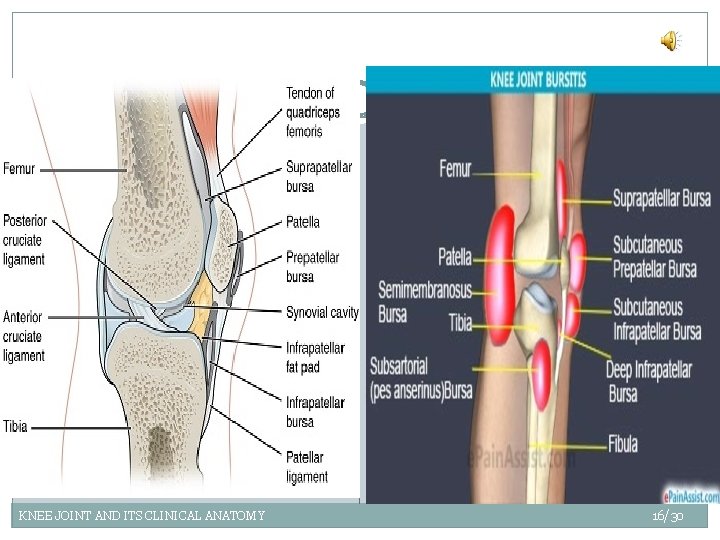
Contd… 5. Transverse ligament � It connects the anterior ends of the medial and lateral menisci. � BURSA There at least 13 bursae around the knee joint. Anterior-4 � The subcutaneous prepatellar and infrapatellar bursa, deep infrapatellar bursa. � The large suprapatellar bursa is especially important because an infection in it may spread to the knee joint cavity. KNEE JOINT AND ITS CLINICAL ANATOMY 13/30
Lateral -4 A bursa deep to medial head of gastrocnemius. q A bursa between the fibular collateral ligament and biceps femoris q A bursa between the fibular collateral ligament and the tendon of popliteus q Tendon of popliteus and the lateral condyle of the tibia q Medial bursa -5 q Deep to medial head of gastroncnemius q Deep to the tibial collateral ligament q Deep to the semimembranosus q Between semimembranosus and semitendinosus q Anserine bursa (deep to the tendinous distal attachments of the sartorius, gracilis, and semitendinosus) KNEE JOINT AND ITS CLINICAL ANATOMY 14/30
INTRACAPSULAR LIGAMENTS KNEE JOINT AND ITS CLINICAL ANATOMY 15/30
KNEE JOINT AND ITS CLINICAL ANATOMY 16/30
�The articulation between the femur and tibia is weight-bearing, and the articulation between the patella and the femur allows the pull of the quadriceps muscle to be directed anteriorly over the knee to the tibia without tendon wear. �Basically the joint is a hinge joint that allows mainly flexion and extension. �Innervations 1. 2. 3. Femoral nerve Sciatic nerve Obturator nerve KNEE JOINT AND ITS CLINICAL ANATOMY 17/30
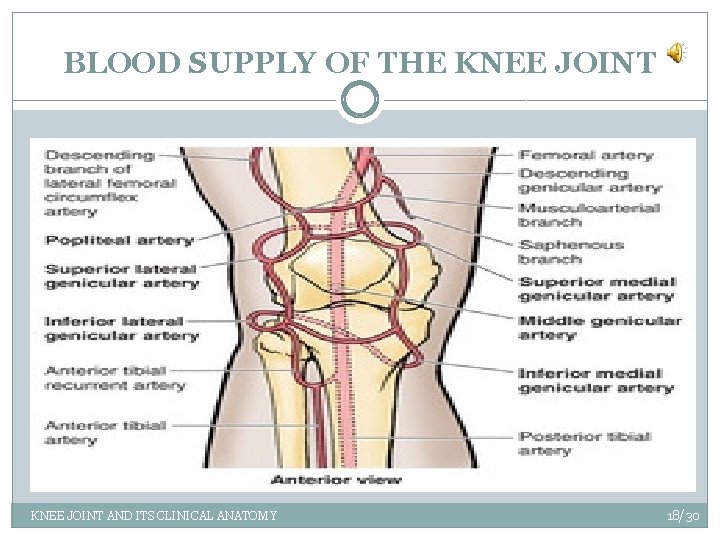
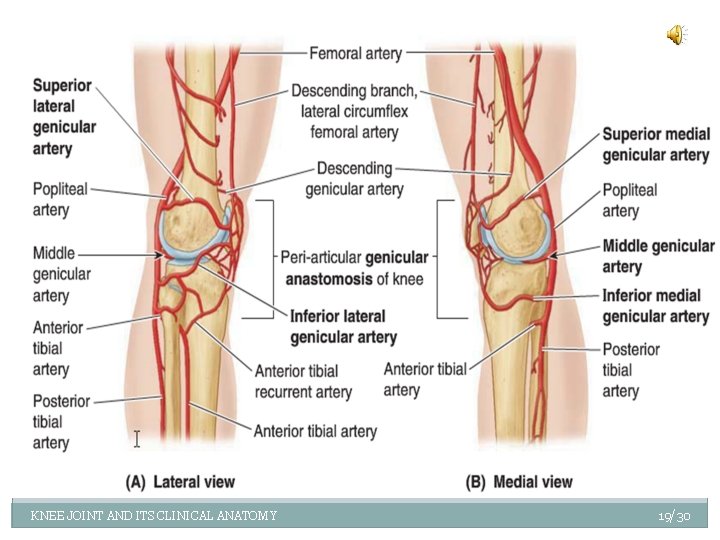
BLOOD SUPPLY OF THE KNEE JOINT AND ITS CLINICAL ANATOMY 18/30
KNEE JOINT AND ITS CLINICAL ANATOMY 19/30
CLINICAL ANATOMY 1) ABNORMAL ANGLES OF KNEE JOINT 2) MENISCAL TEAR 3) CLERGYMAN’S KNEE 4) HOUSEMAID’S KNEE 5) KNEE TENDONITIS [JUMPER’S KNEE] 6) PATELLAR DISLOCATION 7) ANTERIOR AND POSTERIOR DRAWER SIGN 8) TERRIBLE TRIAD OF O’DONOGHUE 9) OSTEOARTHRITIS 10)RHEUMATOID ARTHRITIS KNEE JOINT AND ITS CLINICAL ANATOMY 20/30
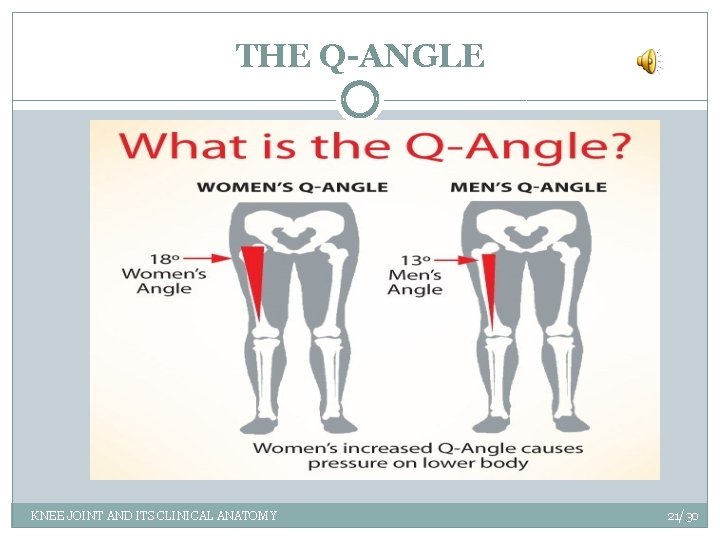
THE Q-ANGLE KNEE JOINT AND ITS CLINICAL ANATOMY 21/30
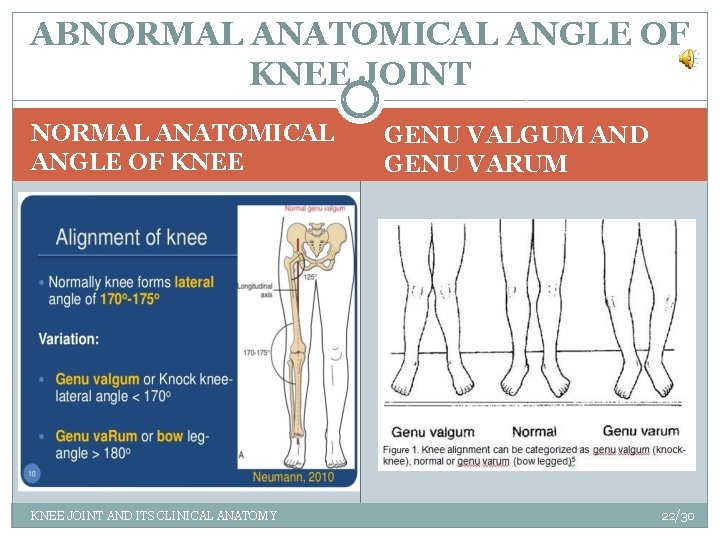
ABNORMAL ANATOMICAL ANGLE OF KNEE JOINT AND ITS CLINICAL ANATOMY GENU VALGUM AND GENU VARUM 22/30
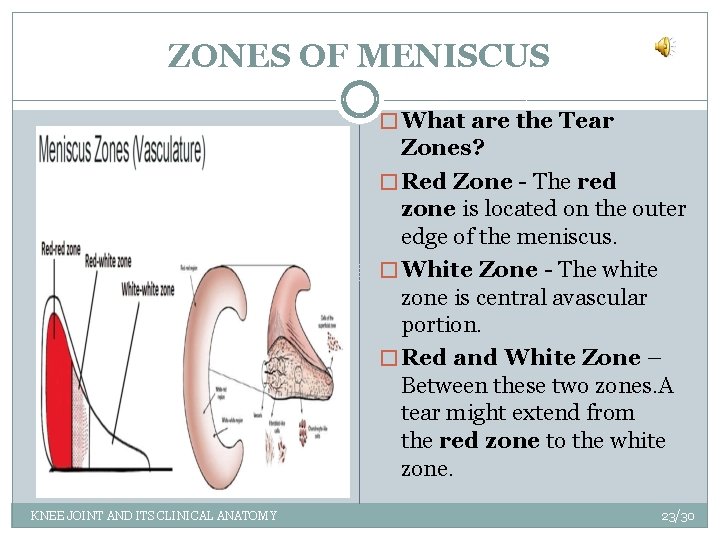
ZONES OF MENISCUS � What are the Tear Zones? � Red Zone - The red zone is located on the outer edge of the meniscus. � White Zone - The white zone is central avascular portion. � Red and White Zone – Between these two zones. A tear might extend from the red zone to the white zone. KNEE JOINT AND ITS CLINICAL ANATOMY 23/30
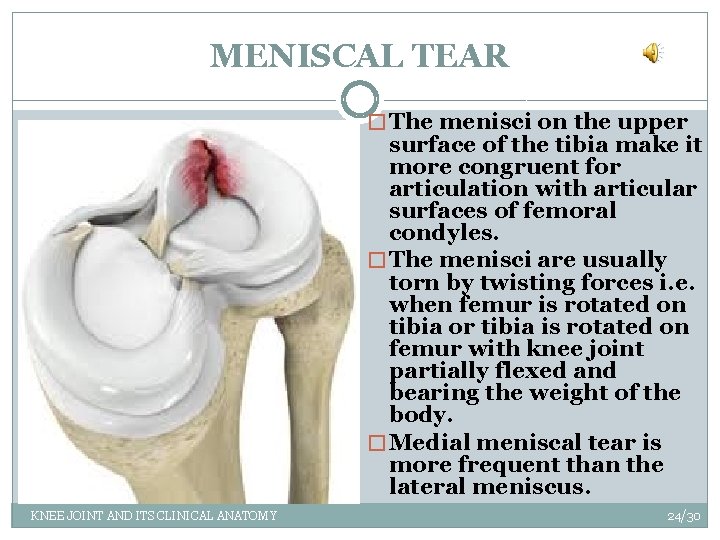
MENISCAL TEAR � The menisci on the upper surface of the tibia make it more congruent for articulation with articular surfaces of femoral condyles. � The menisci are usually torn by twisting forces i. e. when femur is rotated on tibia or tibia is rotated on femur with knee joint partially flexed and bearing the weight of the body. � Medial meniscal tear is more frequent than the lateral meniscus. KNEE JOINT AND ITS CLINICAL ANATOMY 24/30
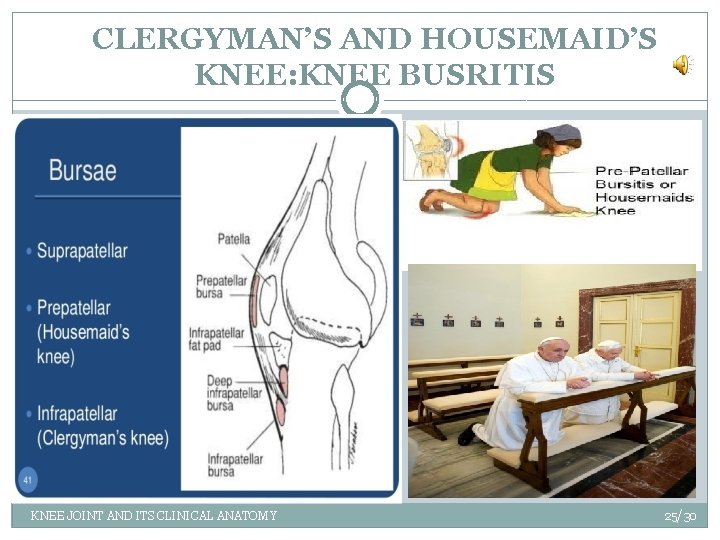
CLERGYMAN’S AND HOUSEMAID’S KNEE: KNEE BUSRITIS KNEE JOINT AND ITS CLINICAL ANATOMY 25/30
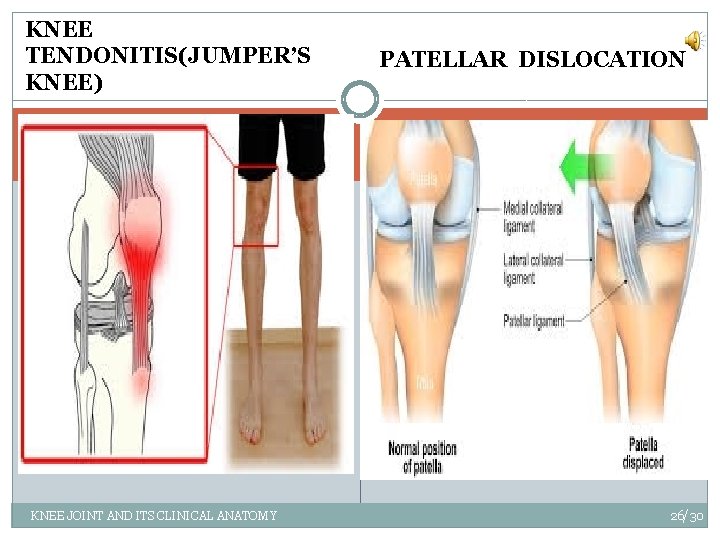
KNEE TENDONITIS(JUMPER’S KNEE) KNEE JOINT AND ITS CLINICAL ANATOMY PATELLAR DISLOCATION 26/30
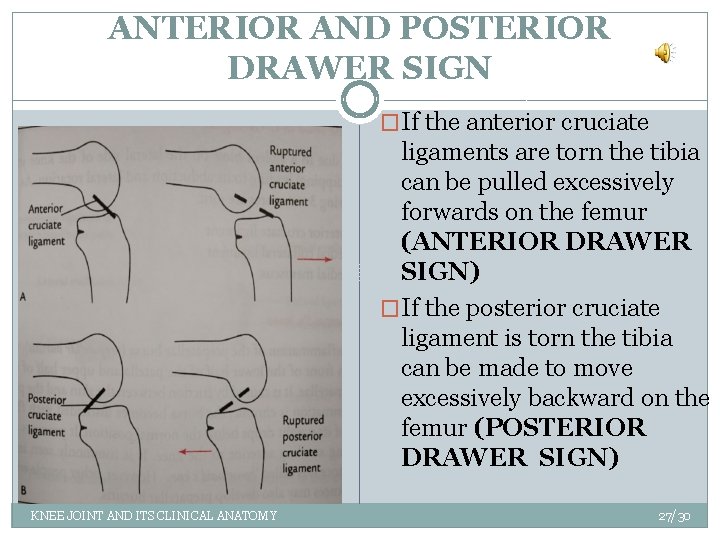
ANTERIOR AND POSTERIOR DRAWER SIGN �If the anterior cruciate ligaments are torn the tibia can be pulled excessively forwards on the femur (ANTERIOR DRAWER SIGN) �If the posterior cruciate ligament is torn the tibia can be made to move excessively backward on the femur (POSTERIOR DRAWER SIGN) KNEE JOINT AND ITS CLINICAL ANATOMY 27/30
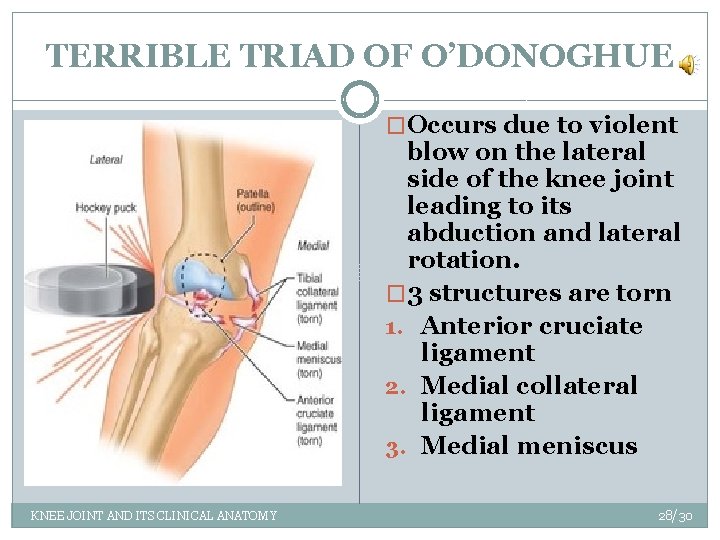
TERRIBLE TRIAD OF O’DONOGHUE �Occurs due to violent blow on the lateral side of the knee joint leading to its abduction and lateral rotation. � 3 structures are torn 1. Anterior cruciate ligament 2. Medial collateral ligament 3. Medial meniscus KNEE JOINT AND ITS CLINICAL ANATOMY 28/30
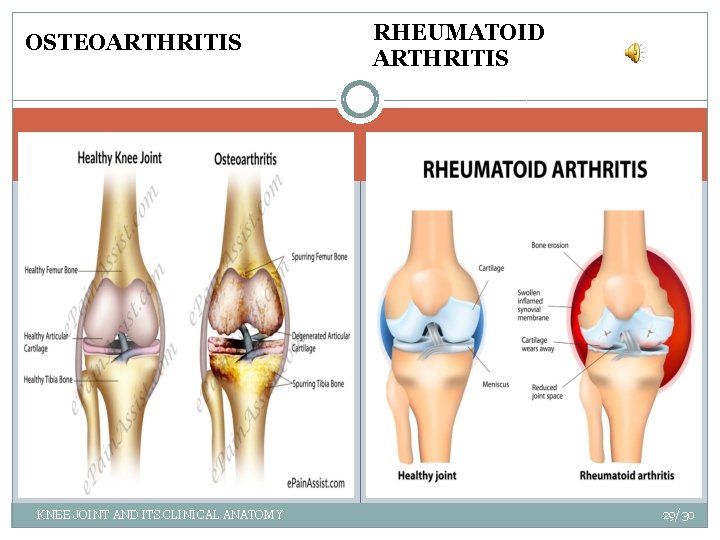
OSTEOARTHRITIS KNEE JOINT AND ITS CLINICAL ANATOMY RHEUMATOID ARTHRITIS 29/30
THANK YOU KNEE JOINT AND ITS CLINICAL ANATOMY 30/30
- Slides: 30