
Knee Anatomy 1 Modified hinge joint n flexion
- Slides: 27
Knee Anatomy (1) Modified hinge joint n flexion/ extension, internal/ external rotation Two distinct joints n n tibiofemoral joint Patellofemoral joint
Knee Anatomy (2) Tibiofemoral joint n condyles of the femur w very rounded w medial condyle is larger than the lateral condyle n Tibial plateaus w flattened, very slightly concave n “Screw home mechanism” w required to reach full extension w tibia rotates laterally on the femur to produce a locking of the knee
Knee Anatomy (3) Patellofemoral joint n patella w triangular shaped seasamoid bone: protect the knee joint n femur w Patellofemoral groove or trochlear surface Q angle n n The angle of pull of quadriceps on the patella normal is 13 degrees male/ 18 female
Knee Anatomy (4) Menisci n n n firbrocartilage discs Functions: 1) deepen the tibial plateaus or joint 2) absorption and dissipation of force 3) congruency of the surface to improve wt distribution 4) nourishment and lubrication of joint surfaces Thicker along the lateral portion
Menisci Cont n n n Poor blood supply (only outer 1/3 receives direct blood supply) Fig 11 -5 -C Medial is C shaped; Lateral is O shaped The medial is more commonly injured because of its attachment to the MCL ligament & more securely attached to the tibia (which makes it less mobile)
Knee Anatomy (5) 4 main ligaments- help stabilize knee jt Medial Collateral (Tibial Collateral) n n prevents valgus & rotational forces/stresses Attaches to medial femoral epicondyle and anterior medial tibia Lateral Collateral (Fibular Collateral) n n prevents varus struss Attaches to lateral femoral epicondyle and head of fibula
Knee Anatomy (6) Fig 11 -9 Anterior Cruciate (ACL) n n Prevents tibia from moving forward/ femur from going back attaches to lateral femoral condyle/ medial tibia at intercondylar eminence Posterior Cruciate (PCL) n n Prevents tibia from moving backward/ femur from going forward attaches to medial femoral condyle/ lateral tibia at intercondylar eminence
Knee Anatomy (7) Bursa – Fig 11 -2 C n n n formed by joint capsule function to reduce friction several: w Suprapatellar: largest in body w Prepatellar: between skin and patellar tendon (housemaids knee) w Infrapatellar: below petella (superficial and deep) w Pes anserine bursa- medial proximal aspect of tibia
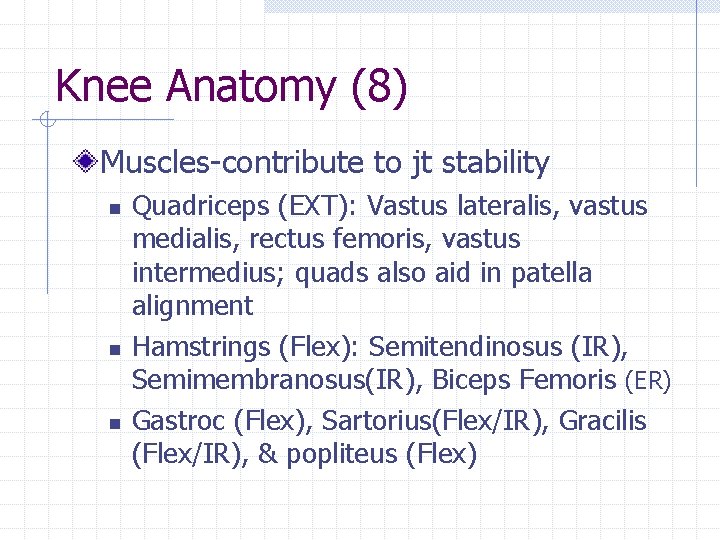
Knee Anatomy (8) Muscles-contribute to jt stability n n n Quadriceps (EXT): Vastus lateralis, vastus medialis, rectus femoris, vastus intermedius; quads also aid in patella alignment Hamstrings (Flex): Semitendinosus (IR), Semimembranosus(IR), Biceps Femoris (ER) Gastroc (Flex), Sartorius(Flex/IR), Gracilis (Flex/IR), & popliteus (Flex)
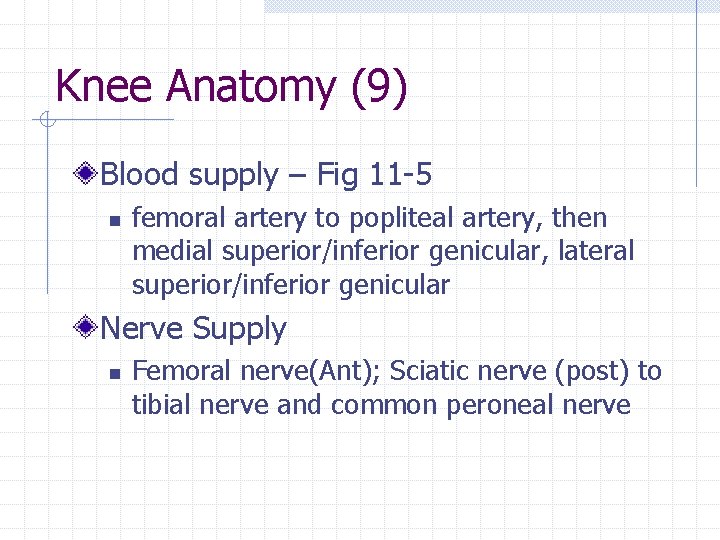
Knee Anatomy (9) Blood supply – Fig 11 -5 n femoral artery to popliteal artery, then medial superior/inferior genicular, lateral superior/inferior genicular Nerve Supply n Femoral nerve(Ant); Sciatic nerve (post) to tibial nerve and common peroneal nerve
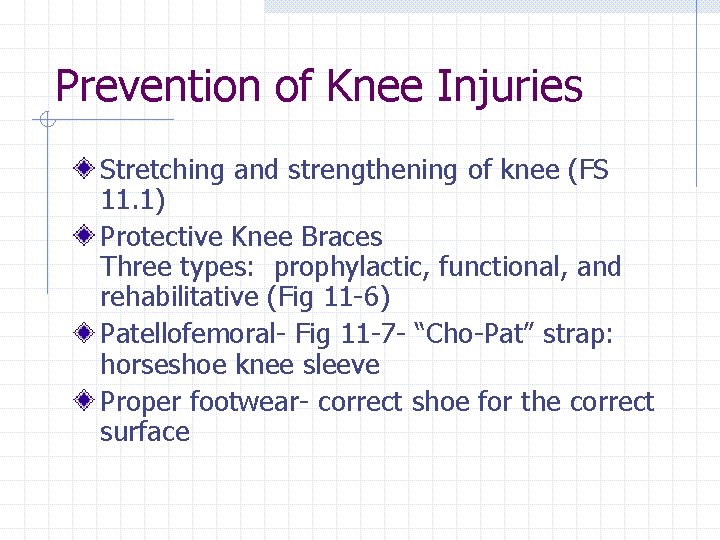
Prevention of Knee Injuries Stretching and strengthening of knee (FS 11. 1) Protective Knee Braces Three types: prophylactic, functional, and rehabilitative (Fig 11 -6) Patellofemoral- Fig 11 -7 - “Cho-Pat” strap: horseshoe knee sleeve Proper footwear- correct shoe for the correct surface
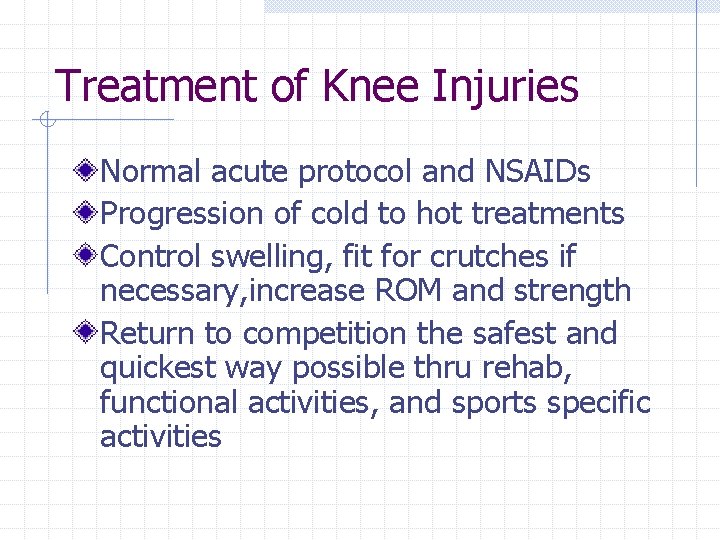
Treatment of Knee Injuries Normal acute protocol and NSAIDs Progression of cold to hot treatments Control swelling, fit for crutches if necessary, increase ROM and strength Return to competition the safest and quickest way possible thru rehab, functional activities, and sports specific activities
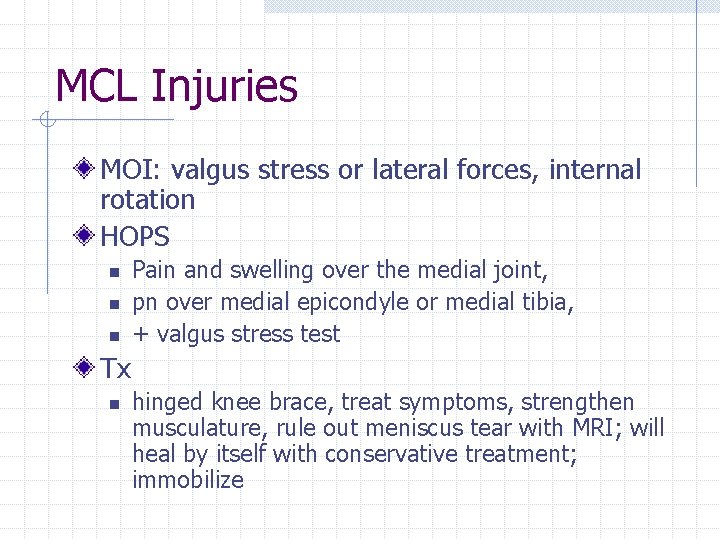
MCL Injuries MOI: valgus stress or lateral forces, internal rotation HOPS n n n Pain and swelling over the medial joint, pn over medial epicondyle or medial tibia, + valgus stress test Tx n hinged knee brace, treat symptoms, strengthen musculature, rule out meniscus tear with MRI; will heal by itself with conservative treatment; immobilize
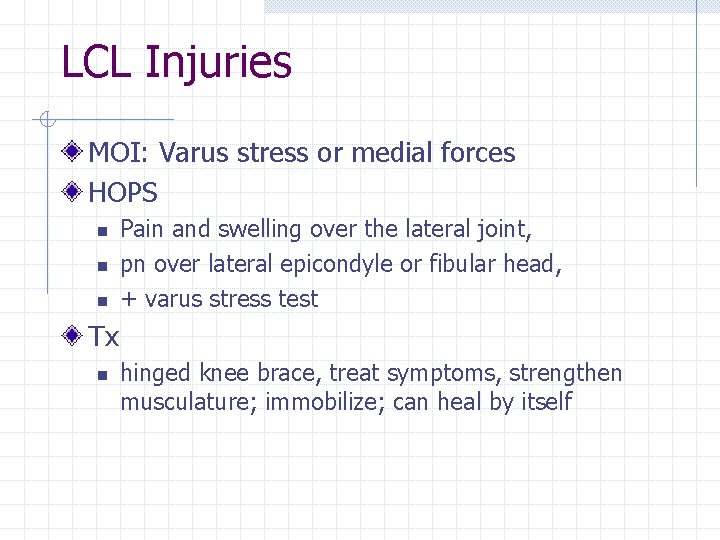
LCL Injuries MOI: Varus stress or medial forces HOPS n n n Pain and swelling over the lateral joint, pn over lateral epicondyle or fibular head, + varus stress test Tx n hinged knee brace, treat symptoms, strengthen musculature; immobilize; can heal by itself
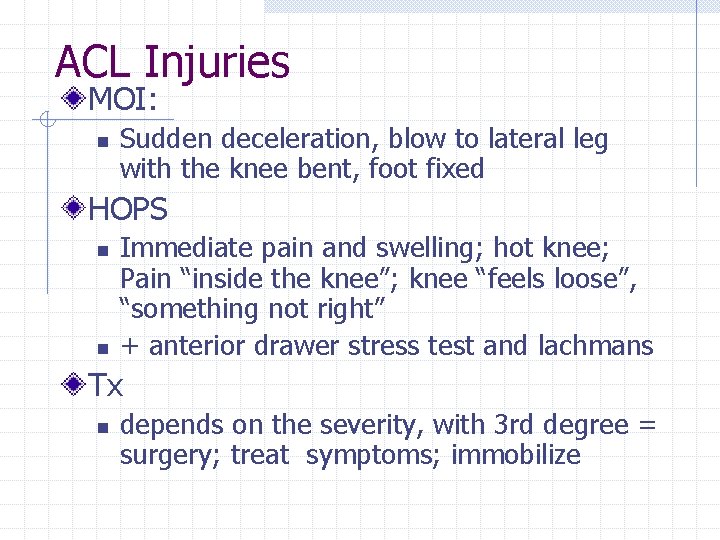
ACL Injuries MOI: n Sudden deceleration, blow to lateral leg with the knee bent, foot fixed HOPS n n Immediate pain and swelling; hot knee; Pain “inside the knee”; knee “feels loose”, “something not right” + anterior drawer stress test and lachmans Tx n depends on the severity, with 3 rd degree = surgery; treat symptoms; immobilize
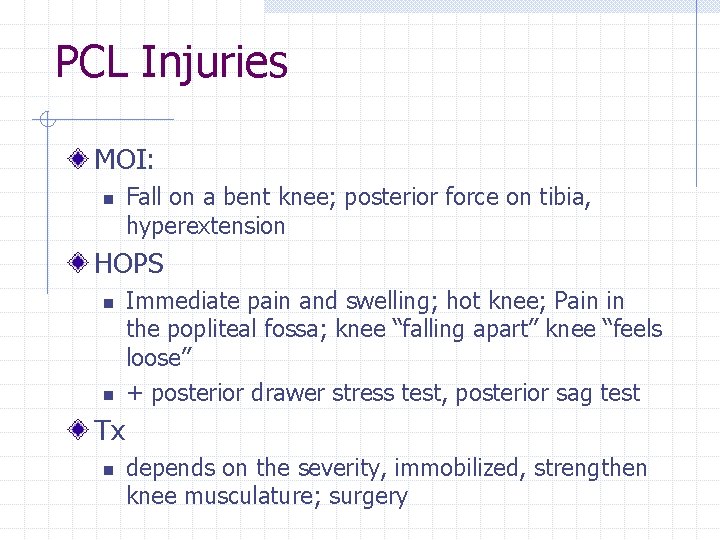
PCL Injuries MOI: n Fall on a bent knee; posterior force on tibia, hyperextension HOPS n n Immediate pain and swelling; hot knee; Pain in the popliteal fossa; knee “falling apart” knee “feels loose” + posterior drawer stress test, posterior sag test Tx n depends on the severity, immobilized, strengthen knee musculature; surgery
Menisci Injuries MOI: Twisting with foot fixed HOPS n Pn over the joint line, catching/locking or giving out of the knee. Popping or clicking in joint line, swelling after activity with little heat, Pn with or deep squat Tx n strengthen knee musculature, surgery if sx persist; recovery time depends on type of surgery and tear
Patello Femoral Stress Synd. Precursor: females, high Q angle, weak VMO, MOI: lateral riding of the patella HOPS n dull achy pain in the center of the knee, pn with compression of the patella Tx n isometric quad contractions, strengthen/stretch all surrounding musculature , closed chain exercises; knee braces; surgery last option
Chondromalacia Degenerative condition of the articular cartilage of patella Precursor: females, high Q angle, weak VMO, MOI: lateral riding of the patella HOPS n pain going down stairs, crepitation under patella Tx: knee sleeve, avoid knee bends’ strengthening of VMO; surgery last option
Subluxing/ Dislocating patella MOI: decelaration with cutting maneuver Other injuries that may occur with sub/dislocating patella: may tear the medial retinaculum and or quad tendon, bruise patella and lateral femoral condyle HOPS n pop, violent collapse of knee, + Pattella Apprehension test, obvious deformity Tx: RICE, splint if able refer to a physician
Patellar Tendonitis “Jumper’s knee” MOI: overuse HOPS n Pn over the patellar tendon, crepitation in tendon, thickening of the tendon, pain after prolonged sitting, pn walking stairs, Tx n Rest, eccentric quad strengthening, stretch hamstrings, treat symptoms, taping, bracing
IT Band Friction Syndrome Occurs when the IT band snaps over the lateral femoral condyle Precursor: distance runners, cyclist, large Q angle MOI: overuse HOPS n Pn while running up and down hill, point tender over the lateral femoral condyle Tx n Box 11 -3; look at the shoes
Osgood Schlatter Disease Inflammation or partial avulsion of the tibial apophysis due to traction forces (Fig 11 -14) Precursor: adolescent athletes (male 10 -15; female 8 -13) MOI: overuse; jumping and cutting type sports HOPS n Pn over the tibial tuberosity, bony growth of tibial tuberosity; a knot will form Tx n treat symptoms, padding, complete rest (may be needed); will usually grow out of condition
SPECIAL TESTS Range of motion w AROM N= 135 flex w RROM n n 0 extension Flexion with IR/ER- prone Extension - seated Stress Tests + Laxity; Note Pain n Valgus = MCL; p. 214 Fig 11 -19 Varus = LCL; p. 214 Fig 11 -19 Mc. Murray’s Click- Menisci
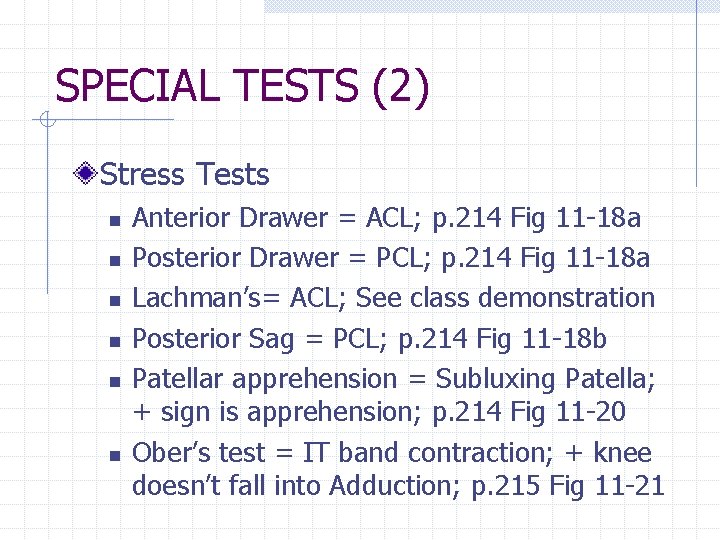
SPECIAL TESTS (2) Stress Tests n n n Anterior Drawer = ACL; p. 214 Fig 11 -18 a Posterior Drawer = PCL; p. 214 Fig 11 -18 a Lachman’s= ACL; See class demonstration Posterior Sag = PCL; p. 214 Fig 11 -18 b Patellar apprehension = Subluxing Patella; + sign is apprehension; p. 214 Fig 11 -20 Ober’s test = IT band contraction; + knee doesn’t fall into Adduction; p. 215 Fig 11 -21
Links http: //www. scoi. com/kneeanat. htm http: //www. swarminteractive. com/prod ucts_licensing. shtml http: //www. sportsknee. com/kneeanato my. htm - Anatomy Review
Links http: //www. arthroscopy. com/sp 05018. h tm- ACL Surgery http: //www. sportsknee. com/acl. htm Step by Step of an ACL Surgery http: //www. csuchico. edu/~sbarker/injur y/knee/ - Knee Scenario