
Kmeans Clustering J S Roger Jang jangmirlab org
K-means Clustering J. -S. Roger Jang (張智星) jang@mirlab. org http: //mirlab. org/jang MIR Lab, CSIE Dept. National Taiwan University 2021/2/23
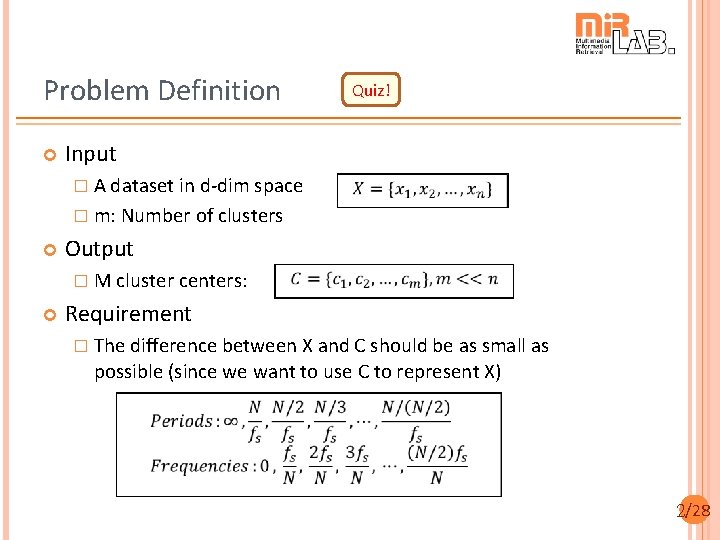
Problem Definition Quiz! Input � A dataset in d-dim space � m: Number of clusters Output � M cluster centers: Requirement � The difference between X and C should be as small as possible (since we want to use C to represent X) 2/28
2021/2/23 3/28
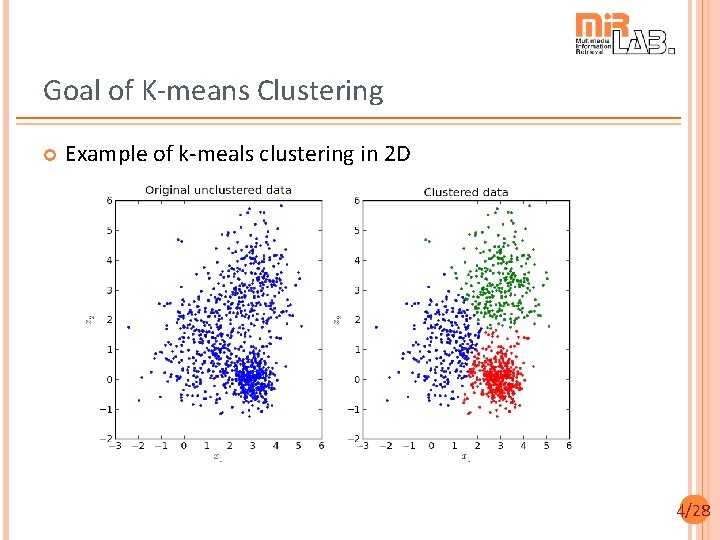
Goal of K-means Clustering Example of k-meals clustering in 2 D 4/28
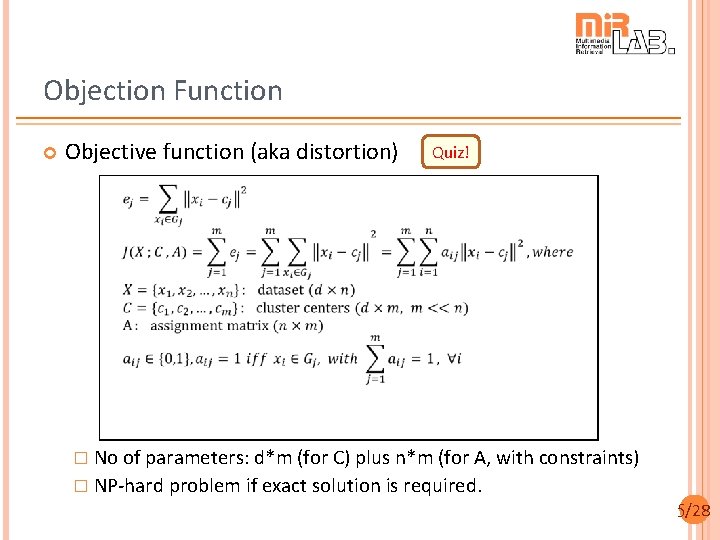
Objection Function Objective function (aka distortion) Quiz! � No of parameters: d*m (for C) plus n*m (for A, with constraints) � NP-hard problem if exact solution is required. 5/28
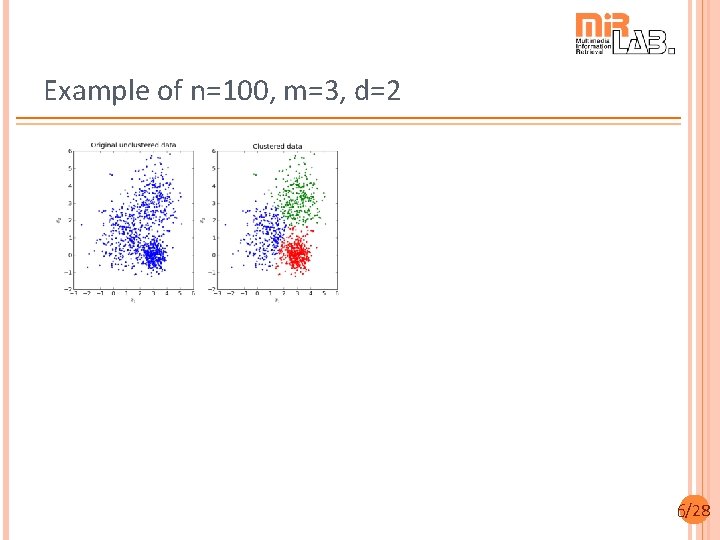
Example of n=100, m=3, d=2 6/28
Strategy for Minimizing the Objective Function Observation � J(X; C, A) is parameterized by C and A � Joint optimization is hard, but separate optimization with respective to C and A is easy Strategy AKA “coordinate optimization” � Fix C and find the best A to minimize J(X; C, A) � Fix A and find the best C to minimize J(X; C, A) � Repeat the above two steps until convergence 7/28
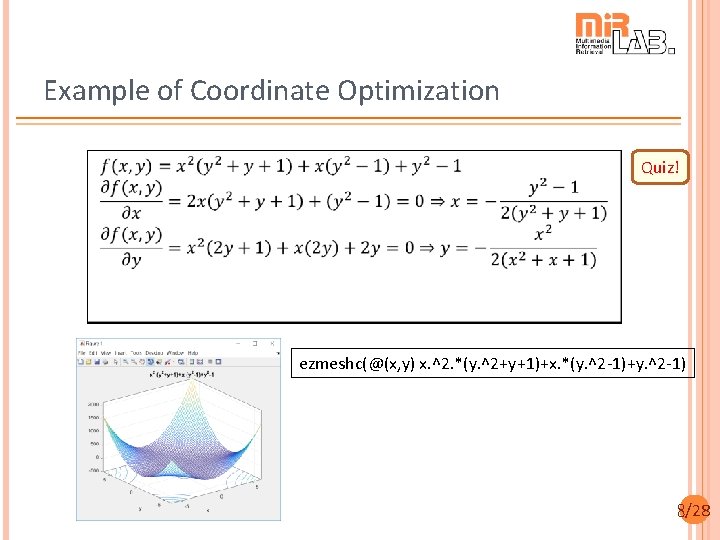
Example of Coordinate Optimization Quiz! ezmeshc(@(x, y) x. ^2. *(y. ^2+y+1)+x. *(y. ^2 -1)+y. ^2 -1) 8/28
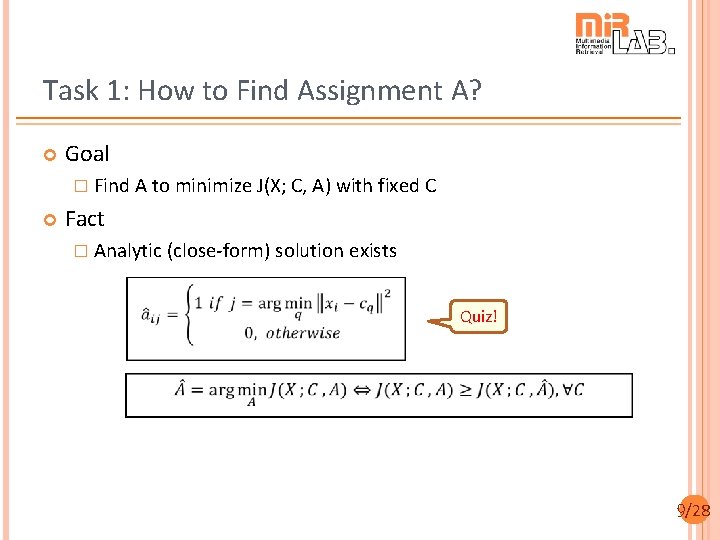
Task 1: How to Find Assignment A? Goal � Find A to minimize J(X; C, A) with fixed C Fact � Analytic (close-form) solution exists Quiz! 9/28
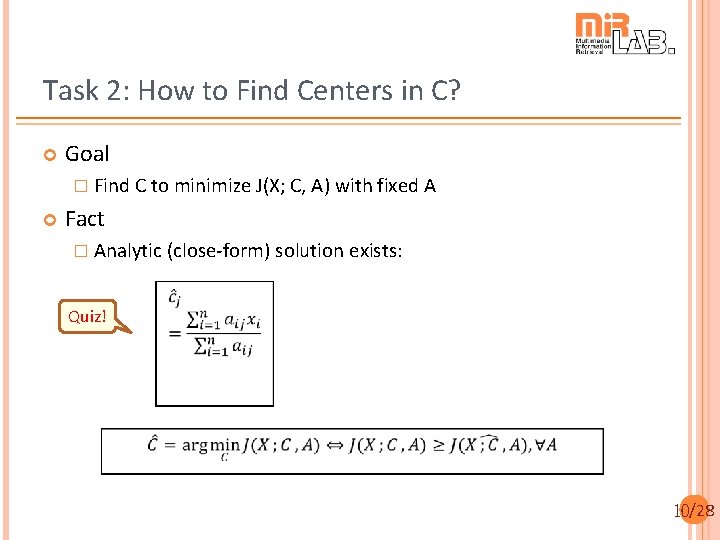
Task 2: How to Find Centers in C? Goal � Find C to minimize J(X; C, A) with fixed A Fact � Analytic (close-form) solution exists: Quiz! 10/28
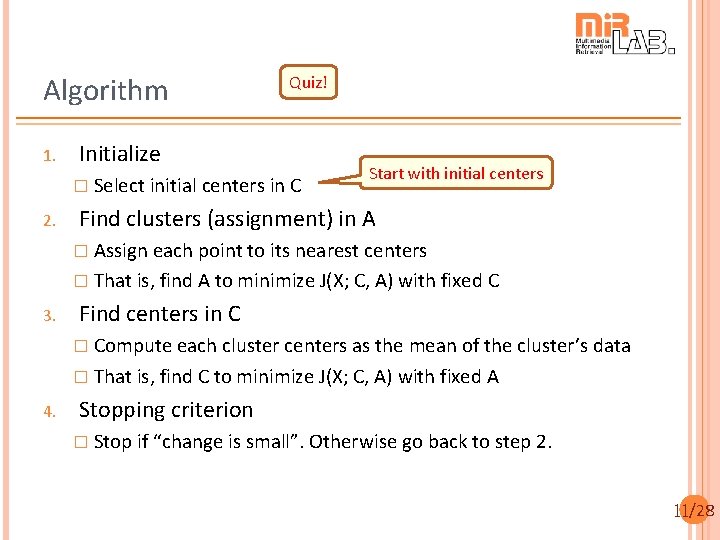
Algorithm 1. Quiz! Initialize � Select initial centers in C 2. Start with initial centers Find clusters (assignment) in A � Assign each point to its nearest centers � That is, find A to minimize J(X; C, A) with fixed C 3. Find centers in C � Compute each cluster centers as the mean of the cluster’s data � That is, find C to minimize J(X; C, A) with fixed A 4. Stopping criterion � Stop if “change is small”. Otherwise go back to step 2. 11/28
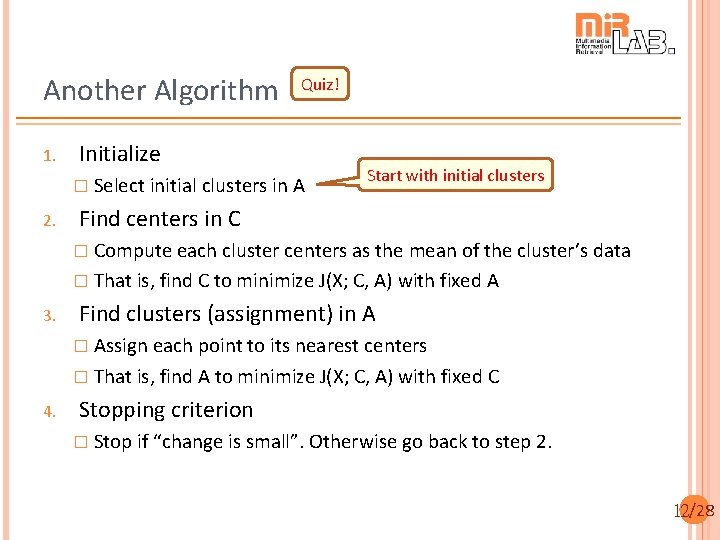
Another Algorithm 1. Quiz! Initialize � Select initial clusters in A 2. Start with initial clusters Find centers in C � Compute each cluster centers as the mean of the cluster’s data � That is, find C to minimize J(X; C, A) with fixed A 3. Find clusters (assignment) in A � Assign each point to its nearest centers � That is, find A to minimize J(X; C, A) with fixed C 4. Stopping criterion � Stop if “change is small”. Otherwise go back to step 2. 12/28
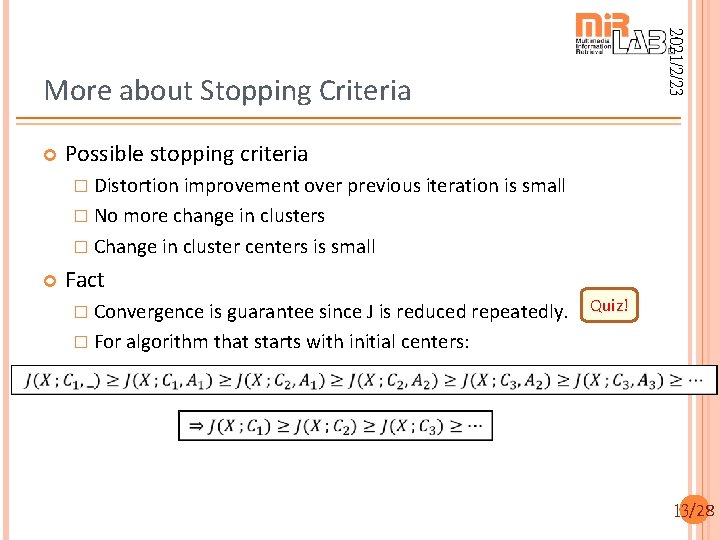
2021/2/23 More about Stopping Criteria Possible stopping criteria � Distortion improvement over previous iteration is small � No more change in clusters � Change in cluster centers is small Fact � Convergence is guarantee since J is reduced repeatedly. Quiz! � For algorithm that starts with initial centers: 13/28
2021/2/23 Properties of K-means Clustering Properties � Always converges � No guarantee to converge to global minimum � To increase the likelihood of reaching the global minimum Start with various sets of initial centers Start with sensible choice of initial centers � Potential distance functions Euclidean distance Texicab distance � How to determine the best choice of k Cluster validation 14/28
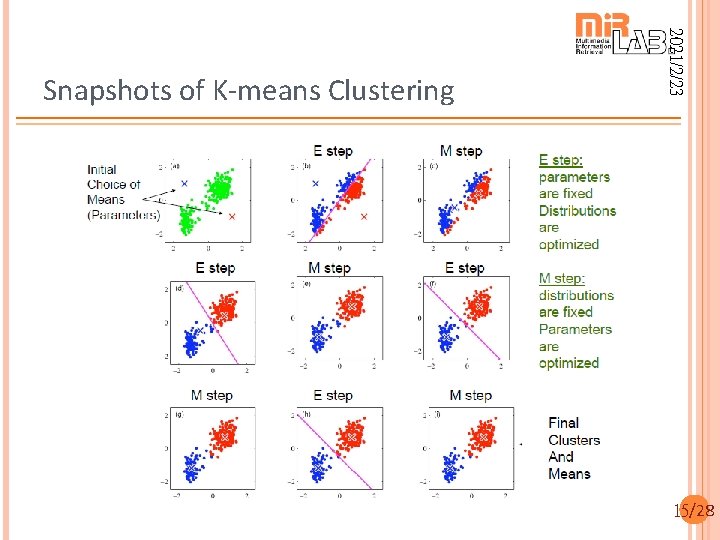
2021/2/23 Snapshots of K-means Clustering 15/28
2021/2/23 Demos of K-means Clustering Required toolboxes � Utility Toolbox � Machine Learning Toolbox Demos � k. Means. Clustering. m � vec. Quantize. m Center splitting to reach 2 p clusters 16/28
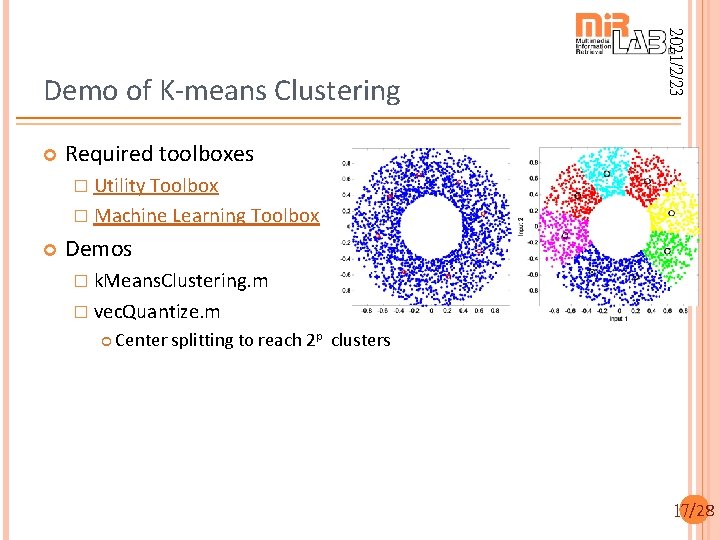
2021/2/23 Demo of K-means Clustering Required toolboxes � Utility Toolbox � Machine Learning Toolbox Demos � k. Means. Clustering. m � vec. Quantize. m Center splitting to reach 2 p clusters 17/28
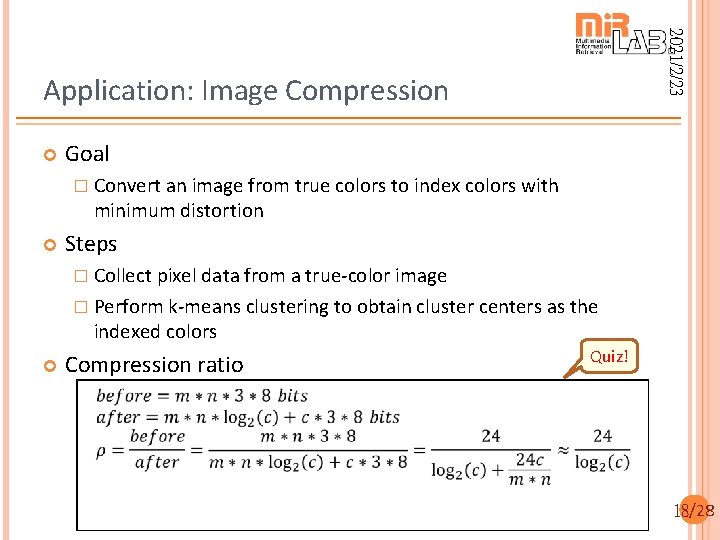
2021/2/23 Application: Image Compression Goal � Convert an image from true colors to index colors with minimum distortion Steps � Collect pixel data from a true-color image � Perform k-means clustering to obtain cluster centers as the indexed colors Compression ratio Quiz! 18/28
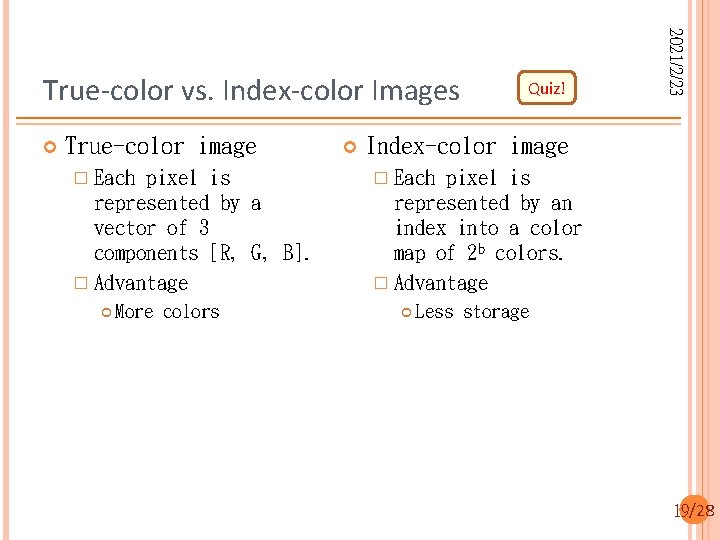
True-color image � Each pixel is represented by a vector of 3 components [R, G, B]. � Advantage More colors Quiz! 2021/2/23 True-color vs. Index-color Images Index-color image � Each pixel is represented by an index into a color map of 2 b colors. � Advantage Less storage 19/28
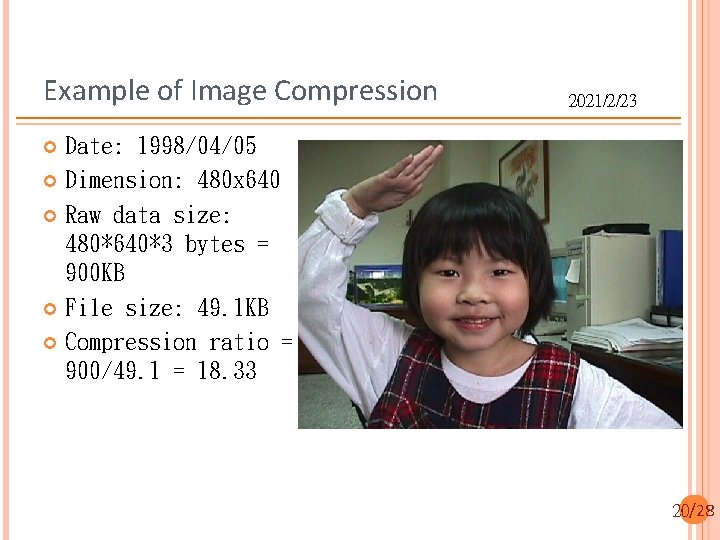
Example of Image Compression 2021/2/23 Date: 1998/04/05 Dimension: 480 x 640 Raw data size: 480*640*3 bytes = 900 KB File size: 49. 1 KB Compression ratio = 900/49. 1 = 18. 33 20/28
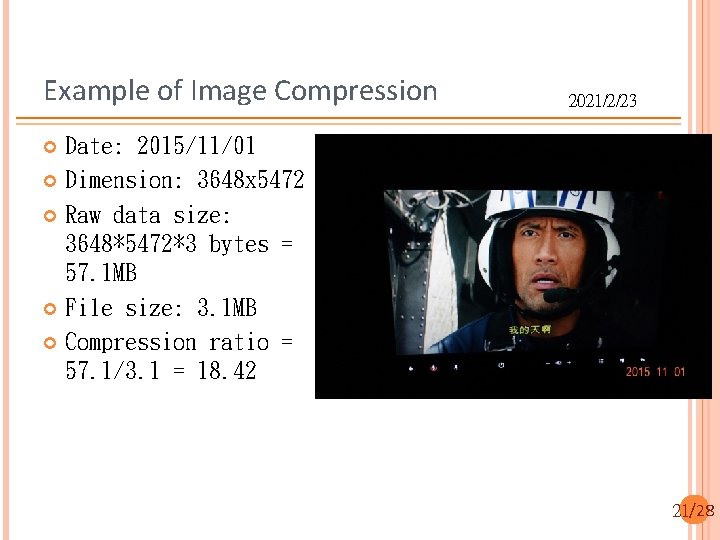
Example of Image Compression 2021/2/23 Date: 2015/11/01 Dimension: 3648 x 5472 Raw data size: 3648*5472*3 bytes = 57. 1 MB File size: 3. 1 MB Compression ratio = 57. 1/3. 1 = 18. 42 21/28
2021/2/23 Image Compression Using K-Means Clustering Some quantities of the k-means clustering � n = 480 x 640 = 307200 (no of vectors to be clustered) � d = 3 (R, G, B) � m = 256 (no. of clusters) 22/28
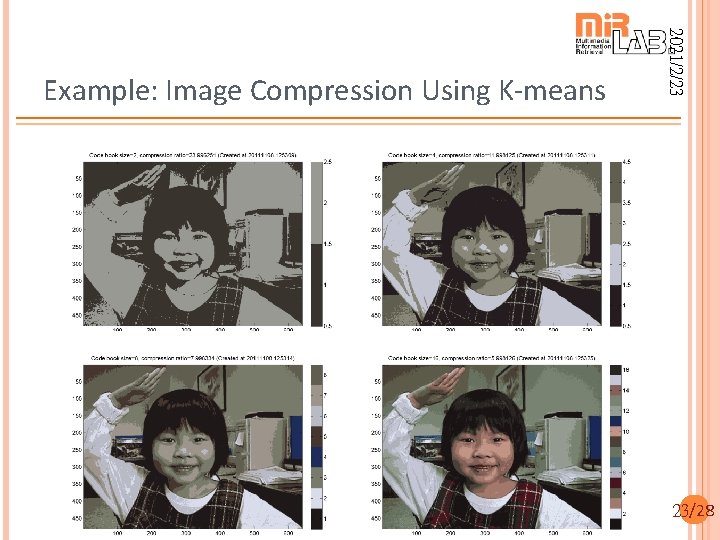
2021/2/23 23 2021/2/23 Example: Image Compression Using K-means 23/28
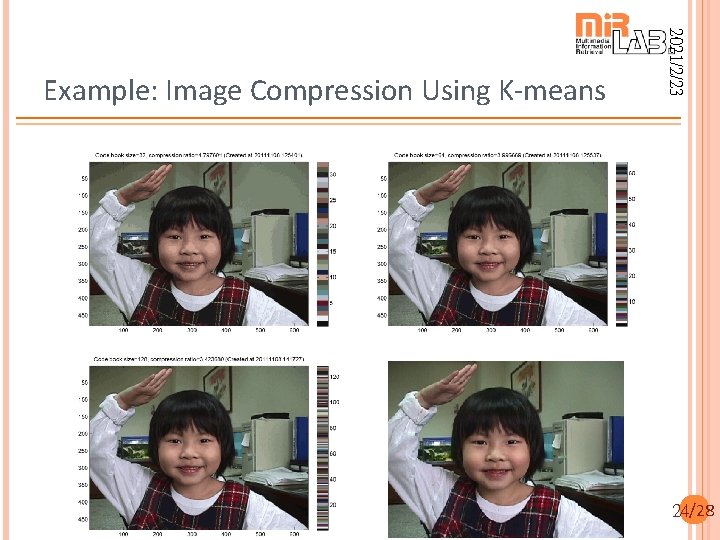
2021/2/23 24 2021/2/23 Example: Image Compression Using K-means 24/28
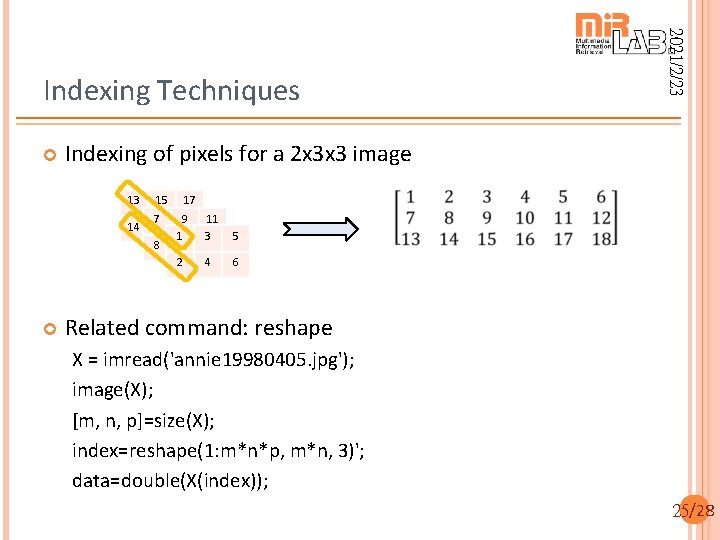
Indexing of pixels for a 2 x 3 x 3 image 13 15 17 14 7 16 9 18 1 10 2 8 2021/2/23 Indexing Techniques 11 3 12 4 5 6 Related command: reshape X = imread('annie 19980405. jpg'); image(X); [m, n, p]=size(X); index=reshape(1: m*n*p, m*n, 3)'; data=double(X(index)); 25/28
![2021/2/23 Code Example X = imread('annie 19980405. jpg'); image(X) [m, n, p]=size(X); index=reshape(1: m*n*p,](http://slidetodoc.com/presentation_image_h/0b8874f2d05a37e83571d3d0a4d10a9d/image-26.jpg "2021/2/23 Code Example X = imread('annie 19980405. jpg'); image(X) [m, n, p]=size(X); index=reshape(1: m*n*p,")
2021/2/23 Code Example X = imread('annie 19980405. jpg'); image(X) [m, n, p]=size(X); index=reshape(1: m*n*p, m*n, 3)'; data=double(X(index)); max. I=6; for i=1: max. I center. Num=2^i; fprintf('i=%d/%d: no. of centers=%dn', i, max. I, center. Num); center=k. Means. Clustering(data, center. Num); dist. Mat=dist. Pairwise(center, data); [min. Value, min. Index]=min(dist. Mat); X 2=reshape(min. Index, m, n); map=center'/255; figure; image(X 2); colormap(map); colorbar; axis image; drawnow; end 26/28
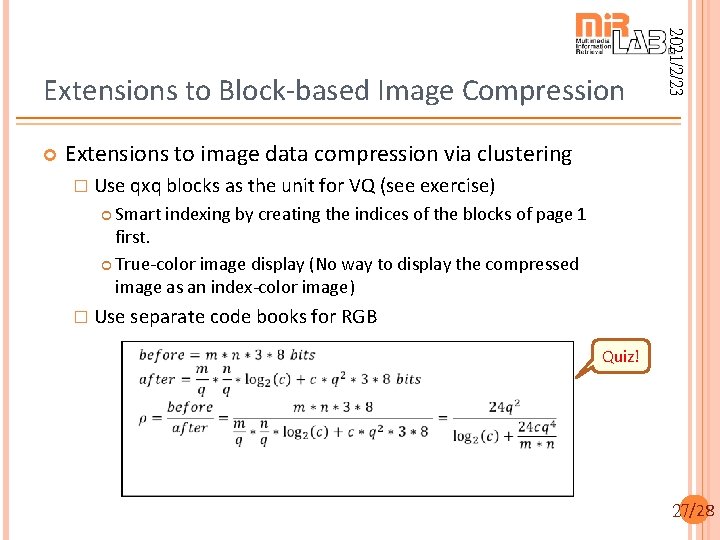
2021/2/23 Extensions to Block-based Image Compression Extensions to image data compression via clustering � Use qxq blocks as the unit for VQ (see exercise) Smart indexing by creating the indices of the blocks of page 1 first. True-color image display (No way to display the compressed image as an index-color image) � Use separate code books for RGB Quiz! 27/28
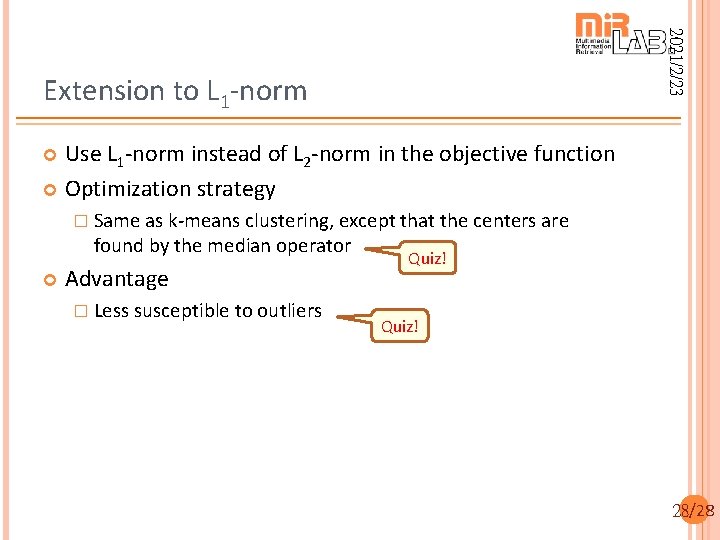
2021/2/23 Extension to L 1 -norm Use L 1 -norm instead of L 2 -norm in the objective function Optimization strategy � Same as k-means clustering, except that the centers are found by the median operator Advantage � Less susceptible to outliers Quiz! 28/28
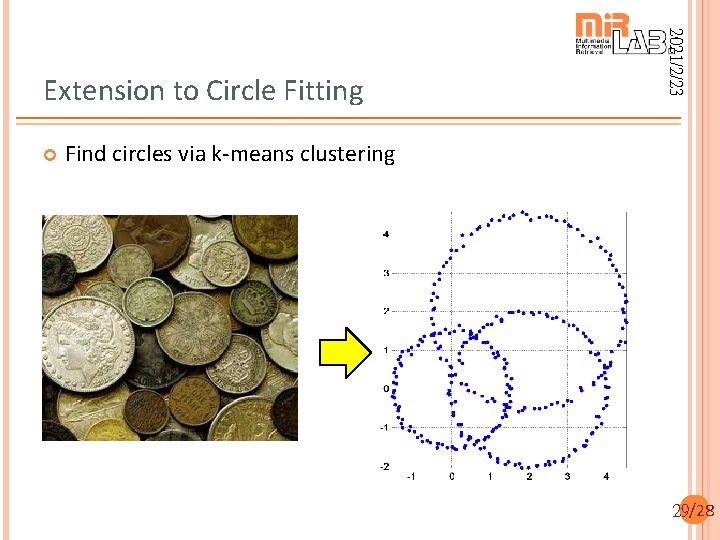
2021/2/23 Extension to Circle Fitting Find circles via k-means clustering 29/28
- Slides: 29