
Kmeans Based Unsupervised Feature Learning for Image Recognition

K-means Based Unsupervised Feature Learning for Image Recognition Ling Zheng
Unsupervised feature learning framework • Extract random patches from unlabeled training images • Apply a pre-processing stage to the patches • Learn a feature-mapping using an unsupervised learning algorithm
Feature Extraction and Classification • Given the learned feature mapping and a set of labeled training images : – Extract features from equally spaced sub-patches covering the input image – Pool features together over regions of the input image to reduce the number of feature values – Train a linear classifier to predict the labels given the feature vectors
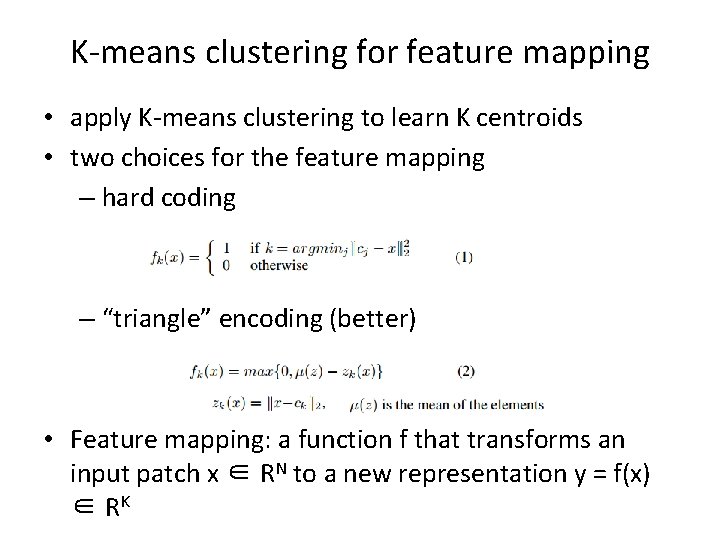
K-means clustering for feature mapping • apply K-means clustering to learn K centroids • two choices for the feature mapping – hard coding – “triangle” encoding (better) • Feature mapping: a function f that transforms an input patch x ∈ RN to a new representation y = f(x) ∈ RK
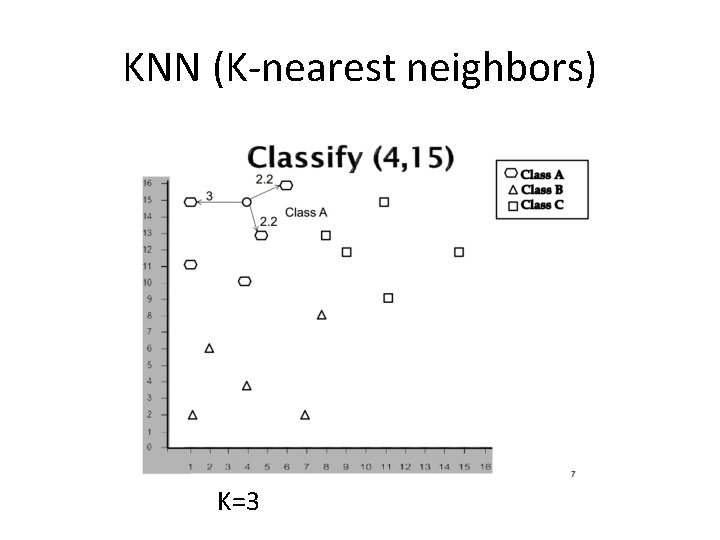
KNN (K-nearest neighbors) K=3
Random forest • N training records, M attributes • Randomly pick records N times with replacement • randomly pick sqrt(M) attributes and find the best split
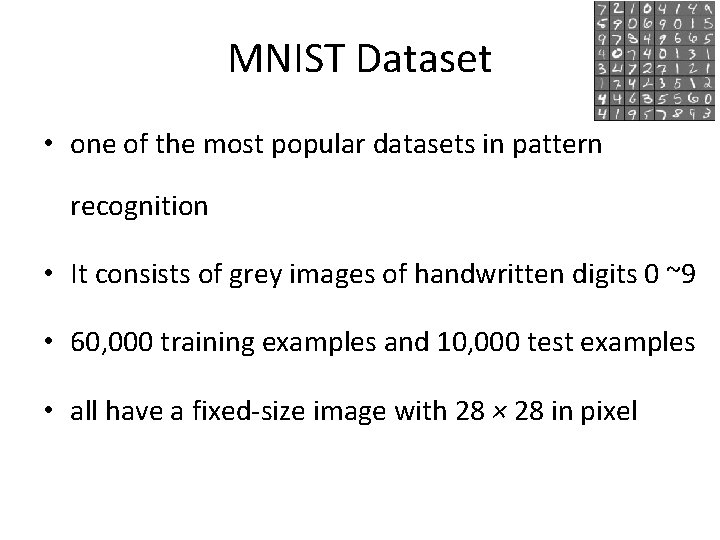
MNIST Dataset • one of the most popular datasets in pattern recognition • It consists of grey images of handwritten digits 0 ~9 • 60, 000 training examples and 10, 000 test examples • all have a fixed-size image with 28 × 28 in pixel
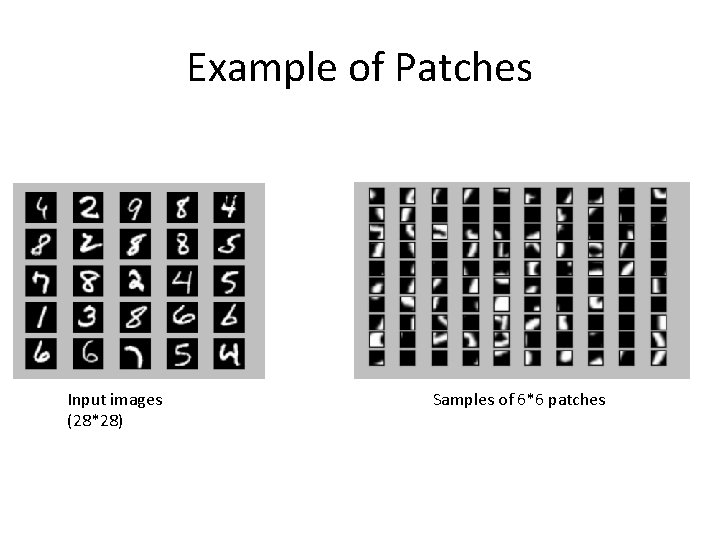
Example of Patches Input images (28*28) Samples of 6*6 patches
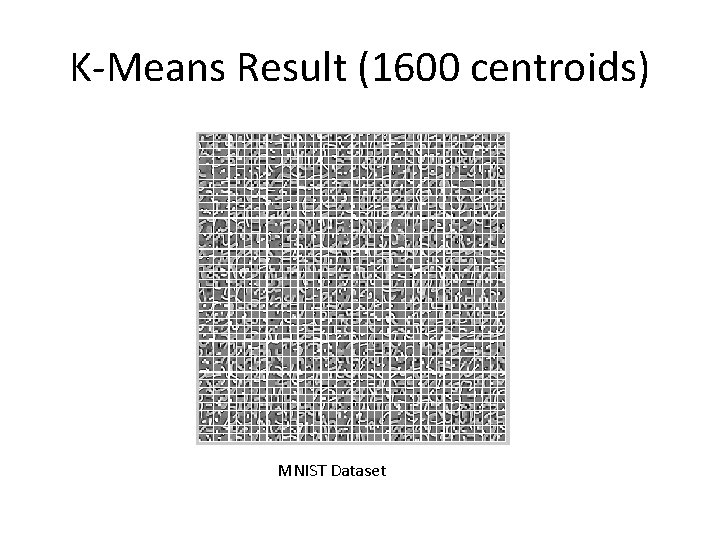
K-Means Result (1600 centroids) MNIST Dataset
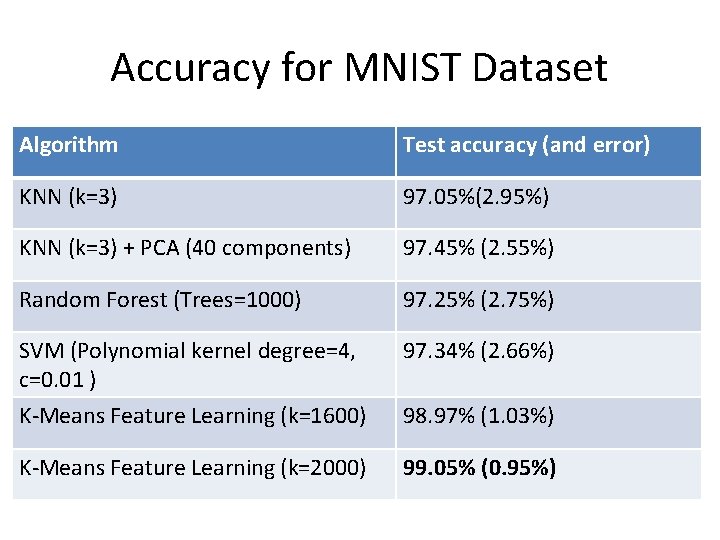
Accuracy for MNIST Dataset Algorithm Test accuracy (and error) KNN (k=3) 97. 05%(2. 95%) KNN (k=3) + PCA (40 components) 97. 45% (2. 55%) Random Forest (Trees=1000) 97. 25% (2. 75%) SVM (Polynomial kernel degree=4, c=0. 01 ) 97. 34% (2. 66%) K-Means Feature Learning (k=1600) 98. 97% (1. 03%) K-Means Feature Learning (k=2000) 99. 05% (0. 95%)
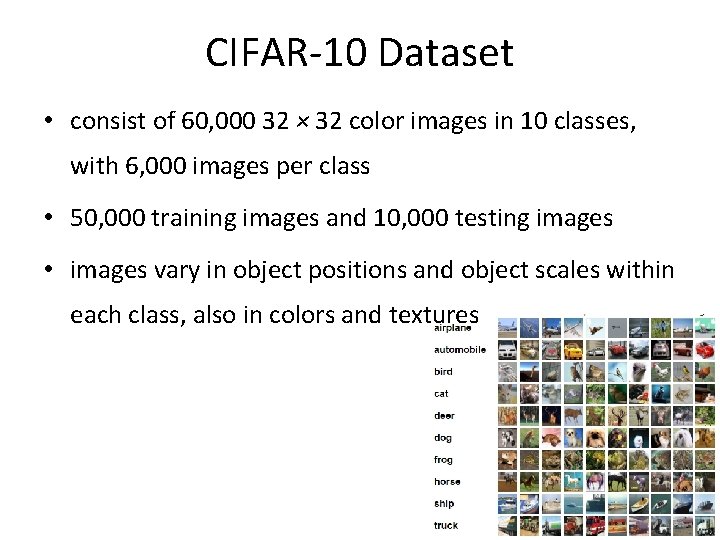
CIFAR-10 Dataset • consist of 60, 000 32 × 32 color images in 10 classes, with 6, 000 images per class • 50, 000 training images and 10, 000 testing images • images vary in object positions and object scales within each class, also in colors and textures
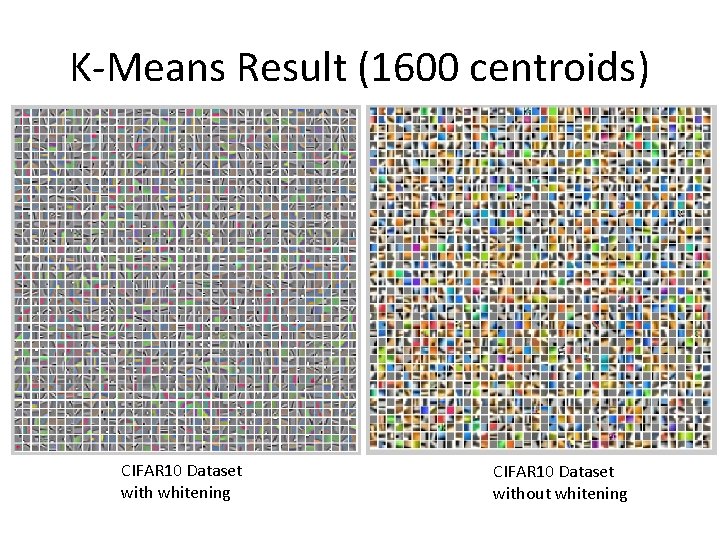
K-Means Result (1600 centroids) CIFAR 10 Dataset with whitening CIFAR 10 Dataset without whitening

Accuracy for CIFAR-10 Dataset Algorithm Test accuracy KNN (k=5) 33. 98% KNN (k=5) + PCA (40 components) 40. 35% Random Forest (Trees=1000) 49. 28% SVM (Polynomial kernel degree=4, 47. 32% c=0. 01 ) K-Means Feature Learning (k=1600) K-Means Feature Learning (k=2000) 77. 3% 77. 96% (77. 96 -49. 28)/49. 28*100%=58. 20%
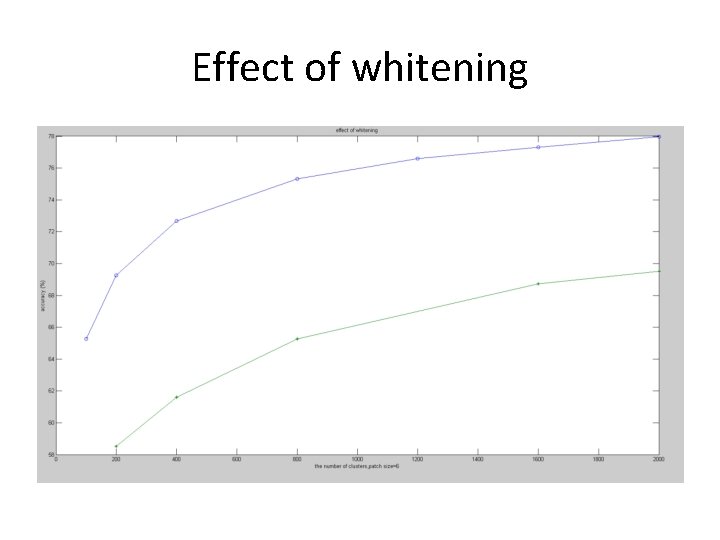
Effect of whitening
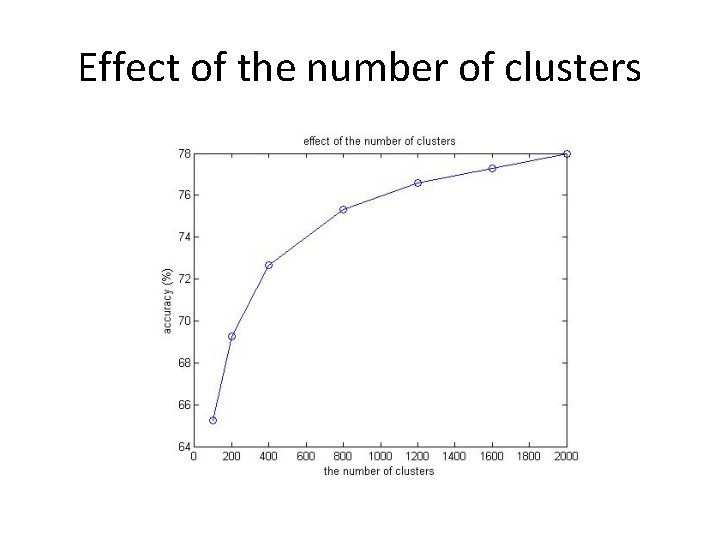
Effect of the number of clusters

Effect of receptive field size
![References • [1] Wang, D and Tan, X. : C-SVDDNet: An Effective Single-Layer Network](http://slidetodoc.com/presentation_image_h2/7d7e115893063ad4e02e6285148f88ab/image-17.jpg "References • [1] Wang, D and Tan, X. : C-SVDDNet: An Effective Single-Layer Network")
References • [1] Wang, D and Tan, X. : C-SVDDNet: An Effective Single-Layer Network for Unsupervised Feature Learning (2015) • [2] Coates, A. , Ng, A. Y. : Learning Feature Representations with Kmeans, G. Montavon, G. B. Orr, K. -R. M uller (Eds. ), Neural Networks: Tricks of the Trade, 2 nd edn, Springer LNCS 7700, 2012 • [3] Coates, A. , Lee, H. , Ng, A. Y. : An analysis of single-layer networks in unsupervised feature learning. In: 14 th International Conference on AI and Statistics. pp. 215– 223 (2011) • [4] The MNIST database of handwritten digits: Yann Le. Cun, Courant Institute, NYU; Corinna Cortes, Google Labs, New York; Christopher J. C. Burges, Microsoft Research, Redmond http: //yann. lecun. com/exdb/mnist/ • [5] The CIFAR-10 dataset: Learning Multiple Layers of Features from Tiny Images, Alex Krizhevsky, 2009. http: //www. cs. toronto. edu/~kriz/cifar. html

Thank you!
- Slides: 18