
KM MODEL Davenport and Prusak 1998 Data A


- Slides: 36
KM MODEL
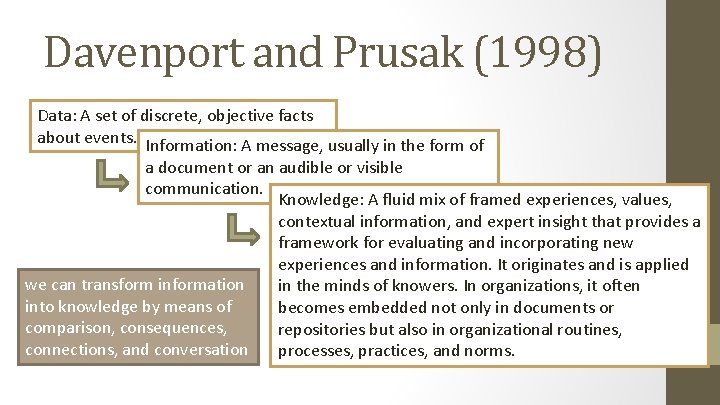
Davenport and Prusak (1998) Data: A set of discrete, objective facts about events. Information: A message, usually in the form of a document or an audible or visible communication. Knowledge: A fluid mix of framed experiences, values, contextual information, and expert insight that provides a framework for evaluating and incorporating new experiences and information. It originates and is applied we can transform information in the minds of knowers. In organizations, it often into knowledge by means of becomes embedded not only in documents or comparison, consequences, repositories but also in organizational routines, connections, and conversation processes, practices, and norms.
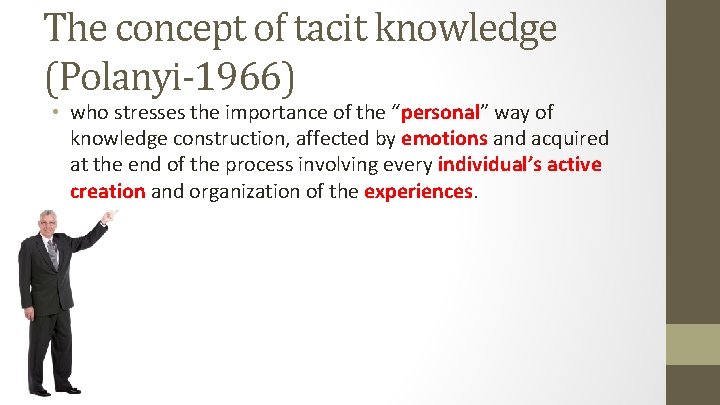
The concept of tacit knowledge (Polanyi-1966) • who stresses the importance of the “personal” way of knowledge construction, affected by emotions and acquired at the end of the process involving every individual’s active creation and organization of the experiences.
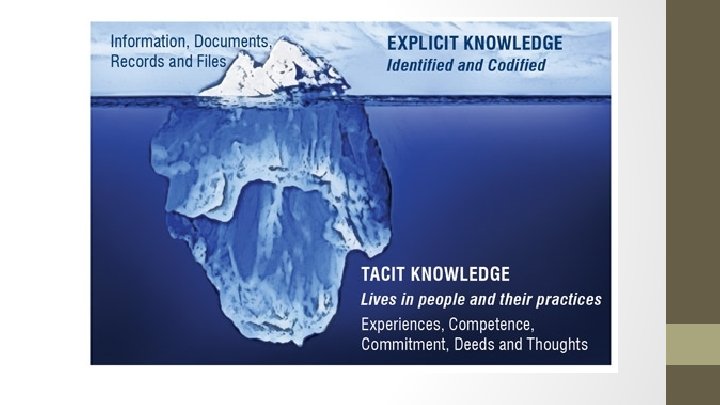
tacit knowledge is not easily expressed in formalized ways, and is context-specific, personal, and difficult to communicate
explicit knowledge is the codified one, expressed in formal and linguistic ways, easily transmittable and storable, and expressible in words and algorithms, but it represents only the tip of the iceberg of the entire body of knowledge
The von Krogh and Roos Model of Organizational Epistemology The von Krogh and Roos KM model (1995) distinguishes between individual knowledge and social knowledge, and they take an epistemological approach to managing organizational knowledge
the definition of organization has been problematic and the term is often used interchangeably with information • How and why individuals within an organization come to know. • How and why organizations, as social entities, come to know. • What counts for knowledge of the individual and the organization. • What are the impediments in organizational KM.
Cognitive system, whether it is a human brain or a computer, creates representations (i. e. , models) of reality and that learning occurs when these representations are manipulated The cognitivist perspective A cognitive organizational epistemology views organizational knowledge as a self-organizing system in which humans are transparent to the information from the outside (i. e. , we take in information through our senses, and we use this information to build our mental models)
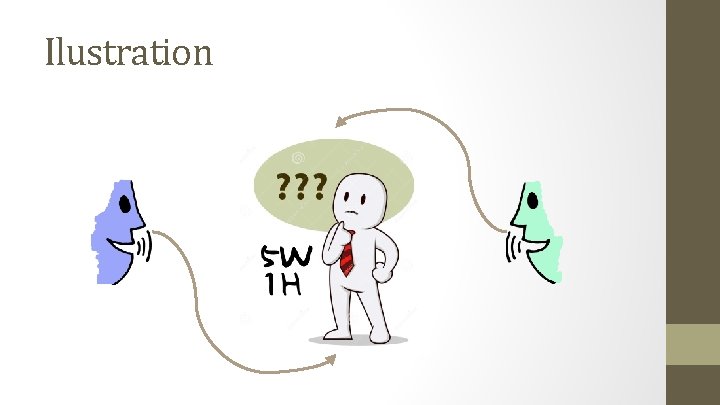
The connectionist approach • Information is not only taken in from the environment but also generated internally. • Familiarity and practice lead to learning. Individuals form nodes in a loosely connected organizational system, and knowledge is an emergent phenomenon that stems from the social interactions of these individuals • knowledge resides not only in the minds of individuals but also in the connections among these individuals.
Ilustration
In their organizational epistemology KM model, knowledge resides both in the individuals of an organization and, at the social level, in the relations between the individuals Unlike cognitivism, which views knowledge as an abstract entity, connectionism maintains that there can be no knowledge without a knower
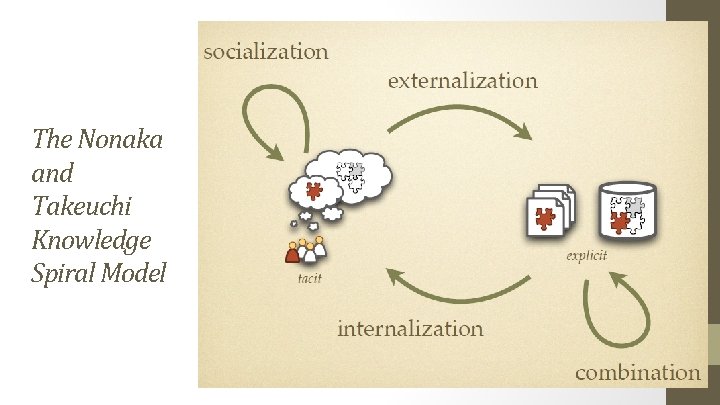
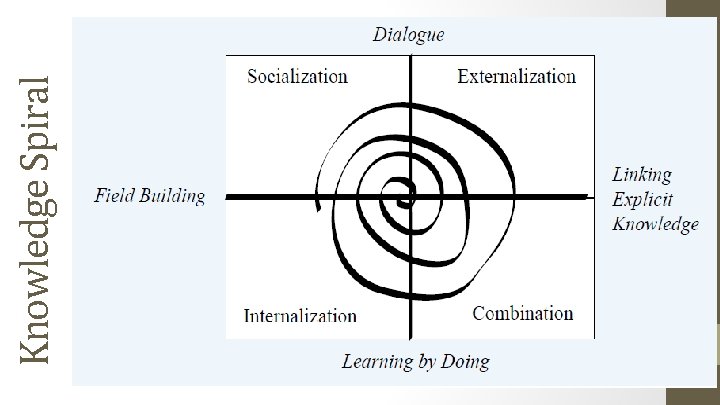
The Nonaka and Takeuchi Knowledge Spiral Model
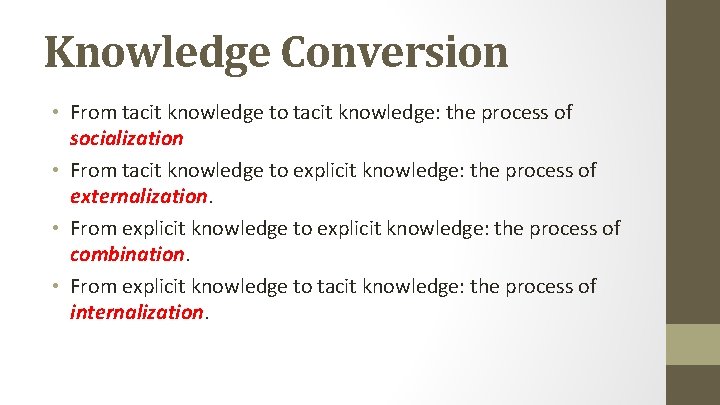
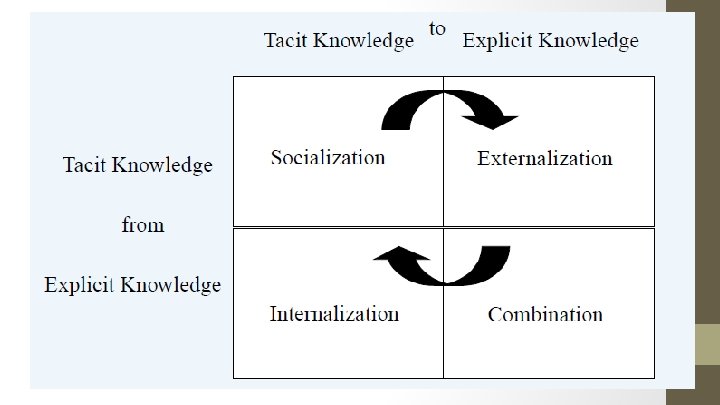
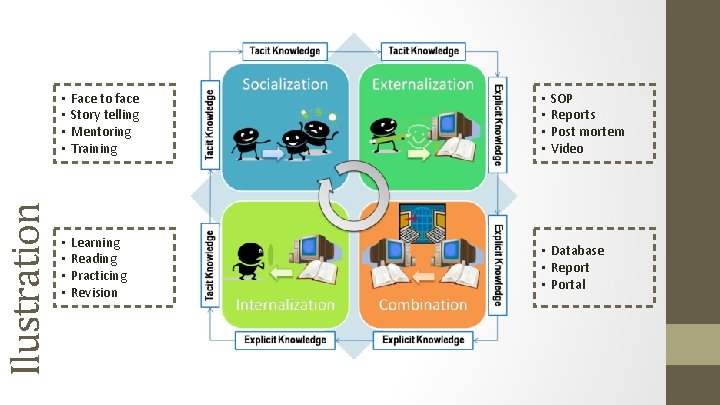
Knowledge Conversion • From tacit knowledge to tacit knowledge: the process of socialization • From tacit knowledge to explicit knowledge: the process of externalization. • From explicit knowledge to explicit knowledge: the process of combination. • From explicit knowledge to tacit knowledge: the process of internalization.
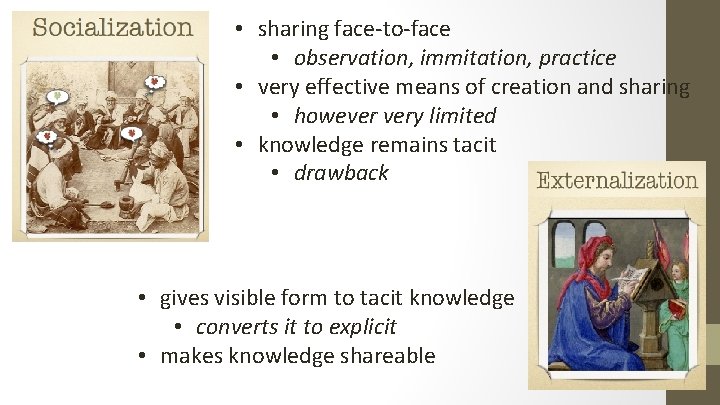
• sharing face-to-face • observation, immitation, practice • very effective means of creation and sharing • however very limited • knowledge remains tacit • drawback • gives visible form to tacit knowledge • converts it to explicit • makes knowledge shareable
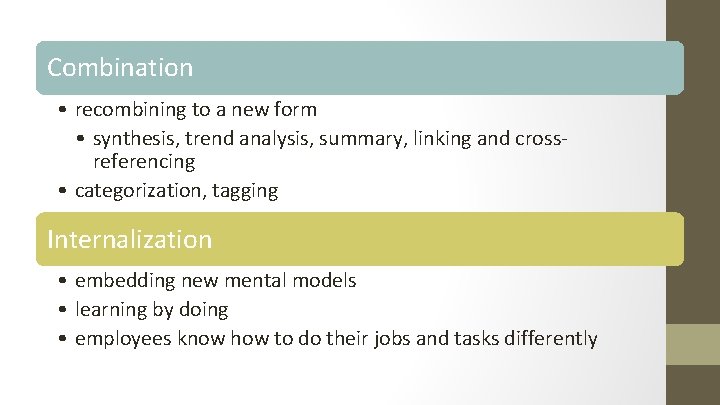
Combination • recombining to a new form • synthesis, trend analysis, summary, linking and crossreferencing • categorization, tagging • creating training material Internalization • embedding new mental models • learning by doing • employees know how to do their jobs and tasks differently
Knowledge Spiral
Ilustration • • Face to face Story telling Mentoring Training • • SOP Reports Post mortem Video • • Learning Reading Practicing Revision • Database • Report • Portal
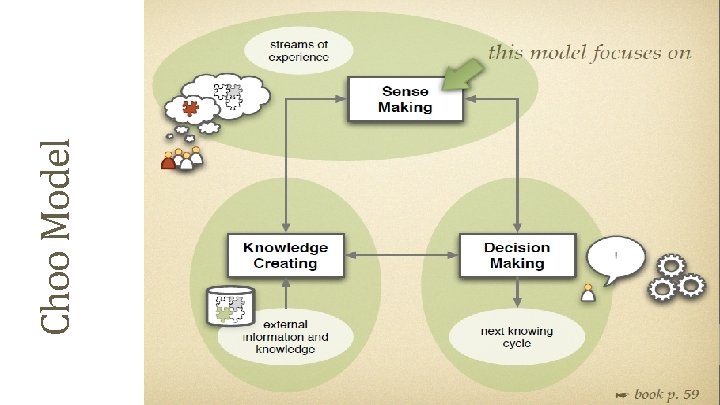
Choo Model
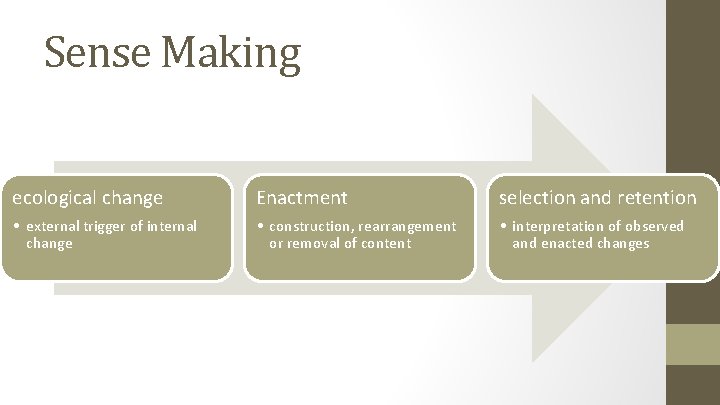
Sense Making ecological change Enactment selection and retention • external trigger of internal change • construction, rearrangement or removal of content • interpretation of observed and enacted changes
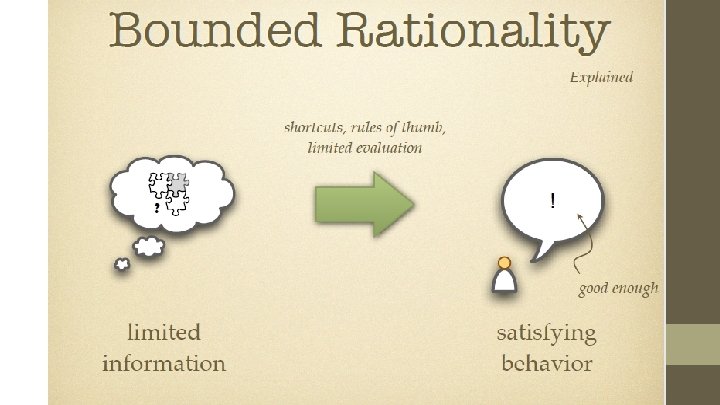
Bounded Rationality is bounded when it falls short of omniscience. Failures of omniscience are largely failures of knowing all the alternatives, uncertainty about relevant exogenous events and inability to calculate consequences. Simon, 1978
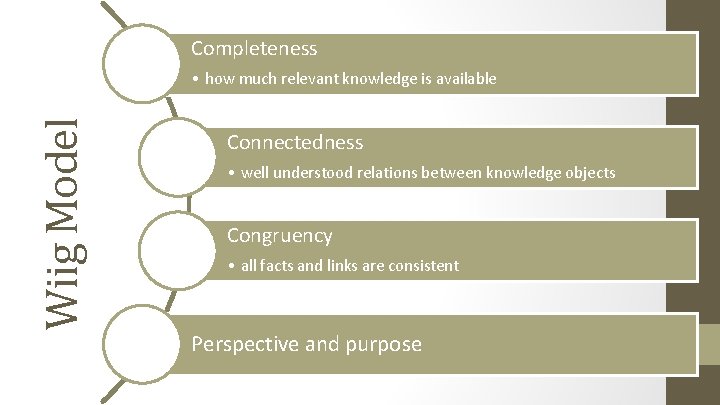
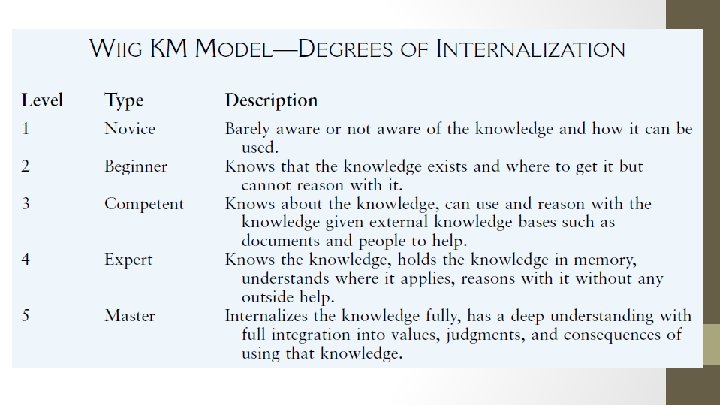
Completeness Wiig Model • how much relevant knowledge is available Connectedness • well understood relations between knowledge objects Congruency • all facts and links are consistent Perspective and purpose
Completeness • addresses the question of how much relevant knowledge is available from a given source • Sources may be human minds or knowledge bases • The knowledge may be complete in the sense that all that is available about the subject is there, but if no one knows of its existence and/or availability, they cannot make use of this knowledge.
Connectedness • refers to the well-understood and defined relations between the different knowledge objects • The more connected a knowledge base is (i. e. , the greater the number of interconnections in the semantic network), then the more coherent the content and the greater its value.
Congruence • when all the facts, concepts, perspectives, values, judgments, and associative and relational links between the knowledge objects are consistent. • There should be no logical inconsistencies, no internal conflicts, and no misunderstandings.
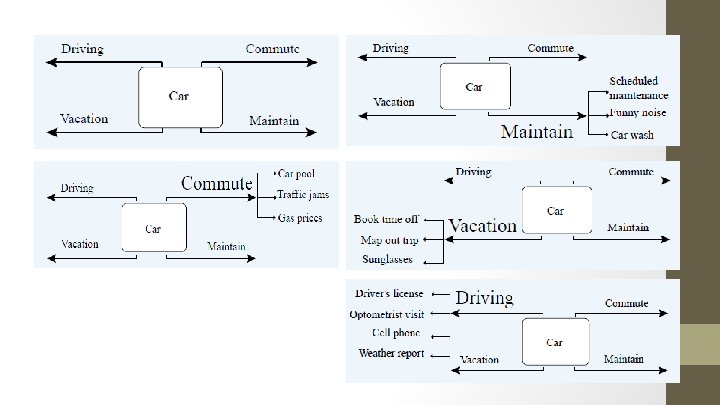
Perspective and purpose • refer to the phenomenon through which we “know something” but often from a particular point of view or for a specific purpose • We organize much of our knowledge using the dual dimensions of perspective and purpose (e. g. , just-in-time knowledge retrieval or just enough—“ondemand” knowledge).
Semantic networks • useful ways of representing different perspectives on the same knowledge content
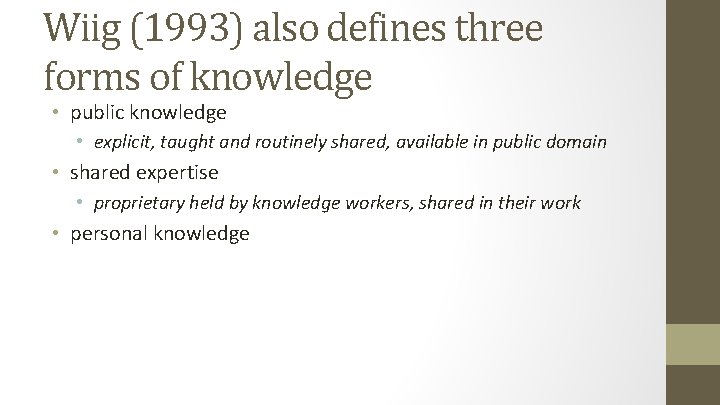
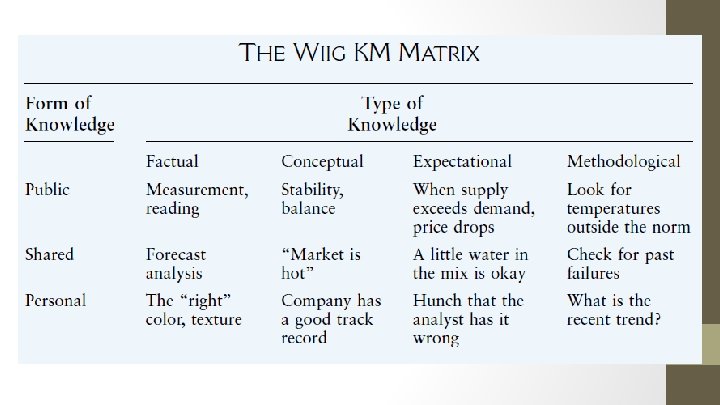
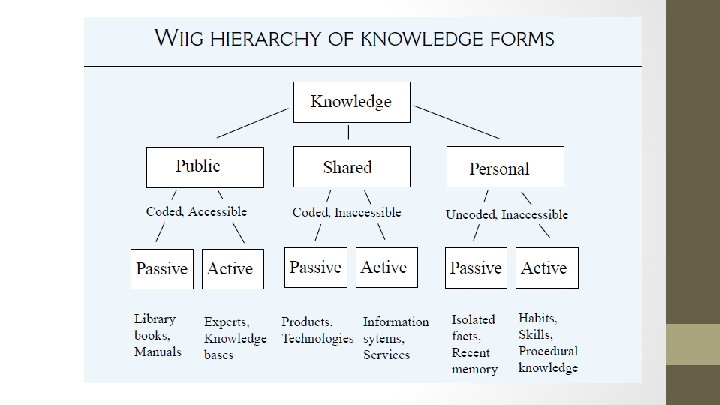
Wiig (1993) also defines three forms of knowledge • public knowledge • explicit, taught and routinely shared, available in public domain • shared expertise • proprietary held by knowledge workers, shared in their work • personal knowledge
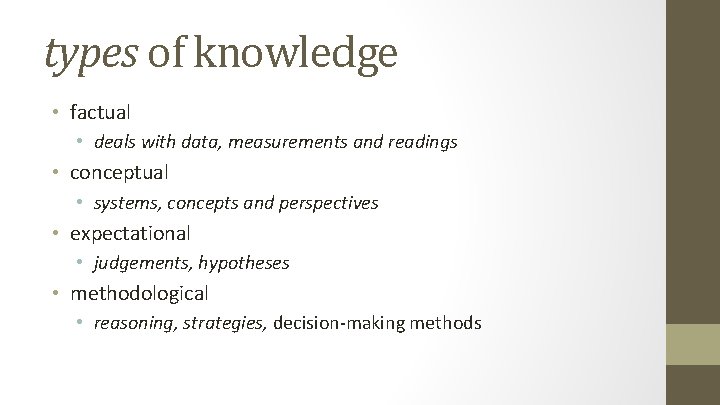
types of knowledge • factual • deals with data, measurements and readings • conceptual • systems, concepts and perspectives • expectational • judgements, hypotheses • methodological • reasoning, strategies, decision-making methods
THANK’S