
Klmn Orientation in brain stem cross sections To
Kálmán: Orientation in brain stem cross sections To the lecture for EM II, Oct. 18, 2017
These sketches are highly schematic and represent only the most important detailes. The purpose is only to help orientation and memorization of the detailed cross-sections of handbooks. Use this handout in parallel with but not instead of them!
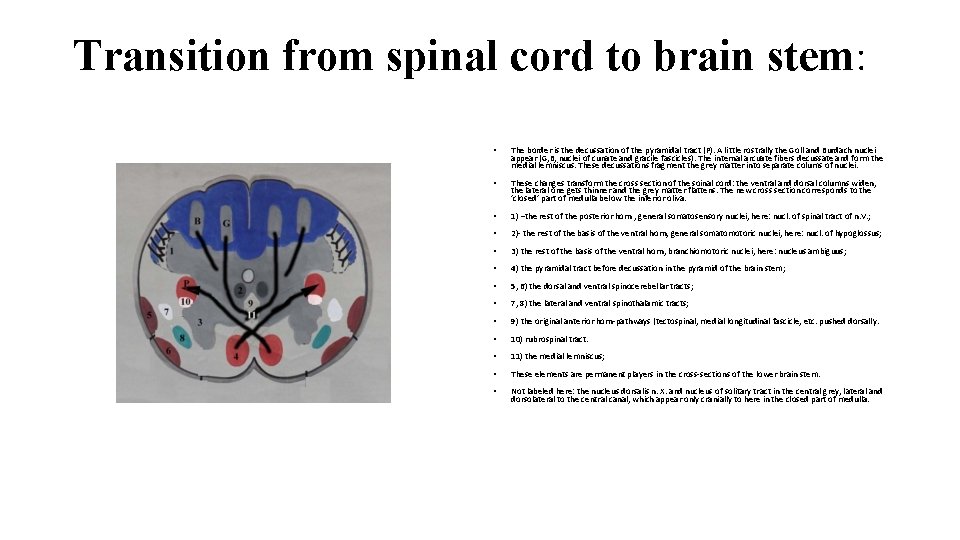
Transition from spinal cord to brain stem: • The border is the decussation of the pyramidal tract (P). A little rostrally the Goll and Burdach nuclei appear (G, B, nuclei of cunate and gracile fascicles). The internal arcuate fibers decussate and form the medial lemniscus. These decussations fragment the grey matter into separate colums of nuclei. • These changes transform the cross section of the soinal cord: the ventral and dorsal columns widen, the lateral one gets thinner and the grey matter flattens. The new cross section corresponds to the ’closed’ part of medulla below the inferior oliva. • 1) –the rest of the posterior horn , general somatosensory nuclei, here: nucl. of spinal tract of n. V. ; • 2)- the rest of the basis of the ventral horn, general somatomotoric nuclei, here: nucl. of hypoglossus; • 3) the rest of the basis of the ventral horn, branchiomotoric nuclei, here: nucleus ambiguus; • 4) the pyramidal tract before decussation in the pyramid of the brain stem; • 5, 6) the dorsal and ventral spinocerebellar tracts; • 7, 8) the lateral and ventral spinothalamic tracts; • 9) the original anterior horn-pathways (tectospinal, medial longitudinal fascicle, etc. pushed dorsally. • 10) rubrospinal tract. • 11) the medial lemniscus; • These elements are permanent players in the cross-sections of the lower brain stem. • Not labeled here: the nucleus dorsalis n. X. and nucleus of solitary tract in the central grey, lateral and dorsolateral to the central canal, which appear only cranially to here in the closed part of medulla.
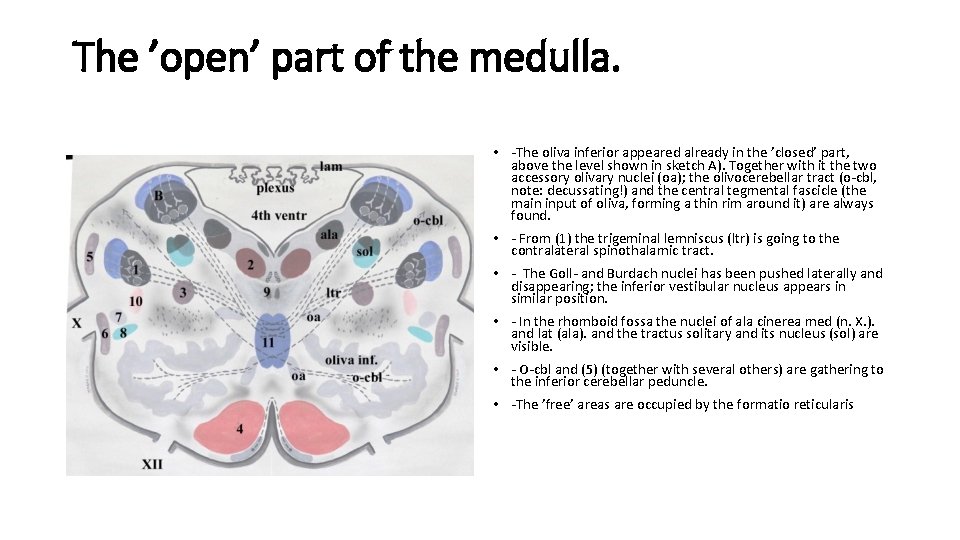
The ’open’ part of the medulla. • -The oliva inferior appeared already in the ’closed’ part, above the level shown in sketch A). Together with it the two accessory olivary nuclei (oa); the olivocerebellar tract (o-cbl, note: decussating!) and the central tegmental fascicle (the main input of oliva, forming a thin rim around it) are always found. • - From (1) the trigeminal lemniscus (ltr) is going to the contralateral spinothalamic tract. • - The Goll- and Burdach nuclei has been pushed laterally and disappearing; the inferior vestibular nucleus appears in similar position. • - In the rhomboid fossa the nuclei of ala cinerea med (n. X. ). and lat (ala). and the tractus solitary and its nucleus (sol) are visible. • - O-cbl and (5) (together with several others) are gathering to the inferior cerebellar peduncle. • -The ’free’ areas are occupied by the formatio reticularis

The main changes in the subsequent cross sections: • a) The medulla/pons border, lower part of pons: • b) The upper part of pons. • -Disappeared: ala, sol, • • -The 4 th ventricle expands latero-ventrally over the inferior peduncle (o-cbl and (5), etc. ) - The 4 th ventricle is borderd laterally by the pathways of the inferior cerebellar peduncle (directly) and the medial one (contralateral pontocerebeliar tract, indirectly). • -Approximately in the former position of G and B the vestibular and cochlear nuclei appear, in the position of the inferior olva the superior oliva and between them the trapezoid body • - In the position (3) the motoric nucl. n. V. , in the position (1) the principal sensory nucl. n. V. , between them the sup. salivatory nucleus (its axons join to N. VII) are found, no structure corresponds to (2). • - In the position (3) the nucl. VII, in the position (2) the nucl. VI are found • - - (4) is fragmented by the pontin nuclei origins of pontocerebellar tract. . • - Between (1) and (3) there is the inf. salivatory nucleus (but its axons join the n. IX!). • Going rostrally, the roof of the 4 th ventricle is formed by the superior medullary velum between the superior cerebellar peduncles and then the 4 th ventricle narrowens to cerebral aqueduct. it is the • - Here and later (9) moves toward (7, 8) and the central tegmental fascicle toward (11). • - (4) is fragmented by the pontin nuclei origins of pontocerebellar tract. . • • c) Isthmus, the transition between the pons and mesencephalon. • • There is no cranial nerve nucleus is here. • In the sup. cerebral peduncle the re-decussating part of and the dentatorubrothalamic tract are found. • In the position of (1) the mesencephalic tract of n. V. is found. • (4) is compact again and parapyramidal tracts (fronto- és temporooccipitopontine) flank it. • Laterally the lateral lemniscus separates (6, 7, 8) from the surface. •
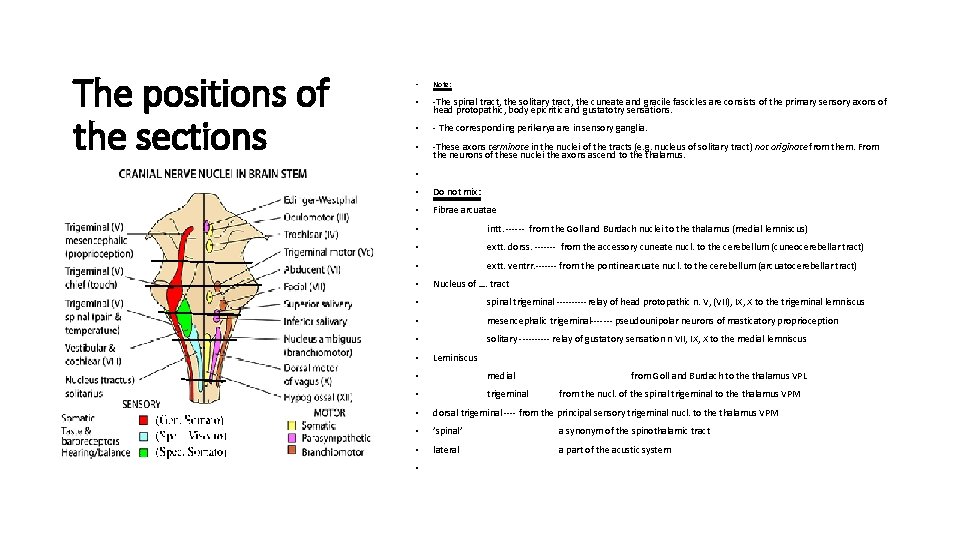
The positions of the sections • Note: • -The spinal tract, the solitary tract, the cuneate and gracile fascicles are consists of the primary sensory axons of head protopathic, body epicritic and gustatotry sensations. • - The corresponding perikarya are in sensory ganglia. • -These axons terminate in the nuclei of the tracts (e. g. nucleus of solitary tract) not originate from them. From the neurons of these nuclei the axons ascend to the thalamus. • • Do not mix: • Fibrae arcuatae • intt. ------ from the Goll and Burdach nuclei to the thalamus (medial lemniscus) • extt. dorss. ------- from the accessory cuneate nucl. to the cerebellum (cuneocerebellar tract) • extt. ventrr. ------- from the pontinearcuate nucl. to the cerebellum (arcuatocerebellar tract) • Nucleus of …. tract • spinal trigeminal -----relay of head protopathic n. V, (VII), IX, X to the trigeminal lemniscus • mesencephalic trigeminal------- pseudounipolar neurons of masticatory proprioception • solitary ----- relay of gustatory sensation n VII, IX, X to the medial lemniscus • Leminiscus • medial • trigeminal from Goll and Burdach to the thalamus VPL from the nucl. of the spinal trigeminal to the thalamus VPM • dorsal trigeminal ---- from the principal sensory trigeminal nucl. to the thalamus VPM • ’spinal’ a synonym of the spinothalamic tract • lateral a part of the acustic system •





- Slides: 11