
KLEE Effective Testing of Systems Programs Cristian Cadar

- Slides: 33
KLEE: Effective Testing of Systems Programs Cristian Cadar Joint work with Daniel Dunbar and Dawson Engler April 16 th, 2009
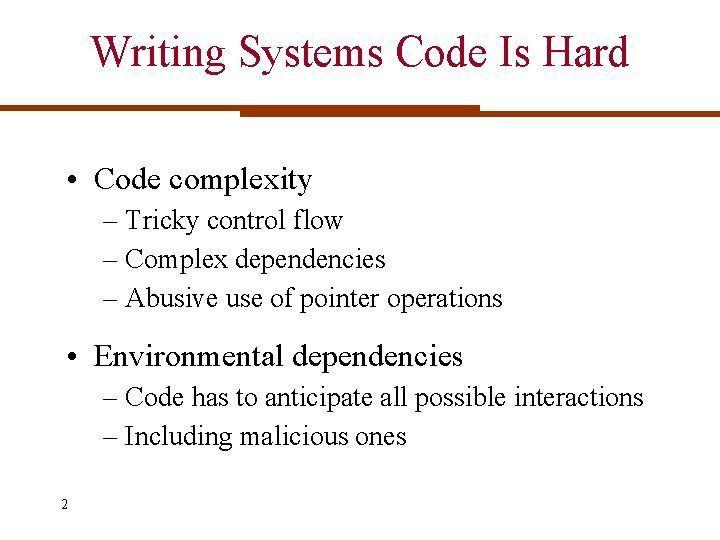
Writing Systems Code Is Hard • Code complexity – Tricky control flow – Complex dependencies – Abusive use of pointer operations • Environmental dependencies – Code has to anticipate all possible interactions – Including malicious ones 2
KLEE [OSDI 2008, Best Paper Award] • Based on symbolic execution and constraint solving techniques • Automatically generates high coverage test suites – Over 90% on average on ~160 user-level apps • Finds deep bugs in complex systems programs – Including higher-level correctness ones
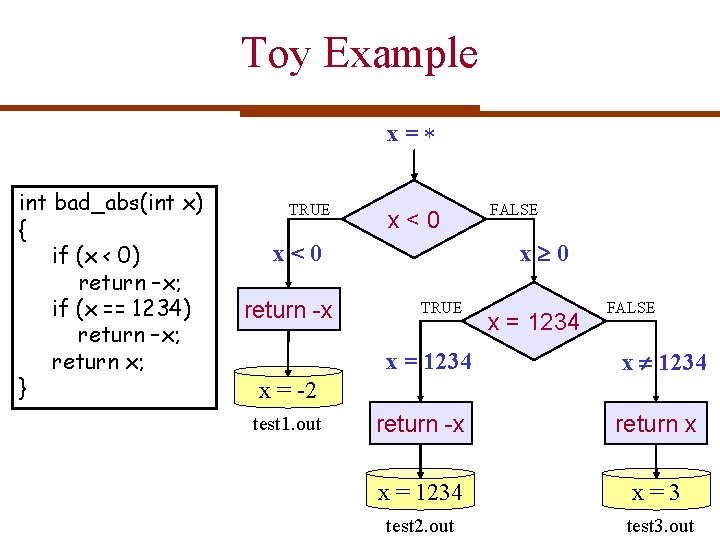
Toy Example x= int bad_abs(int x) { if (x < 0) return –x; if (x == 1234) return –x; return x; } TRUE x<0 x 0 x<0 return -x FALSE TRUE x = 1234 FALSE x 1234 x = -2 test 1. out return -x return x x = 1234 x=3 test 2. out test 3. out
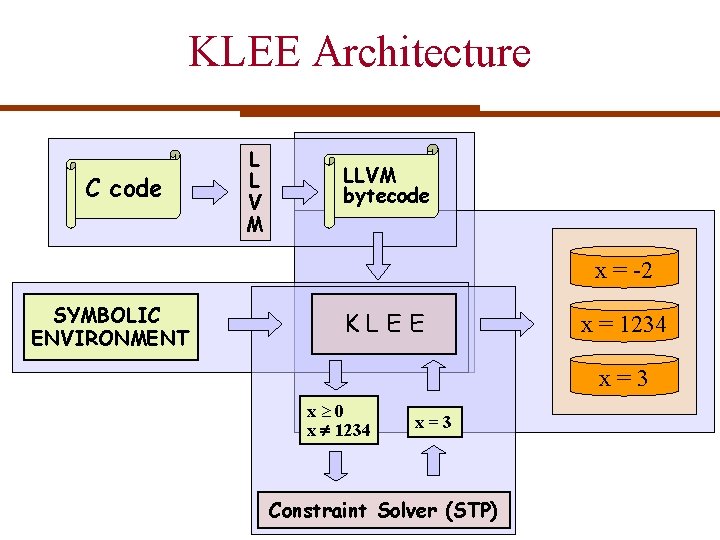
KLEE Architecture C code L L V M LLVM bytecode x = -2 SYMBOLIC ENVIRONMENT KLEE x = 1234 x=3 x 0 x 1234 x=3 Constraint Solver (STP)
Outline • • Motivation Example and Basic Architecture Scalability Challenges Experimental Evaluation
Three Big Challenges • Motivation • Example and Basic Architecture • Scalability Challenges – Exponential number of paths – Expensive constraint solving – Interaction with environment • Experimental Evaluation
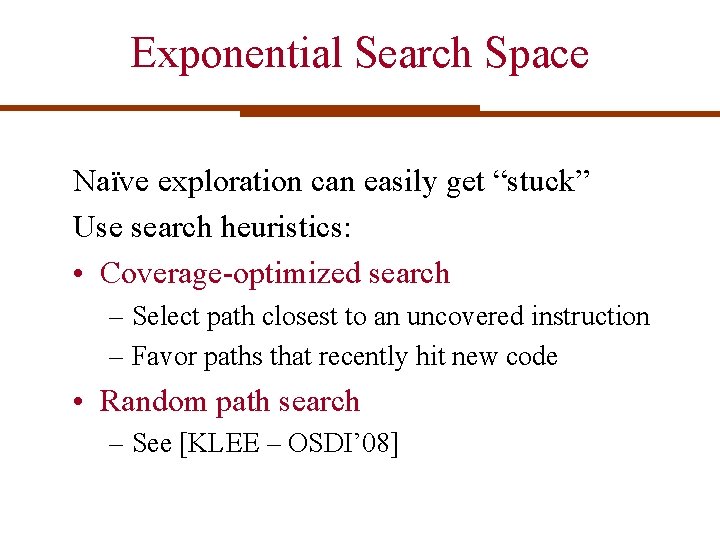
Exponential Search Space Naïve exploration can easily get “stuck” Use search heuristics: • Coverage-optimized search – Select path closest to an uncovered instruction – Favor paths that recently hit new code • Random path search – See [KLEE – OSDI’ 08]
Three Big Challenges • Motivation • Example and Basic Architecture • Scalability Challenges – Exponential number of paths – Expensive constraint solving – Interaction with environment • Experimental Evaluation
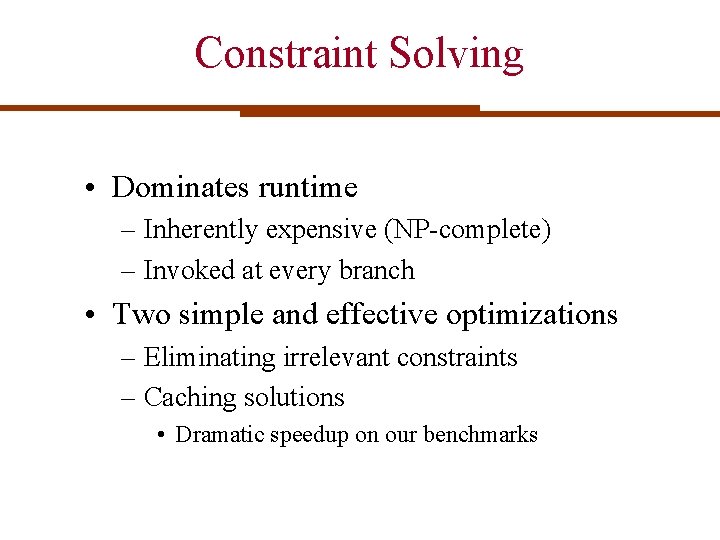
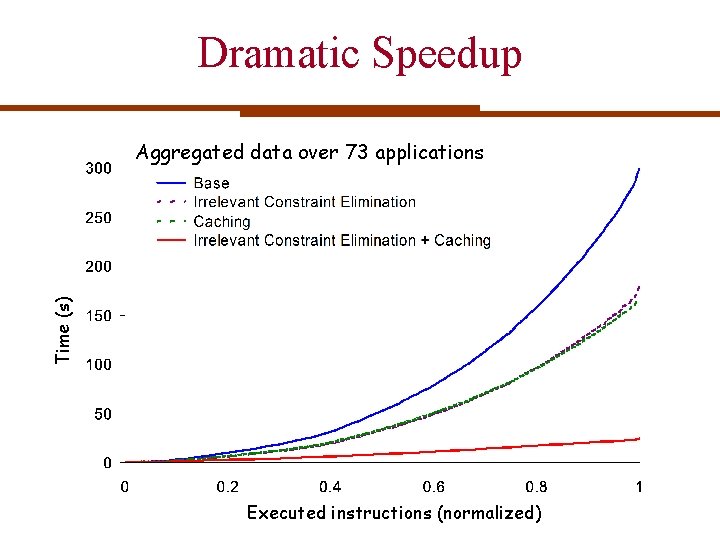
Constraint Solving • Dominates runtime – Inherently expensive (NP-complete) – Invoked at every branch • Two simple and effective optimizations – Eliminating irrelevant constraints – Caching solutions • Dramatic speedup on our benchmarks
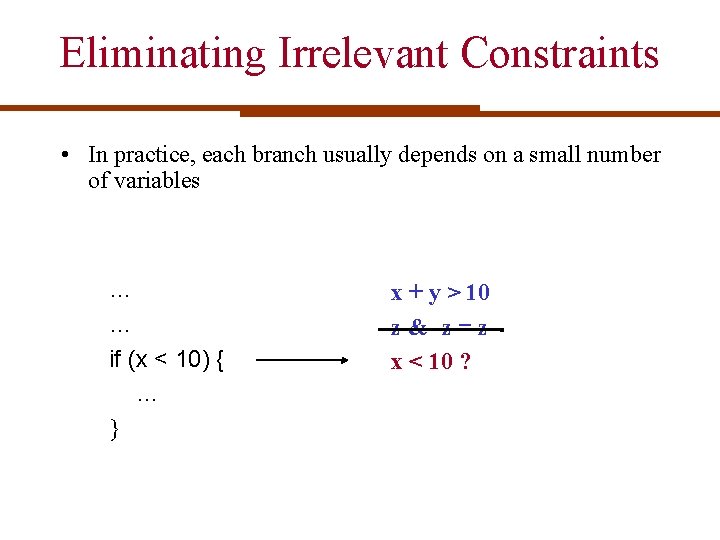
Eliminating Irrelevant Constraints • In practice, each branch usually depends on a small number of variables … … if (x < 10) { … } x + y > 10 z & -z = z x < 10 ?
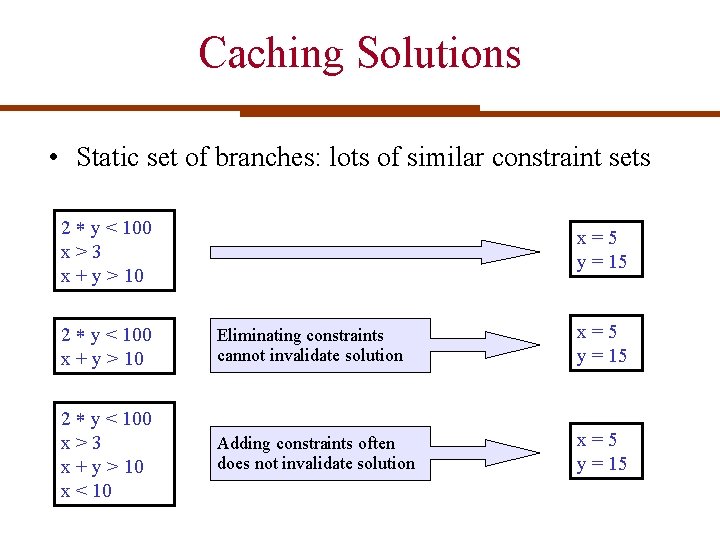
Caching Solutions • Static set of branches: lots of similar constraint sets 2 y < 100 x>3 x + y > 10 x=5 y = 15 2 y < 100 x + y > 10 Eliminating constraints cannot invalidate solution x=5 y = 15 2 y < 100 x>3 x + y > 10 x < 10 Adding constraints often does not invalidate solution x=5 y = 15
Dramatic Speedup Time (s) Aggregated data over 73 applications Executed instructions (normalized)
Three Big Challenges • Motivation • Example and Basic Architecture • Scalability Challenges – Exponential number of paths – Expensive constraint solving – Interaction with environment • Experimental Evaluation
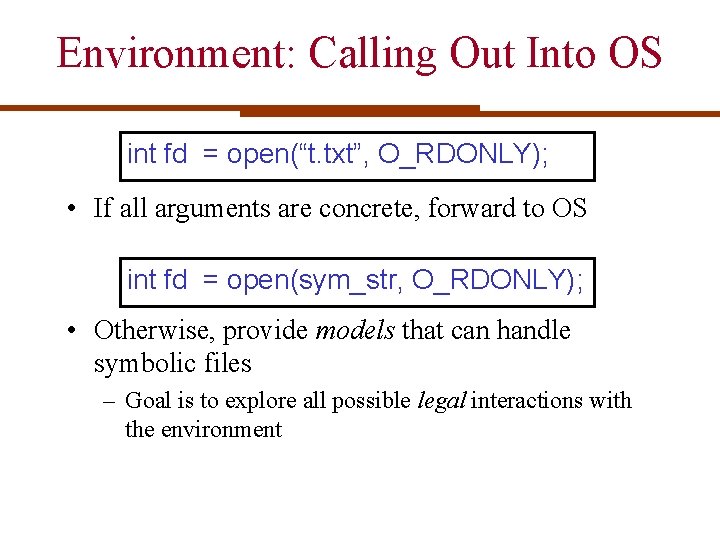
Environment: Calling Out Into OS int fd = open(“t. txt”, O_RDONLY); • If all arguments are concrete, forward to OS int fd = open(sym_str, O_RDONLY); • Otherwise, provide models that can handle symbolic files – Goal is to explore all possible legal interactions with the environment
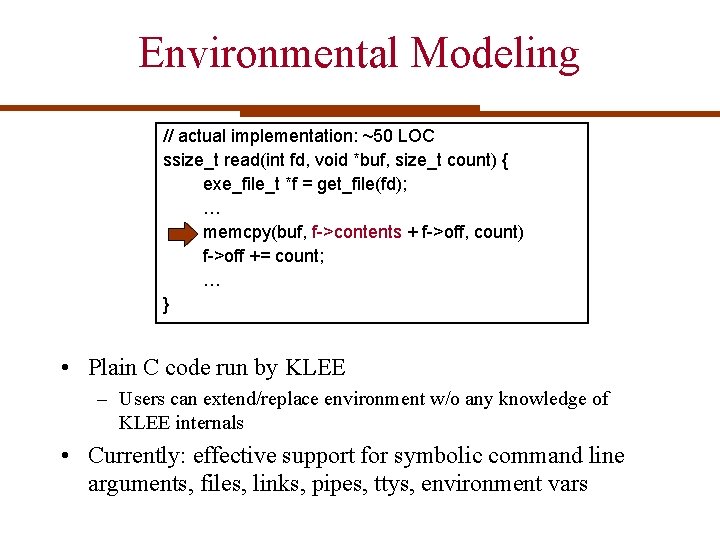
Environmental Modeling // actual implementation: ~50 LOC ssize_t read(int fd, void *buf, size_t count) { exe_file_t *f = get_file(fd); … memcpy(buf, f->contents + f->off, count) f->off += count; … } • Plain C code run by KLEE – Users can extend/replace environment w/o any knowledge of KLEE internals • Currently: effective support for symbolic command line arguments, files, links, pipes, ttys, environment vars
Does KLEE work? • • Motivation Example and Basic Architecture Scalability Challenges Evaluation – Coverage results – Bug finding – Crosschecking
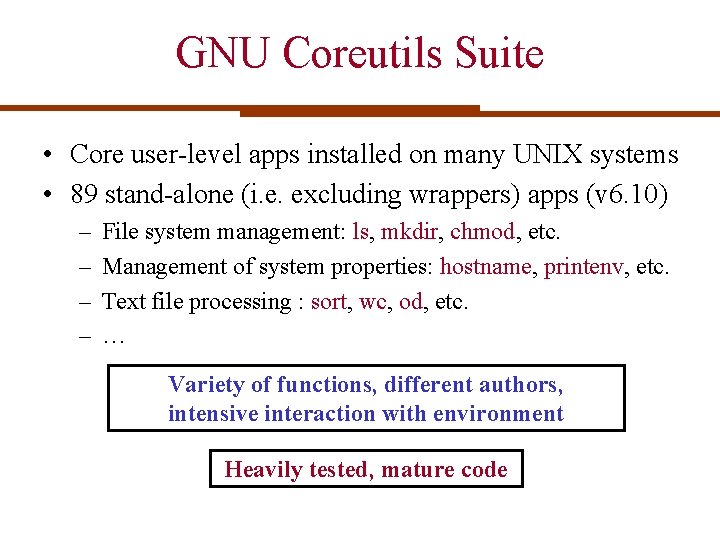
GNU Coreutils Suite • Core user-level apps installed on many UNIX systems • 89 stand-alone (i. e. excluding wrappers) apps (v 6. 10) – – File system management: ls, mkdir, chmod, etc. Management of system properties: hostname, printenv, etc. Text file processing : sort, wc, od, etc. … Variety of functions, different authors, intensive interaction with environment Heavily tested, mature code
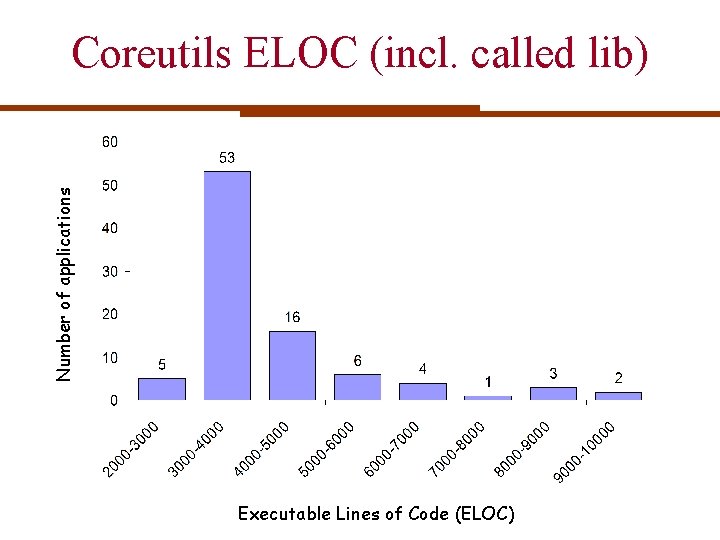
Number of applications Coreutils ELOC (incl. called lib) Executable Lines of Code (ELOC)
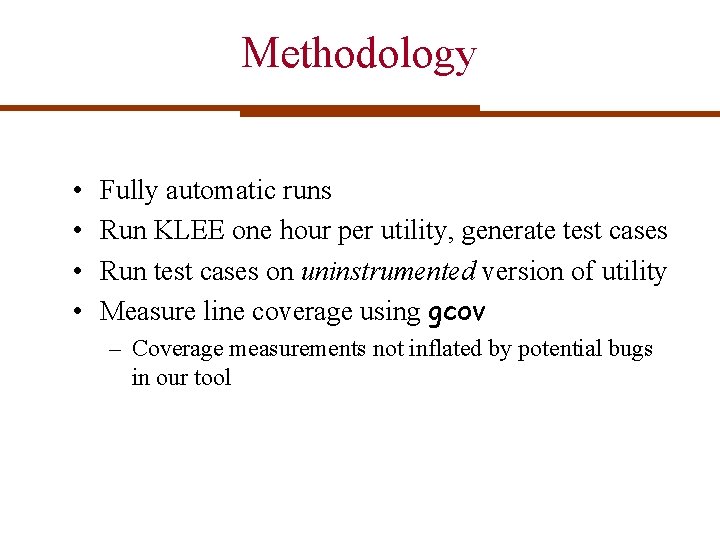
Methodology • • Fully automatic runs Run KLEE one hour per utility, generate test cases Run test cases on uninstrumented version of utility Measure line coverage using gcov – Coverage measurements not inflated by potential bugs in our tool
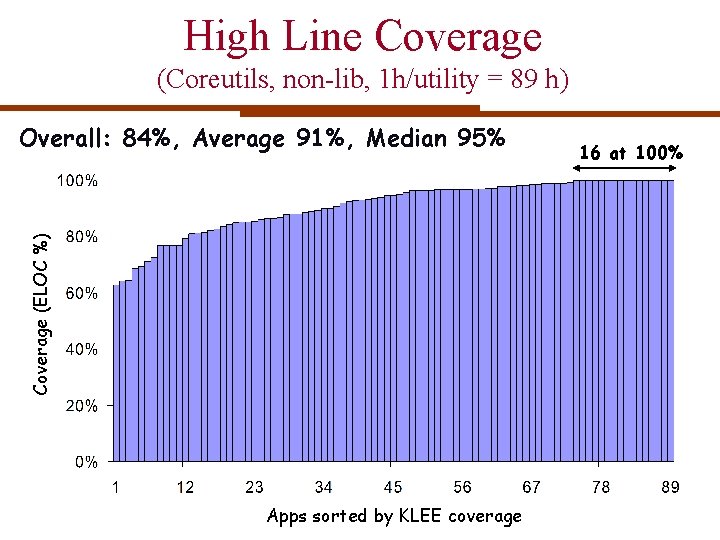
High Line Coverage (Coreutils, non-lib, 1 h/utility = 89 h) Coverage (ELOC %) Overall: 84%, Average 91%, Median 95% Apps sorted by KLEE coverage 16 at 100%
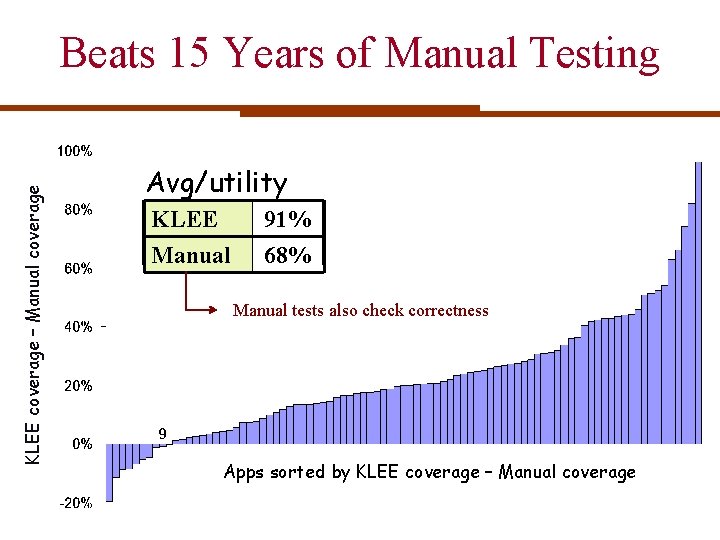
KLEE coverage – Manual coverage Beats 15 Years of Manual Testing Avg/utility KLEE Manual 91% 68% Manual tests also check correctness Apps sorted by KLEE coverage – Manual coverage
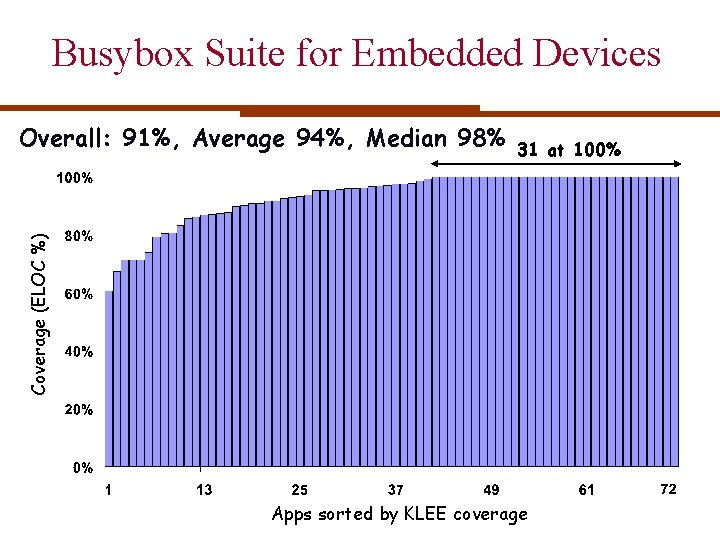
Busybox Suite for Embedded Devices 31 at 100% Coverage (ELOC %) Overall: 91%, Average 94%, Median 98% Apps sorted by KLEE coverage
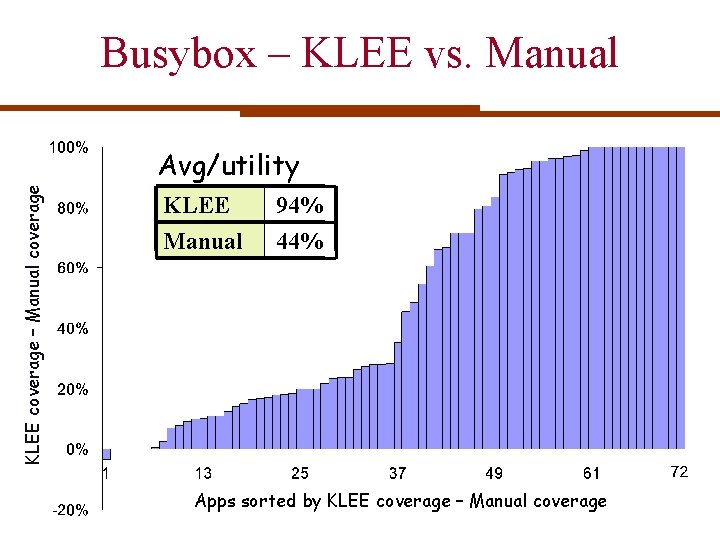
Busybox – KLEE vs. Manual KLEE coverage – Manual coverage Avg/utility KLEE 94% Manual 44% Apps sorted by KLEE coverage – Manual coverage
Does KLEE work? • • Motivation Example and Basic Architecture Scalability Challenges Evaluation – Coverage results – Bug finding – Crosschecking
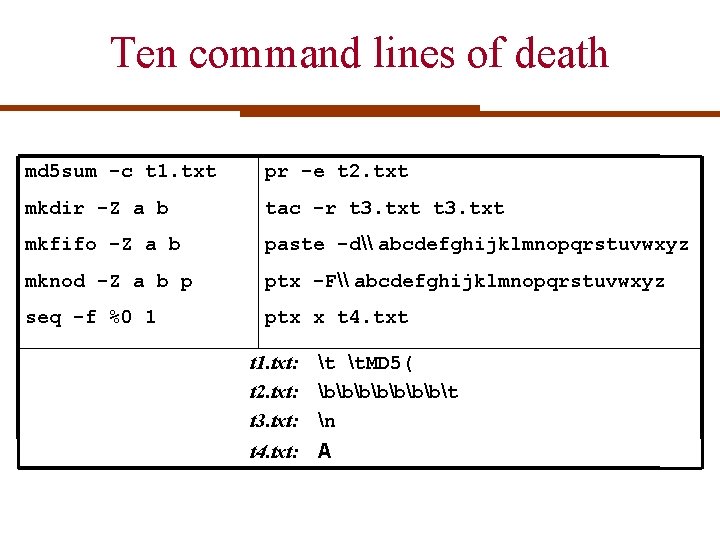
GNU Coreutils Bugs • Ten crash bugs – More crash bugs than approx last three years combined – KLEE generates actual command lines exposing crashes
Ten command lines of death md 5 sum -c t 1. txt pr -e t 2. txt mkdir -Z a b tac -r t 3. txt mkfifo -Z a b paste -d\ abcdefghijklmnopqrstuvwxyz mknod -Z a b p ptx -F\ abcdefghijklmnopqrstuvwxyz seq -f %0 1 ptx x t 4. txt t 1. txt: t 2. txt: t 3. txt: t t. MD 5( bbbbt n t 4. txt: A
Does KLEE work? • • Motivation Example and Basic Architecture Scalability Challenges Evaluation – Coverage results – Bug finding – Crosschecking
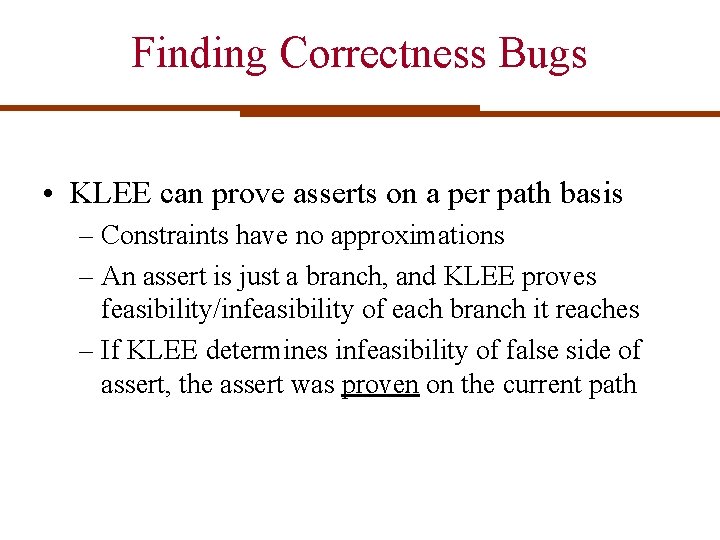
Finding Correctness Bugs • KLEE can prove asserts on a per path basis – Constraints have no approximations – An assert is just a branch, and KLEE proves feasibility/infeasibility of each branch it reaches – If KLEE determines infeasibility of false side of assert, the assert was proven on the current path
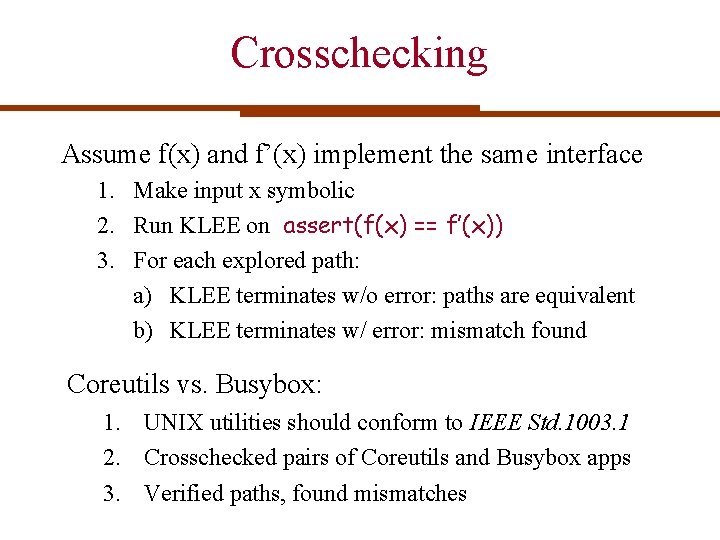
Crosschecking Assume f(x) and f’(x) implement the same interface 1. Make input x symbolic 2. Run KLEE on assert(f(x) == f’(x)) 3. For each explored path: a) KLEE terminates w/o error: paths are equivalent b) KLEE terminates w/ error: mismatch found Coreutils vs. Busybox: 1. UNIX utilities should conform to IEEE Std. 1003. 1 2. Crosschecked pairs of Coreutils and Busybox apps 3. Verified paths, found mismatches
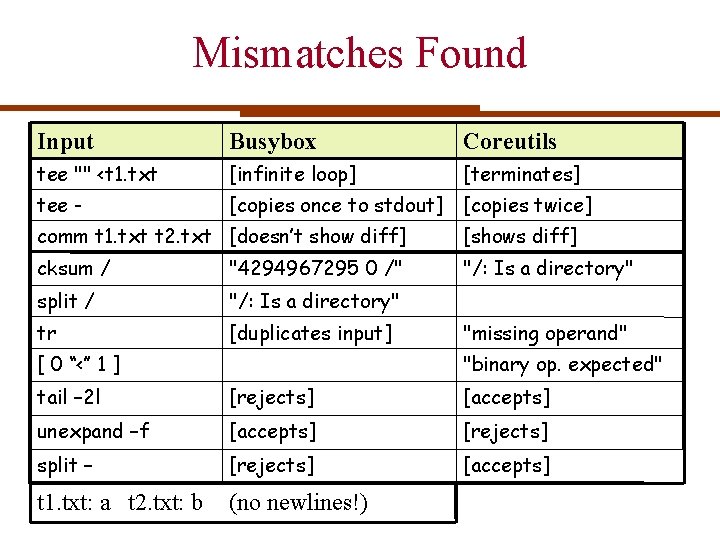
Mismatches Found Input Busybox Coreutils tee "" <t 1. txt [infinite loop] [terminates] tee - [copies once to stdout] [copies twice] comm t 1. txt t 2. txt [doesn’t show diff] [shows diff] cksum / "4294967295 0 /" "/: Is a directory" split / "/: Is a directory" tr [duplicates input] [ 0 ‘‘<’’ 1 ] "missing operand" "binary op. expected" tail – 2 l [rejects] [accepts] unexpand –f [accepts] [rejects] split – [rejects] [accepts] t 1. txt: a t 2. txt: b (no newlines!)
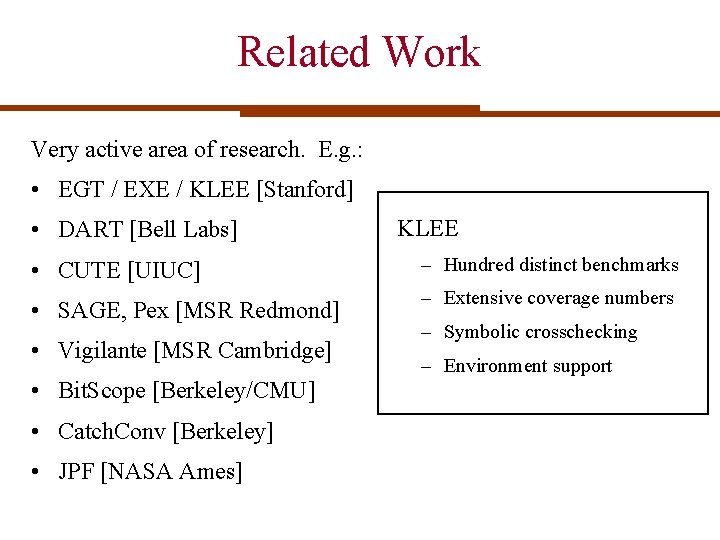
Related Work Very active area of research. E. g. : • EGT / EXE / KLEE [Stanford] • DART [Bell Labs] KLEE • CUTE [UIUC] – Hundred distinct benchmarks • SAGE, Pex [MSR Redmond] – Extensive coverage numbers • Vigilante [MSR Cambridge] • Bit. Scope [Berkeley/CMU] • Catch. Conv [Berkeley] • JPF [NASA Ames] – Symbolic crosschecking – Environment support
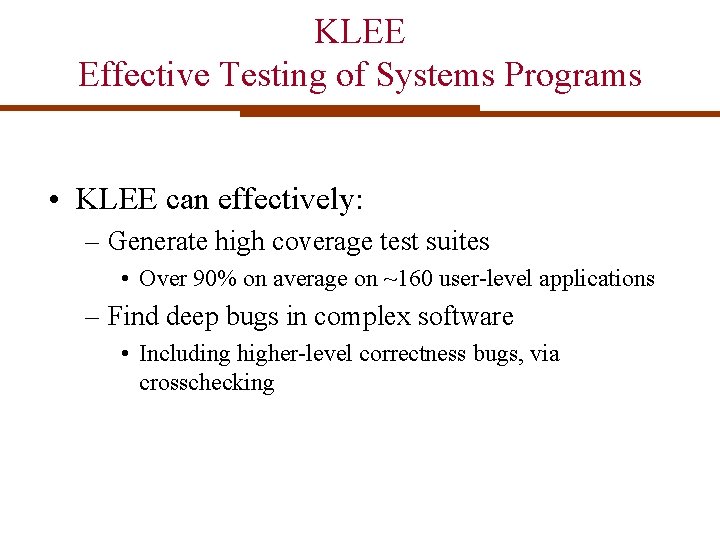
KLEE Effective Testing of Systems Programs • KLEE can effectively: – Generate high coverage test suites • Over 90% on average on ~160 user-level applications – Find deep bugs in complex software • Including higher-level correctness bugs, via crosschecking