
Kjemisk institutt Skolelaboratoriet Introduction to Classification and labelling
Kjemisk institutt - Skolelaboratoriet Introduction to Classification and labelling of mixtures Wednesday 14. aug. 2019 09: 15 – 14. 00 Seminar room, Gleditcsh, Chemistry building Karoline Fægri og Svein Tveit, Skolelaboratoriet i kjemi
Kjemisk institutt - Skolelaboratoriet Competence aims Enable students to: • Be aware of the regulations that apply to classification and labelling of chemicals • Explain some fundamental concepts used in classification and labelling of hazardous substances and mixtures • Explain the elements of CLP hazard labelling • Label aquatic solutions of 2 mol/L Na. OH, 15 % HCl, 9 % NH 3 and 0, 2 mol/L Cu. SO 4
Kjemisk institutt - Skolelaboratoriet Outline • Background information on CLP • Definitions and rules used in classification and labelling with CLP • Example - how to make a label • Exercise 1 & 2 • More definitions and rules • Exercise 3 • Even more definitions and rules • Exercise 4 • How do we label chemicals at the university
Kjemisk institutt - Skolelaboratoriet Breaks 10. 10 – 10. 30 11. 30 – 12. 15 – lunch
Kjemisk institutt - Skolelaboratoriet Outline • Background information on CLP • Definitions and rules used in classification and labelling with CLP • Example – how to make a label • Exercise 1 & 2 • More definitions and rules • Exercise 3 • Even more definitions and rules • Exercise 4 • How do we label chemicals at the university
Kjemisk institutt - Skolelaboratoriet Why is it important to classify and label chemicals?
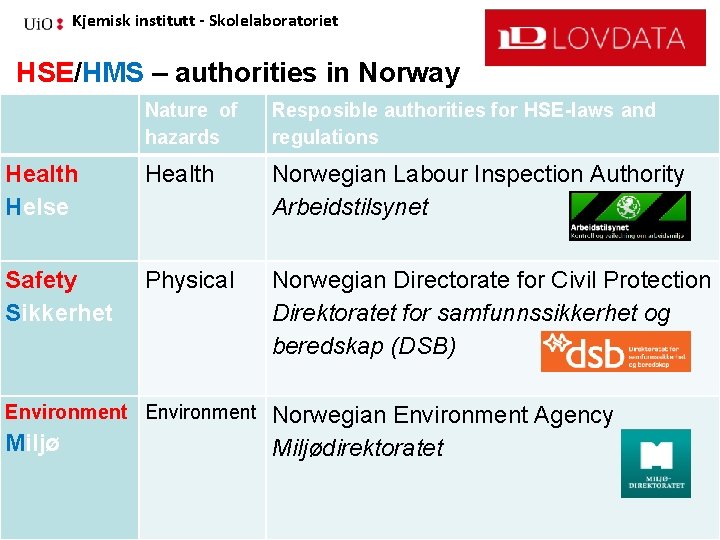
Kjemisk institutt - Skolelaboratoriet HSE/HMS – authorities in Norway Nature of hazards Resposible authorities for HSE-laws and regulations Health Helse Health Norwegian Labour Inspection Authority Arbeidstilsynet Safety Sikkerhet Physical Norwegian Directorate for Civil Protection Direktoratet for samfunnssikkerhet og beredskap (DSB) Environment Miljø Norwegian Environment Agency Miljødirektoratet
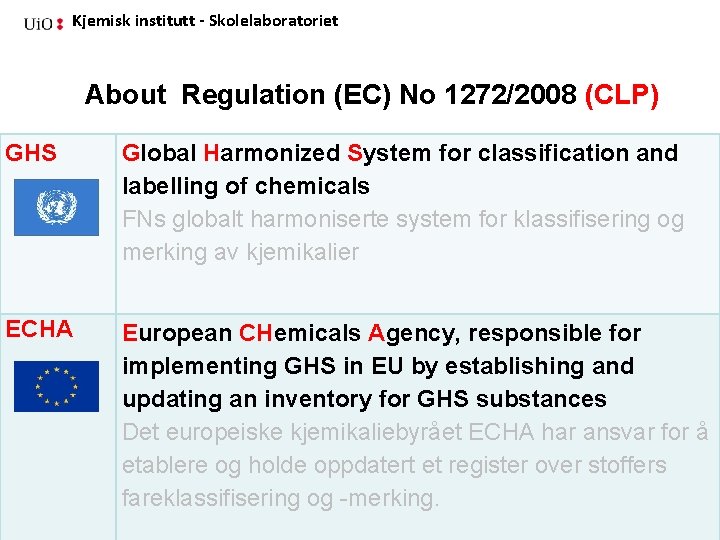
Kjemisk institutt - Skolelaboratoriet About Regulation (EC) No 1272/2008 (CLP) GHS Global Harmonized System for classification and labelling of chemicals FNs globalt harmoniserte system for klassifisering og merking av kjemikalier ECHA European CHemicals Agency, responsible for implementing GHS in EU by establishing and updating an inventory for GHS substances Det europeiske kjemikaliebyrået ECHA har ansvar for å etablere og holde oppdatert et register over stoffers fareklassifisering og -merking.
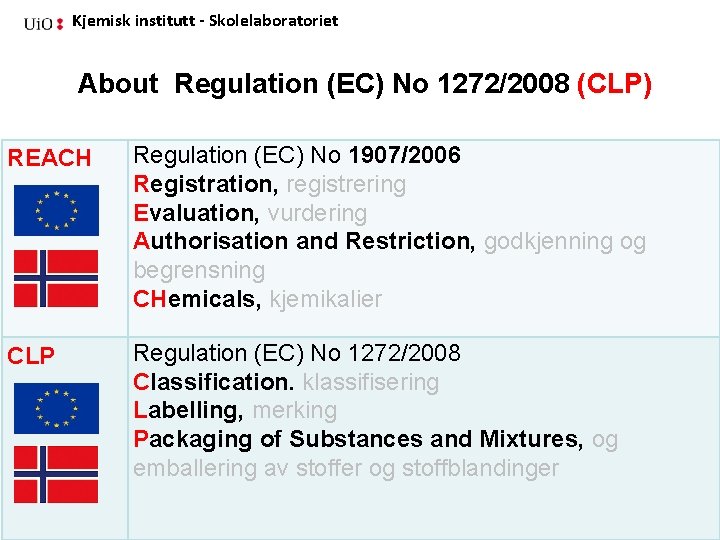
Kjemisk institutt - Skolelaboratoriet About Regulation (EC) No 1272/2008 (CLP) REACH Regulation (EC) No 1907/2006 Registration, registrering Evaluation, vurdering Authorisation and Restriction, godkjenning og begrensning CHemicals, kjemikalier CLP Regulation (EC) No 1272/2008 Classification. klassifisering Labelling, merking Packaging of Substances and Mixtures, og emballering av stoffer og stoffblandinger
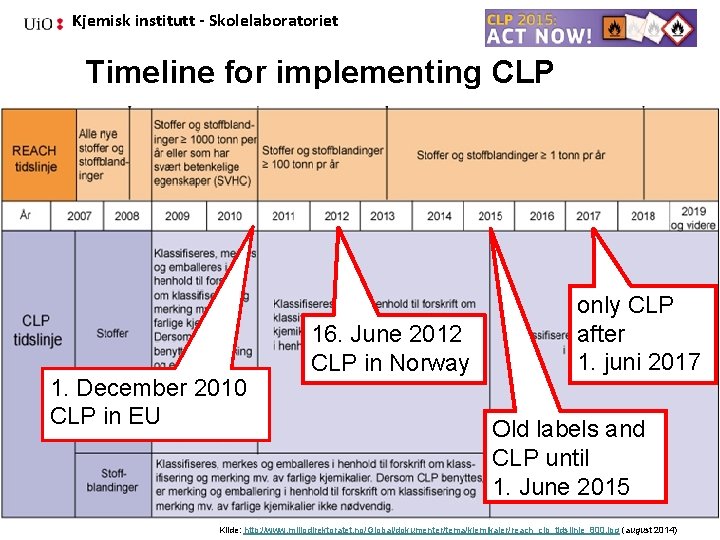
Kjemisk institutt - Skolelaboratoriet Timeline for implementing CLP 1. December 2010 CLP in EU 16. June 2012 CLP in Norway only CLP after 1. juni 2017 Old labels and CLP until 1. June 2015 Kilde: http: //www. miljodirektoratet. no/Global/dokumenter/tema/kjemikaler/reach_clp_tidslinje_800. jpg (august 2014)

Kjemisk institutt - Skolelaboratoriet Hazard communication Product identifier Hazard pictogram Signal word Hazard statement Precautionary statement Company identity
Kjemisk institutt - Skolelaboratoriet Product identifier • Name and identification number given in the Classification and Labelling Inventory if not included in C&L Inventory • CAS number and IUPAC name
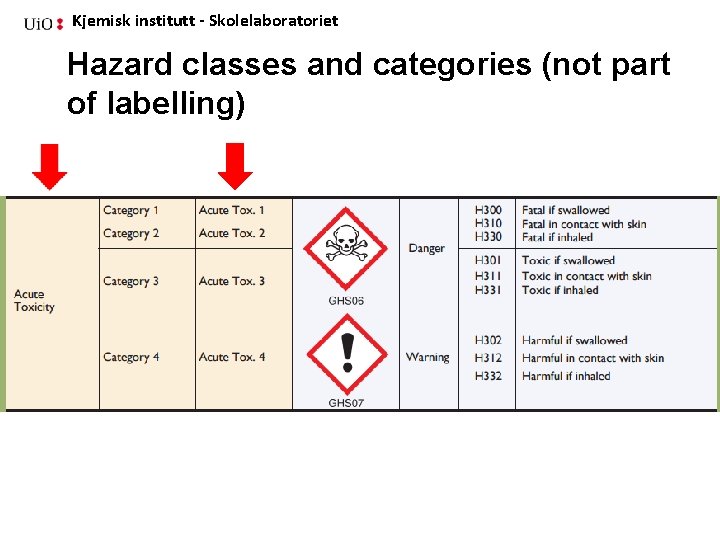
Kjemisk institutt - Skolelaboratoriet Hazard classes and categories (not part of labelling)
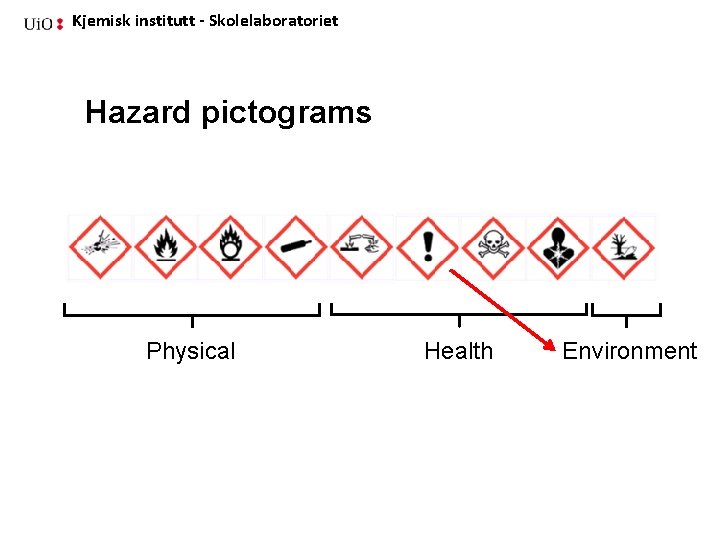
Kjemisk institutt - Skolelaboratoriet Hazard pictograms Physical Health Environment
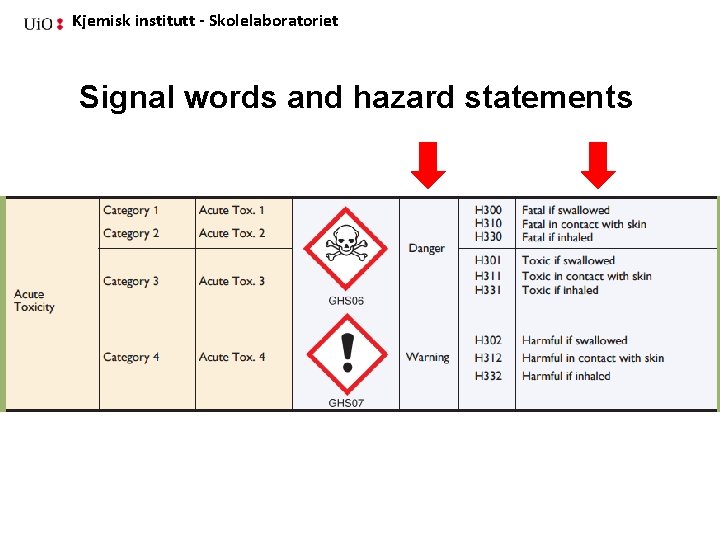
Kjemisk institutt - Skolelaboratoriet Signal words and hazard statements
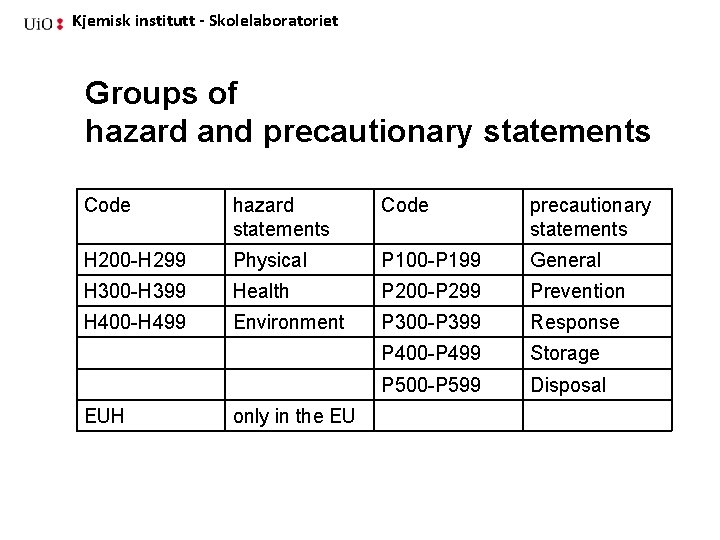
Kjemisk institutt - Skolelaboratoriet Groups of hazard and precautionary statements Code hazard statements Code precautionary statements H 200 -H 299 Physical P 100 -P 199 General H 300 -H 399 Health P 200 -P 299 Prevention H 400 -H 499 Environment P 300 -P 399 Response P 400 -P 499 Storage P 500 -P 599 Disposal EUH only in the EU
Kjemisk institutt - Skolelaboratoriet Exercises – Classifying and making labels Example: label 3 mol/L H 2 SO 4 1 L bottle
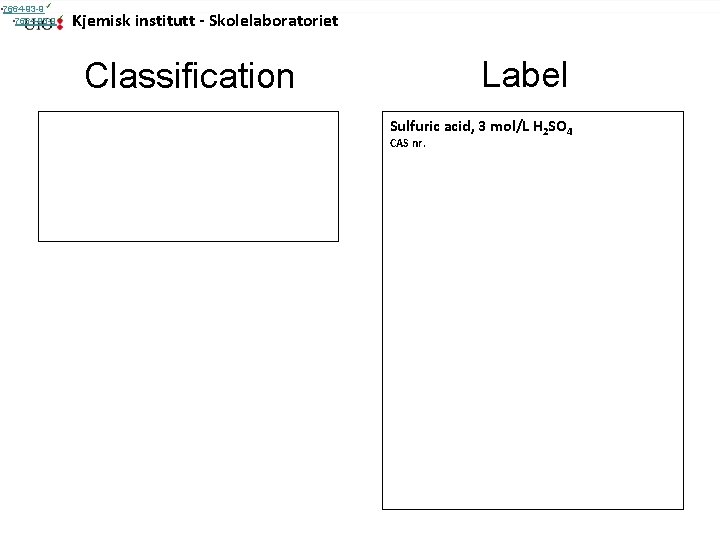
• 7664 -93 -9 Kjemisk institutt - Skolelaboratoriet Label Classification Sulfuric acid, 3 mol/L H 2 SO 4 CAS nr.
Kjemisk institutt - Skolelaboratoriet Exercises – Classifying and making labels 1 a) Label for 2 mol/L Na. OH 1 b) (optional) Label for 5 mol/L HCOOH (density 1, 05 g/m. L)
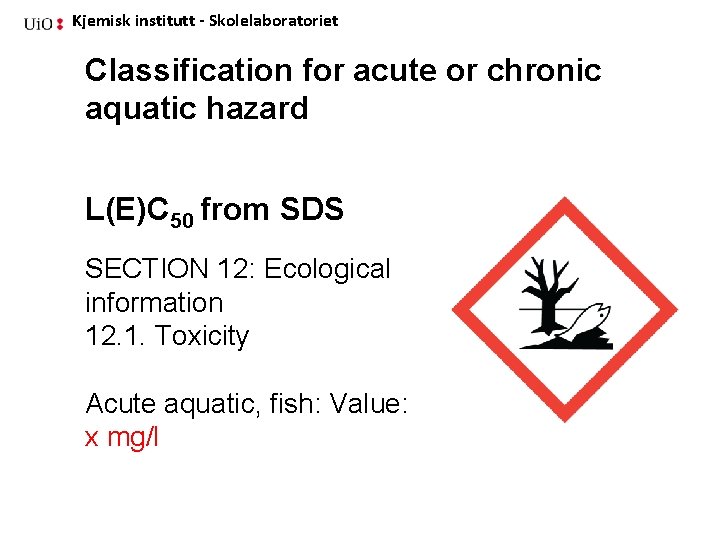
Kjemisk institutt - Skolelaboratoriet Classification for acute or chronic aquatic hazard L(E)C 50 from SDS SECTION 12: Ecological information 12. 1. Toxicity Acute aquatic, fish: Value: x mg/l
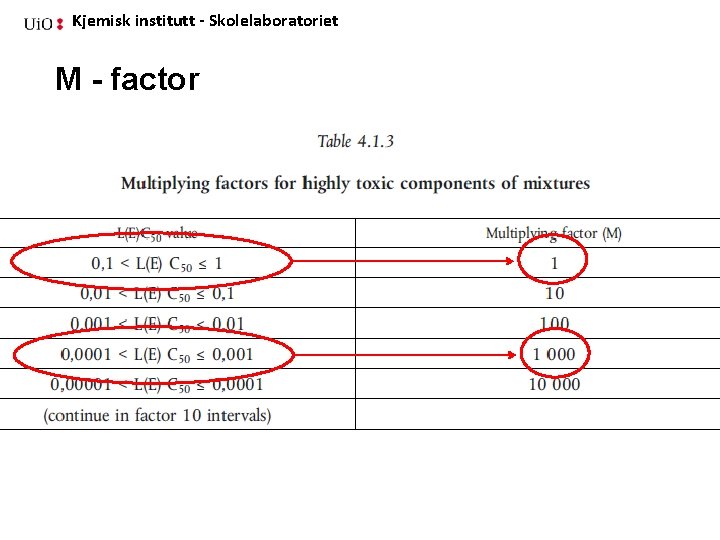
Kjemisk institutt - Skolelaboratoriet M - factor
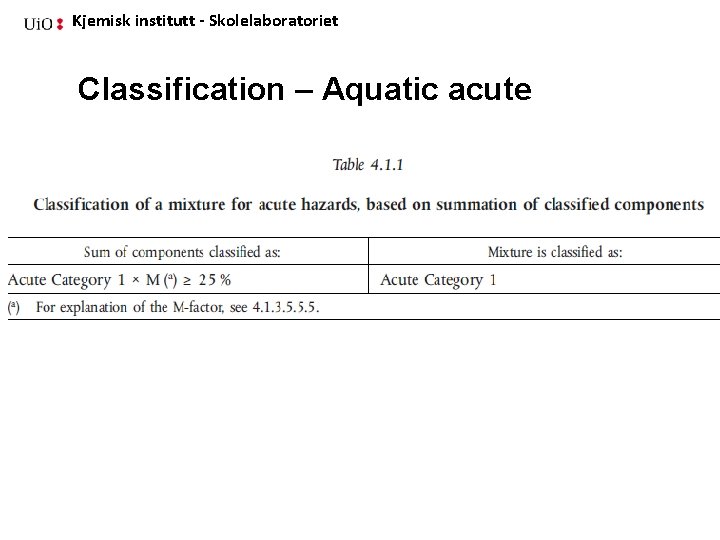
Kjemisk institutt - Skolelaboratoriet Classification – Aquatic acute
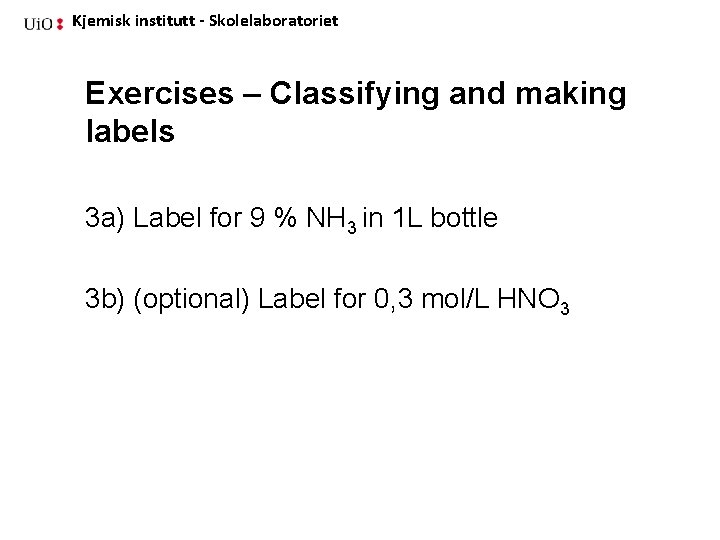
Kjemisk institutt - Skolelaboratoriet Exercises – Classifying and making labels 3 a) Label for 9 % NH 3 in 1 L bottle 3 b) (optional) Label for 0, 3 mol/L HNO 3
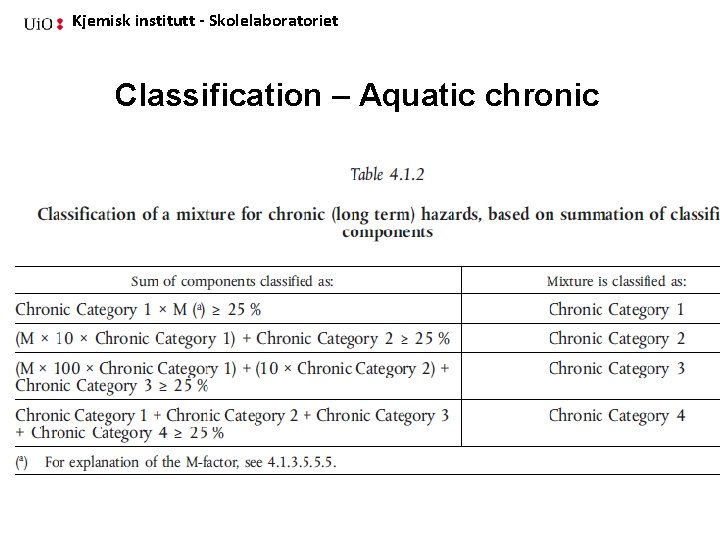
Kjemisk institutt - Skolelaboratoriet Classification – Aquatic chronic
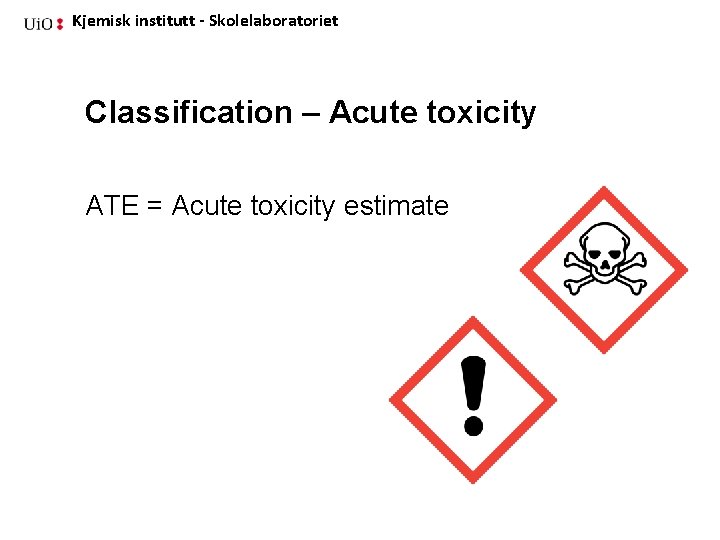
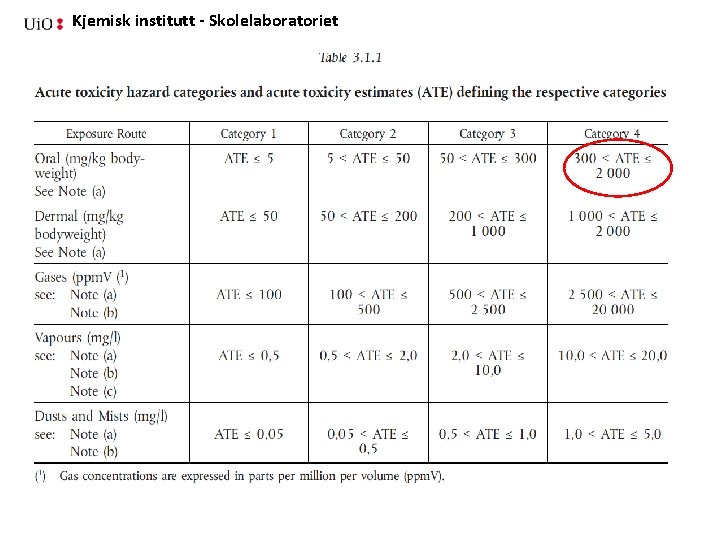
Kjemisk institutt - Skolelaboratoriet Classification – Acute toxicity ATE = Acute toxicity estimate
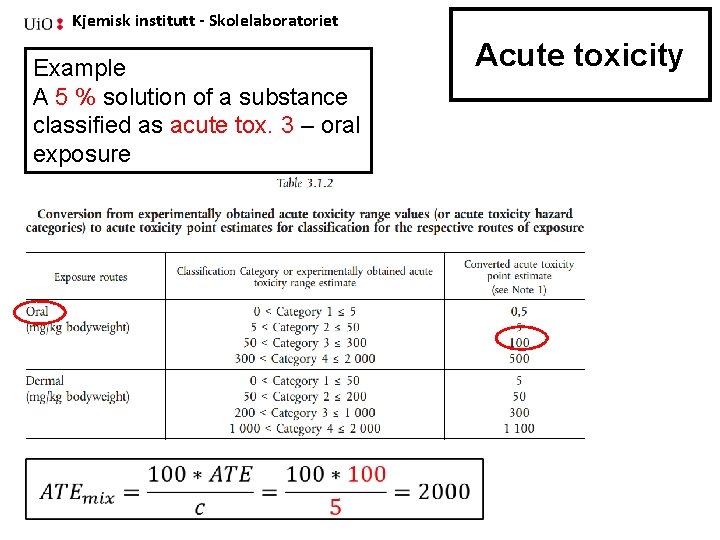
Kjemisk institutt - Skolelaboratoriet Example A 5 % solution of a substance classified as acute tox. 3 – oral exposure Acute toxicity
Kjemisk institutt - Skolelaboratoriet
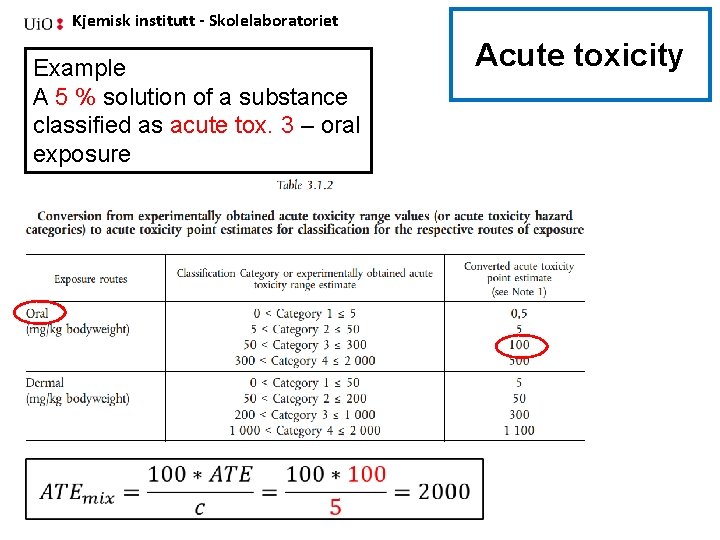
Kjemisk institutt - Skolelaboratoriet Example A 5 % solution of a substance classified as acute tox. 3 – oral exposure Acute toxicity
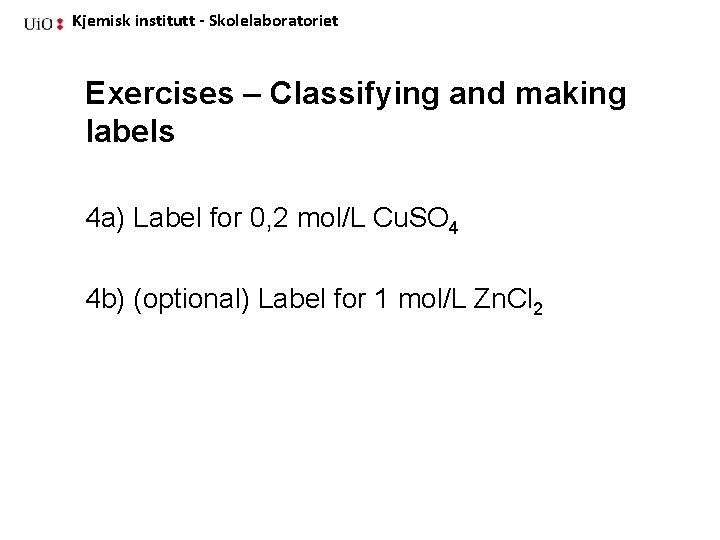
Kjemisk institutt - Skolelaboratoriet Exercises – Classifying and making labels 4 a) Label for 0, 2 mol/L Cu. SO 4 4 b) (optional) Label for 1 mol/L Zn. Cl 2
Kjemisk institutt - Skolelaboratoriet Harmonised classification • Harmonised classification (as provided in Annex VI to CLP), must always be used by a manufacturer • Harmonised classification normally applies to those properties of the highest concern • Where some, but not all hazard classes or differentiations within hazard classes have been harmonised, the remainder should be self-classified to complete the classification Guidance on the Application of the CLP Criteria
Kjemisk institutt - Skolelaboratoriet Leads to different classification for the same mixture Ammonia 25 % (Avantor) Skin corrosion 1 B Aquatic acute, 1 STOT, SE, 3 Serious eyedamage, 1 Aquatic chronic, 2 Ammonia 25 % (Merck) Skin corrosion, 1 B Aquatic acute, 1 STOT, SE, 3 Corrosive to metals, 1
Kjemisk institutt - Skolelaboratoriet CLP in scientific research This Regulation (CLP) shall not apply to the following: substances and mixtures for scientific research and development, which are not placed on the market, provided they are used under controlled conditions in accordance with Community workplace and environmental legislation. http: //eur-lex. europa. eu/Lex. Uri. Serv. do? uri=OJ: L: 2008: 353: 0001: 1355: en: PDF Title 1, Article 1, 2 d
Kjemisk institutt - Skolelaboratoriet How to label mixtures in your science lab • Mixtures that are to be use the same day do not require any labelling • Mixtures that are left over night requires a minimum labelling of: – – Name and molar concentration Hazard pictograms Hazard statements Highly relevant precautionairy statements
Kjemisk institutt - Skolelaboratoriet Evaluation Plus, minus, delta
- Slides: 34