
Kinship Care Brain Development Mental Health and Social
Kinship Care & Brain Development, Mental Health and Social Media The only UK-wide charity dedicated solely to tackling child sexual abuse

Learning Recap What can you recall learning from the last module? What changes have you made as a result?
Learning Outcomes Raised awareness of impact of the internet on teenage brain development and mental health Increased knowledge of young peoples use of technology and the internet The positives and negatives of Social Media
The internet & how society has changed…. . Click on this video to learn how the world has changes over the last 30 years with the introduction of the internet
Brain development • Our brains develop from before birth and into adulthood (Siegel and Bryson, 2012). But there are key ‘sensitive periods’ during early childhood and adolescence where children and young people’s brains are more malleable, making them more susceptible to positive or negative experiences (Shonkoff et al, 2008). • What happens during a child or young person’s life in these periods can have a significant effect on a child’s brain development. • Positive experiences throughout childhood help to build healthy brains. • Although it’s beneficial to provide children with positive experiences as early as possible, our brains always have the potential to change and grow. It’s never too late to give a child or young person positive brain building experiences.
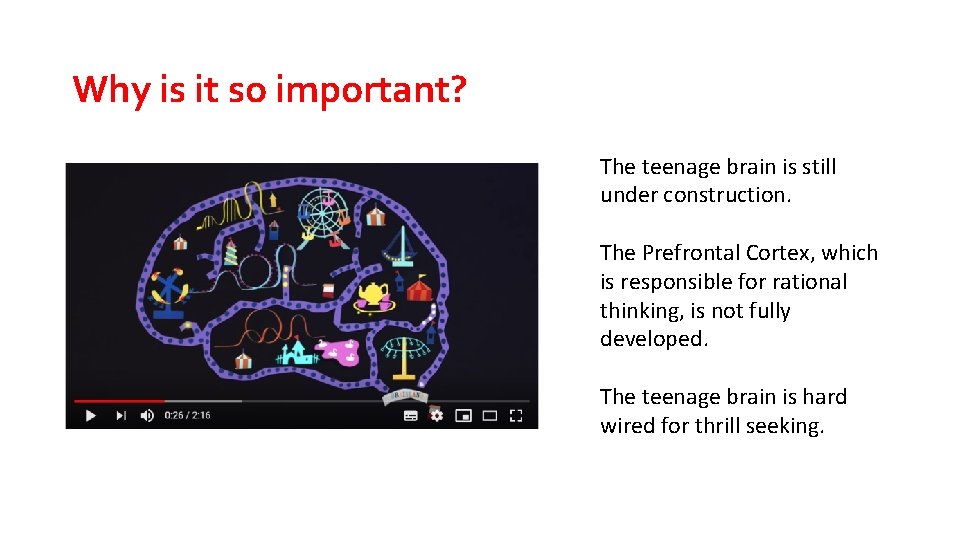
Why is it so important? The teenage brain is still under construction. The Prefrontal Cortex, which is responsible for rational thinking, is not fully developed. The teenage brain is hard wired for thrill seeking.
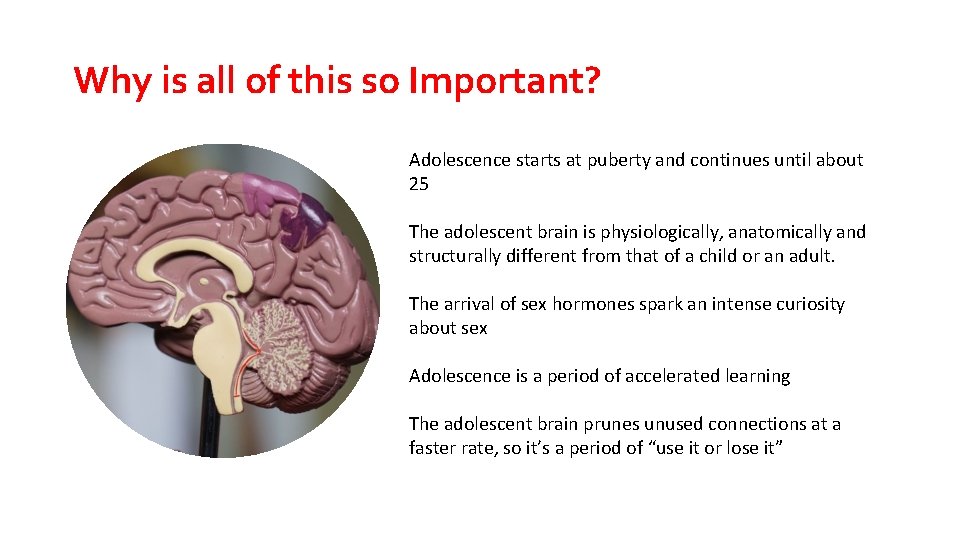
Why is all of this so Important? Adolescence starts at puberty and continues until about 25 The adolescent brain is physiologically, anatomically and structurally different from that of a child or an adult. The arrival of sex hormones spark an intense curiosity about sex Adolescence is a period of accelerated learning The adolescent brain prunes unused connections at a faster rate, so it’s a period of “use it or lose it”
Risk taking The desire for thrills & excitement peaks, due to levels of feel good hormones. This leads to thrill seeking behaviour, risk taking behaviours. What sort of behaviours do you think are more prevalent in adolescence? What might adolescence be more vulnerable too as a result?
Your rear view mirror Think back to when you were 14 years old: Where were you living? Who were your friends? What were your favourite bands? Did your parents know what you were up to? What were you wearing? Where did you hang about? Were you taking risks? How did your parents respond and did that work?
The impact of social media on mental health Psychologists have looked at the effects of heavy social media use on mental wellbeing. The consistent finding is that heavy use of SM is associated with poorer mental health ( >2 hrs/day) Impact on sleep: Blue Light, Notifications, Social Anxiety/trolling Passive scrolling affects wellbeing: We post generally more ‘highlights’ when our mood is high. We just scroll when its low- this creates a differential between what is real and what is idealised = FOMO or not measuring up Using social media as a life comparison tool: Social media is not a barometer of how we measure up and compare to others, affecting self-esteem.
The impact of social media on mental health Constant Posting and updating opens us up to more negative or mean comments rather than compliments or praise Cyberbullying is just as serious as offline bullying and can lead to serious depression and in severe cases harmful behaviour. ‘Chasing Likes’ to drive self esteem or worth: Being too active or worrying about content links to anxiety, poor body image and poor mental health. Worrying about how others view us , makes us more self critical of both our general appearance and our lives in general.
The unstoppable internet We are surrounded by smart phones, i. Pad and devices that can access the Internet The internet offers huge opportunities. Some think it is out of control but we can take control. What opportunities does the internet offer to young people? How can you help your child use the online world in a way that’s safe and positive for their mental health? How can you make having conversations about the internet ordinary?
Your reputation precedes you • What goes online stays online • Everything you do and say online will have a positive and negative impact on your online reputation. • How are you going to keep yours in shape? • What are you sharing? • Who is looking at this? • How does this impact you now and in the future? • Positive Influences for the now and your future • If you have done something online that is negative you can take control and BURY it?
Generate positive content • Become an online Influencer – Positive Brand • Moving forward, generating positive content will become the best way to make sure your reputation online is seen in a positive light. • Lots of positive content can also help push any negative content further down the rankings – Layer it up. • Be aware of what you are connected to – activity log on FB allows you to see this.
Positive influences of social media • Broaden connection and understanding of the world • Develop communication and technical skills • Removing boundaries to develop connections • Strengthen relationships • A place to seek support • Campaigning for social good • Develop a positive digital footprint
Final Reflections • How are you feeling after learning all this? • What will you remember from the module? • Will you do anything differently because of what we’ve covered?
- Slides: 17