
Kings Worthy Primary School Phonics September 2020 Hopefully
Kings Worthy Primary School Phonics September 2020
Hopefully by the end you will… • Greater understanding of ‘Letters and Sounds’. • Knowledge of the structure of our Phonics sessions. • Understanding of some of the terminology. • Gather some ideas and techniques to support children at home.
What is Phonics? • • Skills of segmentation and blending Knowledge of alphabetical code Identifying sounds in words Recognising common spellings of each phoneme • Blending phonemes in reading • Segmenting phonemes in spelling
Phonics Technical terms (these are words that we use with the children in their phonics session): Phoneme Grapheme CVC / CVCC / CCVC Digraph / vowel digraph Segment
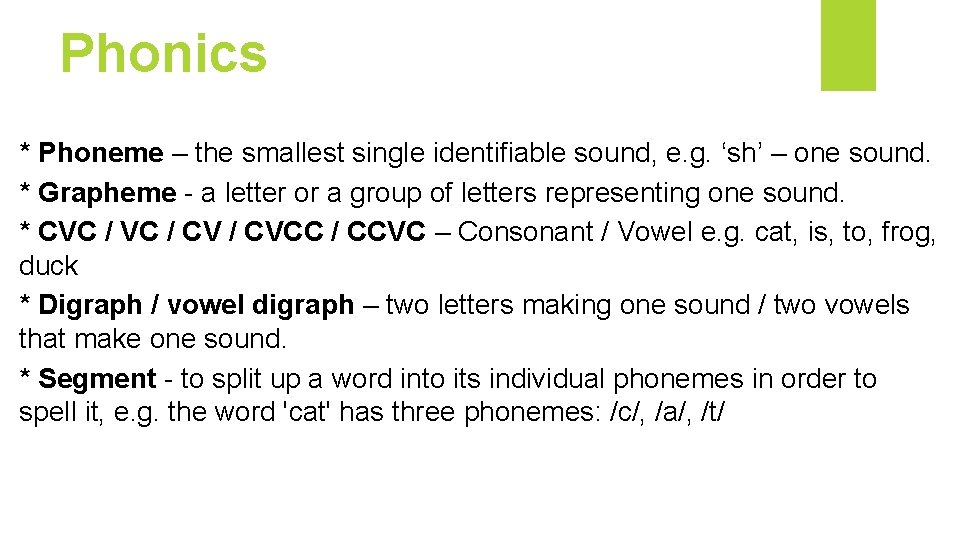
Phonics * Phoneme – the smallest single identifiable sound, e. g. ‘sh’ – one sound. * Grapheme - a letter or a group of letters representing one sound. * CVC / CVCC / CCVC – Consonant / Vowel e. g. cat, is, to, frog, duck * Digraph / vowel digraph – two letters making one sound / two vowels that make one sound. * Segment - to split up a word into its individual phonemes in order to spell it, e. g. the word 'cat' has three phonemes: /c/, /a/, /t/
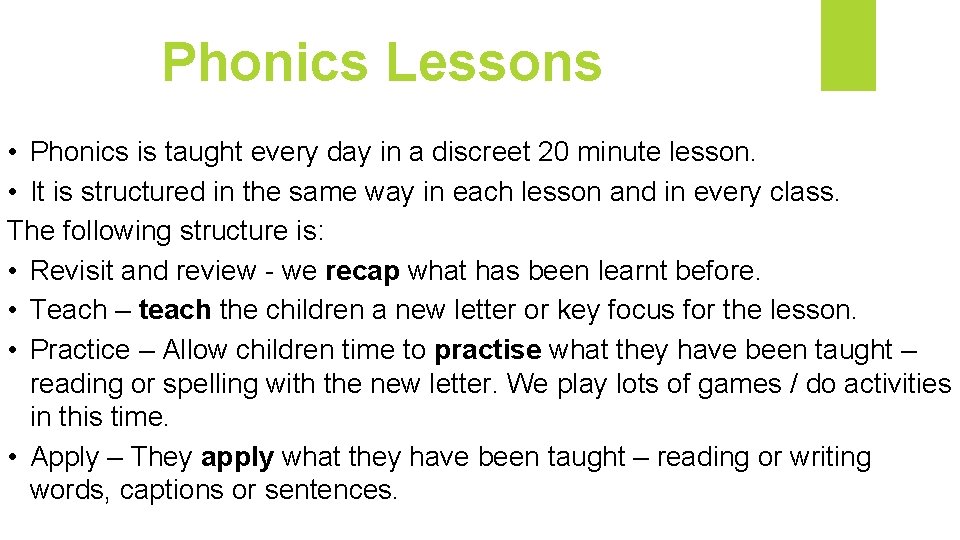
Phonics Lessons • Phonics is taught every day in a discreet 20 minute lesson. • It is structured in the same way in each lesson and in every class. The following structure is: • Revisit and review - we recap what has been learnt before. • Teach – teach the children a new letter or key focus for the lesson. • Practice – Allow children time to practise what they have been taught – reading or spelling with the new letter. We play lots of games / do activities in this time. • Apply – They apply what they have been taught – reading or writing words, captions or sentences.
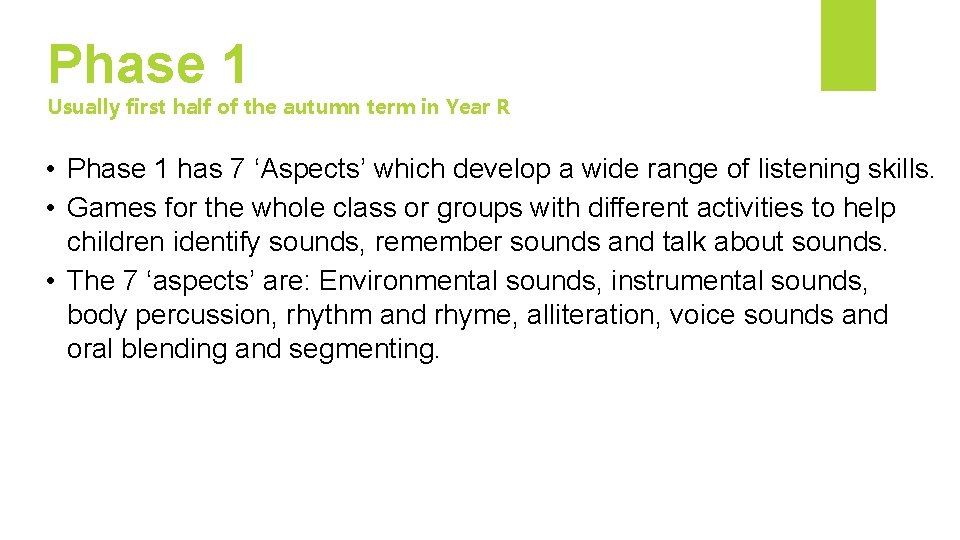
Phase 1 Usually first half of the autumn term in Year R • Phase 1 has 7 ‘Aspects’ which develop a wide range of listening skills. • Games for the whole class or groups with different activities to help children identify sounds, remember sounds and talk about sounds. • The 7 ‘aspects’ are: Environmental sounds, instrumental sounds, body percussion, rhythm and rhyme, alliteration, voice sounds and oral blending and segmenting.
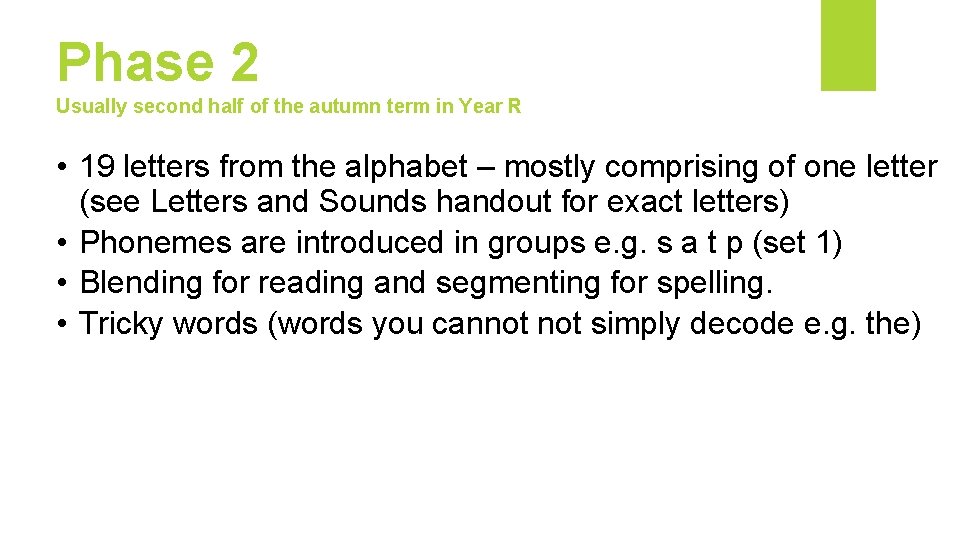
Phase 2 Usually second half of the autumn term in Year R • 19 letters from the alphabet – mostly comprising of one letter (see Letters and Sounds handout for exact letters) • Phonemes are introduced in groups e. g. s a t p (set 1) • Blending for reading and segmenting for spelling. • Tricky words (words you cannot simply decode e. g. the)
Cued Articulation • All 44 sounds (phonemes) of the English phonological system have a separate hand sign which is related to where and how in the mouth the sounds are made. • Cued articulation is not a sign language • https: //www. youtube. com/watch? v=BPLnf. Nci. Lb. A A You. Tube video showing you the different cued articulation for each phoneme.
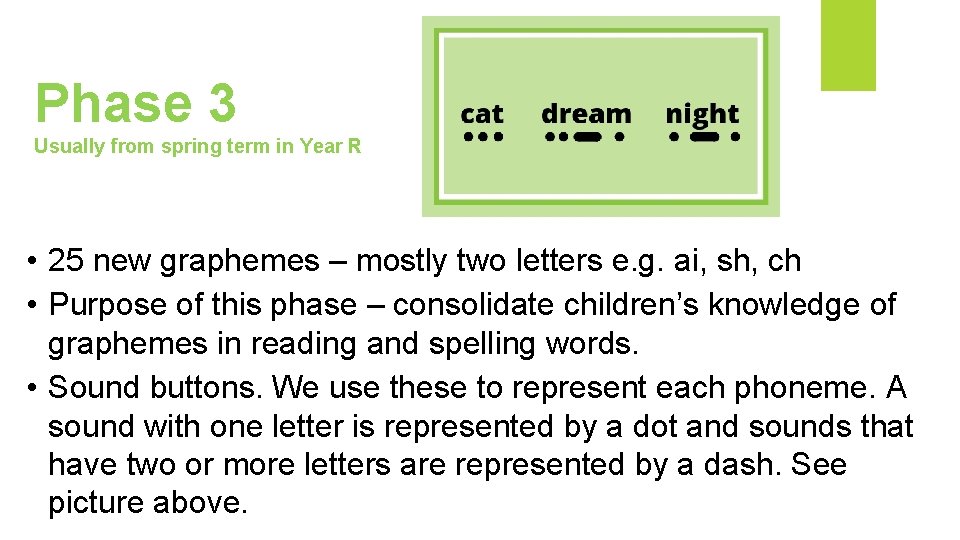
Phase 3 Usually from spring term in Year R • 25 new graphemes – mostly two letters e. g. ai, sh, ch • Purpose of this phase – consolidate children’s knowledge of graphemes in reading and spelling words. • Sound buttons. We use these to represent each phoneme. A sound with one letter is represented by a dot and sounds that have two or more letters are represented by a dash. See picture above.
Phase 4 Usually end of Year R / Beginning of Year • A short phase – blending and segmenting previous phonemes and graphemes learnt. • Two letters e. g. ai, sh, ch • CVC blending and segmenting
Phase 5 Usually throughout the whole of Year 1 • • • Able to represent the 44 phonemes. Two letters e. g. ay, ou, ea CVC blending and segmenting Alternative pronunciations e. g. tin, wild Alternative spellings e. g. train and eight
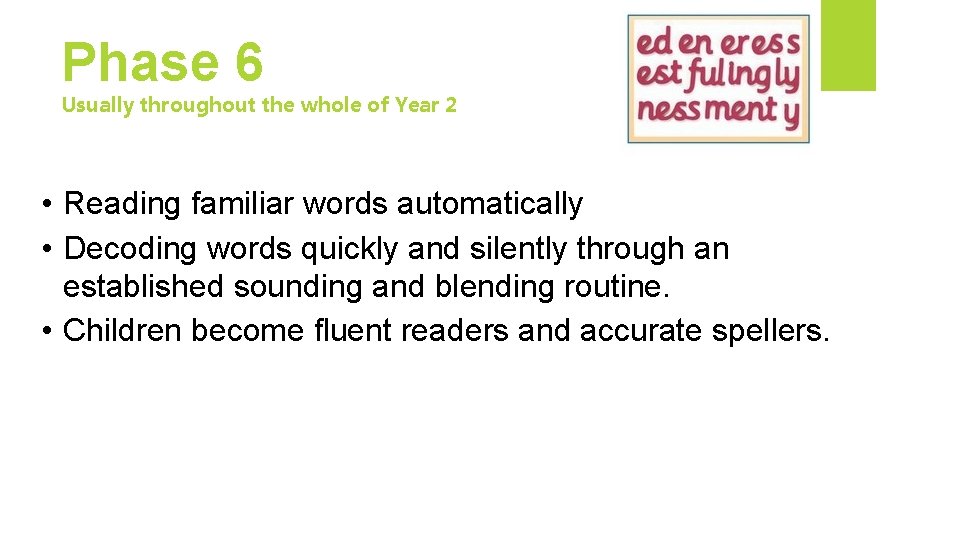
Phase 6 Usually throughout the whole of Year 2 • Reading familiar words automatically • Decoding words quickly and silently through an established sounding and blending routine. • Children become fluent readers and accurate spellers.
Blending To draw individual sounds together to pronounce a word e. g. s-n-a-p, blended together, reads snap. Ways to support blending at home: • Robot arms / disco dancing • Segmenting words (e. g. everyday objects) • Representing digraphs and trigraphs on your arm • Use of flashcards to help create words https: //www. oxfordowl. co. uk/for-home/reading-owl/find-abook/read-write-inc-phonics--1/sound-blending-phonics-video
Supporting Phonics at Home • Reading Useful websites • Phonics play • Tiny Happy People • What to Expect, When? • Learning letter sounds and word building Year R (see next slide for ideas) • Phoneme and tricky word cards - Practise at home (these will be given out soon
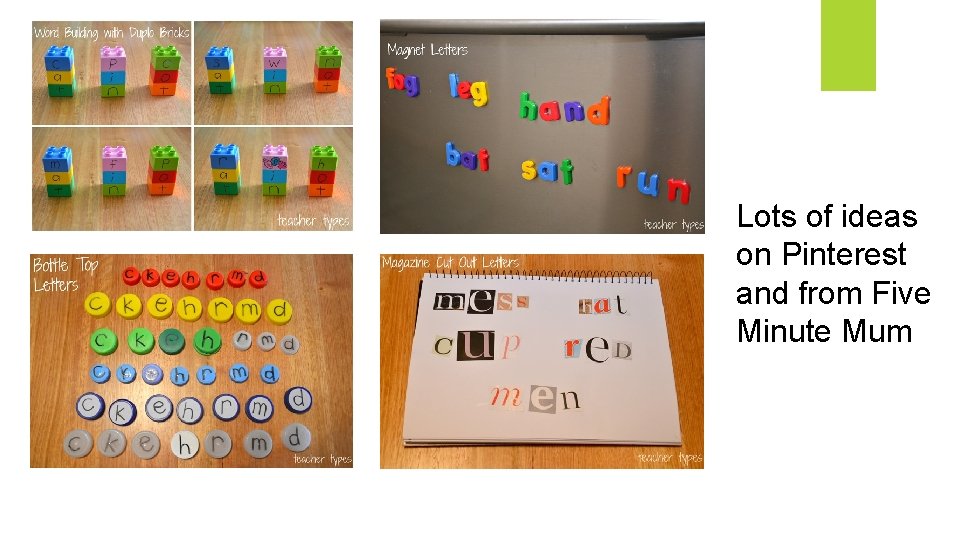
Lots of ideas on Pinterest and from Five Minute Mum
Ways to Support your Child Provide appropriate support and encouragement with any work at home. Hear your child read regularly and write a positive comment in the reading diary. Encourage handwriting and correct pencil grip
Any Questions? Feel free to type any questions in the chat bar Or if you are reading at home at another time, please feel free to ask any of the Early Years team.
- Slides: 18