
Kingdoms and Domains The tree of Live Evolves
- Slides: 30
Kingdoms and Domains The tree of Live “Evolves”
Changes in the classification system • New biological understanding lead to a more accurate classification system • Genes show important similarities at the molecular level – Linnaeu’s didn’t know about DNA • DNA from organisms can be sequenced and compared to show evolutionary relationships.
Molecular Clocks • DNA comparisons can be used to estimate how long 2 species have been evolving independently. • Mutations in the genes accumulate at different rates – The more similar mutations 2 species have the closer related they are
Effect on Classification • Scientist used to believe there were just 2 groups of living things: plants and animals • 2 kingdom system doesn’t adequately represent diversity of life • 6 kingdom system: Eubacteria, Archaebacteria, Protista, Fungi, Plantae and Animalia
Eubacteria • • Prokaryote Cell wall with peptidoglycan (extra outer layer) Unicellular Autotroph or Heterotroph
Archaebacteria • • Prokaryote Cell wall without peptidoglycan layer Unicellular Autotroph or Heterotroph
Protista • • • Eukaryote Cell walls of cellulose in some Some have chloroplasts Most are unicellular Autotroph or Heterotroph Made up of organisms that cannot be classified elsewhere
Fungi • • Eukaryote Cell wall of chitin Most are Multicellular (some unicellular) Heterotrophs – Feed on dead or decaying matter – Secrete digestive enzymes to break down food
Plantae • • • Eukaryote Cell wall of cellulose Chloroplasts Multicellular Autotroph – Carry out photosynthesis • Non-motile (cannot move from place to place)
Animalia Eukaryote No cell wall Multicellular Heterotroph Most can move (at least at some point in there life cycle) • Very diverse group • • • – Species that exist in almost every part of the planet
3 Domain System • The domain is a more inclusive category than any other • Molecular clock analysis allows scientists to group organisms according to how long they have been evolving independently • 3 Domains: Bacteria, Archaea, and Eukarya
Bacteria • Includes all organisms in the Eubacteria kingdom • Unicellular/ Prokaryotes • Ecologically diverse – Free-living soil organisms – Parsites – Photosynthetic – Anaerobic – aerobic
Archaea • Includes all organisms in the Archaebacteria kingdom • Unicellular/ Prokaryotes • Live in the most extreme environments – Volcanic hot springs – Brine pools – Black organic mud (NO oxygen)
Eukarya • Includes all organisms in the Protista, Fungi, Plantae and Animalia kingdom • ALL organisms have cells with a nucleus (eukaryotes)
Animal Phyla
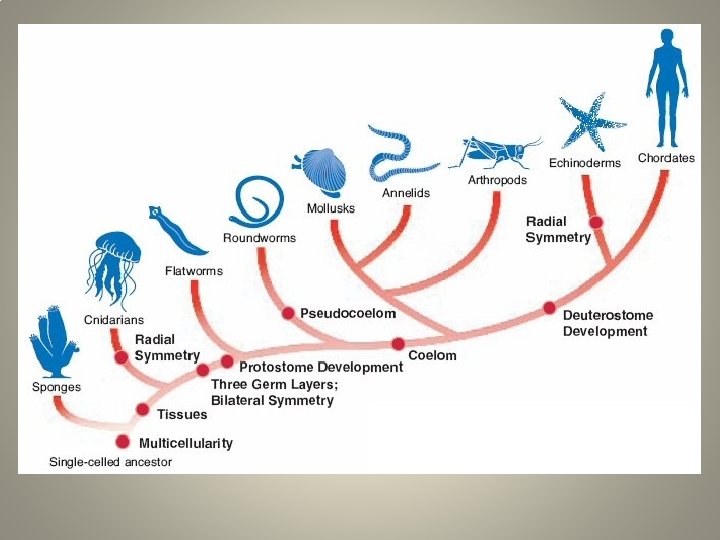
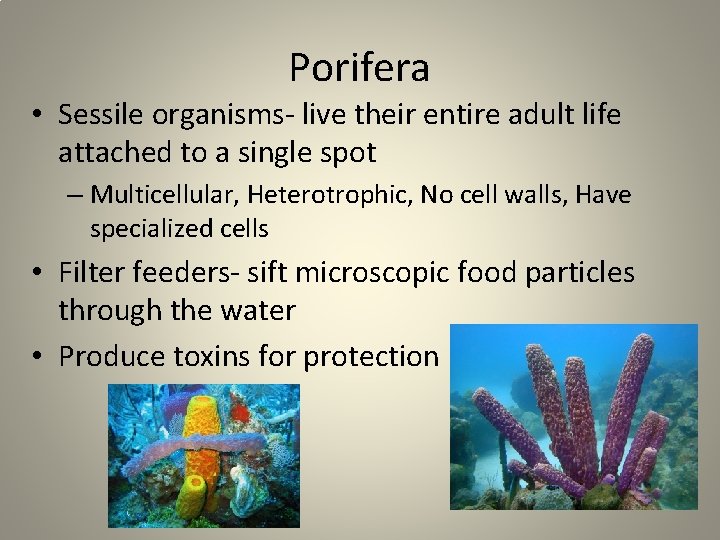
Porifera • Sessile organisms- live their entire adult life attached to a single spot – Multicellular, Heterotrophic, No cell walls, Have specialized cells • Filter feeders- sift microscopic food particles through the water • Produce toxins for protection
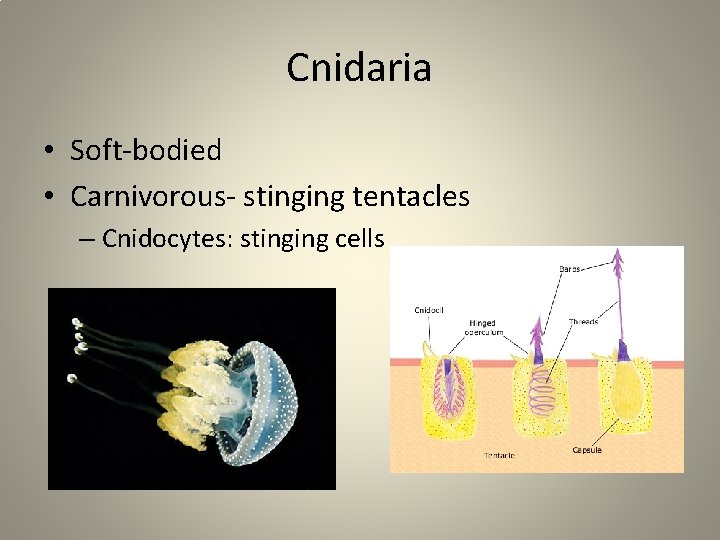
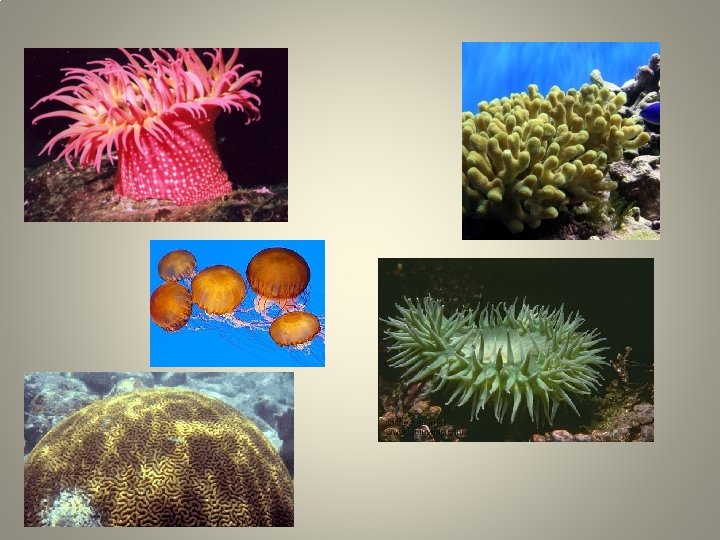
Cnidaria • Soft-bodied • Carnivorous- stinging tentacles – Cnidocytes: stinging cells
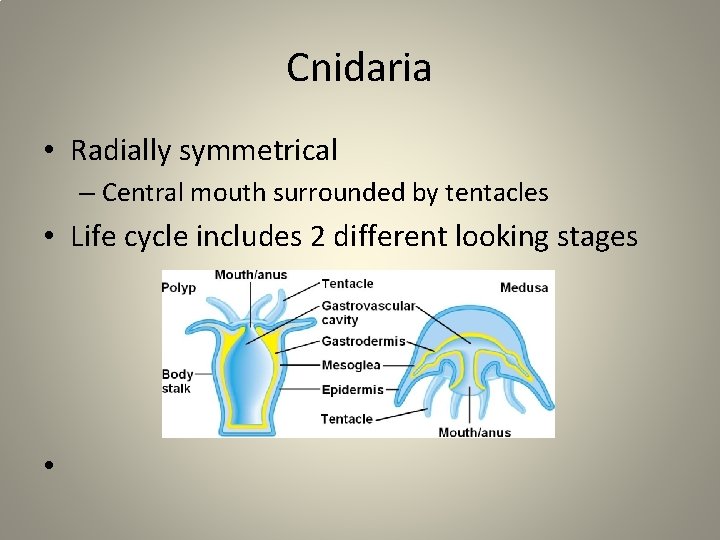
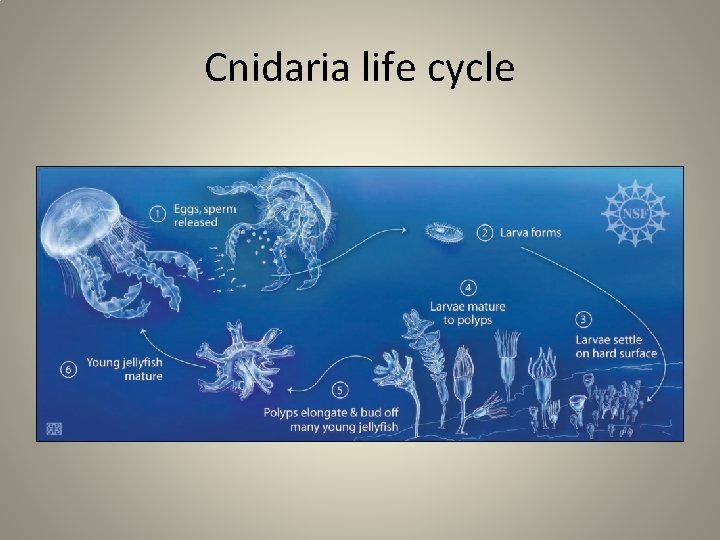
Cnidaria • Radially symmetrical – Central mouth surrounded by tentacles • Life cycle includes 2 different looking stages •
Cnidaria life cycle
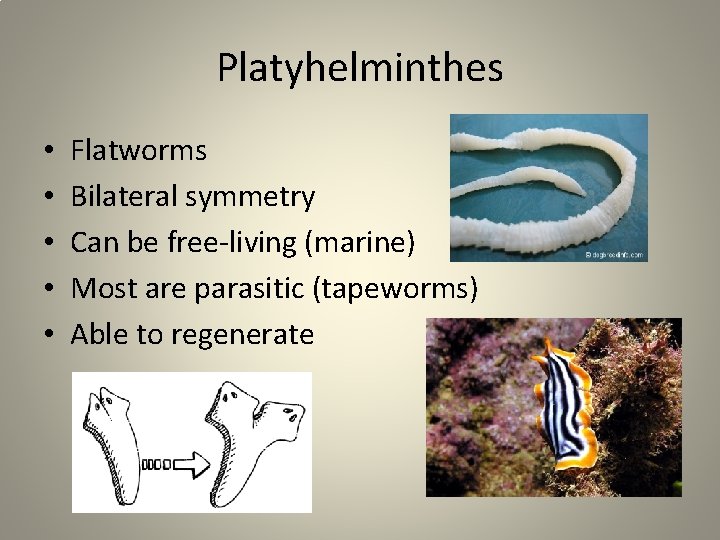
Platyhelminthes • • • Flatworms Bilateral symmetry Can be free-living (marine) Most are parasitic (tapeworms) Able to regenerate
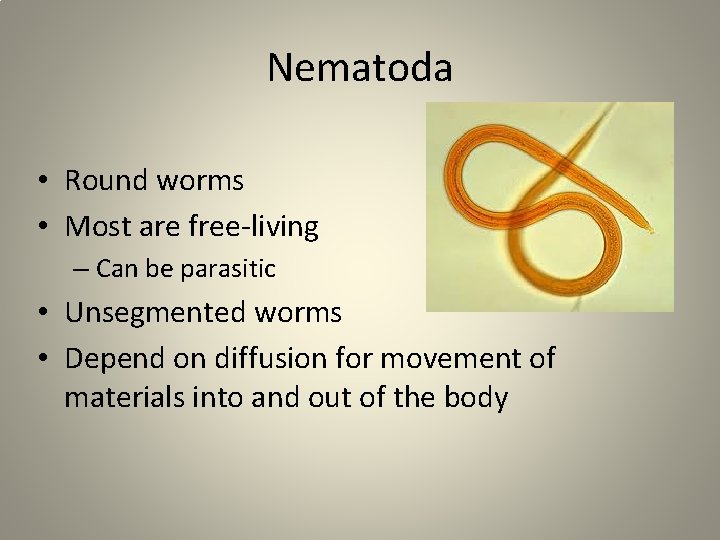
Nematoda • Round worms • Most are free-living – Can be parasitic • Unsegmented worms • Depend on diffusion for movement of materials into and out of the body
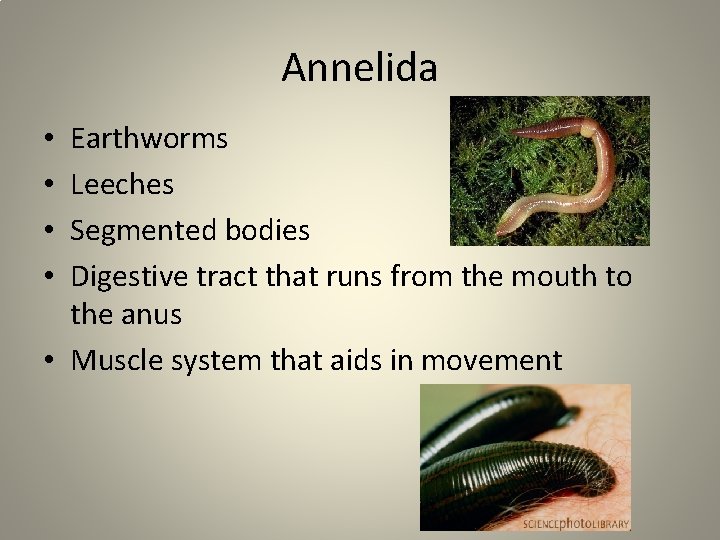
Annelida Earthworms Leeches Segmented bodies Digestive tract that runs from the mouth to the anus • Muscle system that aids in movement • •
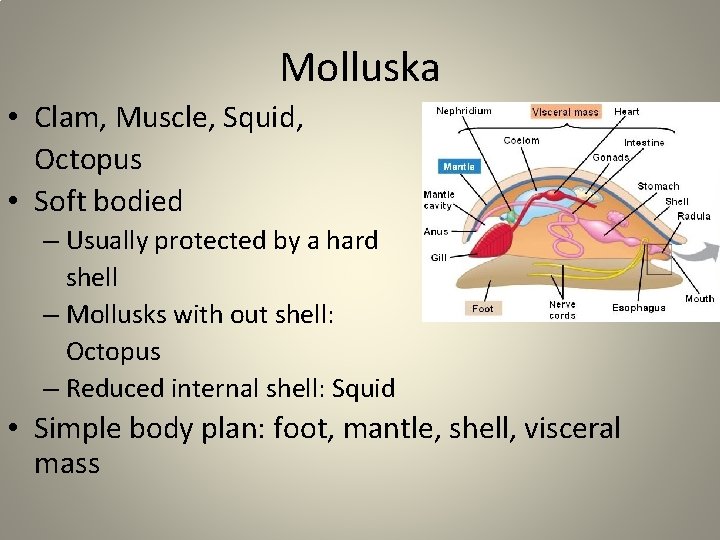
Molluska • Clam, Muscle, Squid, Octopus • Soft bodied – Usually protected by a hard shell – Mollusks with out shell: Octopus – Reduced internal shell: Squid • Simple body plan: foot, mantle, shell, visceral mass
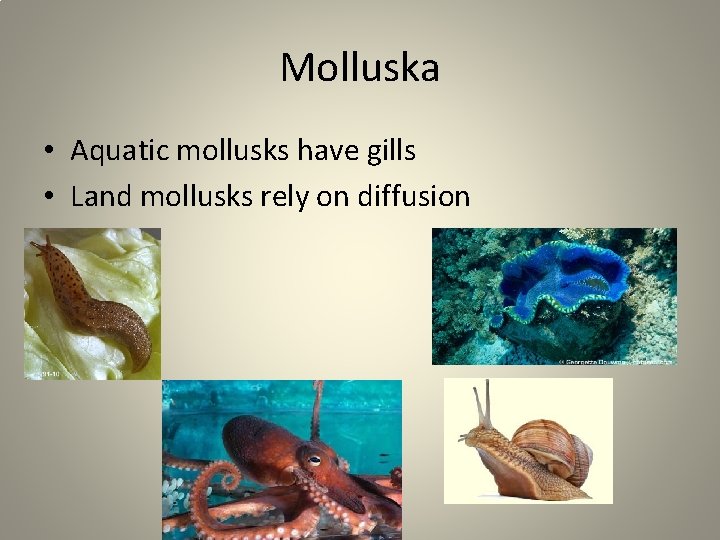
Molluska • Aquatic mollusks have gills • Land mollusks rely on diffusion
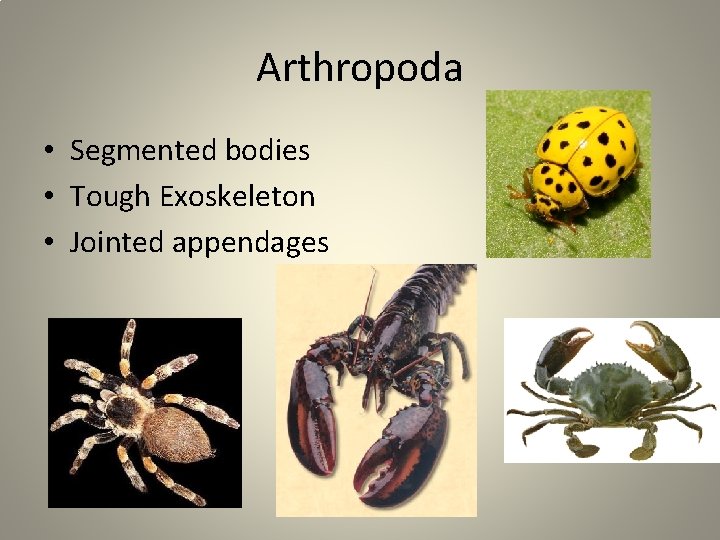
Arthropoda • Segmented bodies • Tough Exoskeleton • Jointed appendages
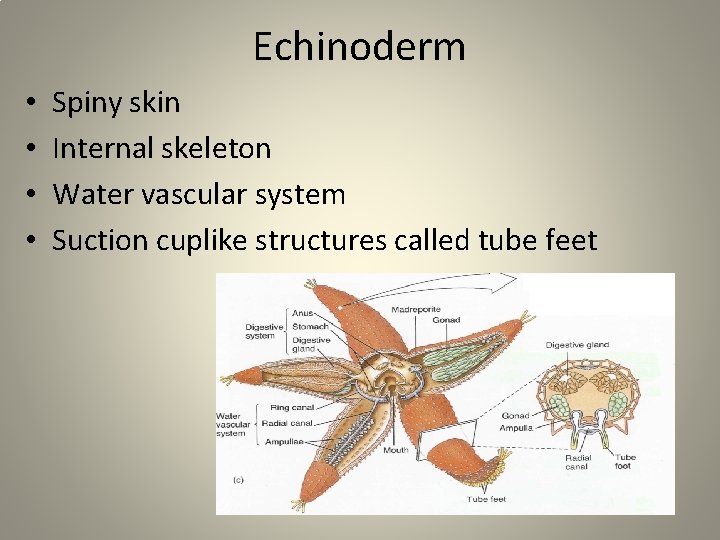
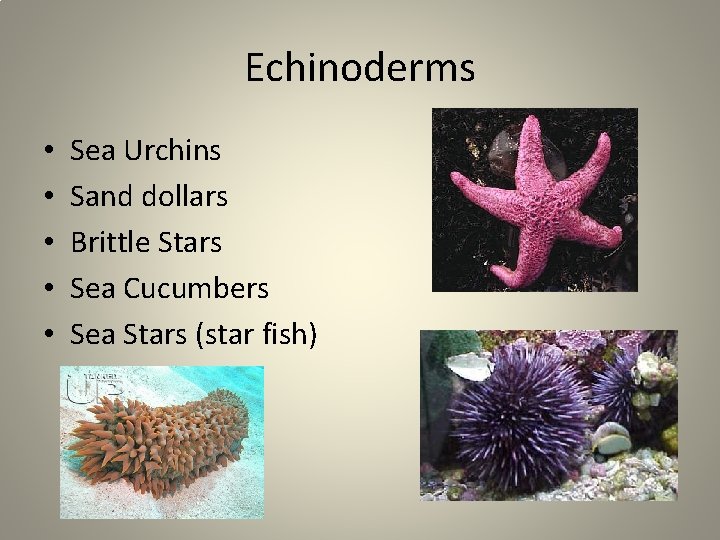
Echinoderm • • Spiny skin Internal skeleton Water vascular system Suction cuplike structures called tube feet
Echinoderms • • • Sea Urchins Sand dollars Brittle Stars Sea Cucumbers Sea Stars (star fish)
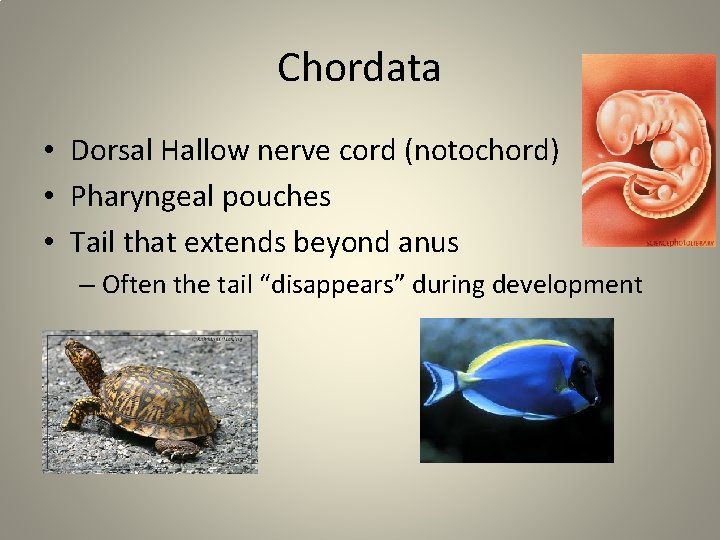
Chordata • Dorsal Hallow nerve cord (notochord) • Pharyngeal pouches • Tail that extends beyond anus – Often the tail “disappears” during development