
Kingdom Animalia Made up of VERTEBRATES and Review
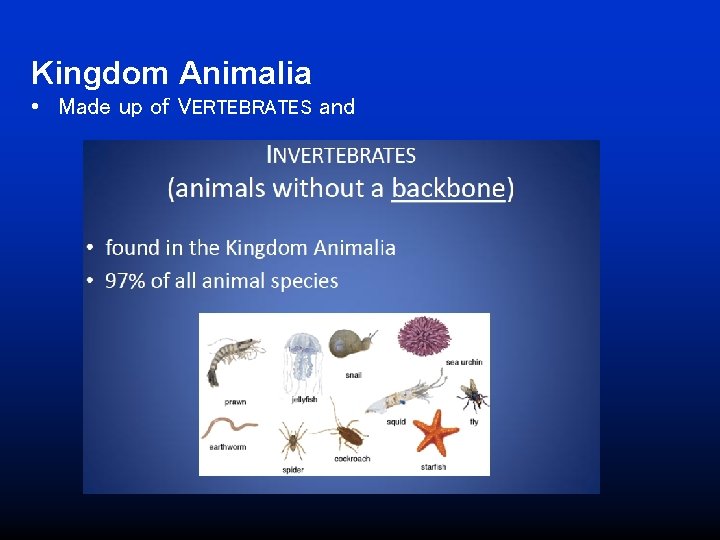
Kingdom Animalia • Made up of VERTEBRATES and
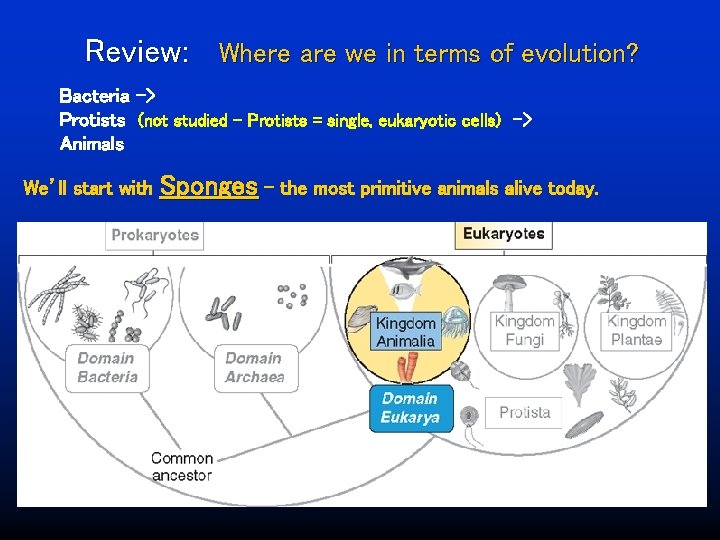
Review: Where are we in terms of evolution? Bacteria -> Protists (not studied - Protists = single, eukaryotic cells) -> Animals We’ll start with Sponges – the most primitive animals alive today.
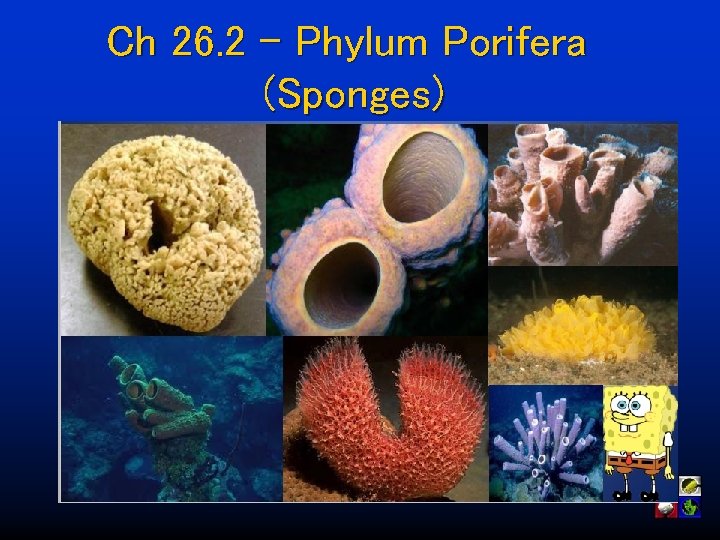
Ch 26. 2 – Phylum Porifera (Sponges)

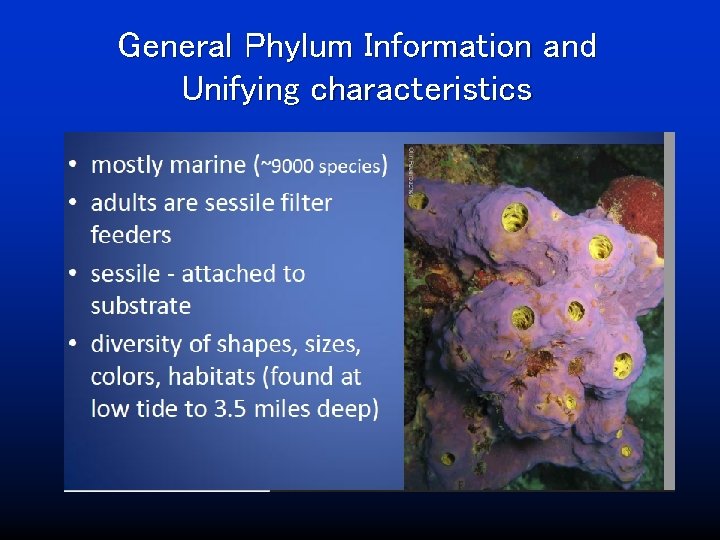
General Phylum Information and Unifying characteristics • Phylum Porifera = “pore bearers” • • = the Simplest multicellular animals They are an evolutionary dead end • Classified as plants until 1765 • Sponges = a loose collection of specialized cells They have NO tissues, NO organs, NO nervous systems, NO mouth, NO stomach, NO eyes, NO appendages. •
General Phylum Information and Unifying characteristics
Body Plan / Structure • Body plan = overall = asymmetrical • All life functions occur at the cellular level and all sponges are only 2 – 3 cell layers thick • Sponges carry out all 7 essential life functions with just 4 different types of cells
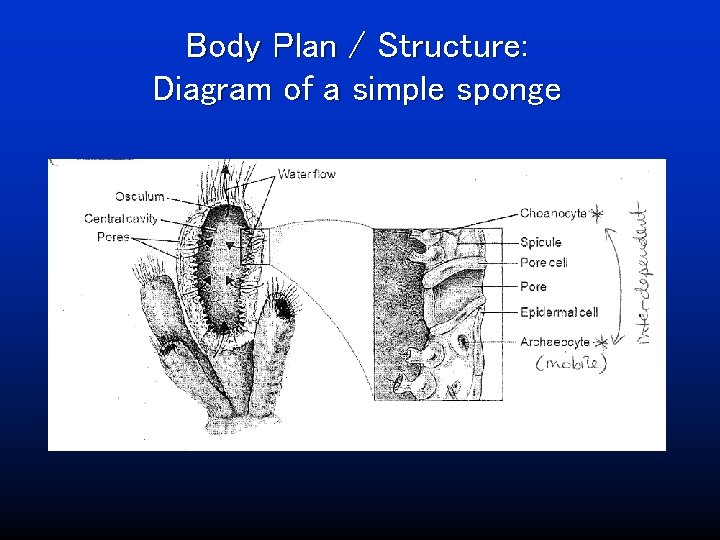
Body Plan / Structure: Diagram of a simple sponge
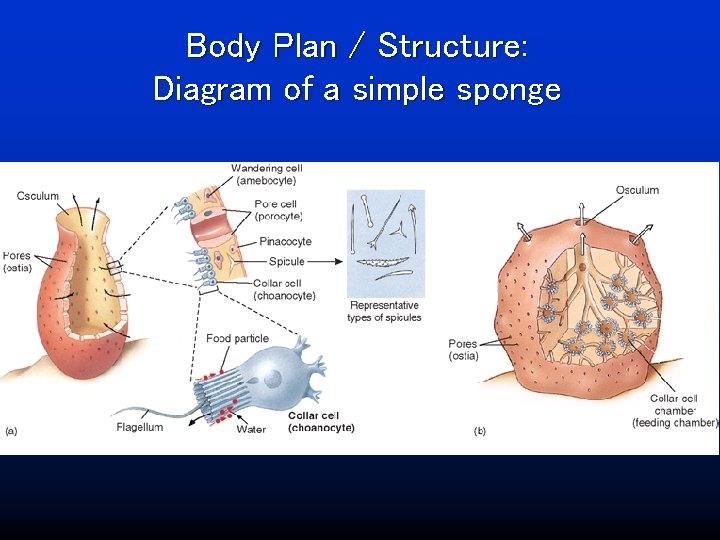
Body Plan / Structure: Diagram of a simple sponge

Structure: Sponge are made up for 4 cells 1. Pinacocytes (epidermal cells )= located on the outside of the sponge = protection of the sponge (like how skin protects humans) 2. Porocyte (pore cells) = form ostia (tiny pores) that allows water (that contains nutrients and oxygen) to enter and circulate throughout the sponge. They can open and close to change the size of the pore.

Structure: 3. Choanocytes (collar cells )= the primary feeding cell of the sponge. Its made up of 2 parts: a. b. The flagellum – beats rhythmically to move water through the pore cells The collar – filters the water & traps food (like plankton & bacteria)

Structure: 4. Archaeocyte or Amebocyte cells = wandering cells. They can specialize in 4 different ways: a) b) c) d) Can transport and store food for the sponge Can become egg and sperm cells Can capture and carry sperm to the eggs They can make sclerocyte cells - sclerocyte cells can make spicules or spongin

Structure – Sponge Skeleton: • The skeleton of a sponge is made of: – • • Spicules – small, hard, spiny structures embedded in the sponges body wall that supports and defends the sponge OR – Spongin – flexible protein used for support OR BOTH The type of skeleton cells depends on the type of sponge
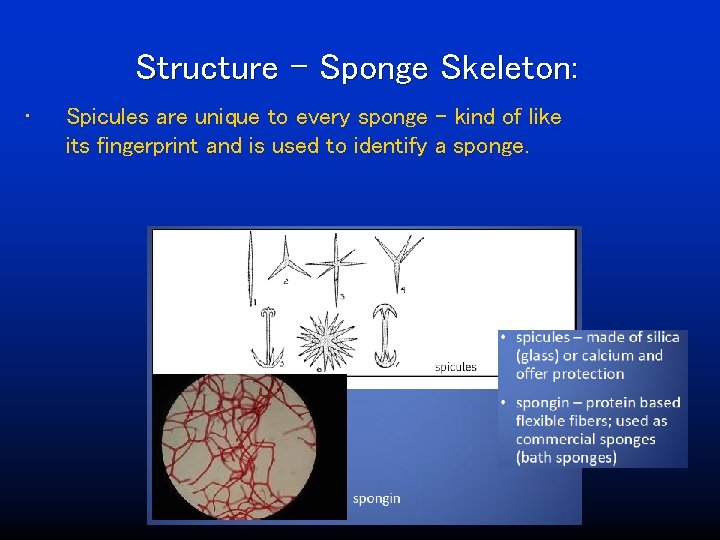
Structure – Sponge Skeleton: • Spicules are unique to every sponge – kind of like its fingerprint and is used to identify a sponge.
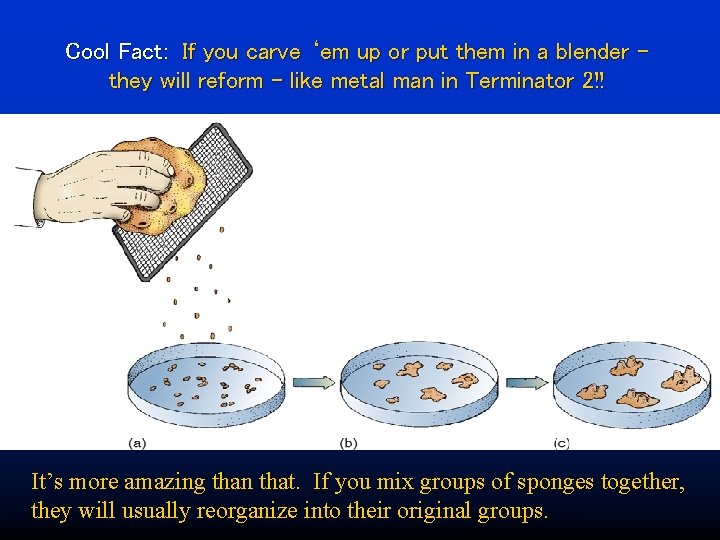
Cool Fact: If you carve ‘em up or put them in a blender – they will reform – like metal man in Terminator 2!! It’s more amazing than that. If you mix groups of sponges together, they will usually reorganize into their original groups.
Sponges: Essential Life Functions Feeding = filter feeders • Water containing food particles enters sponge via the pore cells • Each choanocyte has a flagellum that creates water currents. The thin collar in the Choanocytes traps and engulfs food particles • Food particles are passed to archaeocytes where digestion is completed and shared with the other sponge cells • All digestions is done INTRACELLULARLY (i. e. inside the cells) Video showing sponge feeding: http: //www. youtube. com/watch? v=Rm. PTM 965 -1 c

Feeding • Water leaves through osculum, osculum • Osculum = the large opening at top of sponge
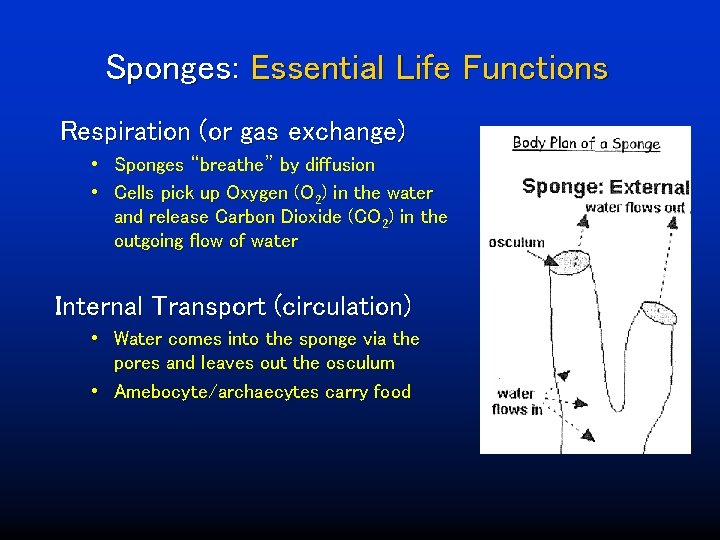
Sponges: Essential Life Functions Respiration (or gas exchange) • Sponges “breathe” by diffusion • Cells pick up Oxygen (O 2) in the water and release Carbon Dioxide (CO 2) in the outgoing flow of water Internal Transport (circulation) • Water comes into the sponge via the pores and leaves out the osculum • Amebocyte/archaecytes carry food
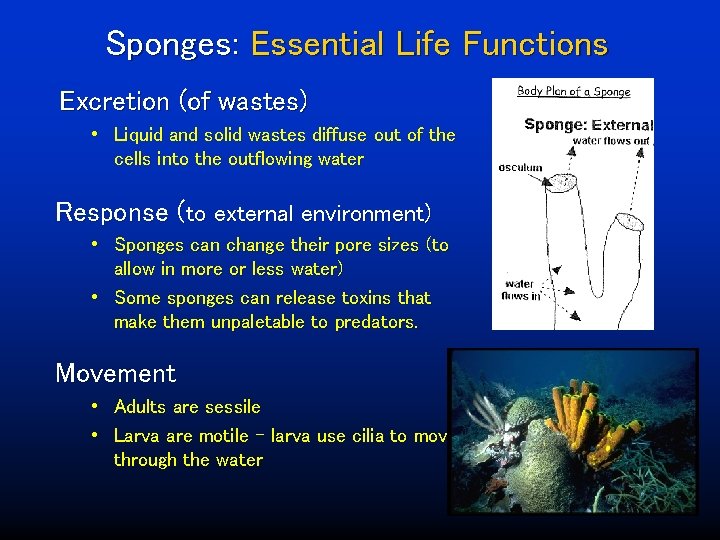
Sponges: Essential Life Functions Excretion (of wastes) • Liquid and solid wastes diffuse out of the cells into the outflowing water Response (to external environment) • Sponges can change their pore sizes (to allow in more or less water) • Some sponges can release toxins that make them unpaletable to predators. Movement • Adults are sessile • Larva are motile – larva use cilia to move through the water
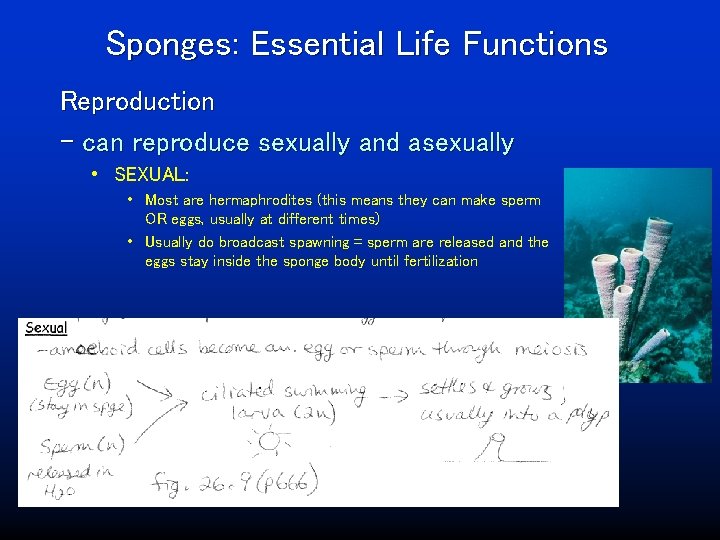
Sponges: Essential Life Functions Reproduction – can reproduce sexually and asexually • SEXUAL: • Most are hermaphrodites (this means they can make sperm OR eggs, usually at different times) • Usually do broadcast spawning = sperm are released and the eggs stay inside the sponge body until fertilization
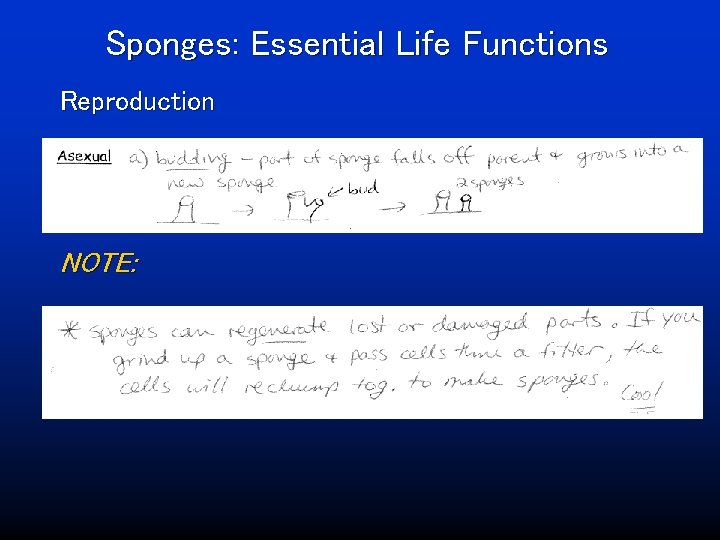
Sponges: Essential Life Functions Reproduction NOTE:
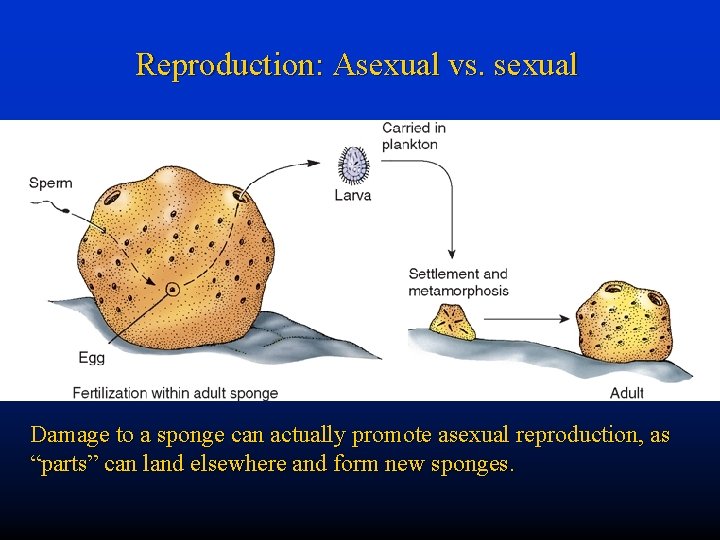
Reproduction: Asexual vs. sexual Damage to a sponge can actually promote asexual reproduction, as “parts” can land elsewhere and form new sponges.
Sponges: Essential Life Functions Reproduction – Sponges have one other cool adaptation. Like bacteria that can make an endospore to survive unfavourable conditions, FRESH WATER Sponges can make GEMMULES – Gemmules = a group of archaecytes surrounded by a tough layer of spicules that can survive freezing temperatures and droughts. – When conditions improve, gemmules grow into new sponges
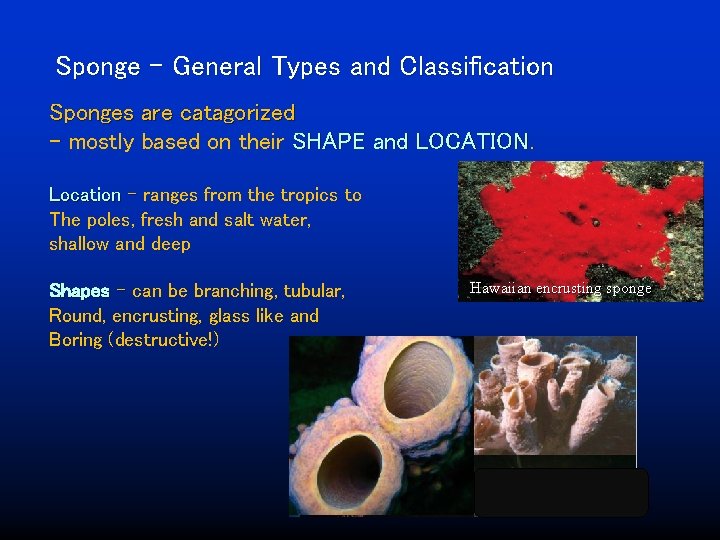
Sponge – General Types and Classification Sponges are catagorized - mostly based on their SHAPE and LOCATION. Location - ranges from the tropics to The poles, fresh and salt water, shallow and deep Shapes – can be branching, tubular, Round, encrusting, glass like and Boring (destructive!) Hawaiian encrusting sponge
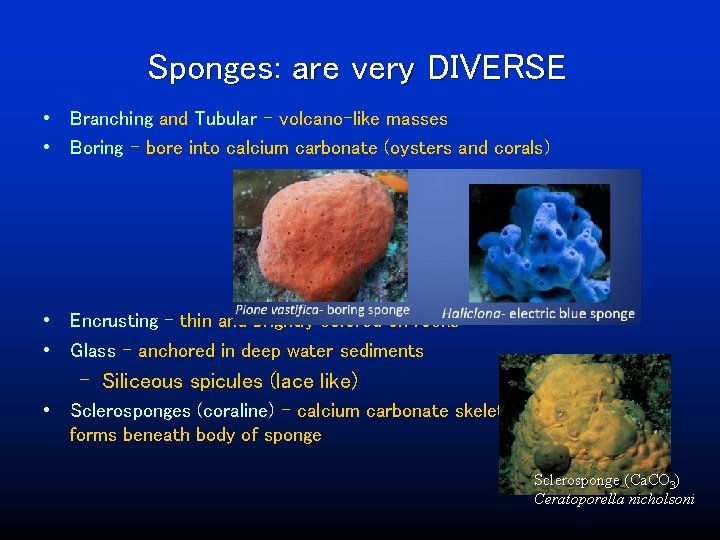
Sponges: are very DIVERSE • Branching and Tubular – volcano-like masses • Boring – bore into calcium carbonate (oysters and corals) • Encrusting – thin and brightly colored on rocks • Glass – anchored in deep water sediments – Siliceous spicules (lace like) • Sclerosponges (coraline) – calcium carbonate skeleton forms beneath body of sponge Sclerosponge (Ca. CO 3) Ceratoporella nicholsoni
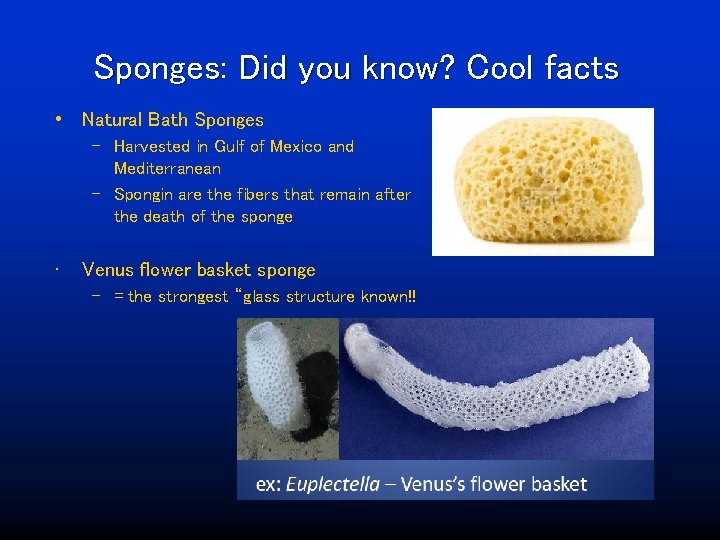
Sponges: Did you know? Cool facts • Natural Bath Sponges – Harvested in Gulf of Mexico and Mediterranean – Spongin are the fibers that remain after the death of the sponge • Venus flower basket sponge – = the strongest “glass structure known!!
- Slides: 25