
Kingdom Animal Invertebrates and Vertebrates Phylum Porifera Sponges

Kingdom - Animal Invertebrates and Vertebrates
Phylum Porifera - Sponges � Sponges are considered the oldest of the animal phyla. The name Porifera means "pore bearer" in Latin. � The surface of a sponge's body is covered by a skin, one cell thick. This skin is penetrated by numerous small pores and a few large openings. These are respectively the entrances and exits for a complex system of canals and chambers through which the sponge pumps a current of water. � The body of the sponge between this system of canals is a loose assemblage of about six different types of specialized cells that secrete a supporting skeleton of collagen fibers and mineral spicules (glass or calcium carbonate) and carry out the processes of growth, repair, nourishment, and reproduction.
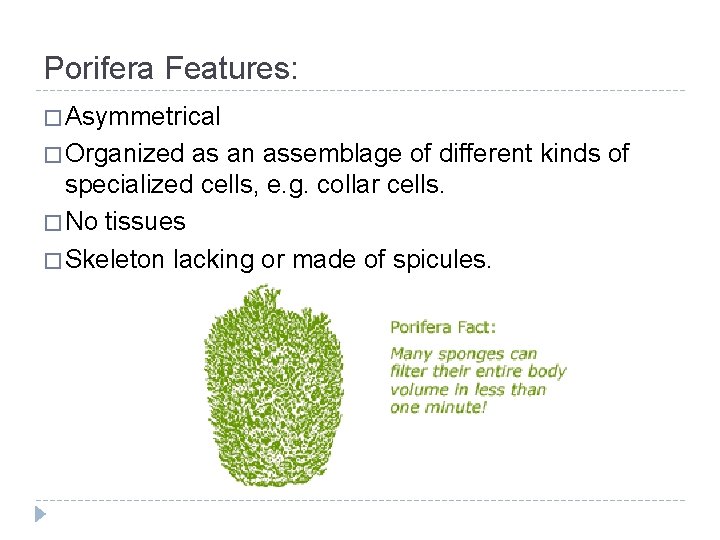
Porifera Features: � Asymmetrical � Organized as an assemblage of different kinds of specialized cells, e. g. collar cells. � No tissues � Skeleton lacking or made of spicules.
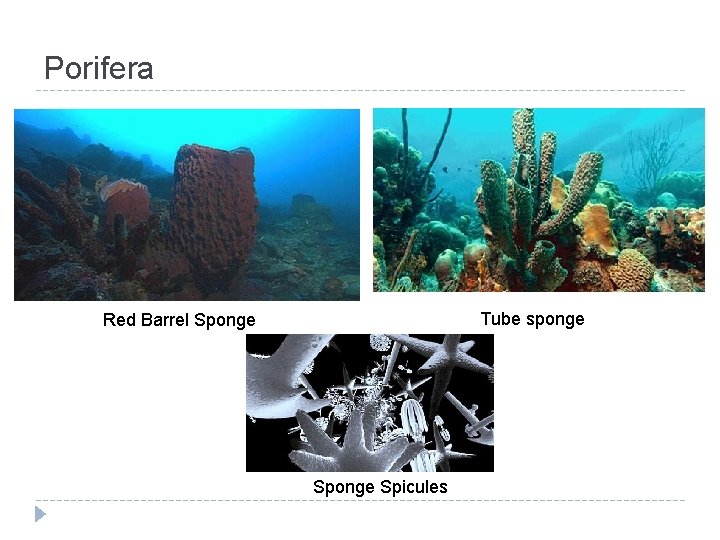
Porifera Tube sponge Red Barrel Sponge Spicules

� http: //www. shapeoflife. org/video/sponges-origins
Phylum Cnidaria Includes: Jellyfish, Corals, Anemones and Hydra � Many cnidarian species exist in two different body forms during their life cycle: the free-swimming form, called the medusa (a jellyfish for instance), and the stationary form called the polyp (which resembles a tiny sea anemone). � Both forms have a single opening that serves as the mouth and anus and is typically surrounded by a ring of tentacles packed with stinging cells called cnidocytes. � Cnidarians have a defined top and bottom and are made up of two layers of tissue that include nerve and muscle cells. This body, formed from tissues with organized groupings of muscles and nerves, allowed ancestral cnidarians to be the first animals on the planet to show animated behavior.

Cnidaria Features: � Radial Symmetry. � Two tissue layers with nerve and muscle tissues � Nematocysts: structures contained in special cells called cnidocytes or cnidoblasts that can act in both offense and defense � Two main life forms: free-swimming medusa (e. g. , jellyfish) or stationary polyp (e. g. , anemone)
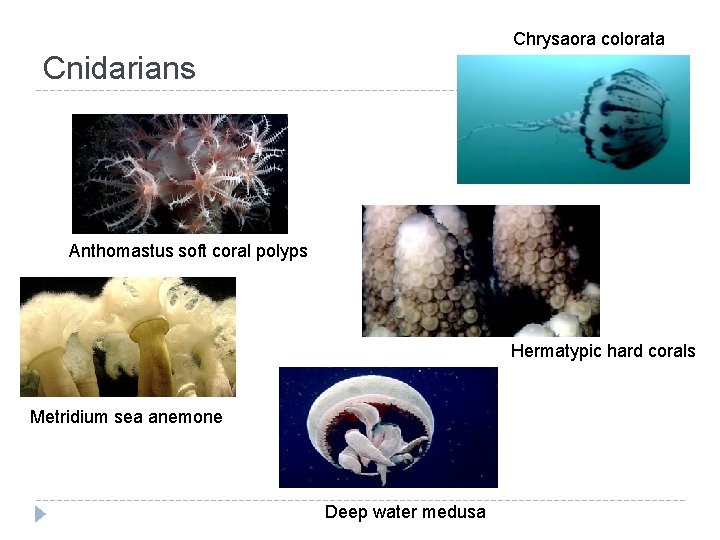
Chrysaora colorata Cnidarians Anthomastus soft coral polyps Hermatypic hard corals Metridium sea anemone Deep water medusa

� http: //www. shapeoflife. org/video/cnidarians-life-move
Phylum Platyhelminthes - Flatworms � There are more than 20, 000 species of Platyhelminthes. They range from brilliantly colored creatures that swim in the ocean to parasitic flatworms that live inside the bodies of an estimated 200 million humans around the world. � Flatworms are bilaterally symmetrical with a defined head and tail region and a centralized nervous system containing a brain and nerve cords. Clusters of light-sensitive cells make up what are called eyespots. The head region of the flatworm also contains other paired sense organs, which are connected to the flatworm's simple brain. � Flatworms are hermaphroditic and capable of sexual and asexual reproduction. Their bodies have only a single opening, which serves as both a mouth and an anus.
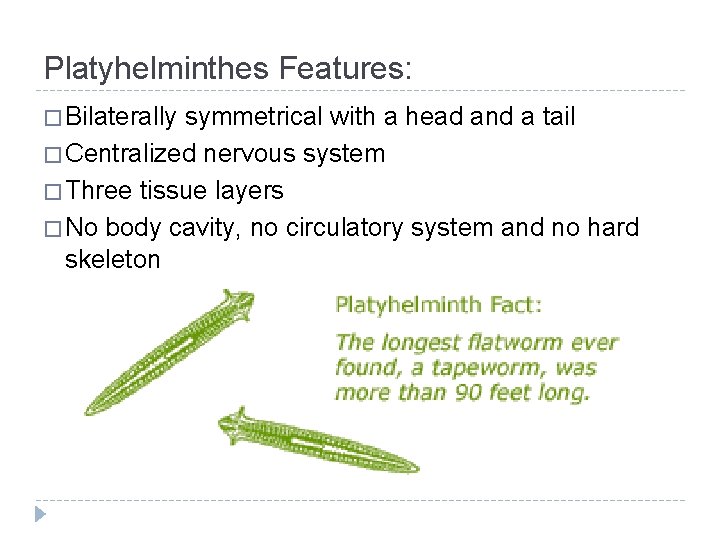
Platyhelminthes Features: � Bilaterally symmetrical with a head and a tail � Centralized nervous system � Three tissue layers � No body cavity, no circulatory system and no hard skeleton
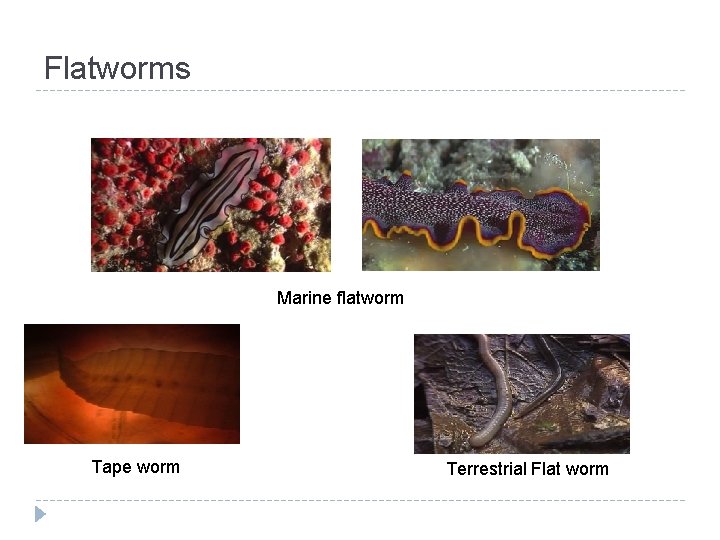
Flatworms Marine flatworm Tape worm Terrestrial Flat worm

� http: //www. shapeoflife. org/video/flatworms-first- hunter
Phylum Arthropoda Includes: Crustaceans, Spiders, Millipedes, Centipedes, Insects � Of the roughly one-and-a-quarter million named animal species, over one million are arthropods. These animals occupy by far the widest variety of habitats on Earth. � The name Arthropod means "jointed foot. " All arthropods have segmented bodies and are covered in a jointed, protective armor called an exoskeleton. Their body muscles attach to the inside of the exoskeleton. In order to grow, arthropods must periodically molt -- a process that entails shedding their exoskeleton and inflating their body before the new skeleton hardens. � The incredible diversity and success of the arthropods can be attributed to their extraordinarily adaptable body plan. A key feature is the evolution of the myriad types of appendages (antennae, claws, wings, shields, mouth parts) that allow arthropods to exploit nearly every niche on Earth.
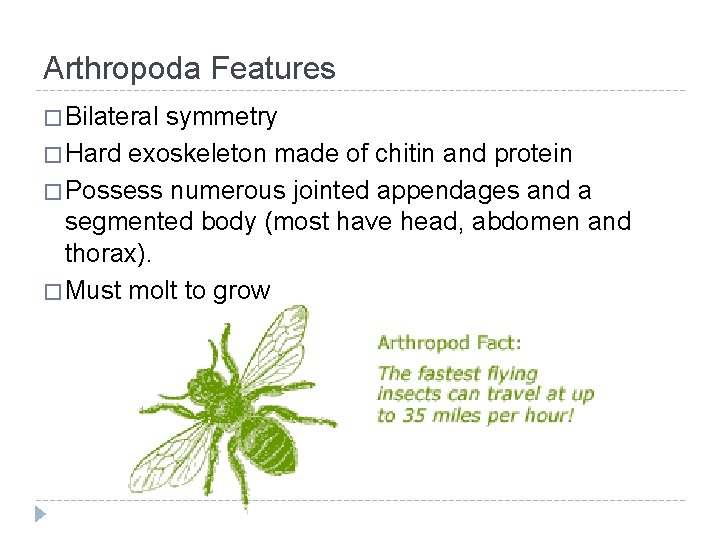
Arthropoda Features � Bilateral symmetry � Hard exoskeleton made of chitin and protein � Possess numerous jointed appendages and a segmented body (most have head, abdomen and thorax). � Must molt to grow
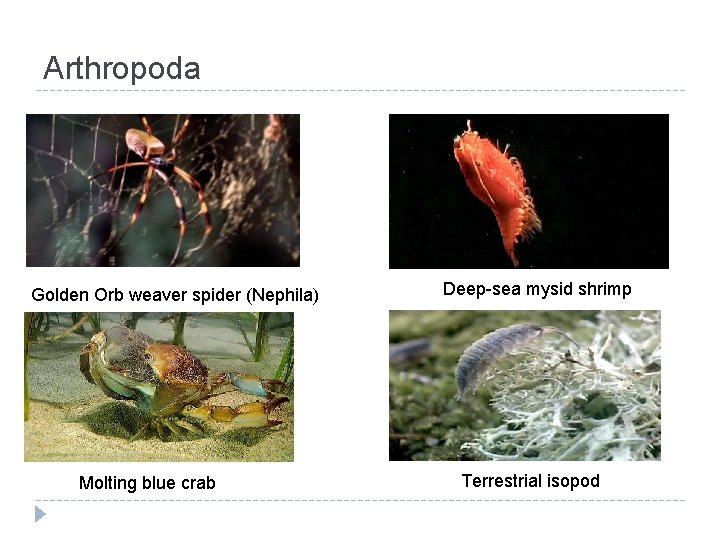
Arthropoda Golden Orb weaver spider (Nephila) Molting blue crab Deep-sea mysid shrimp Terrestrial isopod

� http: //www. shapeoflife. org/video/marine-arthropods- successful-design � http: //www. shapeoflife. org/video/terrestrialarthropods-conquerors

Phylum Mollusca Including: Clams, Snails, Slugs, Nautilus, Squid, Octopus � Molluscs show an amazing degree of diversity, yet all have certain features in common. All have soft bodies and have a strong muscular foot, which is used for movement or grasping. They also have gills, a mouth and an anus. A feature unique to molluscs is a file-like, rasping tool called a radula. This structure allows them to scrape algae and other food off rocks and even to drill through the shell of prey or catch fish. � The diversity of molluscs impressively demonstrates how a basic body plan can evolve into a variety of different forms adapted to specific environments. For example, the hard shell in a land-dwelling snail is relatively large and serves to protect the animal. In the fast-swimming squid, however, the shell is reduced to a small internal
Mollusca Features: � Bilateral symmetry � Rasping organ called a radula: present in all groups except bivalves and Aplacophora � Muscular foot: used for locomotion and other tasks � A sheath of tissue called the mantle that covers the body and can secrete the shell (if there is one) � A mantle cavity that houses the gills or lungs � A calcium shell present in most molluscs: some molluscs have greatly reduced their shells, e. g. , squid; while others have completely lost it, e. g. , slugs, nudibranchs, and octopus
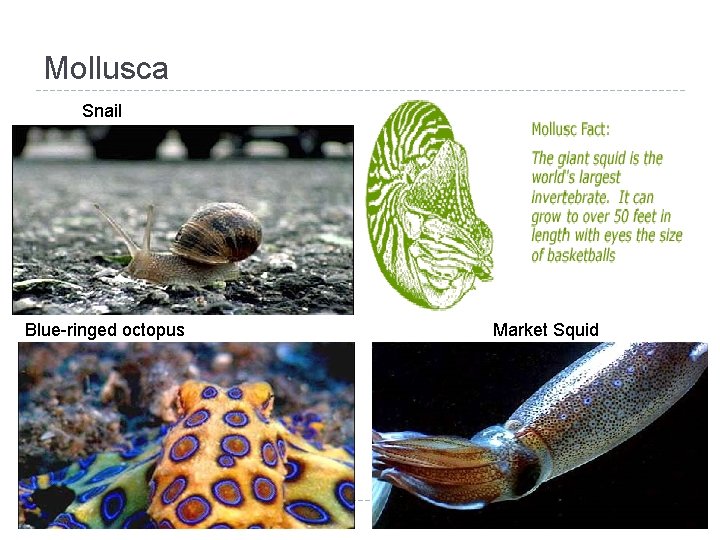
Mollusca Snail Blue-ringed octopus Market Squid

� http: //www. shapeoflife. org/video/molluscs-survival- game
Phylum Echinodermata Includes: Sea Stars, Sea Lillies, Sea Urchins, Sea Cucumbers, Brittle Stars � While the majority of animal body plans are bilateral with a distinct head and tail, echinoderms do not follow this pattern. While many echinoderms begin life as a bilateral larva, later in life they take a radical change of course. They become radial with five-part symmetry and no central brain. � Echinoderms move, feed and breathe with a unique watervascular system ending in what are called tube feet. Sea stars use their tube feet to slowly pry open clams, mussels or other prey. Some sea stars can evert their stomach between the two shells of a bivalve and digest the soft parts inside. � The bodies of echinoderms are made of hard, calcium-based plates that are often spiny and covered by a thin skin. While most echinoderms are either stationary or slow-moving, methodical animals, they are nevertheless prominent members of the marine environment.
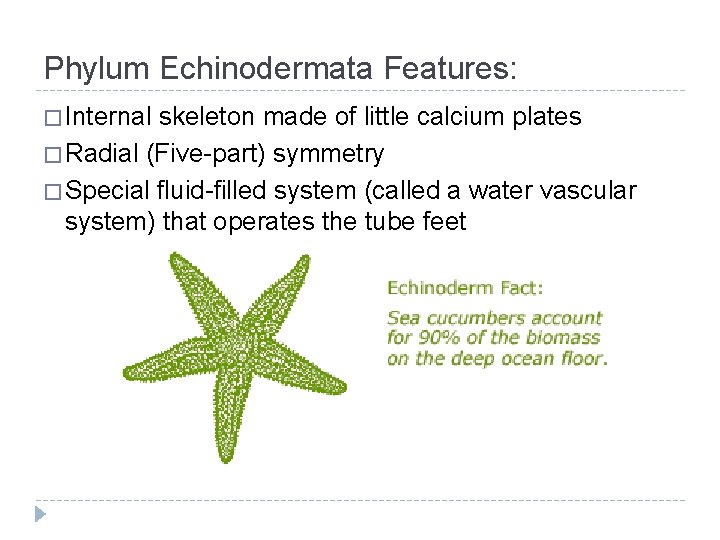
Phylum Echinodermata Features: � Internal skeleton made of little calcium plates � Radial (Five-part) symmetry � Special fluid-filled system (called a water vascular system) that operates the tube feet
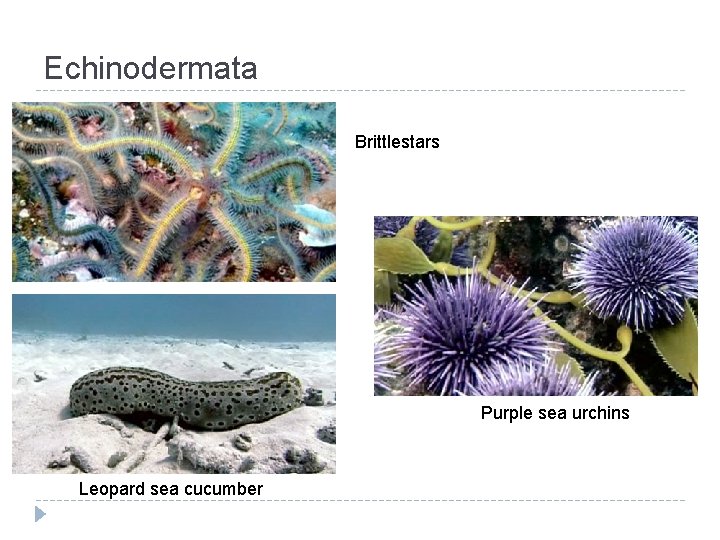
Echinodermata Brittlestars Purple sea urchins Leopard sea cucumber

� http: //www. shapeoflife. org/video/echinoderms- ultimate-animal
Phylum Annelida Includes: Polychaetes, Earthworms, Leeches � Far from being lowly worms, annelids are impressively powerful and capable animals. Annelids are distinguished by ring-like external bands along their muscular body wall that coincide with internal partitions dividing their bodies into segments. � With a circulatory system to distribute blood and oxygen and a one-way gut, their bodies are enormously more complex than modern flatworms. Developing a gut that runs from one end of the body to the other was a major evolutionary step. With such a digestive tract, food can be continuously taken in by a mouth, processed as it passes through the body and released as waste at the other end. Not only can worms continually digest their food, but they can squirm, crawl and slither as they do it. � Annelids creep along or burrow by coordinating two sets of muscles. One set allows them to expand anchor one part of their body while the other set contracts and pushes the rest of the body forward into the sediment. By alternating these two muscle sets, the worm can powerfully inch forward
Phylum Annelida - Features � Elongated and bilateral with segmented true body cavity (coelom). � Complete circulatory system with capillary, arteries and veins. � Body wall made of circular and lengthwise muscles. � Continuous gut running from mouth to anus with own musculature. � Bristle-like structures projecting from the body (except in leeches).
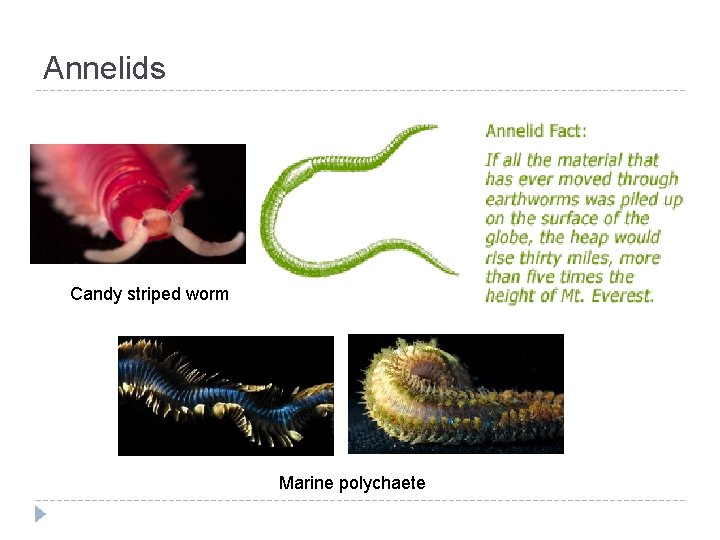
Annelids Candy striped worm Marine polychaete

� http: //www. shapeoflife. org/video/annelids-powerful- and-capable-worms
Phylum Chordata Includes: Tunicates, Lancelets, and Vertebrates (which include Fish, Amphibians, Reptiles, Birds and Mammals) � It's easy to find an example of the chordate body plan -- just look in the mirror. But it's more difficult to see which features we share with the rest of the chordates. � Chordates have their skeletons on the inside, a design that allows for growth without the need for molting. Of the approximately 50, 000 living chordates, 97% are vertebrates -- animals whose skeletons include a backbone. � Three features are present in all chordates. These include a stiffening rod, called a notochord, that in many members (e. g. , the vertebrates) is later replaced by a bony, vertebral column. Another chordate feature is a hollow nerve structure called a dorsal nerve cord that in most members becomes the spinal cord and brain. Also included in the chordate body plan are structures called pharyngeal gill slits, or clefts. In evolution the skeletal elements of the anterior gills came to function as jaws and jaw supports, and in some animals take on a variety of other functions. (Our gill slits close up when we're still embryos. )
Phylum Chordata Features: � Bilateral symmetry � Notochord: an elongate rod-like structure located above the gut and below the nerve cord � Dorsal nerve cord: a hollow tube that in most differentiates into a brain anteriorly and a spinal cord posteriorly � Gill clefts: structures located behind the mouth and in front of the esophagus � Segmented muscles (except for tunicates) � Post-anal tail
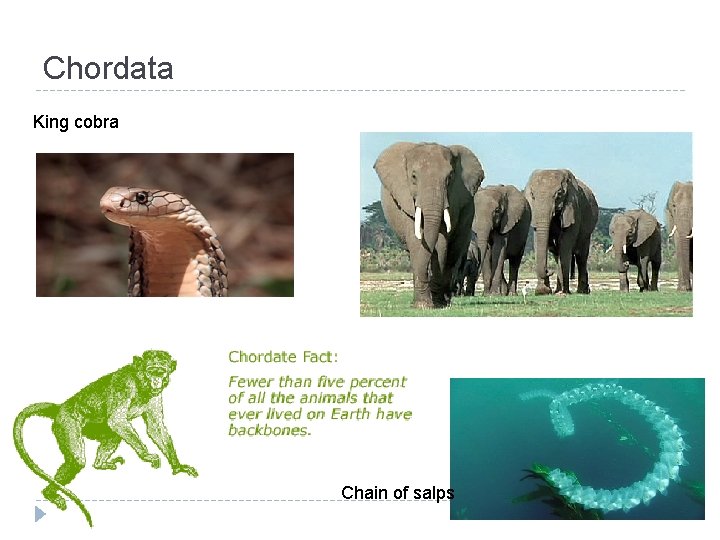
Chordata King cobra Chain of salps

� http: //www. shapeoflife. org/video/chordates- we%E 2%80%99 re-all-family
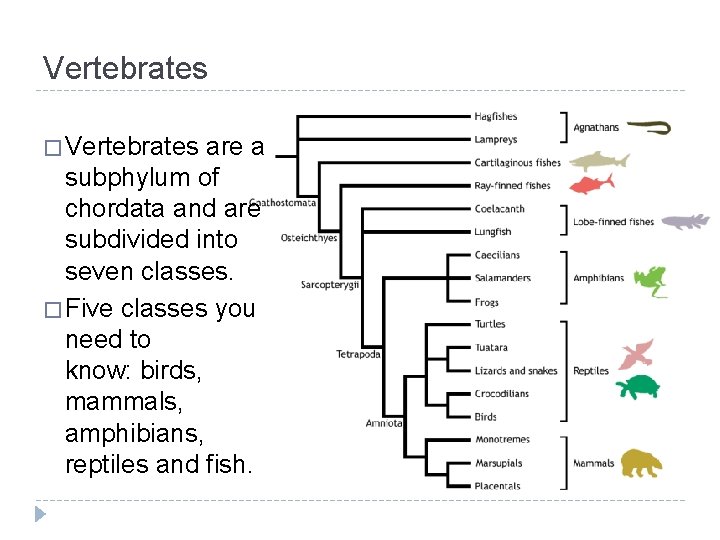
Vertebrates � Vertebrates are a subphylum of chordata and are subdivided into seven classes. � Five classes you need to know: birds, mammals, amphibians, reptiles and fish.
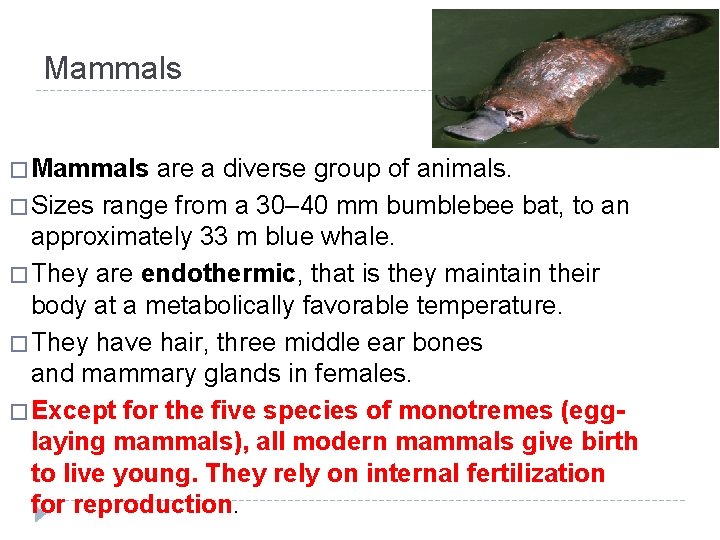
Mammals � Mammals are a diverse group of animals. � Sizes range from a 30– 40 mm bumblebee bat, to an approximately 33 m blue whale. � They are endothermic, that is they maintain their body at a metabolically favorable temperature. � They have hair, three middle ear bones and mammary glands in females. � Except for the five species of monotremes (egglaying mammals), all modern mammals give birth to live young. They rely on internal fertilization for reproduction.
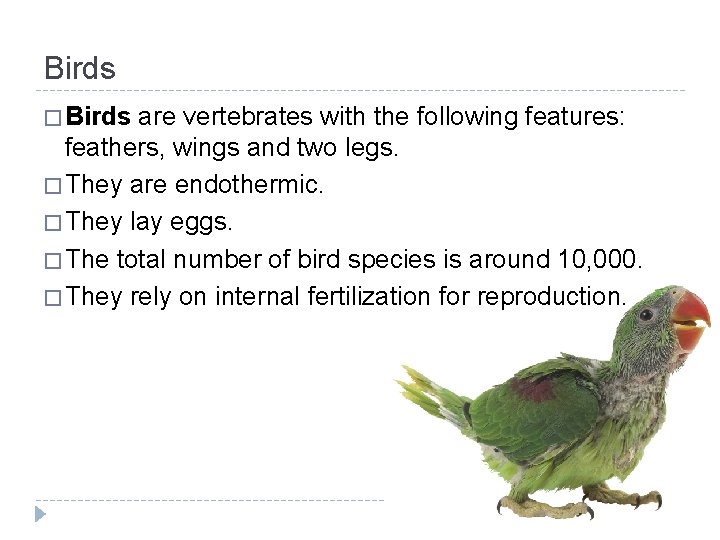
Birds � Birds are vertebrates with the following features: feathers, wings and two legs. � They are endothermic. � They lay eggs. � The total number of bird species is around 10, 000. � They rely on internal fertilization for reproduction.
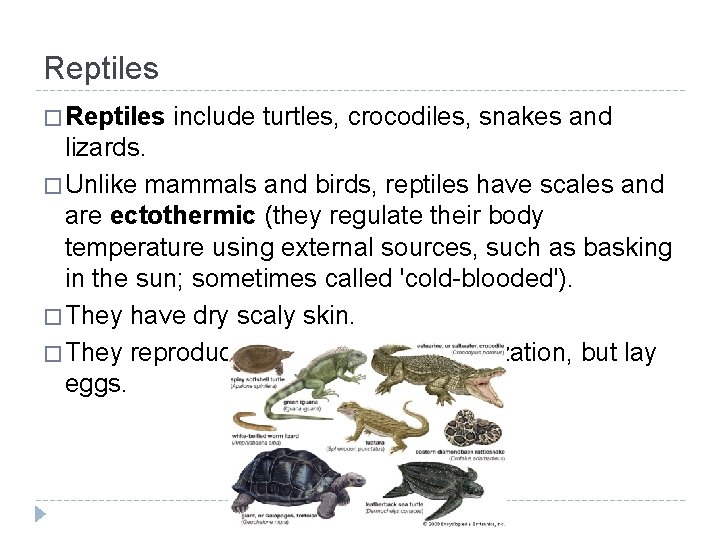
Reptiles � Reptiles include turtles, crocodiles, snakes and lizards. � Unlike mammals and birds, reptiles have scales and are ectothermic (they regulate their body temperature using external sources, such as basking in the sun; sometimes called 'cold-blooded'). � They have dry scaly skin. � They reproduce through internal fertilization, but lay eggs.
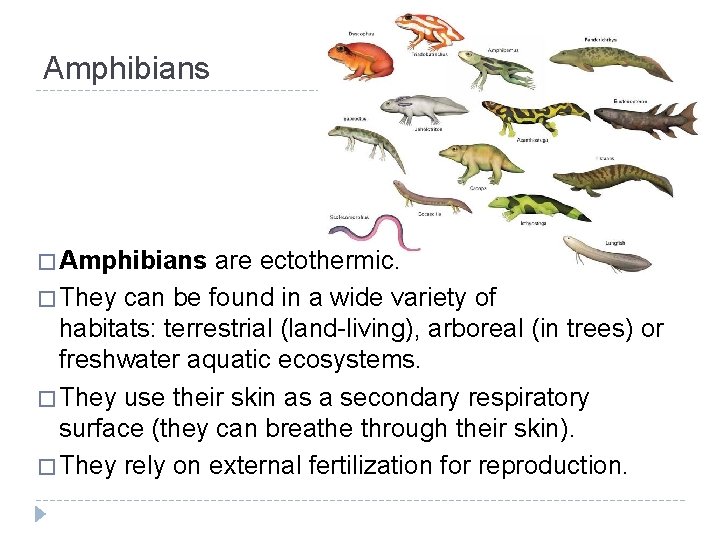
Amphibians � Amphibians are ectothermic. � They can be found in a wide variety of habitats: terrestrial (land-living), arboreal (in trees) or freshwater aquatic ecosystems. � They use their skin as a secondary respiratory surface (they can breathe through their skin). � They rely on external fertilization for reproduction.

Fish �A fish is an animal with gills that lacks limbs with digits. � Most fish are ectothermic. � Have bodies covered with scales. � They possess a swim bladder (this is absent in sharks and rays) for buoyancy. � Most species rely on external fertilization for reproduction.
- Slides: 39