
King Saud University College of Engineering IE 462

- Slides: 24
King Saud University College of Engineering IE – 462: “Industrial Information Systems” Fall – 2018 (1 st Sem. 1439 -40 H) Chapter 3 Data Modeling and Design – p 3 – Case Study Prepared by: Ahmed M. El-Sherbeeny, Ph. D 1
Lesson Overview • Introduction – (p 1) • E-R Diagram – (p 2) • Case Study – (p 3) 2
Case Study – Electronic Commerce Application – Conceptual Data Modeling for “Pine Valley Furniture” Web. Store 3
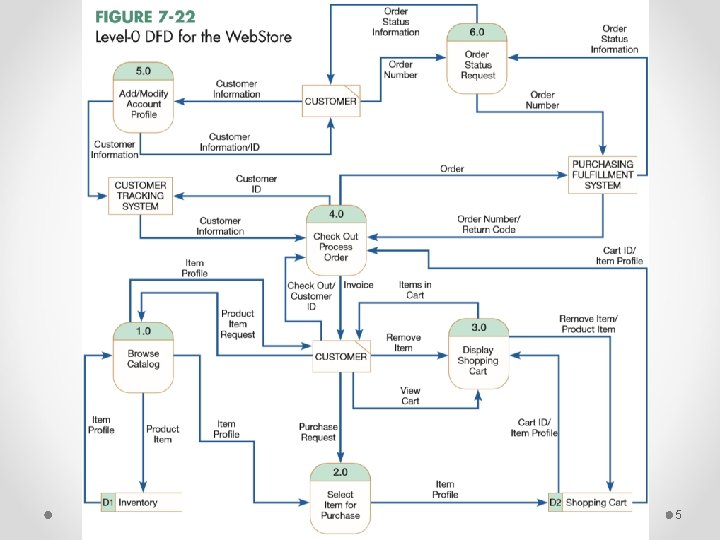
E-R Diagram: PVF Furniture Webstore Background: • Remember, senior systems analyst (Jim Woo): o First, completed JAD (Joint Application Design) session o Then created DFD for webstore system • He was then asked to develop a conceptual data model for the Web. Store 4
5
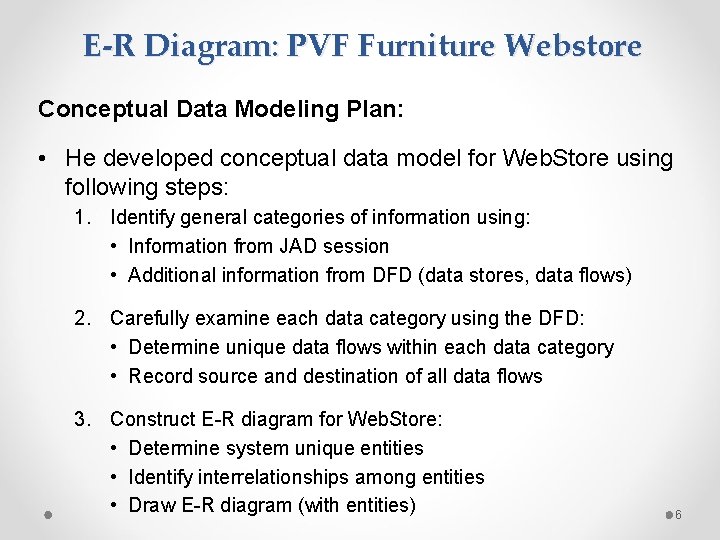
E-R Diagram: PVF Furniture Webstore Conceptual Data Modeling Plan: • He developed conceptual data model for Web. Store using following steps: 1. Identify general categories of information using: • Information from JAD session • Additional information from DFD (data stores, data flows) 2. Carefully examine each data category using the DFD: • Determine unique data flows within each data category • Record source and destination of all data flows 3. Construct E-R diagram for Web. Store: • Determine system unique entities • Identify interrelationships among entities • Draw E-R diagram (with entities) 6
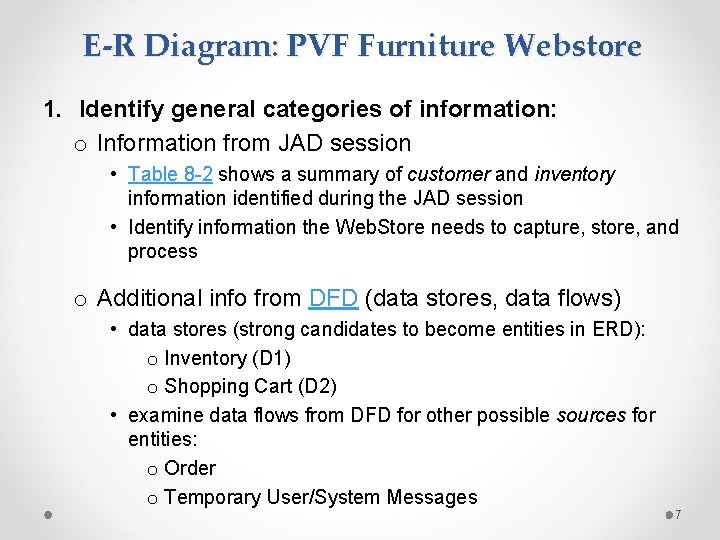
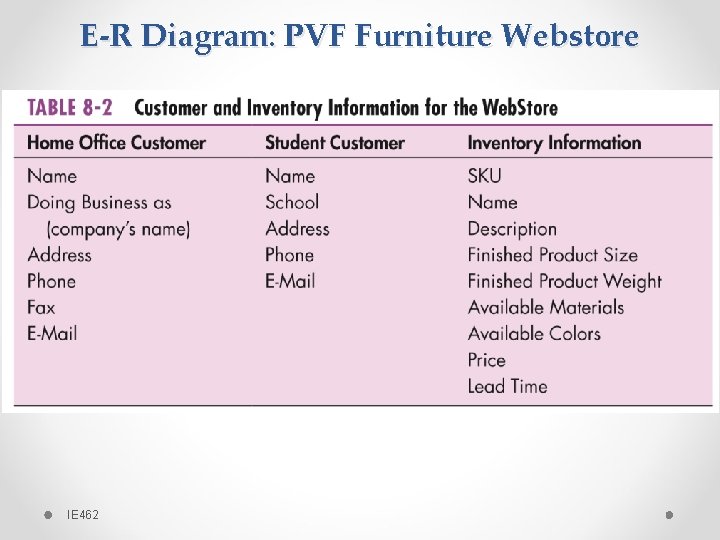
E-R Diagram: PVF Furniture Webstore 1. Identify general categories of information: o Information from JAD session • Table 8 -2 shows a summary of customer and inventory information identified during the JAD session • Identify information the Web. Store needs to capture, store, and process o Additional info from DFD (data stores, data flows) • data stores (strong candidates to become entities in ERD): o Inventory (D 1) o Shopping Cart (D 2) • examine data flows from DFD for other possible sources for entities: o Order o Temporary User/System Messages 7
E-R Diagram: PVF Furniture Webstore IE 462
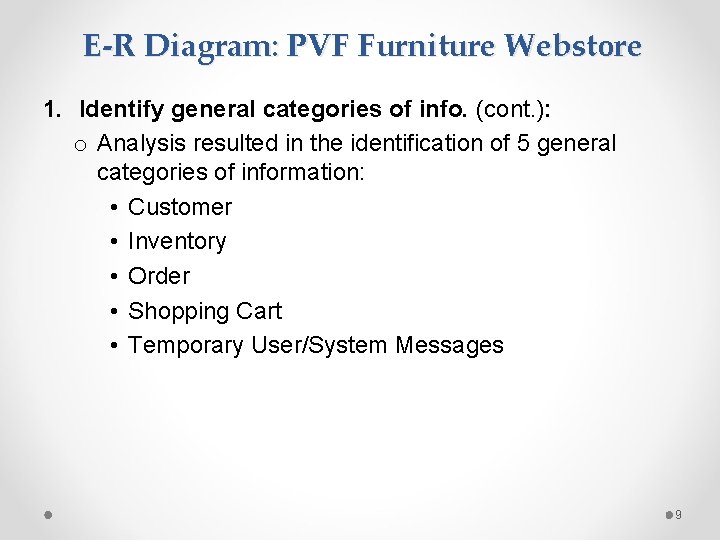
E-R Diagram: PVF Furniture Webstore 1. Identify general categories of info. (cont. ): o Analysis resulted in the identification of 5 general categories of information: • Customer • Inventory • Order • Shopping Cart • Temporary User/System Messages 9
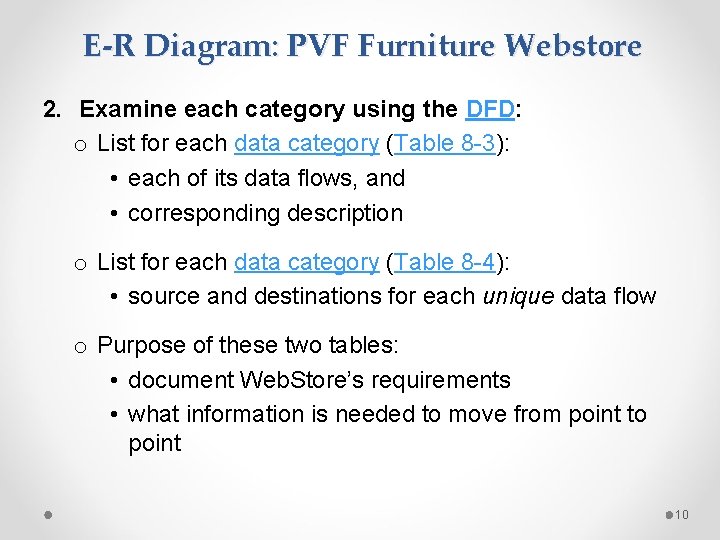
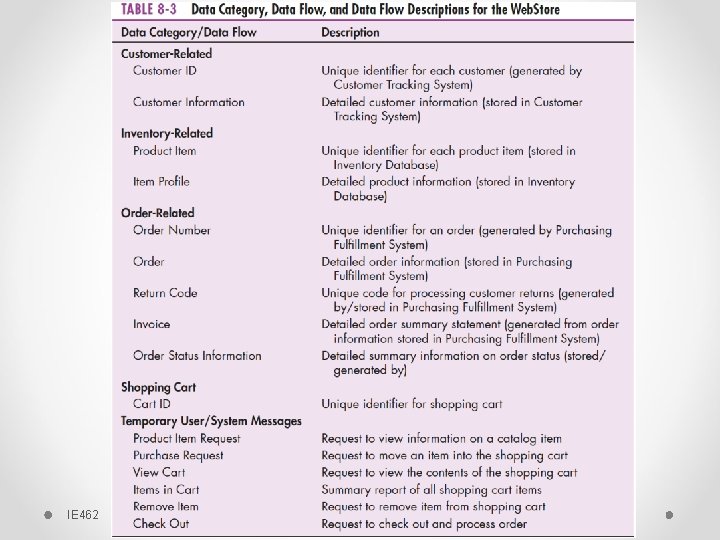
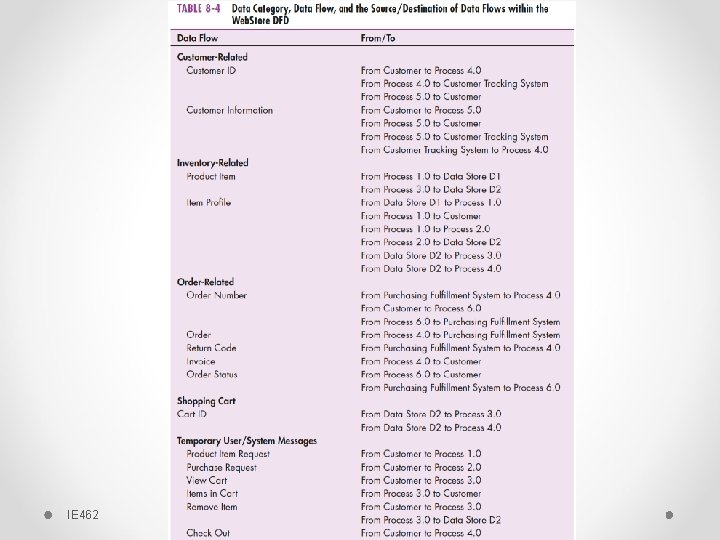
E-R Diagram: PVF Furniture Webstore 2. Examine each category using the DFD: o List for each data category (Table 8 -3): • each of its data flows, and • corresponding description o List for each data category (Table 8 -4): • source and destinations for each unique data flow o Purpose of these two tables: • document Web. Store’s requirements • what information is needed to move from point to point 10
IE 462
IE 462
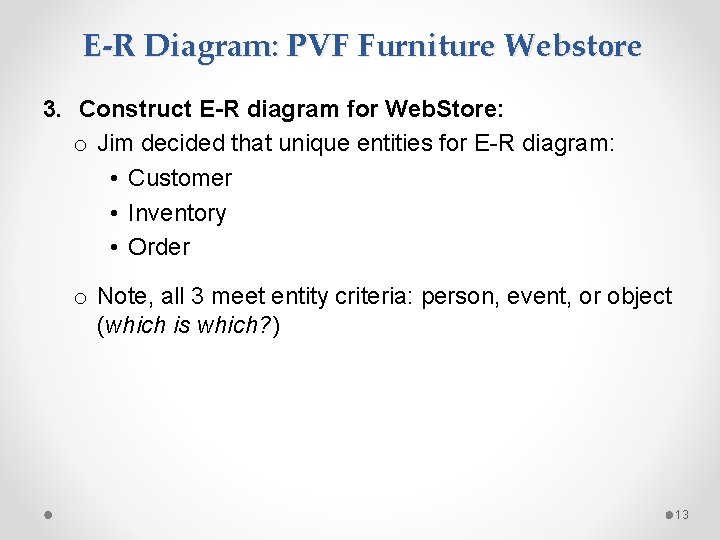
E-R Diagram: PVF Furniture Webstore 3. Construct E-R diagram for Web. Store: o Jim decided that unique entities for E-R diagram: • Customer • Inventory • Order o Note, all 3 meet entity criteria: person, event, or object (which is which? ) 13
E-R Diagram: PVF Furniture Webstore 3. Construct E-R diagram for Web. Store (cont. ): o Remaining two categories: • Temporary User/System Messages: o not permanently stored items o not person/event/object o should not be an entity in model 14
E-R Diagram: PVF Furniture Webstore 3. Construct E-R diagram for Web. Store (cont. ): o Remaining two categories (cont. ): • Shopping Cart: o temporarily stored item (for at least duration of a customer’s visit to the Web. Store), and o can be considered an object o Process 4. 0 (Check Out Process Order) moves Shopping Cart contents to the Purchasing Fulfillment System, where order details are stored o should be an entity in model 15
E-R Diagram: PVF Furniture Webstore 3. Construct E-R diagram for Web. Store (cont. ): o Summary of required entities for E-R diagram: • Customer • Inventory • Order • Shopping Cart 16
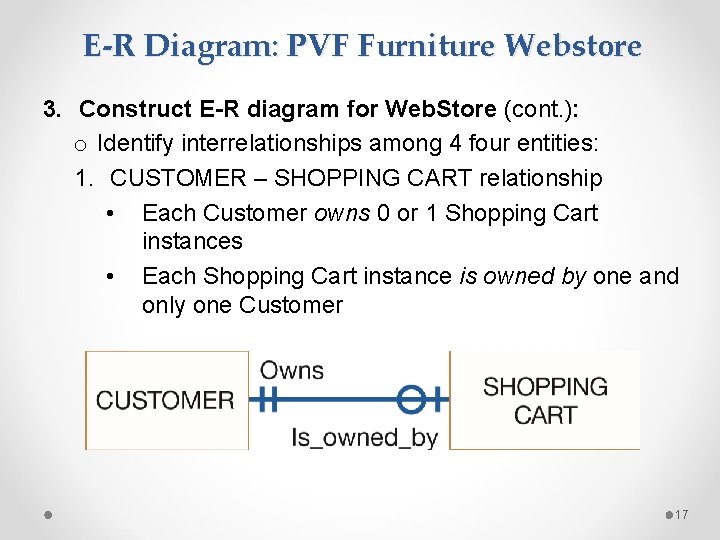
E-R Diagram: PVF Furniture Webstore 3. Construct E-R diagram for Web. Store (cont. ): o Identify interrelationships among 4 four entities: 1. CUSTOMER – SHOPPING CART relationship • Each Customer owns 0 or 1 Shopping Cart instances • Each Shopping Cart instance is owned by one and only one Customer 17
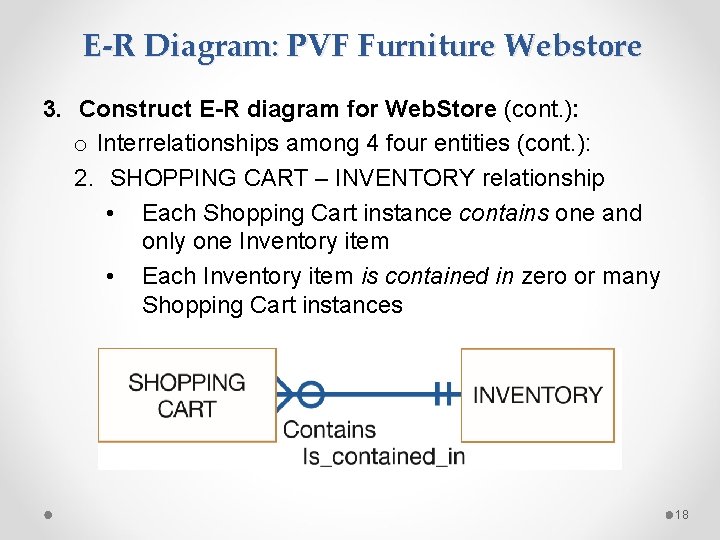
E-R Diagram: PVF Furniture Webstore 3. Construct E-R diagram for Web. Store (cont. ): o Interrelationships among 4 four entities (cont. ): 2. SHOPPING CART – INVENTORY relationship • Each Shopping Cart instance contains one and only one Inventory item • Each Inventory item is contained in zero or many Shopping Cart instances 18
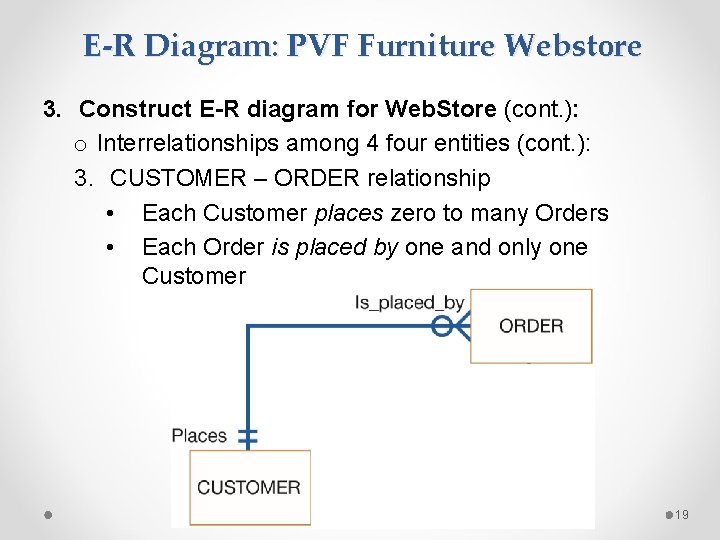
E-R Diagram: PVF Furniture Webstore 3. Construct E-R diagram for Web. Store (cont. ): o Interrelationships among 4 four entities (cont. ): 3. CUSTOMER – ORDER relationship • Each Customer places zero to many Orders • Each Order is placed by one and only one Customer 19
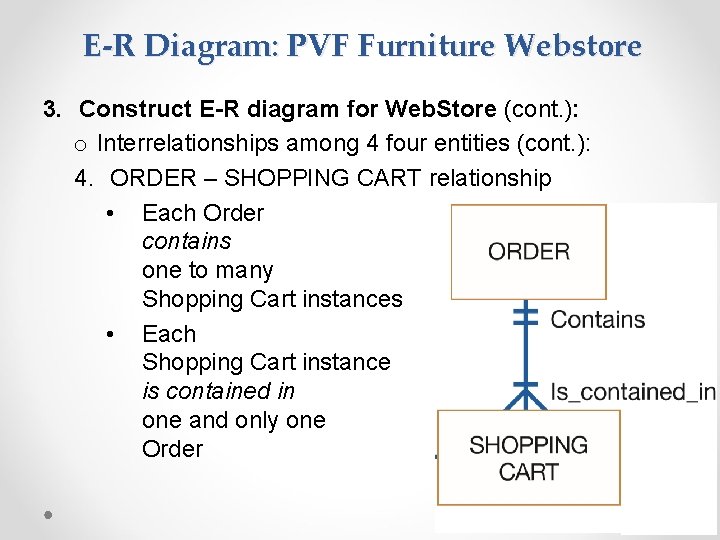
E-R Diagram: PVF Furniture Webstore 3. Construct E-R diagram for Web. Store (cont. ): o Interrelationships among 4 four entities (cont. ): 4. ORDER – SHOPPING CART relationship • Each Order contains one to many Shopping Cart instances • Each Shopping Cart instance is contained in one and only one Order 20
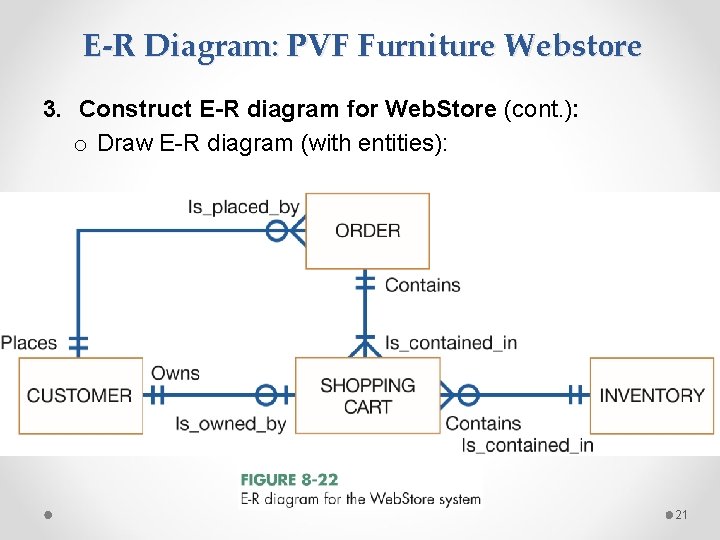
E-R Diagram: PVF Furniture Webstore 3. Construct E-R diagram for Web. Store (cont. ): o Draw E-R diagram (with entities): 21
E-R Diagram: PVF Furniture Webstore 3. Construct E-R diagram for Web. Store (cont. ): o Draw E-R diagram (with entities) – cont. : • Jim can then list specific attributes for each entity • then compare these lists with existing inventory, customer, and order database tables 22
Videos to Watch • Entity Relationship Diagram (ERD) Tutorial - Part 1 https: //youtu. be/Qpdh. BUYk 7 Kk • Entity Relationship Diagram (ERD) Tutorial - Part 2 https: //youtu. be/-Cu. Y 5 ADwn 24 • Entity-Relationship Diagrams (another system) https: //youtu. be/c 0_9 Y 8 QAstg • Entity Relationship Diagram (ERD) Training Video https: //youtu. be/-f. Q-b. Rllh. Xc IE 462 23
Sources • Modern Systems Analysis and Design. Joseph S. Valacich and Joey F. George. Pearson. Eighth Ed. 2017. Chapter 8. IE 462 24