
King Saud University College of Engineering IE 341









- Slides: 40
King Saud University College of Engineering IE – 341: “Human Factors Engineering” Fall – 2015 (1 st Sem. 1436 -7 H) Manual Materials Handling (Chapter 8) Prepared by: Ahmed M. El-Sherbeeny, Ph. D 1
• • Lesson Overview What is MMH? MMH Activities MMH Effect on Health NIOSH Lifting Equation Case 1: Effect of Frequency Factor on RWL Case 2: Effect of Horizontal Distance on RWL Case 3: Effect of Vertical Distance on RWL 2
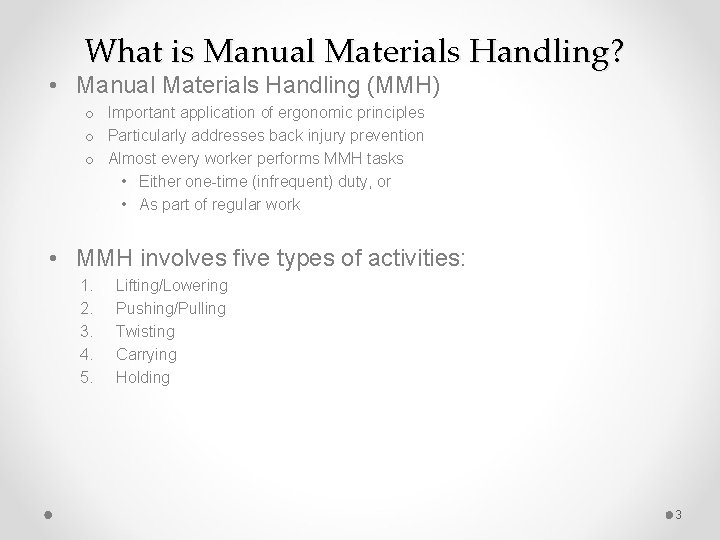
What is Manual Materials Handling? • Manual Materials Handling (MMH) o Important application of ergonomic principles o Particularly addresses back injury prevention o Almost every worker performs MMH tasks • Either one-time (infrequent) duty, or • As part of regular work • MMH involves five types of activities: 1. 2. 3. 4. 5. Lifting/Lowering Pushing/Pulling Twisting Carrying Holding 3
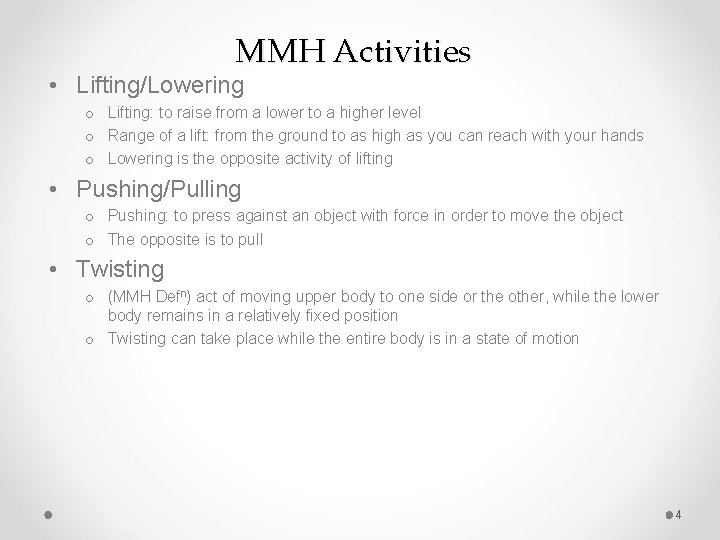
MMH Activities • Lifting/Lowering o Lifting: to raise from a lower to a higher level o Range of a lift: from the ground to as high as you can reach with your hands o Lowering is the opposite activity of lifting • Pushing/Pulling o Pushing: to press against an object with force in order to move the object o The opposite is to pull • Twisting o (MMH Defn) act of moving upper body to one side or the other, while the lower body remains in a relatively fixed position o Twisting can take place while the entire body is in a state of motion 4
• Carrying MMH Activities (cont. ) o Having an object in one’s grasp or attached while in the act of moving o Weight of object becomes a part of the total weight of the person doing the work • Holding o Having an object in one’s grasp while in a static body position 5
MMH: Effect on Health • MMH: most common cause of occupational fatigue and low back pain • About ¾ workers whose job includes MMH suffer pain due to back injury at some time • Such back injuries account for ≈ 1/3 of all lost work + 40% of all compensation costs • More important than financial cost: human suffering • ⇒prevention of back injuries: crucial, challenging problem for occupational health and safety 6
MMH: Effect on Health (cont. ) Work factors causing back injury during MMH • Most common causes of back injuries o Tasks involving MMH > worker's physical capacity, o Poor workplace layout • 1. Weight of the load lifted o For most workers, lifting loads over 20 kilograms ⇒ increased number and severity of back injuries • 2. Range of the lift o Preferred range for lifting is: between knee and waist height o Lifting above/below this range is more hazardous • 3. Location of load in relation to the body o Load lifted far from the body ⇒ more stress on the back than the same load lifted close to the body 7
MMH: Effect on Health (cont. ) Cont. Work factors caus. back injury during MMH • 4. Size and shape of load o Bulky object is harder to lift than a compact one of the same weight because it (or its center of gravity) cannot be brought close to the body o Lifting a bulky object also forces a worker into an awkward and potentially unbalanced position • 5. Number and frequency of lifts performed o How often the worker performs MMH tasks, and for how long, are extremely important factors o Frequently repeated, long-lasting tasks: most tiring ⇒ the most likely to cause back injury o Highly repetitive MMH tasks also make the worker bored and less alert ⇒ safety hazard 8
MMH: Effect on Health (cont. ) Cont. Work factors caus. back injury during MMH • 6. Excessive bending and twisting o Poor layout of the workplace ⇒ risk for injury ↑ o e. g. shelving that is too deep, too high or too low ⇒ unnecessary bending or stretching o e. g. lack of space to move freely ⇒ increases the need for twisting and bending o e. g. unsuitable dimensions of benches, tables, and other furniture ⇒ force worker to perform MMH tasks in awkward positions ⇒ add stress to the musculoskeletal system o e. g. work areas overcrowded with people or equipment ⇒ stressful body movements 9
Establishing if a Lift is too Heavy • NIOSH: National Institute for Occupational Safety and Health (United States) • Following recommendations are based on "Revised NIOSH equation for the design and evaluation of manual lifting tasks” • NIOSH lifting equation takes into account weight, other variables in lifting tasks that contribute to the risk of injury 10
Establishing if a Lift is too Heavy (cont) • e. g. situation requires frequent lifts or lifting loads far away from the body o ⇒ there is an increased risk of injury o Under these conditions, reduce weight limit: • from a baseline weight or "load constant" (LC) • to a recommended weight limit (RWL) • A "load constant" (LC) o 23 kg (about 51 lb. ) o established by NIOSH: load that, under ideal conditions (e. g. shifts ≤ 8 hr. ), is safe for • 75% of females • 99% of males • i. e. 90% of adult employee population • The recommended weight limit (RWL) o Calculated using the NIOSH lifting equation 11
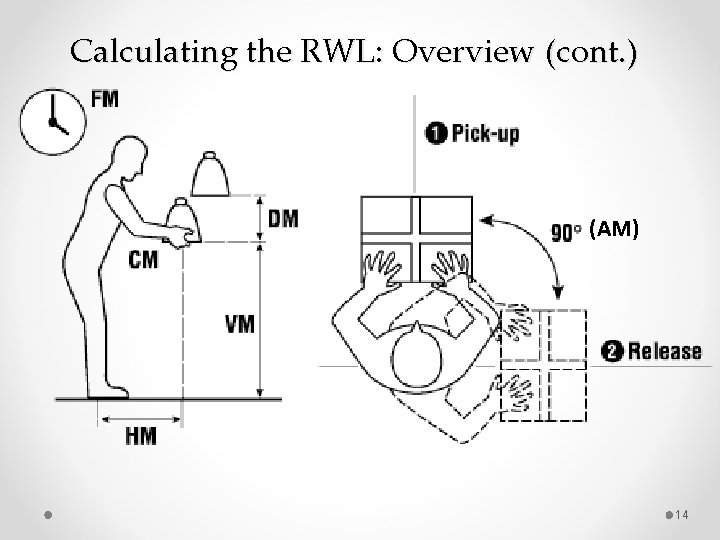
Calculating the RWL: Overview • STEP 1: measure/assess variables related to the lifting task • Six variables considered in determining RWL: 1. 2. 3. 4. 5. 6. horizontal distance (H) the load is lifted, i. e. = distance of hands from midpoint between ankles starting height of the hands from the ground, (vertical location, V) vertical distance of lifting (D) frequency of lifting or time between lifts (F) angle of the load in relation to the body (A) (e. g. straight in front of you = 0º, or off to side) quality of grasp or handhold based on the type of handles available (hand-toload coupling, C). 12
Calculating the RWL: Overview (cont. ) Each of these variables: assigned a numerical value (multiplier factor) from look-up charts STEP 2: Calculate RWL using NIOSH equation (includes six multiplier factors): RWL = LC * HM * VM * DM * FM * AM * CM ◦ ◦ ◦ ◦ where LC is the load constant; other factors are: HM, the "Horizontal Multiplier" factor VM, the "Vertical Multiplier" factor DM, the "Distance Multiplier" factor FM, the "Frequency Multiplier" factor AM, the "Asymmetric Multiplier“ factor CM, the "Coupling Multiplier" factor 13
Calculating the RWL: Overview (cont. ) (AM) 14
Calculating the RWL: Overview (cont. ) • STEP 3: analyze RWL • If all multiplier factors are in best range (i. e. 1) ⇒ weight limit for lifting or lowering: 23 kg (51 pounds) • If multipliers are not in best ranges (i. e. < 1) ⇒ weight limit must be reduced accordingly 15
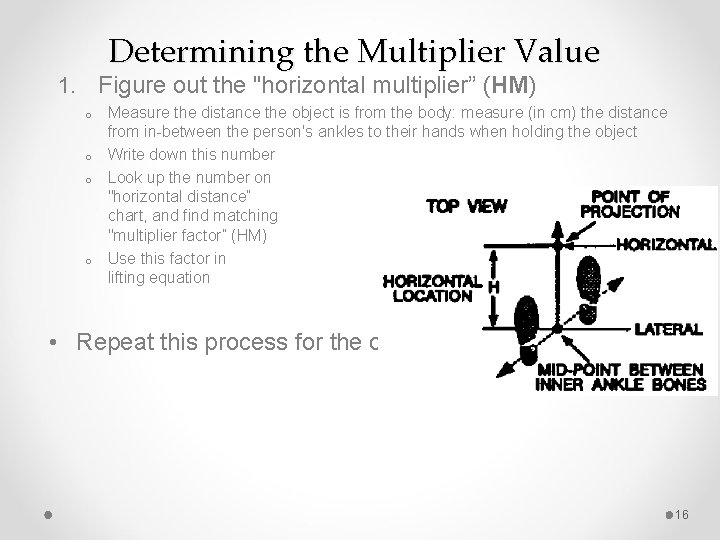
Determining the Multiplier Value 1. Figure out the "horizontal multiplier” (HM) o o Measure the distance the object is from the body: measure (in cm) the distance from in-between the person's ankles to their hands when holding the object Write down this number Look up the number on "horizontal distance“ chart, and find matching "multiplier factor” (HM) Use this factor in lifting equation • Repeat this process for the other 5 factors: 16
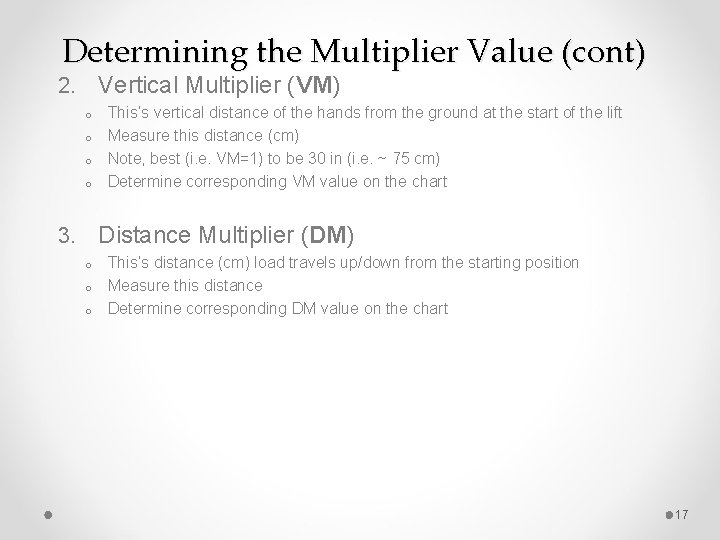
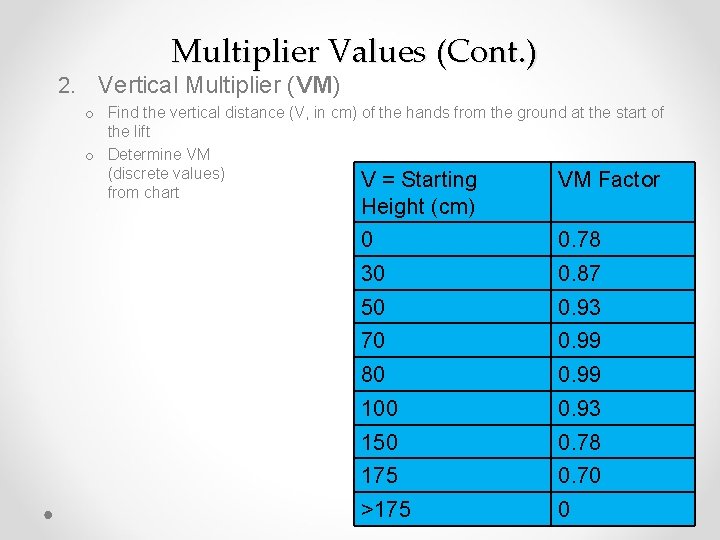
Determining the Multiplier Value (cont) 2. Vertical Multiplier (VM) o o This’s vertical distance of the hands from the ground at the start of the lift Measure this distance (cm) Note, best (i. e. VM=1) to be 30 in (i. e. ~ 75 cm) Determine corresponding VM value on the chart 3. Distance Multiplier (DM) o o o This’s distance (cm) load travels up/down from the starting position Measure this distance Determine corresponding DM value on the chart 17
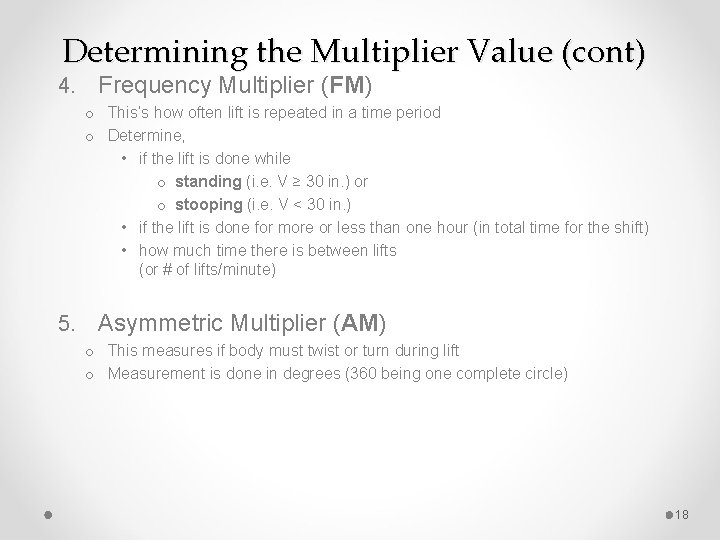
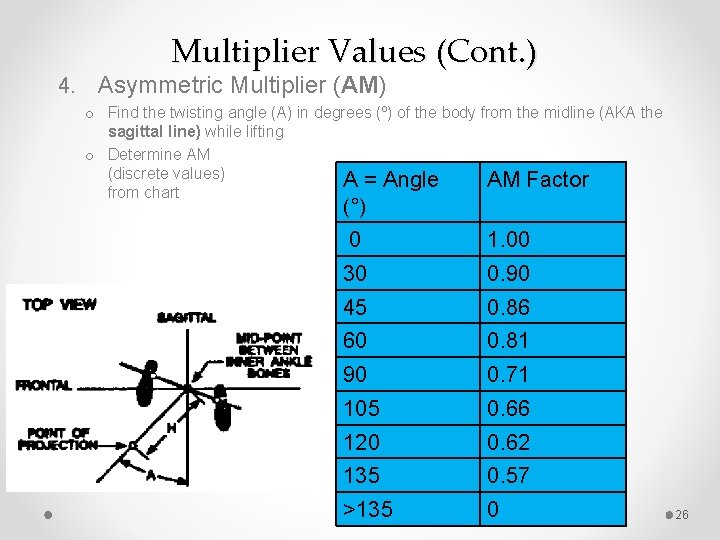
Determining the Multiplier Value (cont) 4. Frequency Multiplier (FM) o This’s how often lift is repeated in a time period o Determine, • if the lift is done while o standing (i. e. V ≥ 30 in. ) or o stooping (i. e. V < 30 in. ) • if the lift is done for more or less than one hour (in total time for the shift) • how much time there is between lifts (or # of lifts/minute) 5. Asymmetric Multiplier (AM) o This measures if body must twist or turn during lift o Measurement is done in degrees (360 being one complete circle) 18
Determining the Multiplier Value (cont) 6. Coupling Multiplier (CM) o This finds “coupling” i. e. type of grasp person has on the container o It rates the type of handles as • good • fair • poor o You also need to know if the lift is done in a standing or stooping position 19
Determining the Multiplier Value (cont) • Once you have all these values ⇒ use Revised lifting equation to determine the RWL • Compare RWL to actual weight of the object • If the RWL < lower than actual object weight: o ⇒ determine which factor(s) contribute to the highest risk o factors that are contributing the highest risk have the lowest multiplier values o modify the lift accordingly 20
Applicability of NIOSH Lifting Equation • It does not apply when lifting/lowering, with one hand for over 8 hours while seated or kneeling in a restricted work space unstable objects (e. g. buckets, liquids containers) while pushing or pulling with wheelbarrows or shovels with high speed motion (faster than about 30 inches/second) o extremely hot or cold objects or in extreme temperatures o with poor foot/floor coupling (high risk of a slip or fall) o o o o 21
Applicability of NIOSH Lifting Equation • It does apply (mostly) with o two-handed lifting, o comfortable lifting postures, and o comfortable environments and non-slip floorings • Calculation of RWL using the formula: o Indicates which of the six components of the task contribute most to the risk o The lower the factor ⇒ it contributes more to risk • Why is equation called “revised”? o NIOSH published their first lifting equation in 1981 o In 1993: new "revised" equation was published o It took into account new research findings and other variables not used in the first equation o “revised” equation can be used in a wider range of lifting situations than the first equation 22
Multiplier Values 1. Horizontal Multiplier (HM) o Find horizontal distance (H, in cm) from midpoint between ankles to point projected on floor directly below the mid-point of hand grasps (i. e. the loadcenter) while holding object, or distance to large middle-knuckle of hand o Determine HM (discrete values) from chart o Q: What to do for H = Horizontal HM Factor intermediate values? Distance (cm) 25 or less 30 40 50 60 63 >63 1. 00 0. 83 0. 63 0. 50 0. 42 0. 40 0 23
Multiplier Values (Cont. ) 2. Vertical Multiplier (VM) o Find the vertical distance (V, in cm) of the hands from the ground at the start of the lift o Determine VM (discrete values) V = Starting VM Factor from chart Height (cm) 0 0. 78 30 0. 87 50 0. 93 70 0. 99 80 0. 99 100 0. 93 150 0. 78 175 0. 70 >175 0 24
Multiplier Values (Cont. ) 3. Distance Multiplier (DM) o Find the vertical distance (D, in cm) that the load travels o Determine DM (discrete values) from chart below D = Lifting DM Factor Distance (cm) 25 or less 1. 00 40 0. 93 55 0. 90 100 0. 87 145 0. 85 175 0. 85 >175 0 25
Multiplier Values (Cont. ) 4. Asymmetric Multiplier (AM) o Find the twisting angle (A) in degrees (º) of the body from the midline (AKA the sagittal line) while lifting o Determine AM (discrete values) A = Angle AM Factor from chart (°) 0 1. 00 30 0. 90 45 0. 86 60 0. 81 90 0. 71 105 0. 66 120 0. 62 135 0. 57 >135 0 26
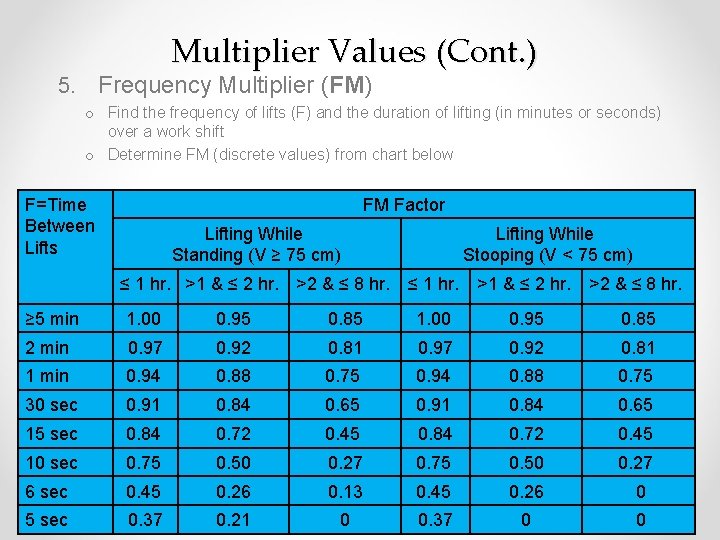
Multiplier Values (Cont. ) 5. Frequency Multiplier (FM) o Find the frequency of lifts (F) and the duration of lifting (in minutes or seconds) over a work shift o Determine FM (discrete values) from chart below F=Time Between Lifts FM Factor Lifting While Standing (V ≥ 75 cm) ≤ 1 hr. >1 & ≤ 2 hr. >2 & ≤ 8 hr. Lifting While Stooping (V < 75 cm) ≤ 1 hr. >1 & ≤ 2 hr. >2 & ≤ 8 hr. ≥ 5 min 1. 00 0. 95 0. 85 2 min 0. 97 0. 92 0. 81 1 min 0. 94 0. 88 0. 75 30 sec 0. 91 0. 84 0. 65 15 sec 0. 84 0. 72 0. 45 0. 84 0. 72 0. 45 10 sec 0. 75 0. 50 0. 27 6 sec 0. 45 0. 26 0. 13 0. 45 0. 26 0 5 sec 0. 37 0. 21 0 0. 37 0 0 27
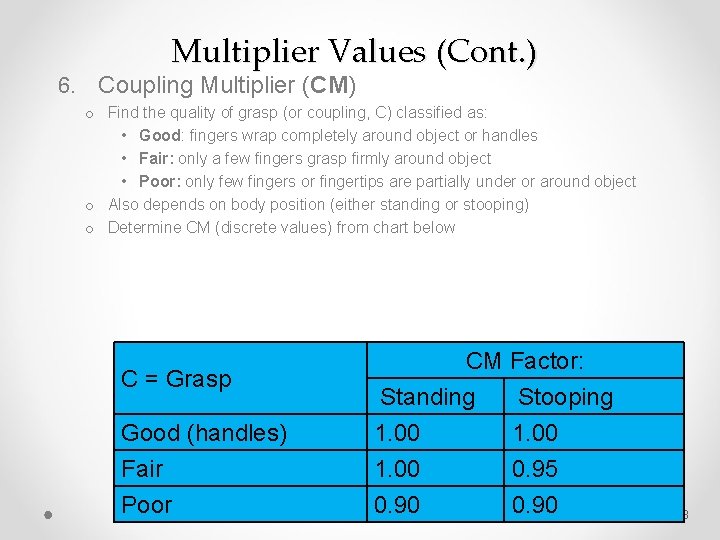
Multiplier Values (Cont. ) 6. Coupling Multiplier (CM) o Find the quality of grasp (or coupling, C) classified as: • Good: fingers wrap completely around object or handles • Fair: only a few fingers grasp firmly around object • Poor: only few fingers or fingertips are partially under or around object o Also depends on body position (either standing or stooping) o Determine CM (discrete values) from chart below Good (handles) Fair CM Factor: Standing Stooping 1. 00 0. 95 Poor 0. 90 C = Grasp 0. 90 28
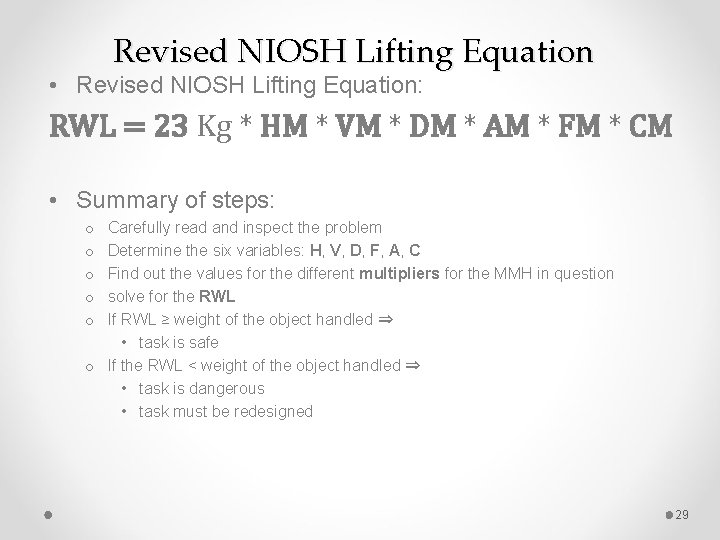
Revised NIOSH Lifting Equation • Revised NIOSH Lifting Equation: RWL = 23 Kg * HM * VM * DM * AM * FM * CM • Summary of steps: Carefully read and inspect the problem Determine the six variables: H, V, D, F, A, C Find out the values for the different multipliers for the MMH in question solve for the RWL If RWL ≥ weight of the object handled ⇒ • task is safe o If the RWL < weight of the object handled ⇒ • task is dangerous • task must be redesigned o o o 29
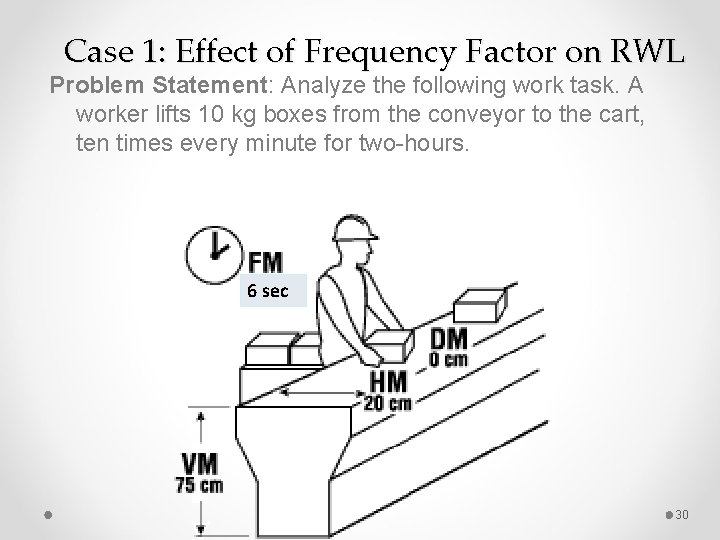
Case 1: Effect of Frequency Factor on RWL Problem Statement: Analyze the following work task. A worker lifts 10 kg boxes from the conveyor to the cart, ten times every minute for two-hours. 6 sec 30
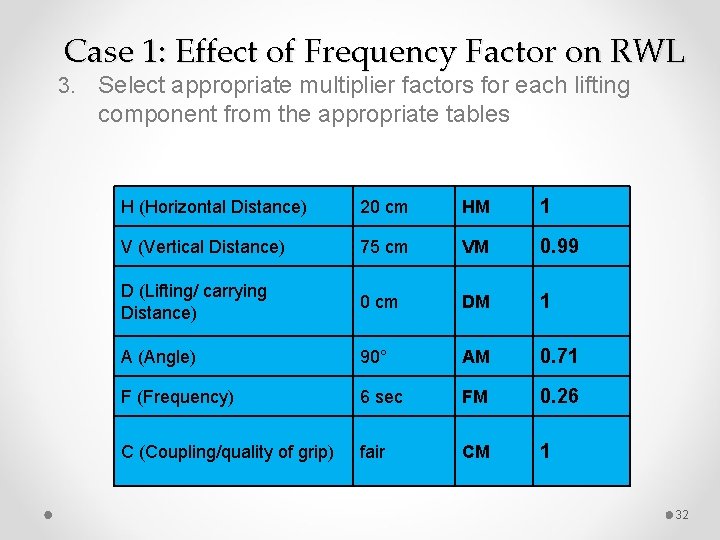
Case 1: Effect of Frequency Factor on RWL Solution: First, calculate the recommended weight limit (RWL) for the task 1. Determine the weight of the load. Weight = 10 kg 2. Assess the six components of lifting task. H (Horizontal Distance) 20 cm V (Vertical Distance) 75 cm D (Lifting/ carrying Distance) 0 cm A (Angle) 90° F (Frequency) 6 sec C (Coupling/quality of grip) fair 31
Case 1: Effect of Frequency Factor on RWL 3. Select appropriate multiplier factors for each lifting component from the appropriate tables H (Horizontal Distance) 20 cm HM 1 V (Vertical Distance) 75 cm VM 0. 99 D (Lifting/ carrying Distance) 0 cm DM 1 A (Angle) 90° AM 0. 71 F (Frequency) 6 sec FM 0. 26 C (Coupling/quality of grip) fair CM 1 32
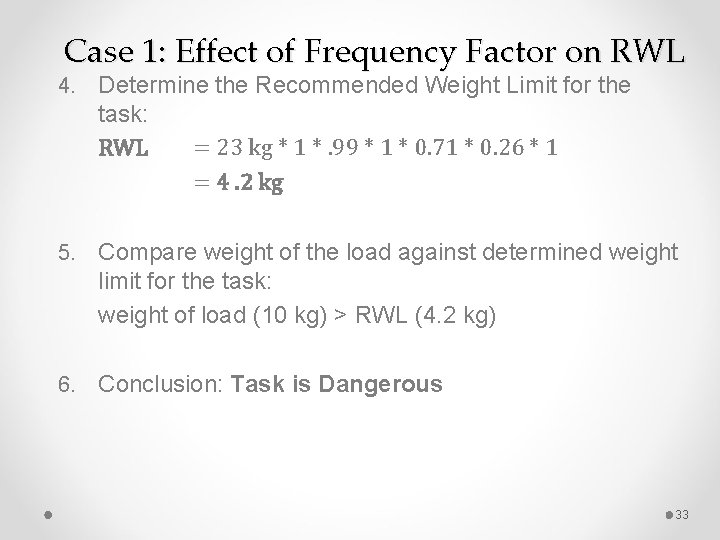
Case 1: Effect of Frequency Factor on RWL 4. Determine the Recommended Weight Limit for the task: RWL = 23 kg * 1 *. 99 * 1 * 0. 71 * 0. 26 * 1 = 4. 2 kg 5. Compare weight of the load against determined weight limit for the task: weight of load (10 kg) > RWL (4. 2 kg) 6. Conclusion: Task is Dangerous 33
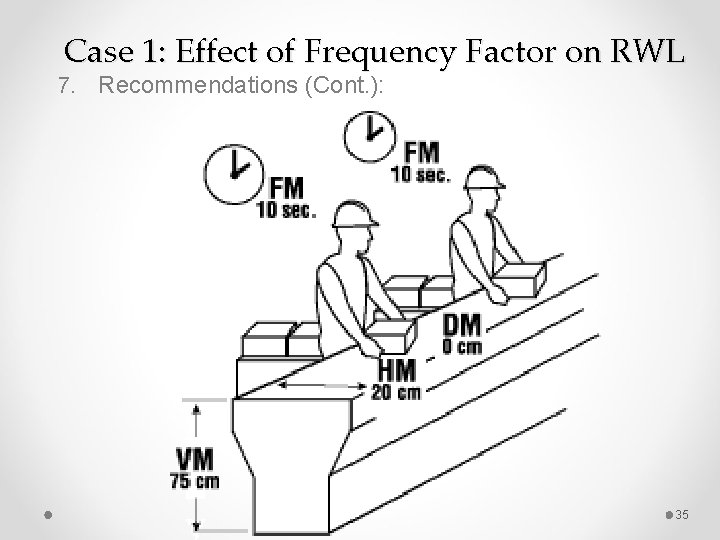
Case 1: Effect of Frequency Factor on RWL 7. Recommendations: Assess which component(s) contribute(s) most to the risk • o the critical factor is FM ⇒ it is required to reconsider the frequency of lifting and/or duration of task Shorten the frequency of lifting by: • a. b. c. reducing the frequency of incoming boxes (i. e. increasing F) and/or assigning additional workers to task, and/or shortening the time of the task to 1 hour 34
Case 1: Effect of Frequency Factor on RWL 7. Recommendations (Cont. ): 35
Case 1: Effect of Frequency Factor on RWL 8. Redesign the Task • • Assess the six components in the redesigned task Determine new RWL: RWL =23 kg * 1 *. 99 * 1 * 0. 75 * 1 = 12. 1 kg • • Compare weight of the box against determined weight limit for redesigned task: weight of load (10 kg): now < RWL (12. 1 kg) Conclusion: most workers can perform the task safely (why most? ) 36
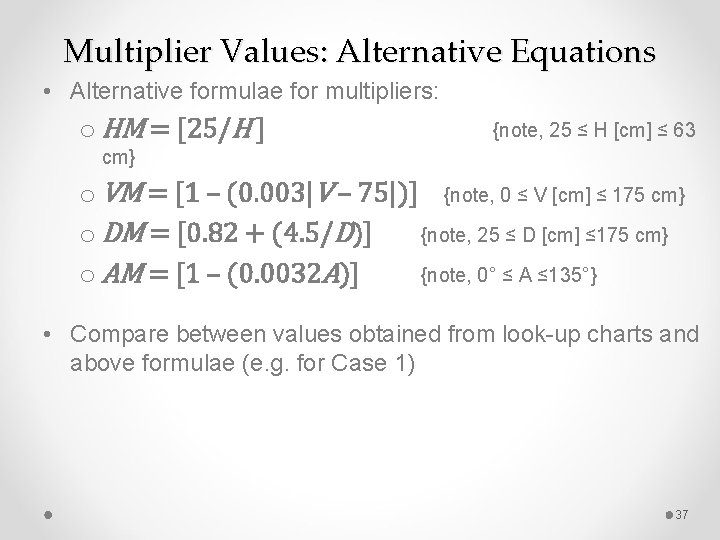
Multiplier Values: Alternative Equations • Alternative formulae for multipliers: o HM = [25/H ] {note, 25 ≤ H [cm] ≤ 63 cm} o VM = [1 – (0. 003|V – 75|)] {note, 0 ≤ V [cm] ≤ 175 cm} o DM = [0. 82 + (4. 5/D)] {note, 25 ≤ D [cm] ≤ 175 cm} o AM = [1 – (0. 0032 A)] {note, 0° ≤ A ≤ 135°} • Compare between values obtained from look-up charts and above formulae (e. g. for Case 1) 37
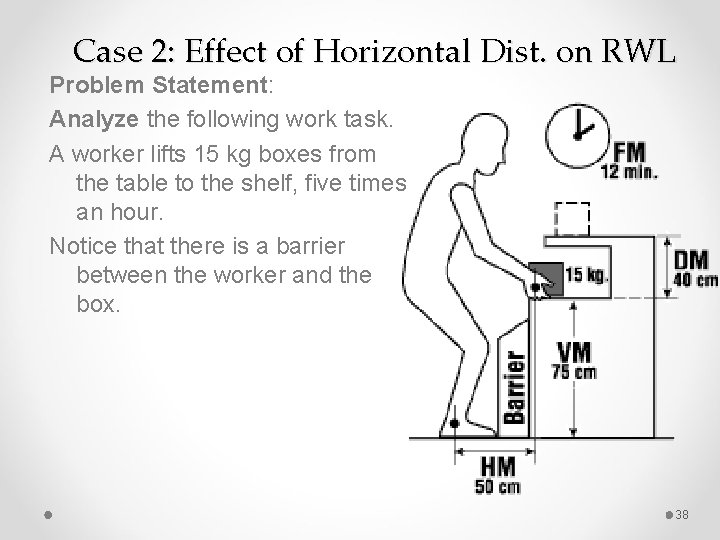
Case 2: Effect of Horizontal Dist. on RWL Problem Statement: Analyze the following work task. A worker lifts 15 kg boxes from the table to the shelf, five times an hour. Notice that there is a barrier between the worker and the box. 38
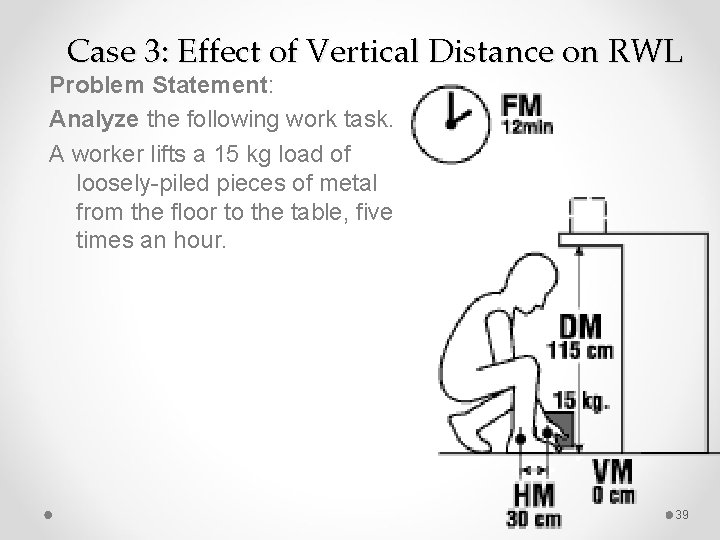
Case 3: Effect of Vertical Distance on RWL Problem Statement: Analyze the following work task. A worker lifts a 15 kg load of loosely-piled pieces of metal from the floor to the table, five times an hour. 39
References 1. Slides by: Dr. Khaled Al-Saleh; online at: http: //faculty. ksu. edu. sa/alsaleh/default. aspx 2. Slides by: Dr. Mohammed Z. Ramadan; online at: http: //faculty. ksu. edu. sa/mramadan/default. aspx 3. Revised NIOSH Equation for the Design and Evaluation of Manual Lifting Tasks. Thomas R. Walters et al. Ergonomics 36(7): 749 -776, 1993. 4. Applications Manual for the Revised NIOSH Lifting Equation. Thomas R. Walters, Vern Putz-Anderson, Arun Garg. US Department of Health and Human Services: Public Health Services. Cincinnati, OH, 1994. 5. OSHA Technical Manual. Section VII: Chapter 1: Back Disorders and Injuries. Online at: www. osha. gov/dts/osta/otm_vii/otm_vii_1. html 40