
King Saud University College of Engineering IE 341
- Slides: 16
King Saud University College of Engineering IE – 341: “Human Factors Engineering” Fall – 2017 (1 st Sem. 1438 -9 H) Manual Materials Handling (Chapter 8) part 2 – Case Studies Prepared by: Ahmed M. El-Sherbeeny, Ph. D 1
Lesson Overview Part 1: • What is MMH? • MMH Activities • MMH Effect on Health • NIOSH Lifting Equation Part 2: • Case Studies o Case 1: Effect of Frequency Factor on RWL o Case 2: Effect of Horizontal Distance on RWL o Case 3: Effect of Vertical Distance on RWL 2
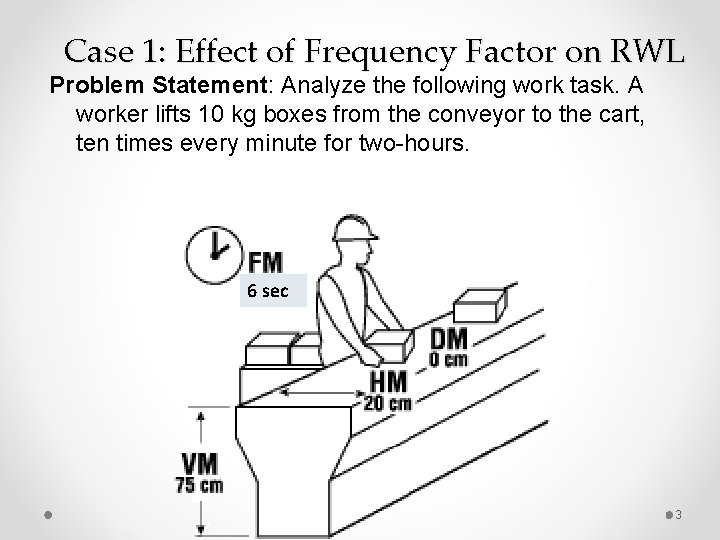
Case 1: Effect of Frequency Factor on RWL Problem Statement: Analyze the following work task. A worker lifts 10 kg boxes from the conveyor to the cart, ten times every minute for two-hours. 6 sec 3
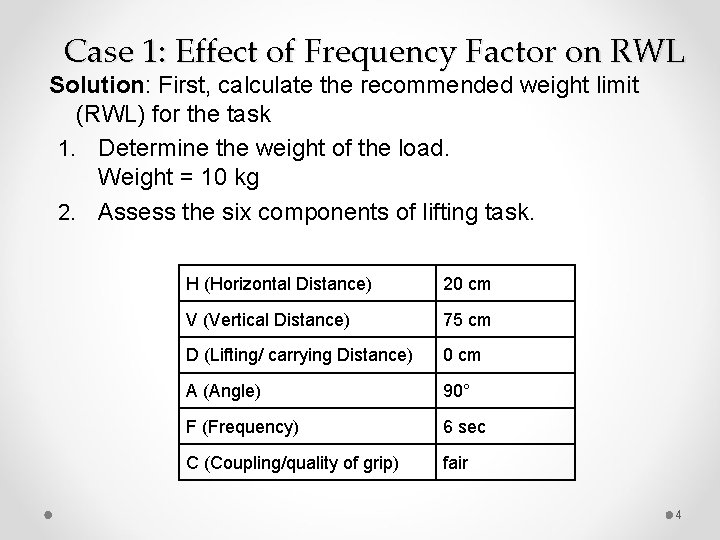
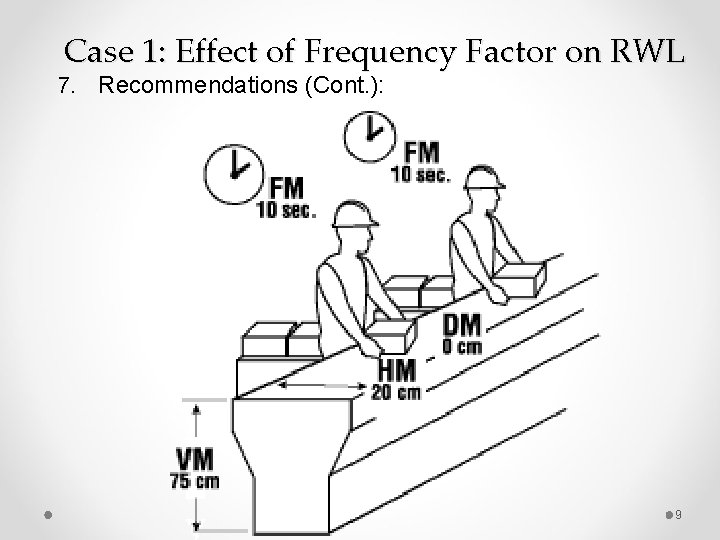
Case 1: Effect of Frequency Factor on RWL Solution: First, calculate the recommended weight limit (RWL) for the task 1. Determine the weight of the load. Weight = 10 kg 2. Assess the six components of lifting task. H (Horizontal Distance) 20 cm V (Vertical Distance) 75 cm D (Lifting/ carrying Distance) 0 cm A (Angle) 90° F (Frequency) 6 sec C (Coupling/quality of grip) fair 4
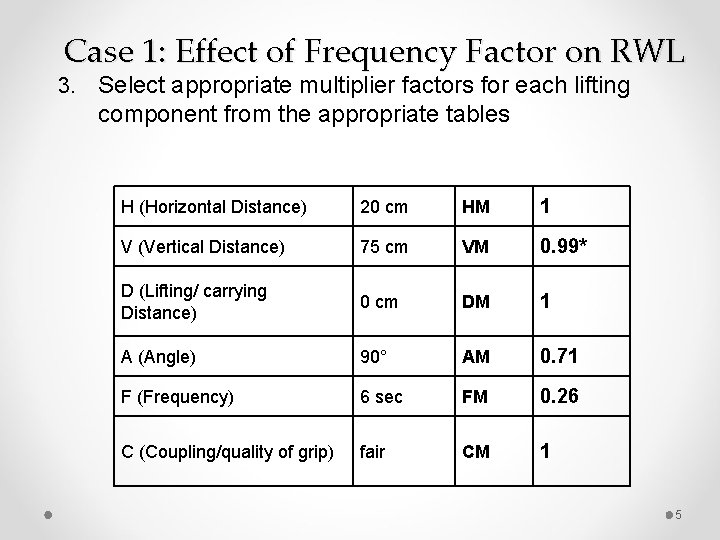
Case 1: Effect of Frequency Factor on RWL 3. Select appropriate multiplier factors for each lifting component from the appropriate tables H (Horizontal Distance) 20 cm HM 1 V (Vertical Distance) 75 cm VM 0. 99* D (Lifting/ carrying Distance) 0 cm DM 1 A (Angle) 90° AM 0. 71 F (Frequency) 6 sec FM 0. 26 C (Coupling/quality of grip) fair CM 1 5
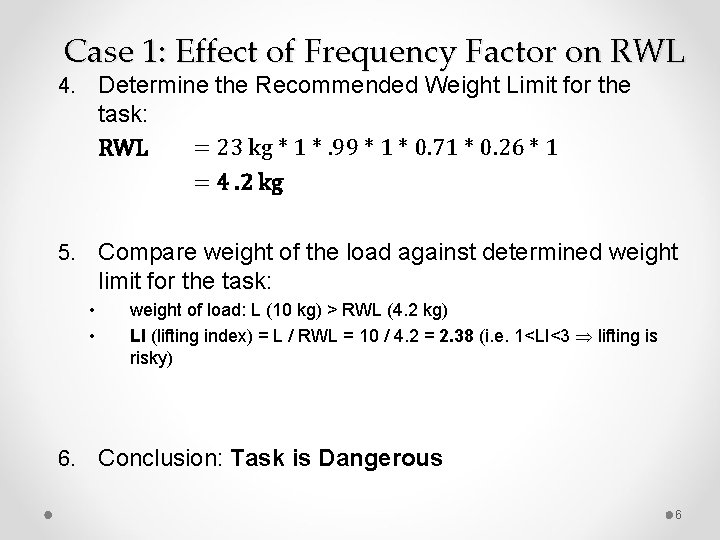
Case 1: Effect of Frequency Factor on RWL 4. Determine the Recommended Weight Limit for the task: RWL = 23 kg * 1 *. 99 * 1 * 0. 71 * 0. 26 * 1 = 4. 2 kg 5. Compare weight of the load against determined weight limit for the task: • • weight of load: L (10 kg) > RWL (4. 2 kg) LI (lifting index) = L / RWL = 10 / 4. 2 = 2. 38 (i. e. 1<LI<3 lifting is risky) 6. Conclusion: Task is Dangerous 6
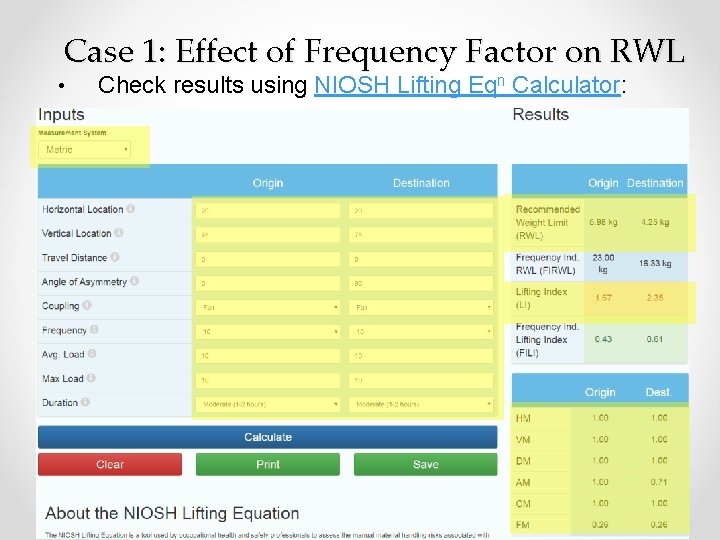
Case 1: Effect of Frequency Factor on RWL • Check results using NIOSH Lifting Eqn Calculator: 7
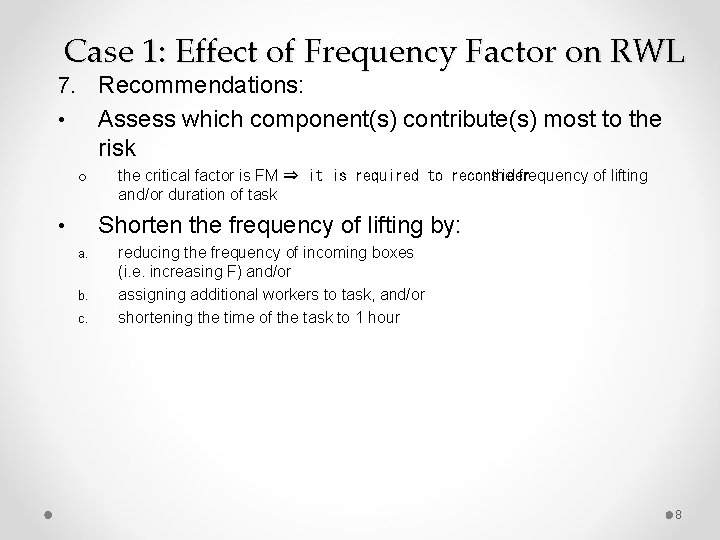
Case 1: Effect of Frequency Factor on RWL 7. Recommendations: Assess which component(s) contribute(s) most to the risk • o the critical factor is FM ⇒ it is required to reconsider the frequency of lifting and/or duration of task Shorten the frequency of lifting by: • a. b. c. reducing the frequency of incoming boxes (i. e. increasing F) and/or assigning additional workers to task, and/or shortening the time of the task to 1 hour 8
Case 1: Effect of Frequency Factor on RWL 7. Recommendations (Cont. ): 9
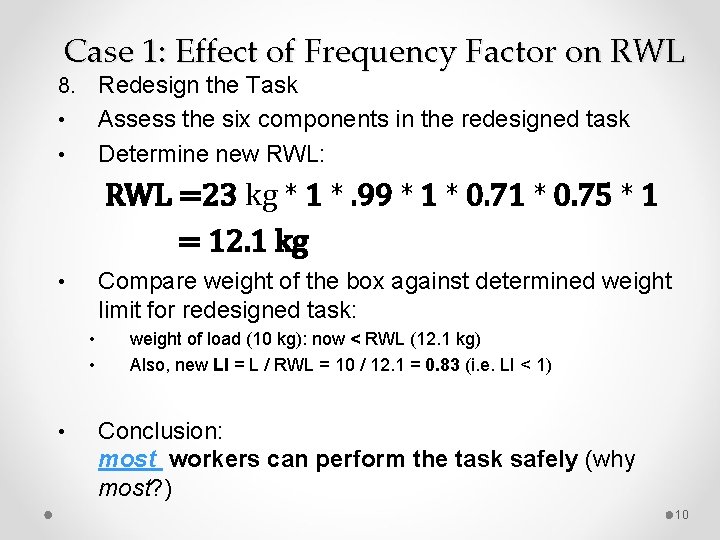
Case 1: Effect of Frequency Factor on RWL 8. Redesign the Task Assess the six components in the redesigned task Determine new RWL: • • RWL =23 kg * 1 *. 99 * 1 * 0. 75 * 1 = 12. 1 kg Compare weight of the box against determined weight limit for redesigned task: • • weight of load (10 kg): now < RWL (12. 1 kg) Also, new LI = L / RWL = 10 / 12. 1 = 0. 83 (i. e. LI < 1) Conclusion: most workers can perform the task safely (why most? ) 10
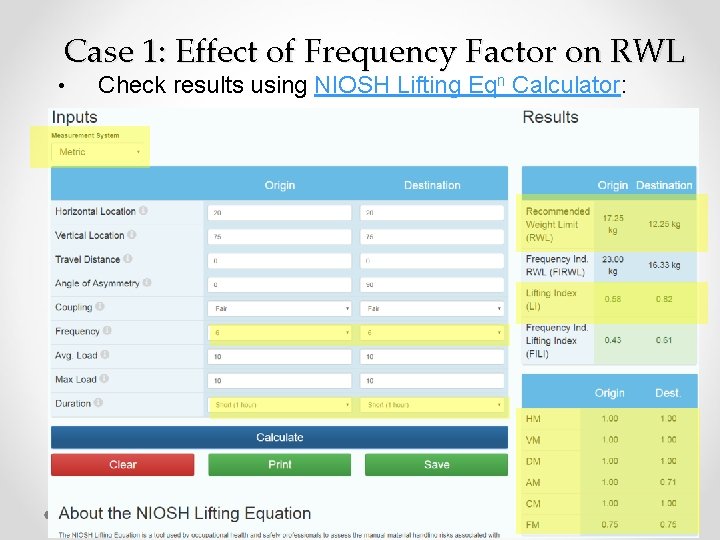
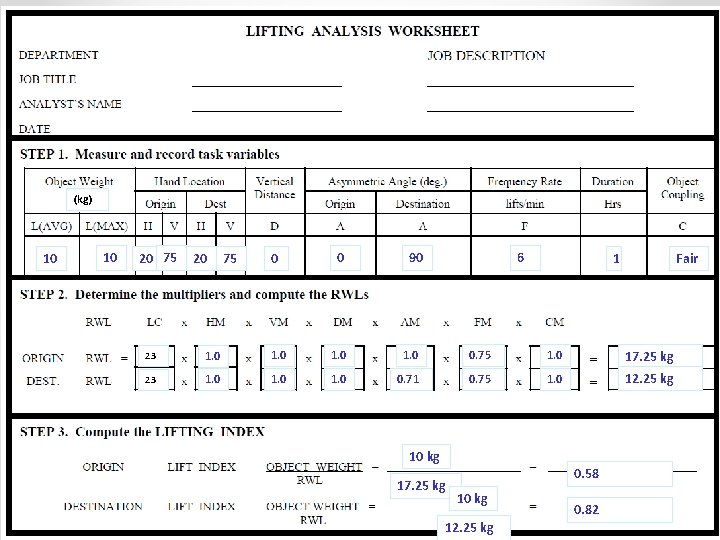
Case 1: Effect of Frequency Factor on RWL • Check results using NIOSH Lifting Eqn Calculator: 11
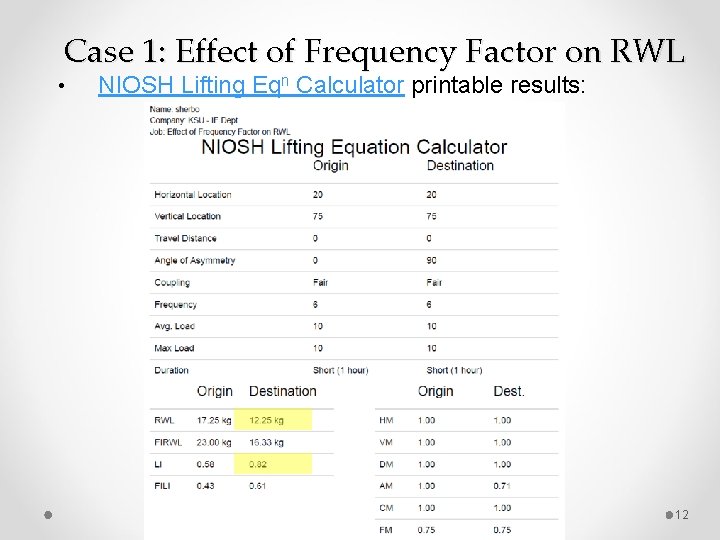
Case 1: Effect of Frequency Factor on RWL • NIOSH Lifting Eqn Calculator printable results: 12
(kg) 10 10 20 75 0 0 90 6 1 Fair 23 1. 0 0. 75 1. 0 17. 25 kg 23 1. 0 0. 71 0. 75 1. 0 12. 25 kg 10 kg 17. 25 kg 0. 58 10 kg 12. 25 kg 0. 82 13
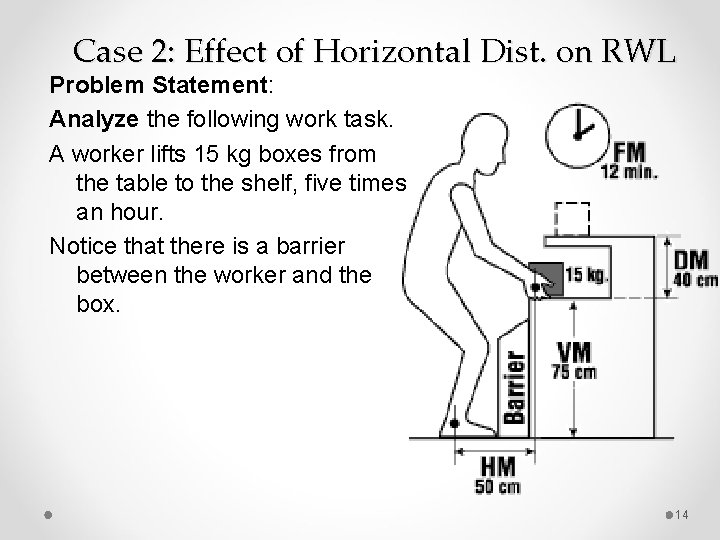
Case 2: Effect of Horizontal Dist. on RWL Problem Statement: Analyze the following work task. A worker lifts 15 kg boxes from the table to the shelf, five times an hour. Notice that there is a barrier between the worker and the box. 14
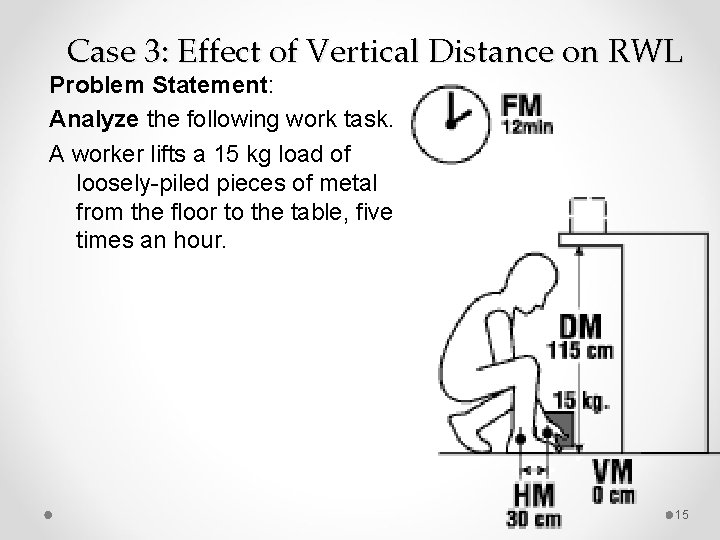
Case 3: Effect of Vertical Distance on RWL Problem Statement: Analyze the following work task. A worker lifts a 15 kg load of loosely-piled pieces of metal from the floor to the table, five times an hour. 15
References 1. Slides by: Dr. Khaled Al-Saleh; online at: http: //faculty. ksu. edu. sa/alsaleh/default. aspx 2. Slides by: Dr. Mohammed Z. Ramadan; online at: http: //faculty. ksu. edu. sa/mramadan/default. aspx 3. Revised NIOSH Equation for the Design and Evaluation of Manual Lifting Tasks. Thomas R. Walters et al. Ergonomics 36(7): 749 -776, 1993. 4. Applications Manual for the Revised NIOSH Lifting Equation. Thomas R. Walters, Vern Putz-Anderson, Arun Garg. US Department of Health and Human Services: Public Health Services. Cincinnati, OH, 1994. 5. OSHA Technical Manual. Section VII: Chapter 1: Back Disorders and Injuries. Online at: www. osha. gov/dts/osta/otm_vii/otm_vii_1. html 16