
King Khalid University Hospital Department of Obstetrics Gynecology
King Khalid University Hospital Department of Obstetrics & Gynecology Course 482 MULTIPLE PREGNANCY
Multiple pregnancy Objectives: -Incidence -Diagnosis of multiple pregnancy -Mechanism of twinning & Zygosity -Complication of multiple pregnancy -Causes of perinatal mortality & morbidity -Twin to twin transfusion -Antenatal management of multiple pregnancy -Assessment of chorionicity by ultrasound -Management of labour in multiple pregnancy
Incidence of multiple pregnancy -The natural rate of twinning is 1: 90 -Slightly higher in blacks than whites -In USA the incidence is 3% The incidence is increasing due to Assisted reproduction technique(ART)and ovulation induction -The incidence of monozygotic twins is constant and is 4: 1000 pregnancies -The incidence of dizygotic twins increase with age, parity, weight, height, and is higher in some families

Diagnosis of multiple pregnancy Suspected if: -Large for date uterine size -Multiple fetal heart rates are detected -Multiple fetal parts are felt -HCG & maternal serum alpha-fetoprotein is elevated for gestational age -Pregnancy with ART -Confirmed by ultrasound

Zygosity Dizygotic: Diamniotic/Dichorionic 70 -80% of all twins Fertilization of two ova Each fetus will be surronded by amnion & chorion( each fetus has its own placenta)

Zygosity Monozygotic: 20 -30% of all twins Result from cleavage of a single fertilized ova The timing of cleavage determines placentation Dichorionic/diamniotic monozygotic twins: Cleavage in the first 3 days after fertilization Each fetus will be surrounded by amnion & chorion( each fetus has its own placenta)like dizygotic twins Has the lowest mortality rate of monozygotic twins <10% of all monozygotic twins
Zygosity Monochorionic/diamniotic: Cleavage between day 4 and 8 after fertilization Share single placenta but separate amniotic sac The mortality is 25% Monochorionic/monoamniotic: < 1% of cases Cleavage after the 8 th day (day 9 -12) Share single placenta & single sac Mortality is 50 -60%, usually before 32 weeks
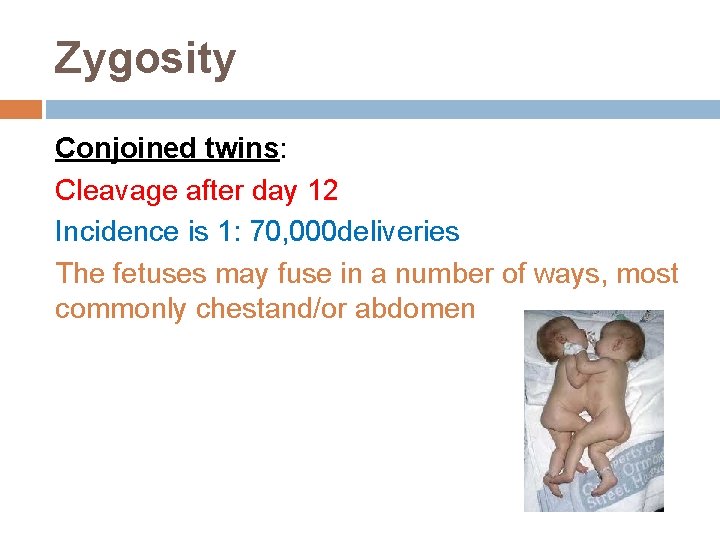
Zygosity Conjoined twins: Cleavage after day 12 Incidence is 1: 70, 000 deliveries The fetuses may fuse in a number of ways, most commonly chestand/or abdomen
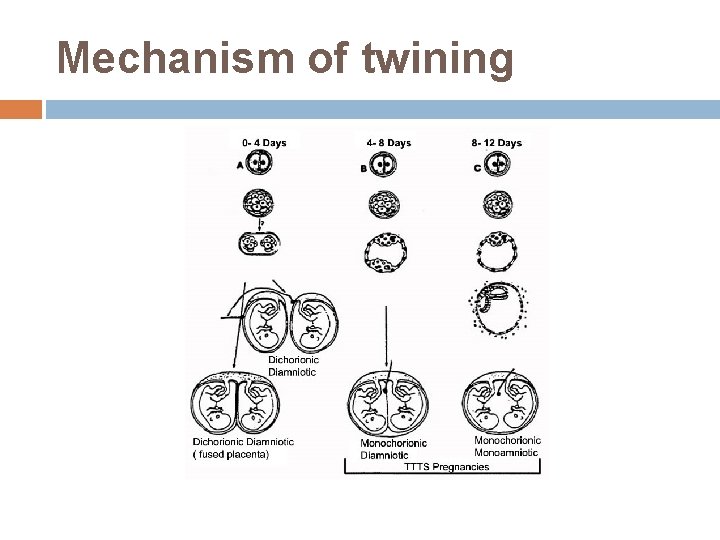
Mechanism of twining

Monozygotic twins
Complications of multiple pregnancy -High perinatal mortality & morbidity (3 -4 times higher than singleton pregnancy) -Abortion(<50% of twins diagnosed in the first trimester result in live birth(vanishing twin)) -Nausea & vomiting -Preterm labour (50%)(twins delver at 37 weeks, triples at 33 weeks, Quadruplets at 29 weeks) -IUGR -PET (3 times higher than singleton) -Polyhydramnios ( in 10%) -Congenital anomalies -Postpartum hemorrhage -Placental abruption, placenta previa -Discordant twin growth ( more than 20%discrepacy in fetal weights) -Malpresentation, cord prolapse, Operative delivery
Causes of perinatal mortality & morbidity -Prematurity (Respiratory distress syndrome) -Birth trauma -Cerebral hemorrhage -Birth asphyxia -Congenital anomalies -Still birth -
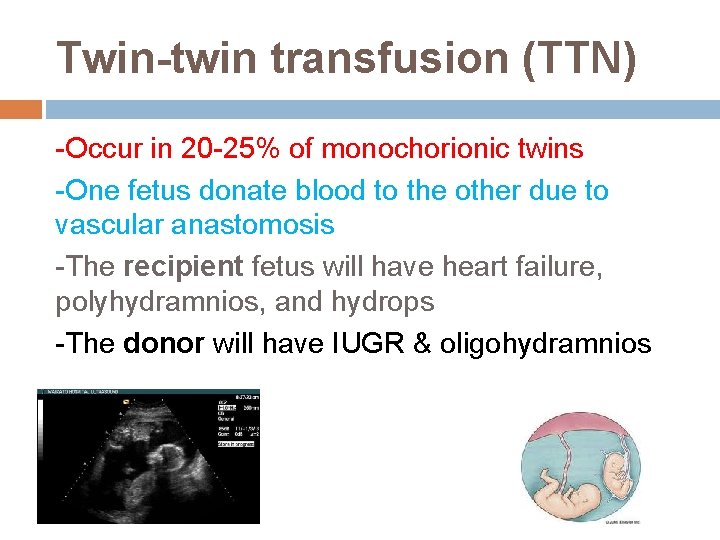
Twin-twin transfusion (TTN) -Occur in 20 -25% of monochorionic twins -One fetus donate blood to the other due to vascular anastomosis -The recipient fetus will have heart failure, polyhydramnios, and hydrops -The donor will have IUGR & oligohydramnios
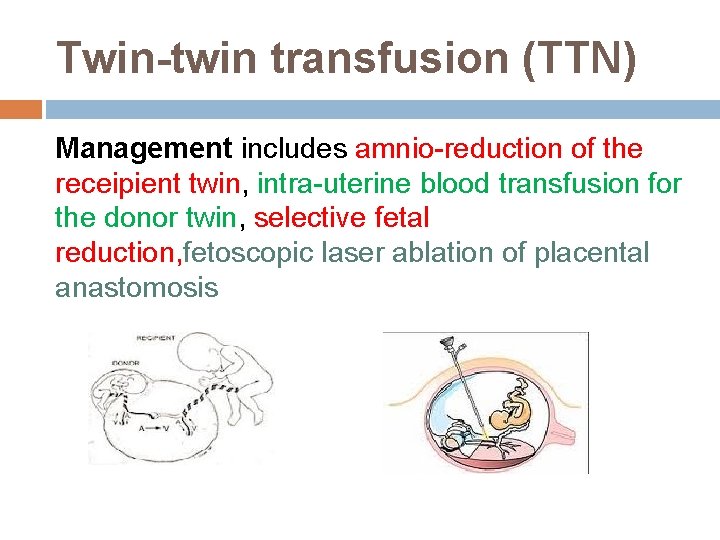
Twin-twin transfusion (TTN) Management includes amnio-reduction of the receipient twin, intra-uterine blood transfusion for the donor twin, selective fetal reduction, fetoscopic laser ablation of placental anastomosis
Antenatal management of multiple pregnancy -Adequate nutrition (300 additional calories per day per fetus) -Prevent anemia -More frequent antenatal visits -Ultrasound: Assess chorionicity at 9 -10 weeks Nuchal translucency at 12 -13+ weeks Assessment of fetal growth & fetal wellbeing every 3 -4 weeks from 23 weeks onward -Multifetal reduction may offered for high order multiple gestation in the first trimester -Preterm labour risk: Serial cervical length assessment Steroids for fetal lung maturation

ASSESSMENT OF CHORIONICITY BY ULTRASOUND Multiple gestational sacs in first trimester
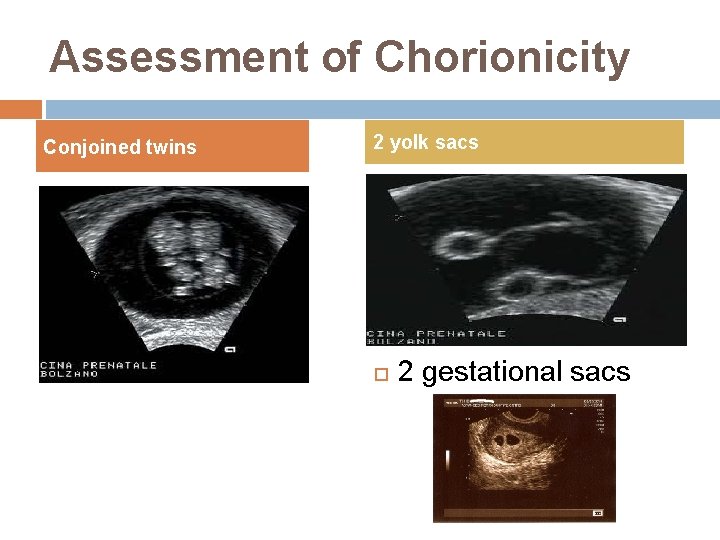
Assessment of Chorionicity Conjoined twins 2 yolk sacs 2 gestational sacs

Assessment of chorionicity Twin Peak Sign (Lambda) Dichorionic twins T sign Monochorionic twin
Management of labour in multiple pregnancy -Contoversial -Depends on presentation , gestational age, presence of fetal complications, experience of the obstetrician -usually if the first fetus is cephalic– normal delivery -Non vertex first twin--- cesarean section -Locked twins: Breech-vertex twins ---cesarean section - Active management of third stage to prevent
Pre-requisite for intra-partum management of multiple pregnancy Secondary or tertiary center Well functioning large-bore IV line Availability of emergency C/S –anesthesiablood bank Continuous simultaneous fetal heart rates monitoring Availability of NICU beds- paediatrician Imaging technique (ultrasound)
Multiple pregnancy Recommended books: -Essentials of obstetrics & gynecology (Hacker and Moore’s) P 160 -172 -Current diagnosis & treatment –Obstetrics & gynecology (p 301 -3100)
- Slides: 21