
King Fahd University of Petroleum Minerals College of
- Slides: 17
King Fahd University of Petroleum & Minerals College of Computer Sciences & Engineering Shor’s Algorithm ICS 562 – Quantum Cryptography Prepared by: Sultan Almuhammadi This lecture is based on: Yanofsky: Section 6. 5 (and recall of 6. 3*)
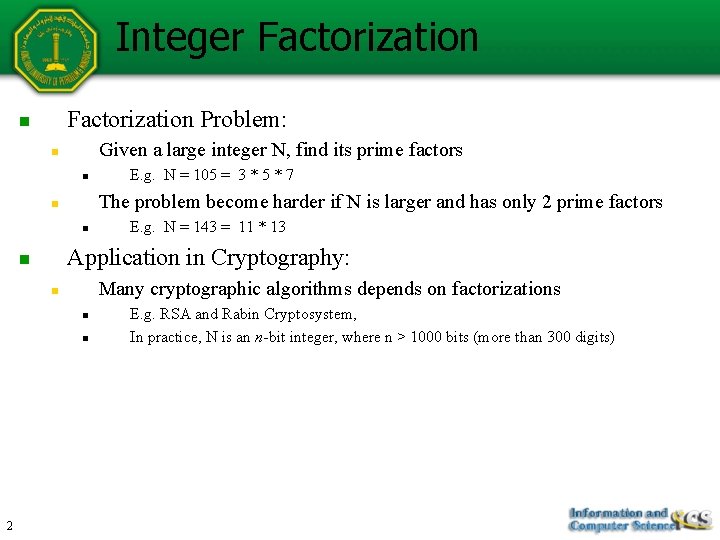
Integer Factorization Problem: n Given a large integer N, find its prime factors n n The problem become harder if N is larger and has only 2 prime factors n n E. g. N = 143 = 11 * 13 Application in Cryptography: n Many cryptographic algorithms depends on factorizations n n n 2 E. g. N = 105 = 3 * 5 * 7 E. g. RSA and Rabin Cryptosystem, In practice, N is an n-bit integer, where n > 1000 bits (more than 300 digits)
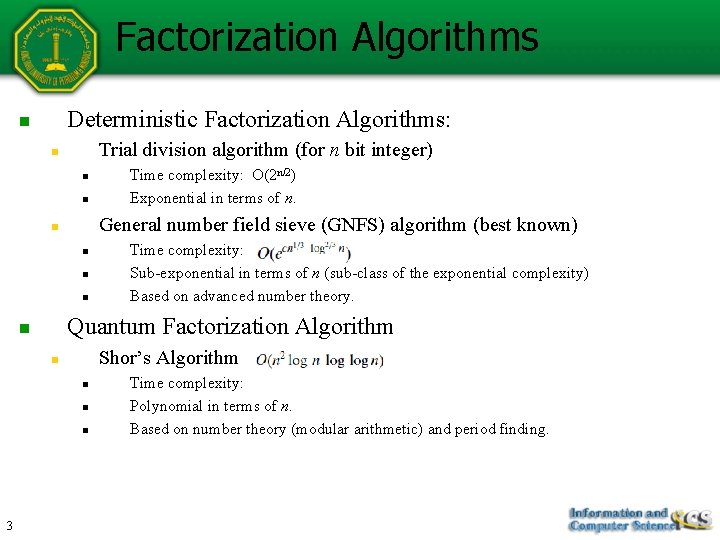
Factorization Algorithms Deterministic Factorization Algorithms: n Trial division algorithm (for n bit integer) n n n General number field sieve (GNFS) algorithm (best known) n n Time complexity: Sub-exponential in terms of n (sub-class of the exponential complexity) Based on advanced number theory. Quantum Factorization Algorithm n Shor’s Algorithm n n 3 Time complexity: O(2 n/2) Exponential in terms of n. Time complexity: Polynomial in terms of n. Based on number theory (modular arithmetic) and period finding.
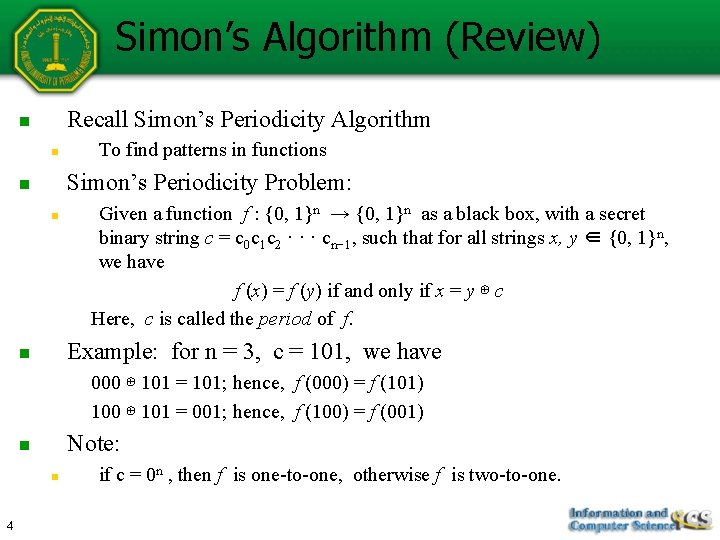
Simon’s Algorithm (Review) Recall Simon’s Periodicity Algorithm n n To find patterns in functions Simon’s Periodicity Problem: n n Given a function f : {0, 1}n → {0, 1}n as a black box, with a secret binary string c = c 0 c 1 c 2 · · · cn− 1, such that for all strings x, y ∈ {0, 1}n, we have f (x) = f (y) if and only if x = y ⊕ c Here, c is called the period of f. Example: for n = 3, c = 101, we have n 000 ⊕ 101 = 101; hence, f (000) = f (101) 100 ⊕ 101 = 001; hence, f (100) = f (001) Note: n n 4 if c = 0 n , then f is one-to-one, otherwise f is two-to-one.
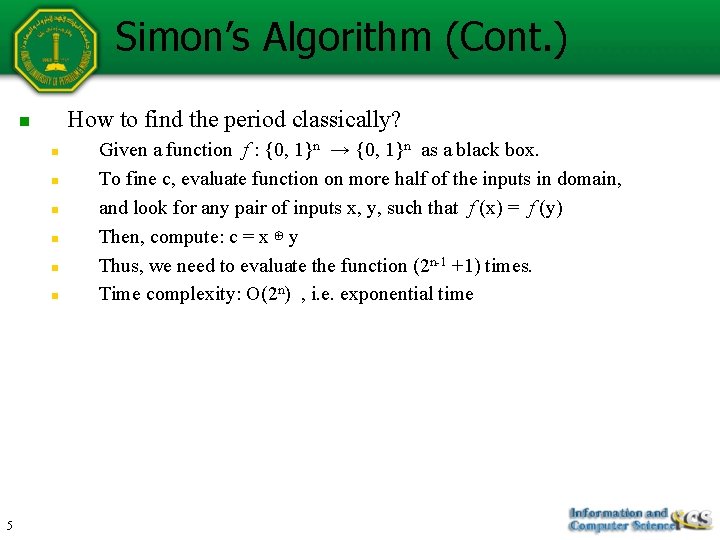
Simon’s Algorithm (Cont. ) How to find the period classically? n n n n 5 Given a function f : {0, 1}n → {0, 1}n as a black box. To fine c, evaluate function on more half of the inputs in domain, and look for any pair of inputs x, y, such that f (x) = f (y) Then, compute: c = x ⊕ y Thus, we need to evaluate the function (2 n-1 +1) times. Time complexity: O(2 n) , i. e. exponential time
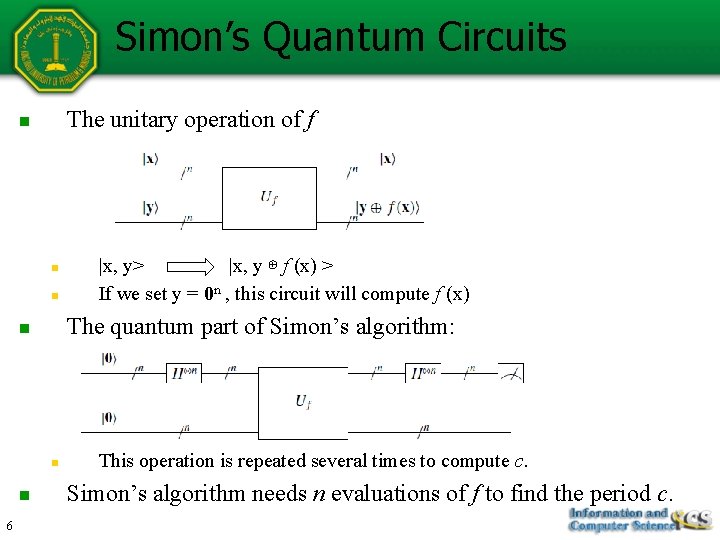
Simon’s Quantum Circuits The unitary operation of f n n n The quantum part of Simon’s algorithm: n n n 6 |x, y> |x, y ⊕ f (x) > If we set y = 0 n , this circuit will compute f (x) This operation is repeated several times to compute c. Simon’s algorithm needs n evaluations of f to find the period c.
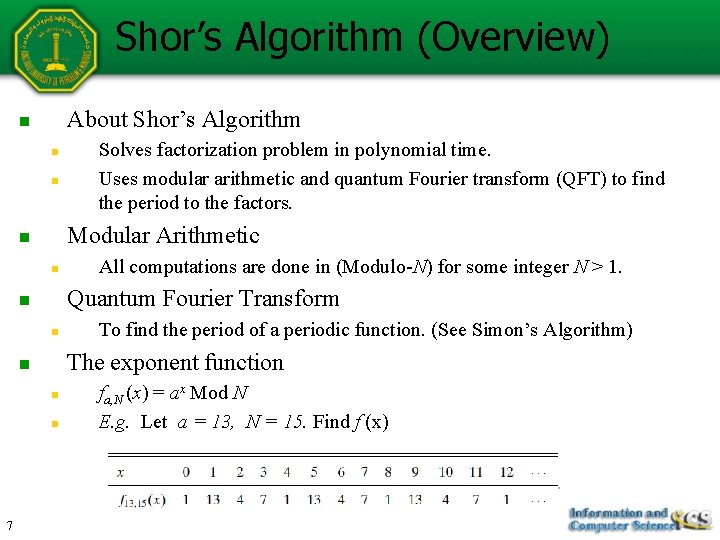
Shor’s Algorithm (Overview) About Shor’s Algorithm n n n Modular Arithmetic n n All computations are done in (Modulo-N) for some integer N > 1. Quantum Fourier Transform n n To find the period of a periodic function. (See Simon’s Algorithm) The exponent function n 7 Solves factorization problem in polynomial time. Uses modular arithmetic and quantum Fourier transform (QFT) to find the period to the factors. fa, N (x) = ax Mod N E. g. Let a = 13, N = 15. Find f (x)
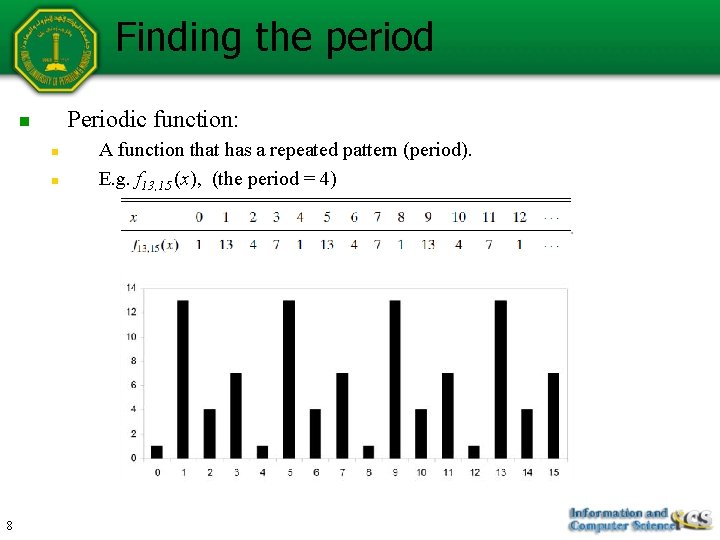
Finding the period Periodic function: n n n 8 A function that has a repeated pattern (period). E. g. f 13, 15 (x), (the period = 4)
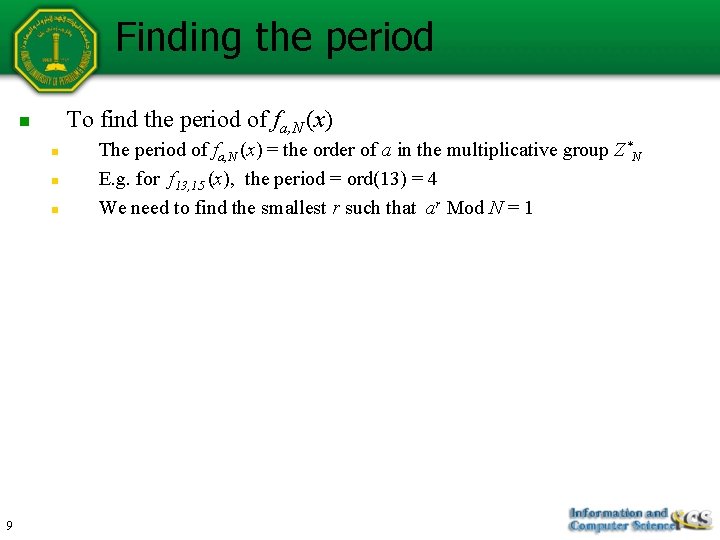
Finding the period To find the period of fa, N (x) n n 9 The period of fa, N (x) = the order of a in the multiplicative group Z*N E. g. for f 13, 15 (x), the period = ord(13) = 4 We need to find the smallest r such that ar Mod N = 1
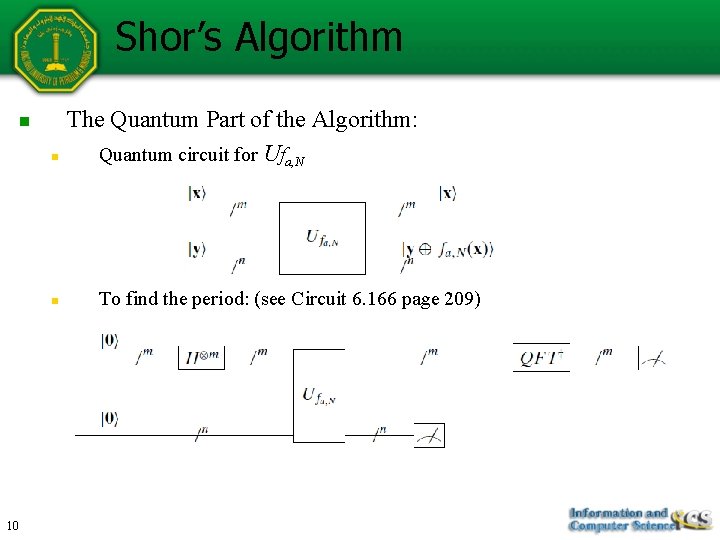
Shor’s Algorithm n n n 10 The Quantum Part of the Algorithm: Quantum circuit for Ufa, N To find the period: (see Circuit 6. 166 page 209)
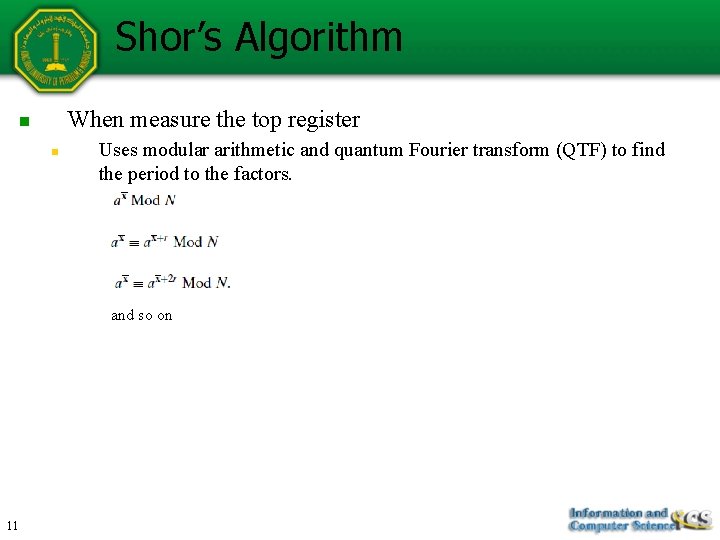
Shor’s Algorithm When measure the top register n n Uses modular arithmetic and quantum Fourier transform (QTF) to find the period to the factors. and so on 11
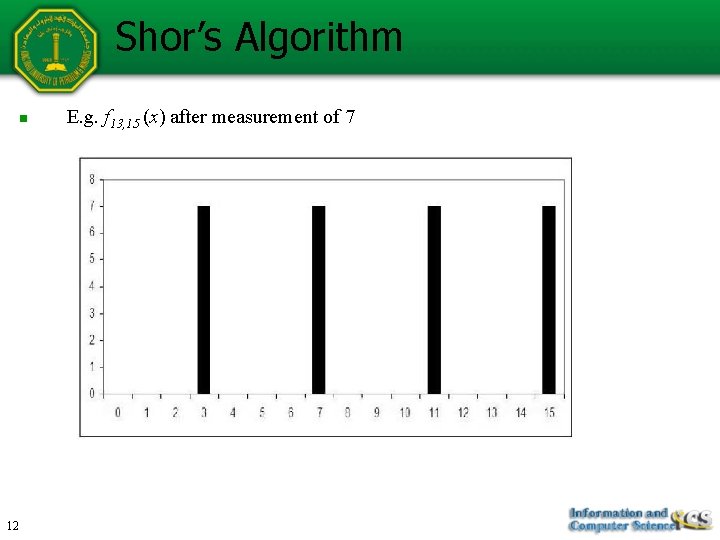
Shor’s Algorithm n 12 E. g. f 13, 15 (x) after measurement of 7
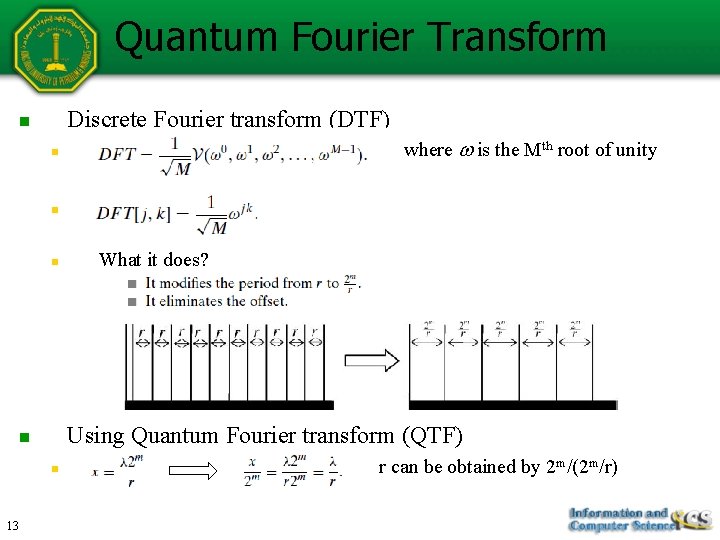
Quantum Fourier Transform Discrete Fourier transform (DTF) n n _ n What it does? Using Quantum Fourier transform (QTF) n n 13 where is the Mth root of unity r can be obtained by 2 m/(2 m/r)
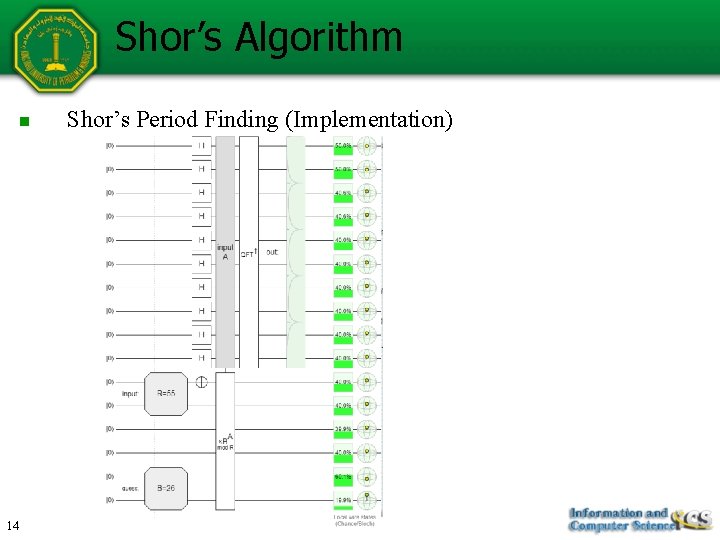
Shor’s Algorithm n 14 Shor’s Period Finding (Implementation)
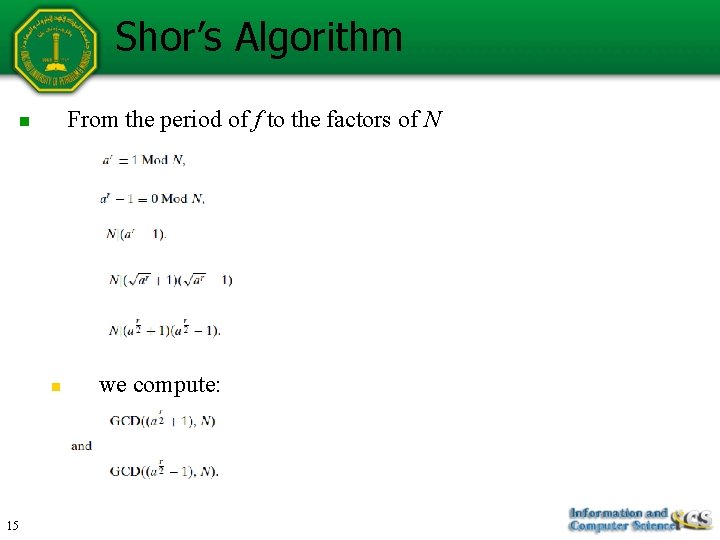
Shor’s Algorithm From the period of f to the factors of N n n 15 we compute:
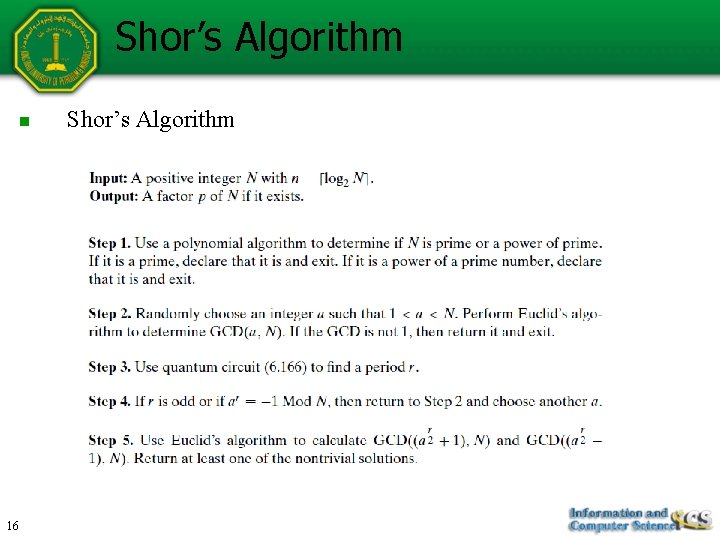
Shor’s Algorithm n 16 Shor’s Algorithm
Demo: n n Examples: n n n 17 See Shor’s algorithm demo on Quirk (Period finding) See Examples 6. 5. 6, 6. 5. 8, 6. 5. 10, in the textbook. See also Examples (6. 5. 7, 6. 5. 9, 6. 5. 11, 6. 5. 12)* for more details.