KINETICS OF THE SELFREACTION OF NEOPENTYL RADICALS Ksenia
- Slides: 1
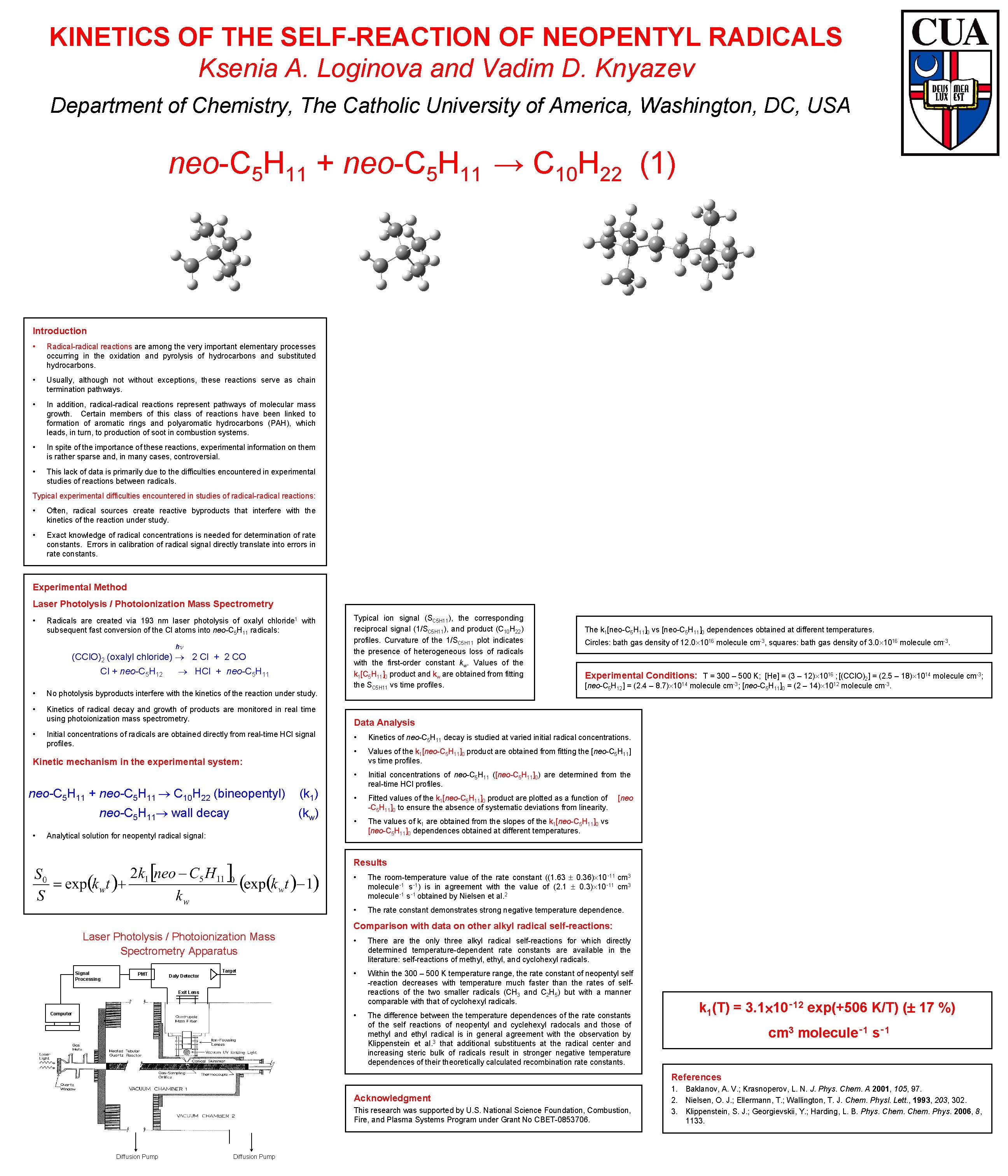
KINETICS OF THE SELF-REACTION OF NEOPENTYL RADICALS Ksenia A. Loginova and Vadim D. Knyazev Department of Chemistry, The Catholic University of America, Washington, DC, USA neo-C 5 H 11 + neo-C 5 H 11 → C 10 H 22 (1) Introduction • Radical-radical reactions are among the very important elementary processes occurring in the oxidation and pyrolysis of hydrocarbons and substituted hydrocarbons. • Usually, although not without exceptions, these reactions serve as chain termination pathways. • In addition, radical-radical reactions represent pathways of molecular mass growth. Certain members of this class of reactions have been linked to formation of aromatic rings and polyaromatic hydrocarbons (PAH), which leads, in turn, to production of soot in combustion systems. • In spite of the importance of these reactions, experimental information on them is rather sparse and, in many cases, controversial. • This lack of data is primarily due to the difficulties encountered in experimental studies of reactions between radicals. Typical experimental difficulties encountered in studies of radical-radical reactions: • Often, radical sources create reactive byproducts that interfere with the kinetics of the reaction under study. • Exact knowledge of radical concentrations is needed for determination of rate constants. Errors in calibration of radical signal directly translate into errors in rate constants. Experimental Method Laser Photolysis / Photoionization Mass Spectrometry • Radicals are created via 193 nm laser photolysis of oxalyl chloride 1 with subsequent fast conversion of the Cl atoms into neo-C 5 H 11 radicals: h (CCl. O)2 (oxalyl chloride) 2 Cl + 2 CO Cl + neo-C 5 H 12 HCl + neo-C 5 H 11 • No photolysis byproducts interfere with the kinetics of the reaction under study. • Kinetics of radical decay and growth of products are monitored in real time using photoionization mass spectrometry. • Initial concentrations of radicals are obtained directly from real-time HCl signal profiles. Typical ion signal (SC 5 H 11), the corresponding reciprocal signal (1/SC 5 H 11), and product (C 10 H 22) profiles. Curvature of the 1/SC 5 H 11 plot indicates the presence of heterogeneous loss of radicals with the first-order constant kw. Values of the k 1[C 5 H 11]0 product and kw are obtained from fitting the SC 5 H 11 vs time profiles. neo-C 5 H 11 wall decay • Circles: bath gas density of 12. 0 1016 molecule cm-3, squares: bath gas density of 3. 0 1016 molecule cm-3. Experimental Conditions: T = 300 – 500 K; [He] = (3 – 12) 1016 ; [(CCl. O)2] = (2. 5 – 18) 1014 molecule cm-3; [neo-C 5 H 12] = (2. 4 – 8. 7) 1014 molecule cm-3; [neo-C 5 H 11]0 = (2 – 14) 1012 molecule cm-3. Data Analysis • Kinetics of neo-C 5 H 11 decay is studied at varied initial radical concentrations. • Values of the k 1[neo-C 5 H 11]0 product are obtained from fitting the [neo-C 5 H 11] vs time profiles. • (k 1) Initial concentrations of neo-C 5 H 11 ([neo-C 5 H 11]0) are determined from the real-time HCl profiles. • (kw) Fitted values of the k 1[neo-C 5 H 11]0 product are plotted as a function of -C 5 H 11]0 to ensure the absence of systematic deviations from linearity. • The values of k 1 are obtained from the slopes of the k 1[neo-C 5 H 11]0 vs [neo-C 5 H 11]0 dependences obtained at different temperatures. Kinetic mechanism in the experimental system: neo-C 5 H 11 + neo-C 5 H 11 C 10 H 22 (bineopentyl) The k 1[neo-C 5 H 11]0 vs [neo-C 5 H 11]0 dependences obtained at different temperatures. Analytical solution for neopentyl radical signal: [neo Results Laser Photolysis / Photoionization Mass Spectrometry Apparatus Signal Processing PMT Target Daly Detector • The room-temperature value of the rate constant ((1. 63 0. 36) 10‑ 11 cm 3 molecule‑ 1 s‑ 1) is in agreement with the value of (2. 1 0. 3) 10‑ 11 cm 3 molecule‑ 1 s‑ 1 obtained by Nielsen et al. 2 • The rate constant demonstrates strong negative temperature dependence. Comparison with data on other alkyl radical self-reactions: • There are the only three alkyl radical self-reactions for which directly determined temperature-dependent rate constants are available in the literature: self-reactions of methyl, and cyclohexyl radicals. • Within the 300 – 500 K temperature range, the rate constant of neopentyl self -reaction decreases with temperature much faster than the rates of selfreactions of the two smaller radicals (CH 3 and C 2 H 5) but with a manner comparable with that of cyclohexyl radicals. Exit Lens • Computer The difference between the temperature dependences of the rate constants of the self reactions of neopentyl and cyclehexyl radocals and those of methyl and ethyl radical is in general agreement with the observation by Klippenstein et al. 3 that additional substituents at the radical center and increasing steric bulk of radicals result in stronger negative temperature dependences of their theoretically calculated recombination rate constants. k 1(T) = 3. 1 10‑ 12 exp(+506 K/T) ( 17 %) cm 3 molecule‑ 1 s‑ 1 References Acknowledgment This research was supported by U. S. National Science Foundation, Combustion, Fire, and Plasma Systems Program under Grant No CBET-0853706. Diffusion Pump 1. Baklanov, A. V. ; Krasnoperov, L. N. J. Phys. Chem. A 2001, 105, 97. 2. Nielsen, O. J. ; Ellermann, T. ; Wallington, T. J. Chem. Physl. Lett. , 1993, 203, 302. 3. Klippenstein, S. J. ; Georgievskii, Y. ; Harding, L. B. Phys. Chem. Phys. 2006, 8, 1133.