
KINETICS OF A PARTICLE FORCE ACCELERATION Mechanics for



- Slides: 35
KINETICS OF A PARTICLE: FORCE & ACCELERATION Mechanics for Engineers: Dynamics , 13 th SI Edition R. C. Hibbeler and Kai Beng Yap © Pearson Education South Asia Pte Ltd 2013. All rights reserved.
NEWTON’S LAWS OF MOTION, EQUATIONS OF MOTION, & EQUATIONS OF MOTION FOR A SYSTEM OF PARTICLES Mechanics for Engineers: Dynamics , 13 th SI Edition R. C. Hibbeler and Kai Beng Yap © Pearson Education South Asia Pte Ltd 2013. All rights reserved.
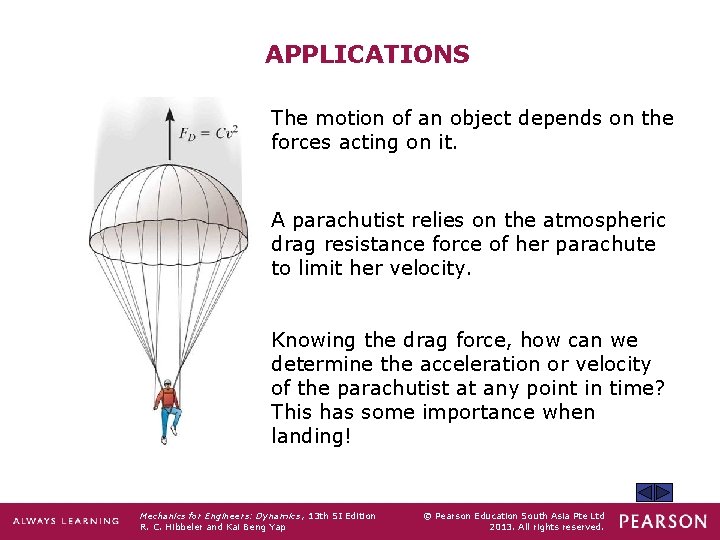
APPLICATIONS The motion of an object depends on the forces acting on it. A parachutist relies on the atmospheric drag resistance force of her parachute to limit her velocity. Knowing the drag force, how can we determine the acceleration or velocity of the parachutist at any point in time? This has some importance when landing! Mechanics for Engineers: Dynamics , 13 th SI Edition R. C. Hibbeler and Kai Beng Yap © Pearson Education South Asia Pte Ltd 2013. All rights reserved.
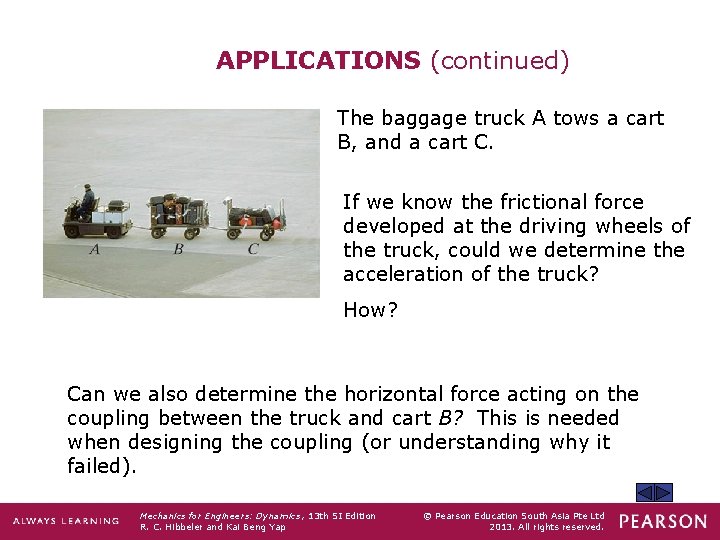
APPLICATIONS (continued) The baggage truck A tows a cart B, and a cart C. If we know the frictional force developed at the driving wheels of the truck, could we determine the acceleration of the truck? How? Can we also determine the horizontal force acting on the coupling between the truck and cart B? This is needed when designing the coupling (or understanding why it failed). Mechanics for Engineers: Dynamics , 13 th SI Edition R. C. Hibbeler and Kai Beng Yap © Pearson Education South Asia Pte Ltd 2013. All rights reserved.
APPLICATIONS (continued) A freight elevator is lifted using a motor attached to a cable and pulley system as shown. How can we determine the tension force in the cable required to lift the elevator and load at a given acceleration? This is needed to decide what size cable should be used. Is the tension force in the cable greater than the weight of the elevator and its load? Mechanics for Engineers: Dynamics , 13 th SI Edition R. C. Hibbeler and Kai Beng Yap © Pearson Education South Asia Pte Ltd 2013. All rights reserved.
NEWTON’S LAWS OF MOTION (Section 13. 1) The motion of a particle is governed by Newton’s three laws of motion. First Law: A particle originally at rest, or moving in a straight line at constant velocity, will remain in this state if the resultant force acting on the particle is zero. Second Law: If the resultant force on the particle is not zero, the particle experiences an acceleration in the same direction as the resultant force. This acceleration has a magnitude proportional to the resultant force. Third Law: Mutual forces of action and reaction between two particles are equal, opposite, and collinear. Mechanics for Engineers: Dynamics , 13 th SI Edition R. C. Hibbeler and Kai Beng Yap © Pearson Education South Asia Pte Ltd 2013. All rights reserved.
NEWTON’S LAWS OF MOTION (continued) The first and third laws were used in developing the concepts of statics. Newton’s second law forms the basis of the study of dynamics. Mathematically, Newton’s second law of motion can be written F = ma where F is the resultant unbalanced force acting on the particle, and a is the acceleration of the particle. The positive scalar m is called the mass of the particle. Newton’s second law cannot be used when the particle’s speed approaches the speed of light, or if the size of the particle is extremely small (~ size of an atom). Mechanics for Engineers: Dynamics , 13 th SI Edition R. C. Hibbeler and Kai Beng Yap © Pearson Education South Asia Pte Ltd 2013. All rights reserved.
NEWTON’S LAW OF GRAVITATIONAL ATTRACTION Any two particles or bodies have a mutually attractive gravitational force acting between them. Newton postulated the law governing this gravitational force as F = G(m 1 m 2/r 2) where F = force of attraction between the two bodies, G = universal constant of gravitation , m 1, m 2 = mass of each body, and r = distance between centers of the two bodies. When near the surface of the earth, the only gravitational force having any sizable magnitude is that between the earth and the body. This force is called the weight of the body. Mechanics for Engineers: Dynamics , 13 th SI Edition R. C. Hibbeler and Kai Beng Yap © Pearson Education South Asia Pte Ltd 2013. All rights reserved.
MASS AND WEIGHT It is important to understand the difference between the mass and weight of a body! Mass is an absolute property of a body. It is independent of the gravitational field in which it is measured. The mass provides a measure of the resistance of a body to a change in velocity, as defined by Newton’s second law of motion (m = F/a). The weight of a body is not absolute, since it depends on the gravitational field in which it is measured. Weight is defined as W = mg where g is the acceleration due to gravity. Mechanics for Engineers: Dynamics , 13 th SI Edition R. C. Hibbeler and Kai Beng Yap © Pearson Education South Asia Pte Ltd 2013. All rights reserved.
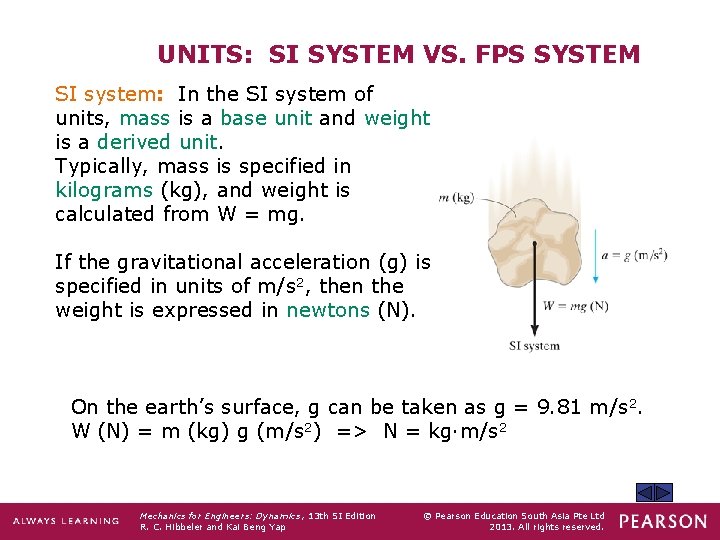
UNITS: SI SYSTEM VS. FPS SYSTEM SI system: In the SI system of units, mass is a base unit and weight is a derived unit. Typically, mass is specified in kilograms (kg), and weight is calculated from W = mg. If the gravitational acceleration (g) is specified in units of m/s 2, then the weight is expressed in newtons (N). On the earth’s surface, g can be taken as g = 9. 81 m/s 2. W (N) = m (kg) g (m/s 2) => N = kg·m/s 2 Mechanics for Engineers: Dynamics , 13 th SI Edition R. C. Hibbeler and Kai Beng Yap © Pearson Education South Asia Pte Ltd 2013. All rights reserved.
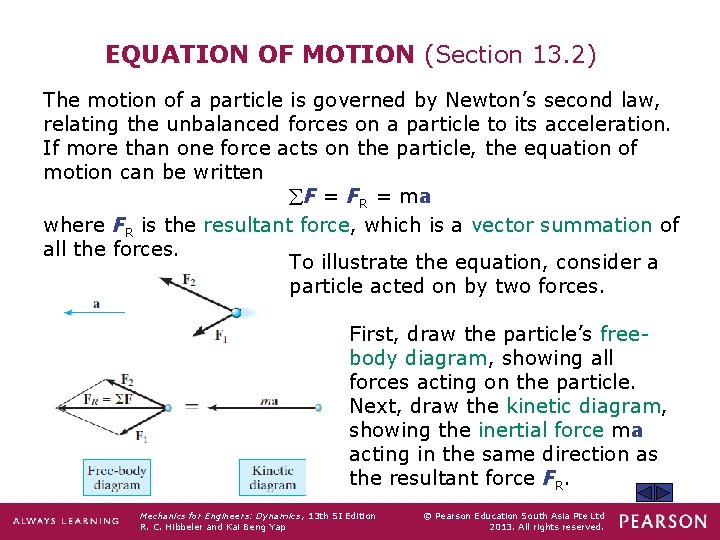
EQUATION OF MOTION (Section 13. 2) The motion of a particle is governed by Newton’s second law, relating the unbalanced forces on a particle to its acceleration. If more than one force acts on the particle, the equation of motion can be written F = FR = ma where FR is the resultant force, which is a vector summation of all the forces. To illustrate the equation, consider a particle acted on by two forces. First, draw the particle’s freebody diagram, showing all forces acting on the particle. Next, draw the kinetic diagram, showing the inertial force ma acting in the same direction as the resultant force FR. Mechanics for Engineers: Dynamics , 13 th SI Edition R. C. Hibbeler and Kai Beng Yap © Pearson Education South Asia Pte Ltd 2013. All rights reserved.
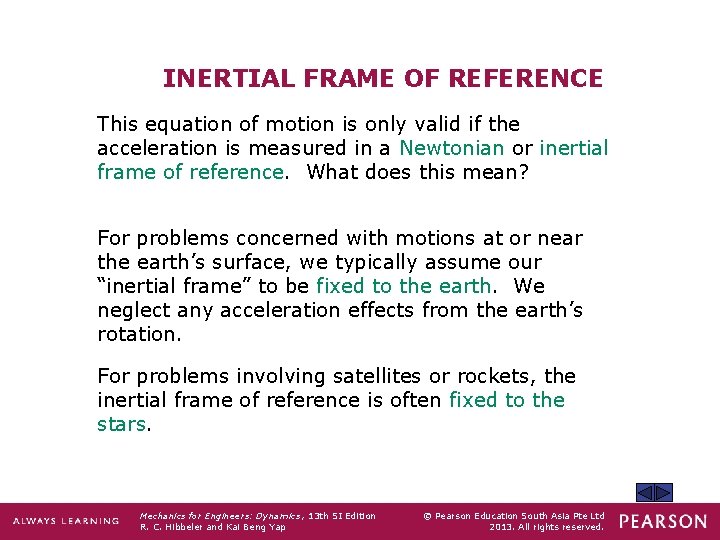
INERTIAL FRAME OF REFERENCE This equation of motion is only valid if the acceleration is measured in a Newtonian or inertial frame of reference. What does this mean? For problems concerned with motions at or near the earth’s surface, we typically assume our “inertial frame” to be fixed to the earth. We neglect any acceleration effects from the earth’s rotation. For problems involving satellites or rockets, the inertial frame of reference is often fixed to the stars. Mechanics for Engineers: Dynamics , 13 th SI Edition R. C. Hibbeler and Kai Beng Yap © Pearson Education South Asia Pte Ltd 2013. All rights reserved.
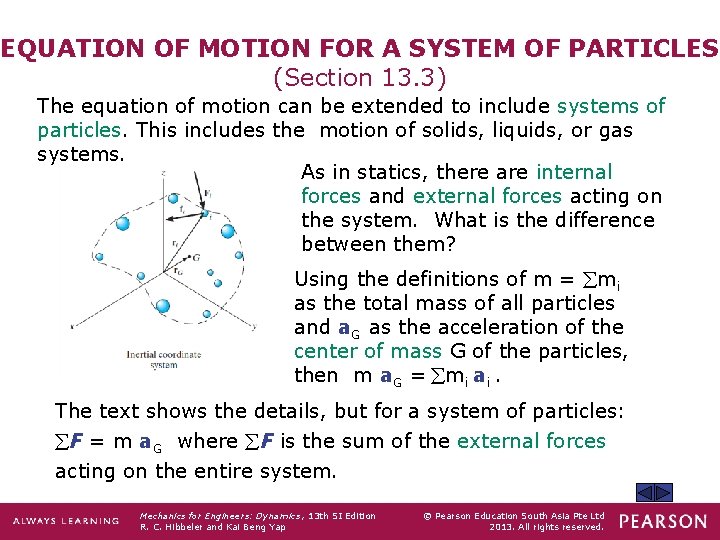
EQUATION OF MOTION FOR A SYSTEM OF PARTICLES (Section 13. 3) The equation of motion can be extended to include systems of particles. This includes the motion of solids, liquids, or gas systems. As in statics, there are internal forces and external forces acting on the system. What is the difference between them? Using the definitions of m = mi as the total mass of all particles and a. G as the acceleration of the center of mass G of the particles, then m a. G = mi ai. The text shows the details, but for a system of particles: F = m a. G where F is the sum of the external forces acting on the entire system. Mechanics for Engineers: Dynamics , 13 th SI Edition R. C. Hibbeler and Kai Beng Yap © Pearson Education South Asia Pte Ltd 2013. All rights reserved.
KEY POINTS 1) Newton’s second law is a “law of nature”-experimentally proven, not the result of an analytical proof. 2) Mass (property of an object) is a measure of the resistance to a change in velocity of the object. 3) Weight (a force) depends on the local gravitational field. Calculating the weight of an object is an application of F = m a, i. e. , W = m g. 4) Unbalanced forces cause the acceleration of objects. This condition is fundamental to all dynamics problems! Mechanics for Engineers: Dynamics , 13 th SI Edition R. C. Hibbeler and Kai Beng Yap © Pearson Education South Asia Pte Ltd 2013. All rights reserved.
PROCEDURE FOR THE APPLICATION OF THE EQUATION OF MOTION 1) Select a convenient inertial coordinate system. Rectangular, normal/tangential, or cylindrical coordinates may be used. 2) Draw a free-body diagram showing all external forces applied to the particle. Resolve forces into their appropriate components. 3) Draw the kinetic diagram, showing the particle’s inertial force, ma. Resolve this vector into its appropriate components. 4) Apply the equations of motion in their scalar component form and solve these equations for the unknowns. 5) It may be necessary to apply the proper kinematic relations to generate additional equations. Mechanics for Engineers: Dynamics , 13 th SI Edition R. C. Hibbeler and Kai Beng Yap © Pearson Education South Asia Pte Ltd 2013. All rights reserved.
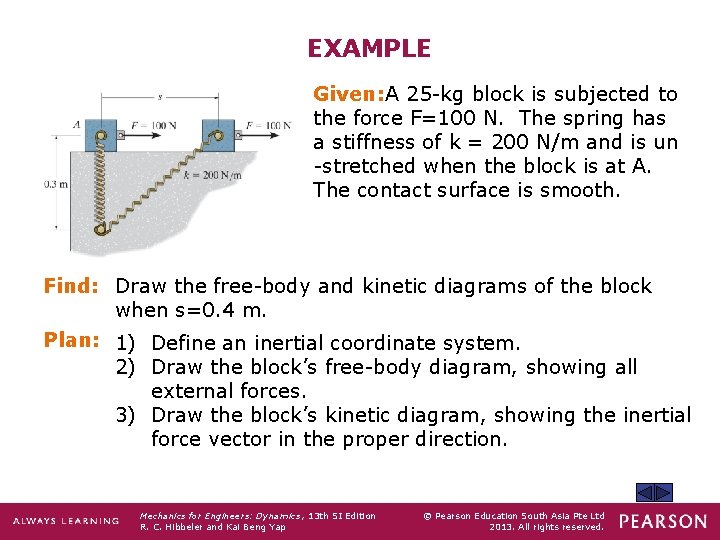
EXAMPLE Given: A 25 -kg block is subjected to the force F=100 N. The spring has a stiffness of k = 200 N/m and is un -stretched when the block is at A. The contact surface is smooth. Find: Draw the free-body and kinetic diagrams of the block when s=0. 4 m. Plan: 1) Define an inertial coordinate system. 2) Draw the block’s free-body diagram, showing all external forces. 3) Draw the block’s kinetic diagram, showing the inertial force vector in the proper direction. Mechanics for Engineers: Dynamics , 13 th SI Edition R. C. Hibbeler and Kai Beng Yap © Pearson Education South Asia Pte Ltd 2013. All rights reserved.
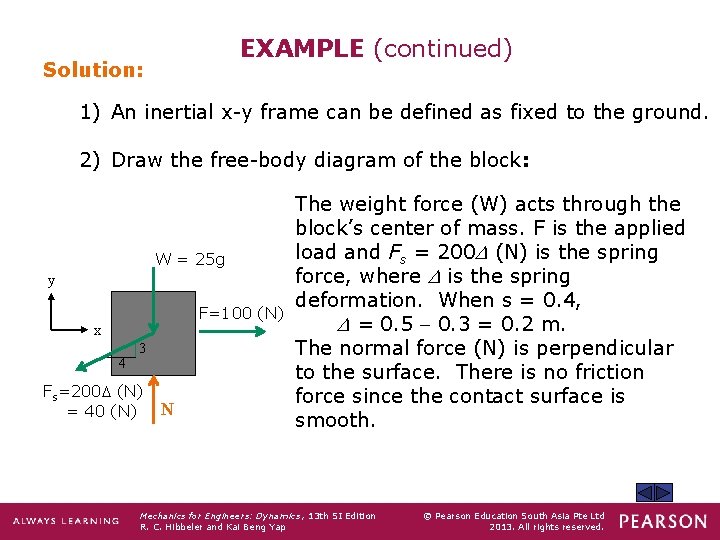
EXAMPLE (continued) Solution: 1) An inertial x-y frame can be defined as fixed to the ground. 2) Draw the free-body diagram of the block: W = 25 g y F=100 (N) x 4 3 Fs=200 (N) = 40 (N) N The weight force (W) acts through the block’s center of mass. F is the applied load and Fs = 200 (N) is the spring force, where is the spring deformation. When s = 0. 4, = 0. 5 0. 3 = 0. 2 m. The normal force (N) is perpendicular to the surface. There is no friction force since the contact surface is smooth. Mechanics for Engineers: Dynamics , 13 th SI Edition R. C. Hibbeler and Kai Beng Yap © Pearson Education South Asia Pte Ltd 2013. All rights reserved.
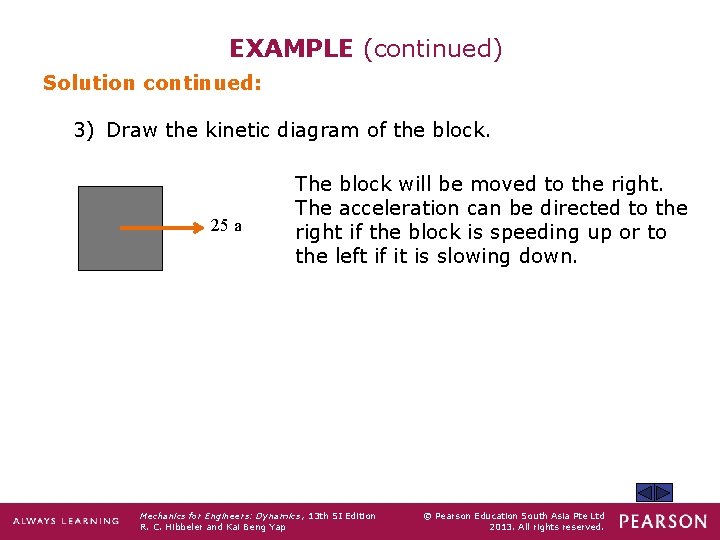
EXAMPLE (continued) Solution continued: 3) Draw the kinetic diagram of the block. 25 a The block will be moved to the right. The acceleration can be directed to the right if the block is speeding up or to the left if it is slowing down. Mechanics for Engineers: Dynamics , 13 th SI Edition R. C. Hibbeler and Kai Beng Yap © Pearson Education South Asia Pte Ltd 2013. All rights reserved.
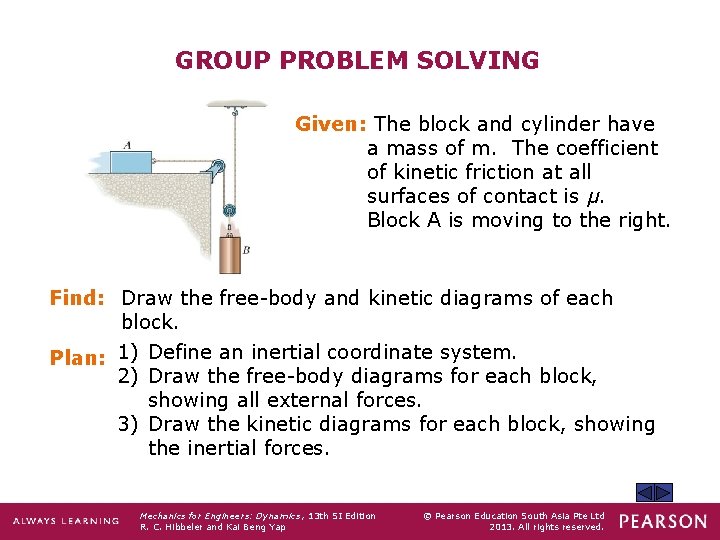
GROUP PROBLEM SOLVING Given: The block and cylinder have a mass of m. The coefficient of kinetic friction at all surfaces of contact is μ. Block A is moving to the right. Find: Draw the free-body and kinetic diagrams of each block. Plan: 1) Define an inertial coordinate system. 2) Draw the free-body diagrams for each block, showing all external forces. 3) Draw the kinetic diagrams for each block, showing the inertial forces. Mechanics for Engineers: Dynamics , 13 th SI Edition R. C. Hibbeler and Kai Beng Yap © Pearson Education South Asia Pte Ltd 2013. All rights reserved.
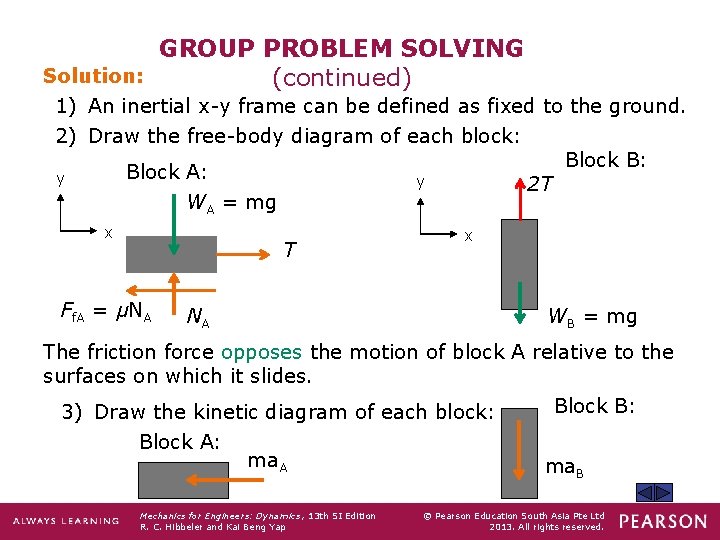
GROUP PROBLEM SOLVING Solution: (continued) 1) An inertial x-y frame can be defined as fixed to the ground. 2) Draw the free-body diagram of each block: Block B: Block A: y y 2 T WA = mg x T Ff. A = μNA NA x WB = mg The friction force opposes the motion of block A relative to the surfaces on which it slides. Block B: 3) Draw the kinetic diagram of each block: Block A: ma. A Mechanics for Engineers: Dynamics , 13 th SI Edition R. C. Hibbeler and Kai Beng Yap ma. B © Pearson Education South Asia Pte Ltd 2013. All rights reserved.
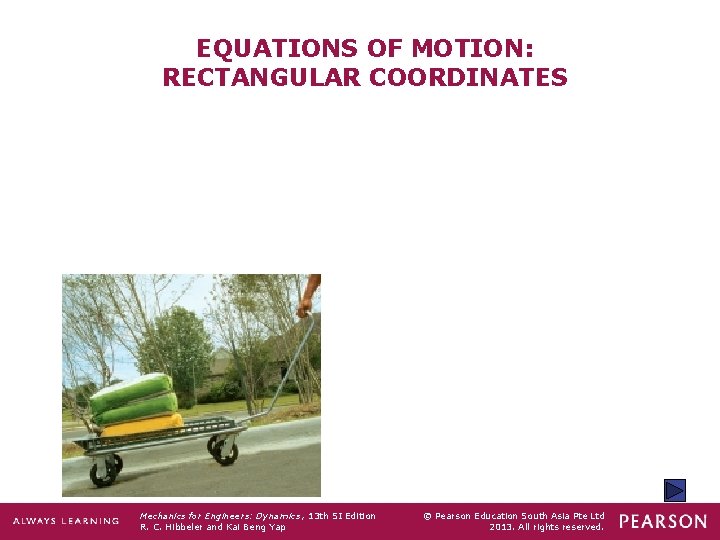
EQUATIONS OF MOTION: RECTANGULAR COORDINATES Mechanics for Engineers: Dynamics , 13 th SI Edition R. C. Hibbeler and Kai Beng Yap © Pearson Education South Asia Pte Ltd 2013. All rights reserved.
APPLICATIONS If a man is trying to move a 50 -kg crate, how large a force F must he exert to start moving the crate? What factors influence how large this force must be to start moving the crate? If the crate starts moving, is there acceleration present? What would you have to know before you could find these answers? Mechanics for Engineers: Dynamics , 13 th SI Edition R. C. Hibbeler and Kai Beng Yap © Pearson Education South Asia Pte Ltd 2013. All rights reserved.
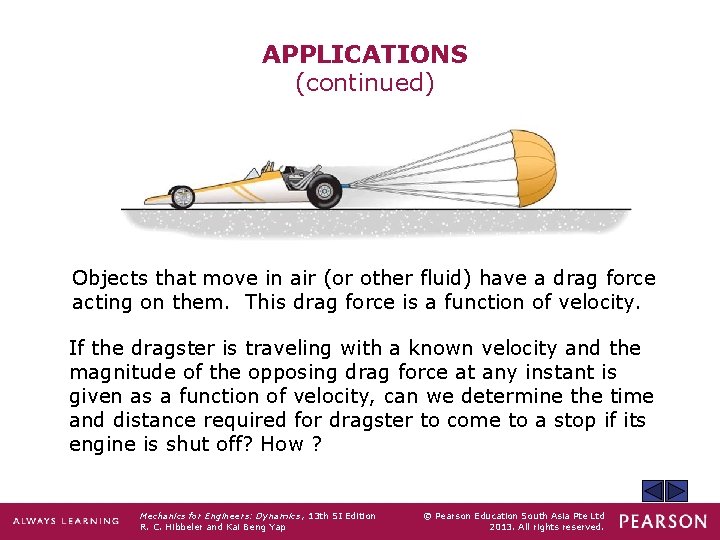
APPLICATIONS (continued) Objects that move in air (or other fluid) have a drag force acting on them. This drag force is a function of velocity. If the dragster is traveling with a known velocity and the magnitude of the opposing drag force at any instant is given as a function of velocity, can we determine the time and distance required for dragster to come to a stop if its engine is shut off? How ? Mechanics for Engineers: Dynamics , 13 th SI Edition R. C. Hibbeler and Kai Beng Yap © Pearson Education South Asia Pte Ltd 2013. All rights reserved.
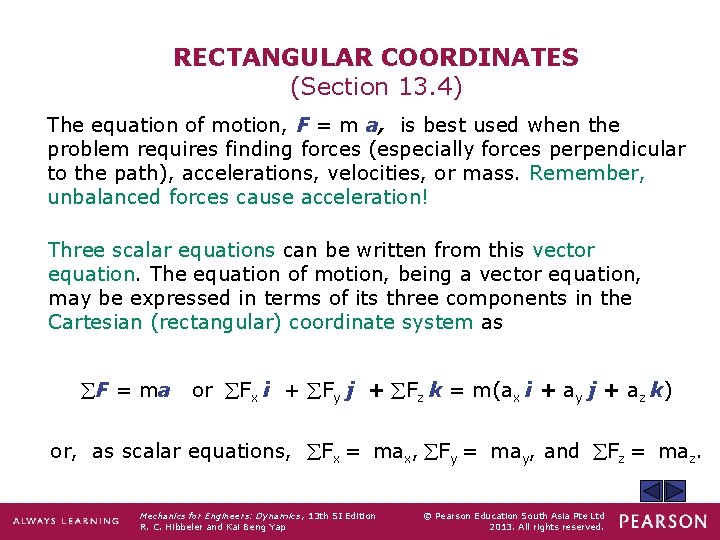
RECTANGULAR COORDINATES (Section 13. 4) The equation of motion, F = m a, is best used when the problem requires finding forces (especially forces perpendicular to the path), accelerations, velocities, or mass. Remember, unbalanced forces cause acceleration! Three scalar equations can be written from this vector equation. The equation of motion, being a vector equation, may be expressed in terms of its three components in the Cartesian (rectangular) coordinate system as F = ma or Fx i + Fy j + Fz k = m(ax i + ay j + az k) or, as scalar equations, Fx = max, Fy = may, and Fz = maz. Mechanics for Engineers: Dynamics , 13 th SI Edition R. C. Hibbeler and Kai Beng Yap © Pearson Education South Asia Pte Ltd 2013. All rights reserved.
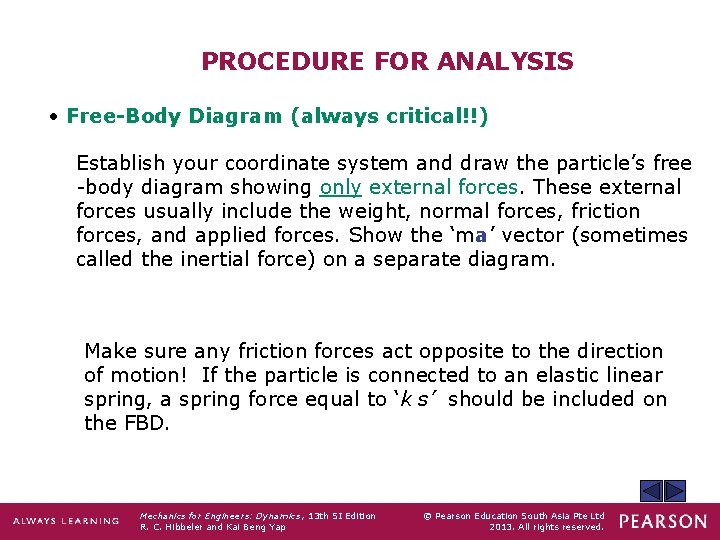
PROCEDURE FOR ANALYSIS • Free-Body Diagram (always critical!!) Establish your coordinate system and draw the particle’s free -body diagram showing only external forces. These external forces usually include the weight, normal forces, friction forces, and applied forces. Show the ‘ma’ vector (sometimes called the inertial force) on a separate diagram. Make sure any friction forces act opposite to the direction of motion! If the particle is connected to an elastic linear spring, a spring force equal to ‘k s’ should be included on the FBD. Mechanics for Engineers: Dynamics , 13 th SI Edition R. C. Hibbeler and Kai Beng Yap © Pearson Education South Asia Pte Ltd 2013. All rights reserved.
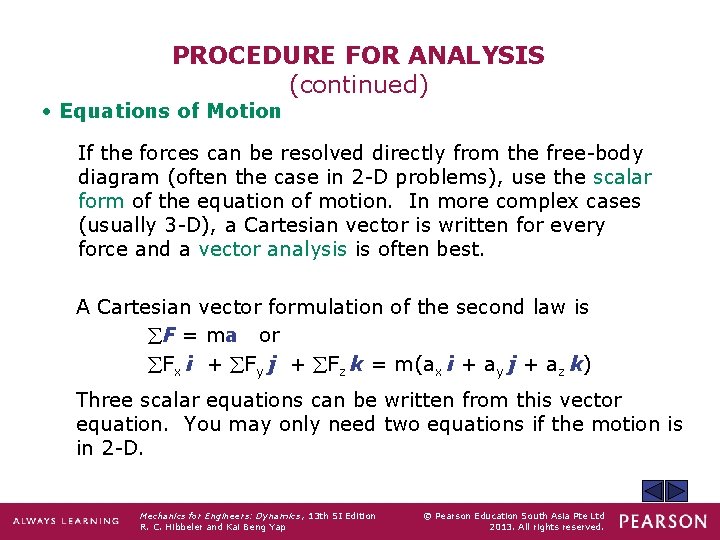
PROCEDURE FOR ANALYSIS (continued) • Equations of Motion If the forces can be resolved directly from the free-body diagram (often the case in 2 -D problems), use the scalar form of the equation of motion. In more complex cases (usually 3 -D), a Cartesian vector is written for every force and a vector analysis is often best. A Cartesian vector formulation of the second law is F = ma or Fx i + Fy j + Fz k = m(ax i + ay j + az k) Three scalar equations can be written from this vector equation. You may only need two equations if the motion is in 2 -D. Mechanics for Engineers: Dynamics , 13 th SI Edition R. C. Hibbeler and Kai Beng Yap © Pearson Education South Asia Pte Ltd 2013. All rights reserved.
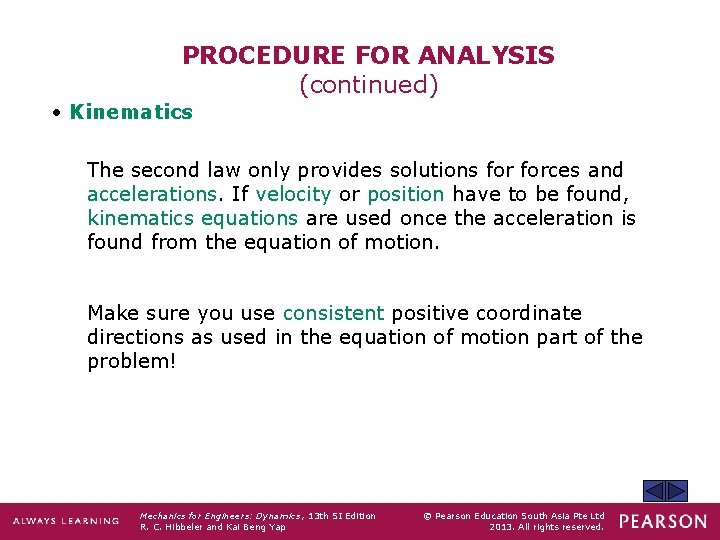
PROCEDURE FOR ANALYSIS (continued) • Kinematics The second law only provides solutions forces and accelerations. If velocity or position have to be found, kinematics equations are used once the acceleration is found from the equation of motion. Make sure you use consistent positive coordinate directions as used in the equation of motion part of the problem! Mechanics for Engineers: Dynamics , 13 th SI Edition R. C. Hibbeler and Kai Beng Yap © Pearson Education South Asia Pte Ltd 2013. All rights reserved.
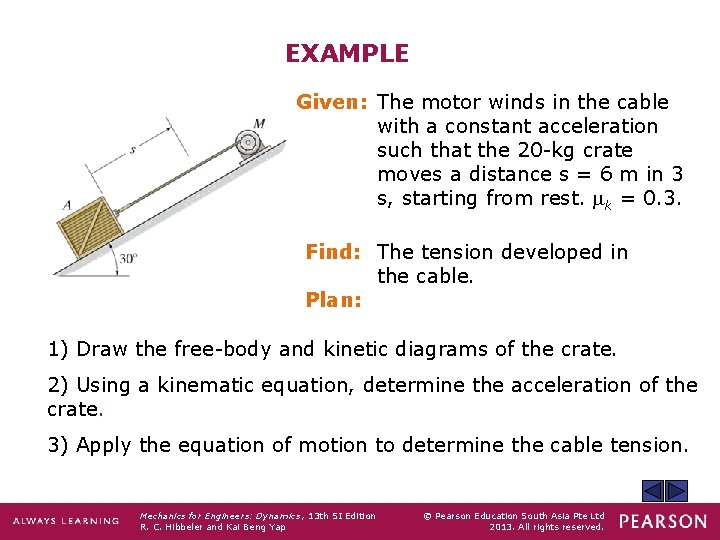
EXAMPLE Given: The motor winds in the cable with a constant acceleration such that the 20 -kg crate moves a distance s = 6 m in 3 s, starting from rest. k = 0. 3. Find: The tension developed in the cable. Plan: 1) Draw the free-body and kinetic diagrams of the crate. 2) Using a kinematic equation, determine the acceleration of the crate. 3) Apply the equation of motion to determine the cable tension. Mechanics for Engineers: Dynamics , 13 th SI Edition R. C. Hibbeler and Kai Beng Yap © Pearson Education South Asia Pte Ltd 2013. All rights reserved.
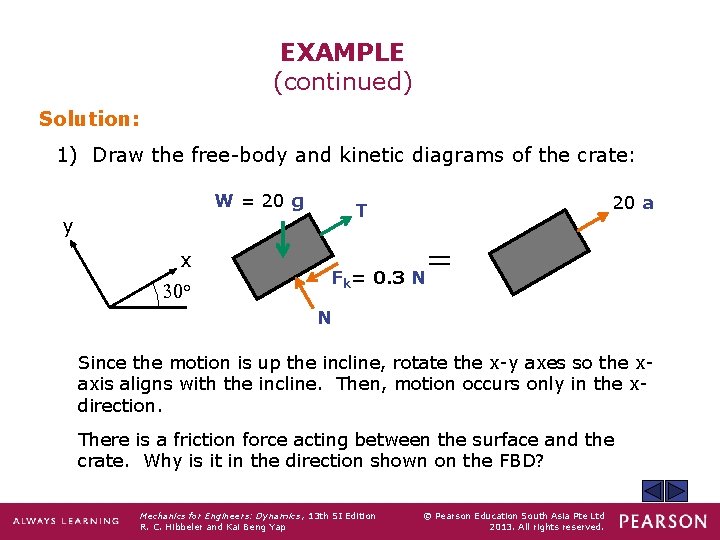
EXAMPLE (continued) Solution: 1) Draw the free-body and kinetic diagrams of the crate: W = 20 g y x 30° 20 a T Fk= 0. 3 N = N Since the motion is up the incline, rotate the x-y axes so the xaxis aligns with the incline. Then, motion occurs only in the xdirection. There is a friction force acting between the surface and the crate. Why is it in the direction shown on the FBD? Mechanics for Engineers: Dynamics , 13 th SI Edition R. C. Hibbeler and Kai Beng Yap © Pearson Education South Asia Pte Ltd 2013. All rights reserved.
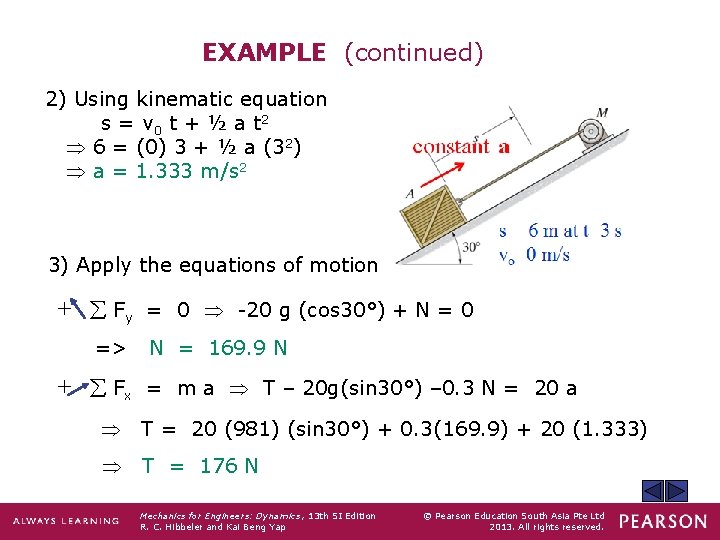
EXAMPLE (continued) 2) Using kinematic equation s = v 0 t + ½ a t 2 6 = (0) 3 + ½ a (32) a = 1. 333 m/s 2 3) Apply the equations of motion + Fy = 0 -20 g (cos 30°) + N = 0 => N = 169. 9 N + Fx = m a T – 20 g(sin 30°) – 0. 3 N = 20 a T = 20 (981) (sin 30°) + 0. 3(169. 9) + 20 (1. 333) T = 176 N Mechanics for Engineers: Dynamics , 13 th SI Edition R. C. Hibbeler and Kai Beng Yap © Pearson Education South Asia Pte Ltd 2013. All rights reserved.
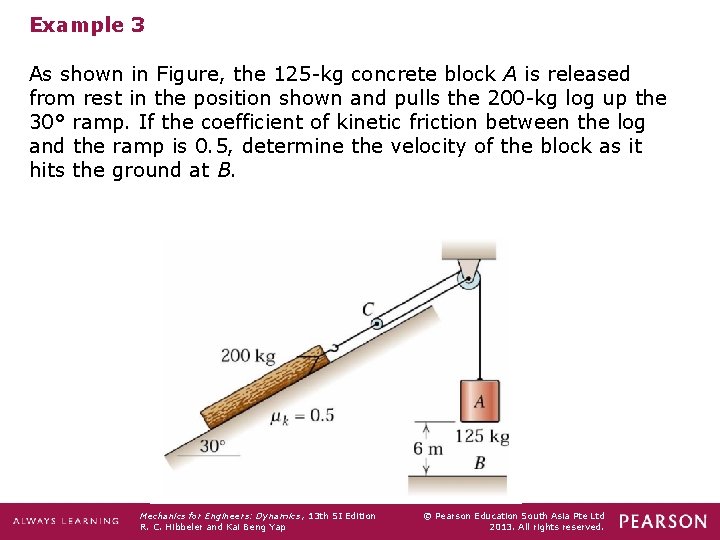
Example 3 As shown in Figure, the 125 -kg concrete block A is released from rest in the position shown and pulls the 200 -kg log up the 30° ramp. If the coefficient of kinetic friction between the log and the ramp is 0. 5, determine the velocity of the block as it hits the ground at B. Mechanics for Engineers: Dynamics , 13 th SI Edition R. C. Hibbeler and Kai Beng Yap © Pearson Education South Asia Pte Ltd 2013. All rights reserved.
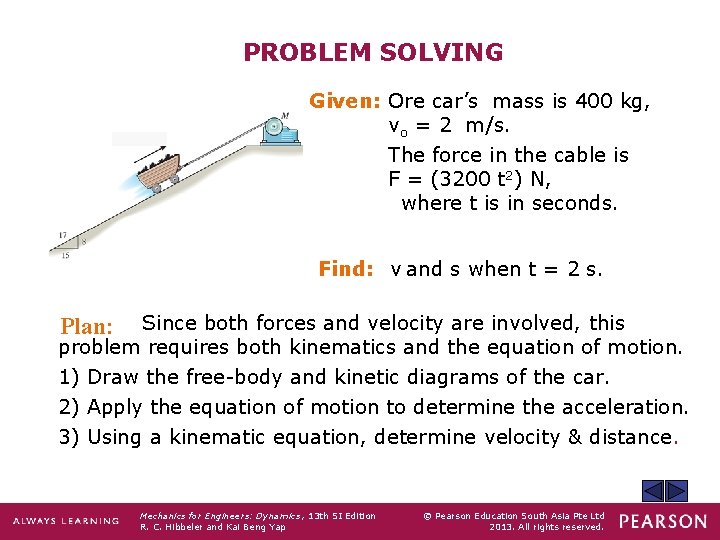
PROBLEM SOLVING Given: Ore car’s mass is 400 kg, vo = 2 m/s. The force in the cable is F = (3200 t 2) N, where t is in seconds. Find: v and s when t = 2 s. Since both forces and velocity are involved, this problem requires both kinematics and the equation of motion. Plan: 1) Draw the free-body and kinetic diagrams of the car. 2) Apply the equation of motion to determine the acceleration. 3) Using a kinematic equation, determine velocity & distance. Mechanics for Engineers: Dynamics , 13 th SI Edition R. C. Hibbeler and Kai Beng Yap © Pearson Education South Asia Pte Ltd 2013. All rights reserved.
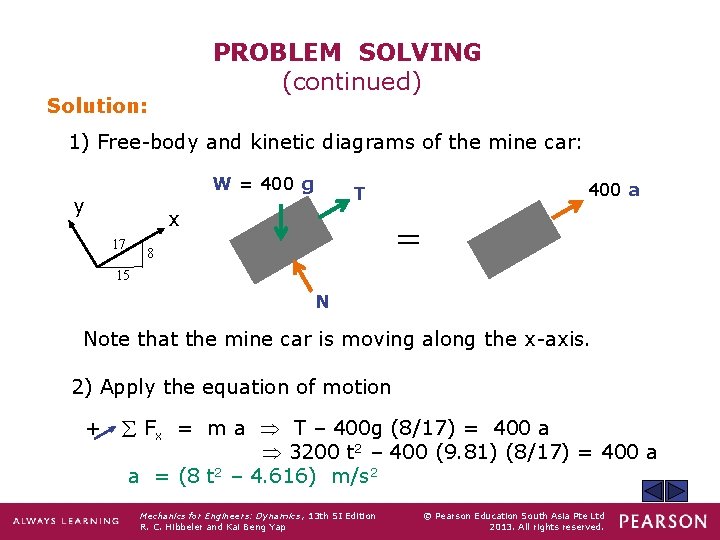
PROBLEM SOLVING (continued) Solution: 1) Free-body and kinetic diagrams of the mine car: W = 400 g y x 17 400 a T = 8 15 N Note that the mine car is moving along the x-axis. 2) Apply the equation of motion + Fx = m a T – 400 g (8/17) = 400 a 3200 t 2 – 400 (9. 81) (8/17) = 400 a a = (8 t 2 – 4. 616) m/s 2 Mechanics for Engineers: Dynamics , 13 th SI Edition R. C. Hibbeler and Kai Beng Yap © Pearson Education South Asia Pte Ltd 2013. All rights reserved.
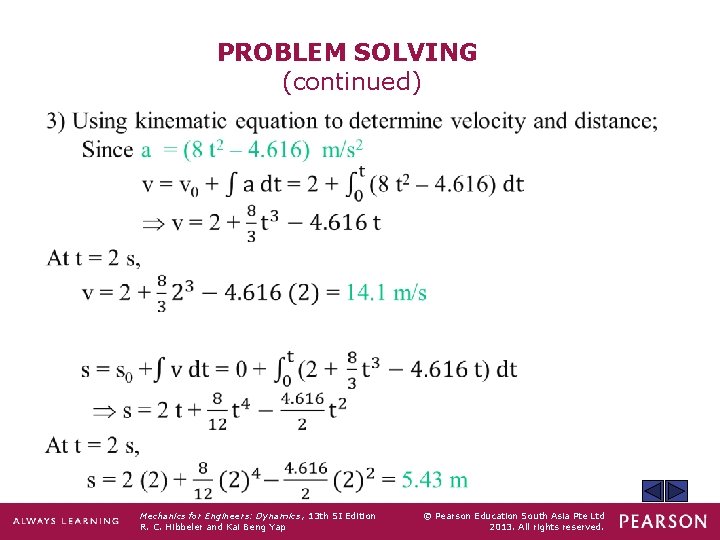
PROBLEM SOLVING (continued) Mechanics for Engineers: Dynamics , 13 th SI Edition R. C. Hibbeler and Kai Beng Yap © Pearson Education South Asia Pte Ltd 2013. All rights reserved.
Mechanics for Engineers: Dynamics , 13 th SI Edition R. C. Hibbeler and Kai Beng Yap © Pearson Education South Asia Pte Ltd 2013. All rights reserved.