
Kinetics Collision Theory and Rates of Reactions By
Kinetics Collision Theory and Rates of Reactions By Adriana Hartmann
What do we mean by kinetics? Kinetics refers to � the rate at which chemical reactions occur. �The reaction mechanism or pathway through which a reaction proceeds. �One example of Kinetics is the reaction that occurs in airbags. 2.
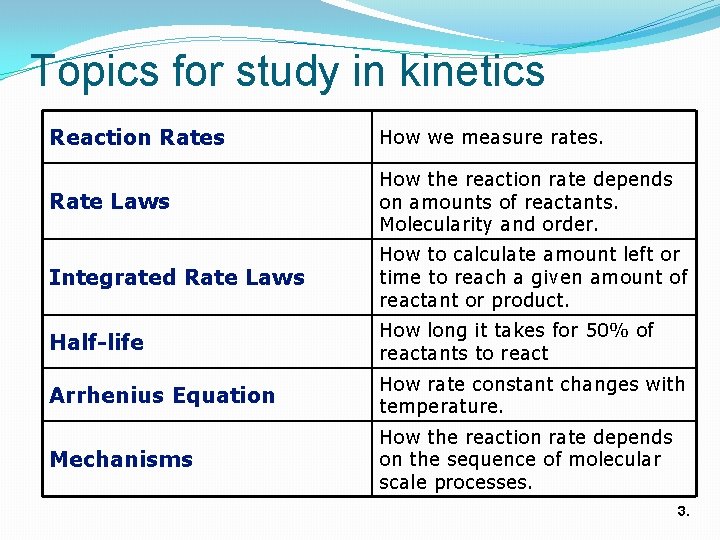
Topics for study in kinetics Reaction Rates How we measure rates. Rate Laws How the reaction rate depends on amounts of reactants. Molecularity and order. Integrated Rate Laws How to calculate amount left or time to reach a given amount of reactant or product. Half-life How long it takes for 50% of reactants to react Arrhenius Equation How rate constant changes with temperature. Mechanisms How the reaction rate depends on the sequence of molecular scale processes. 3.
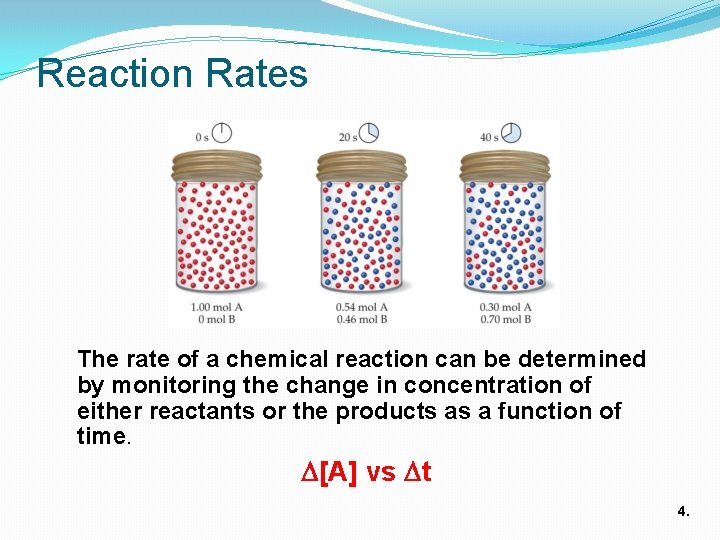
Reaction Rates The rate of a chemical reaction can be determined by monitoring the change in concentration of either reactants or the products as a function of time. [A] vs t 4.
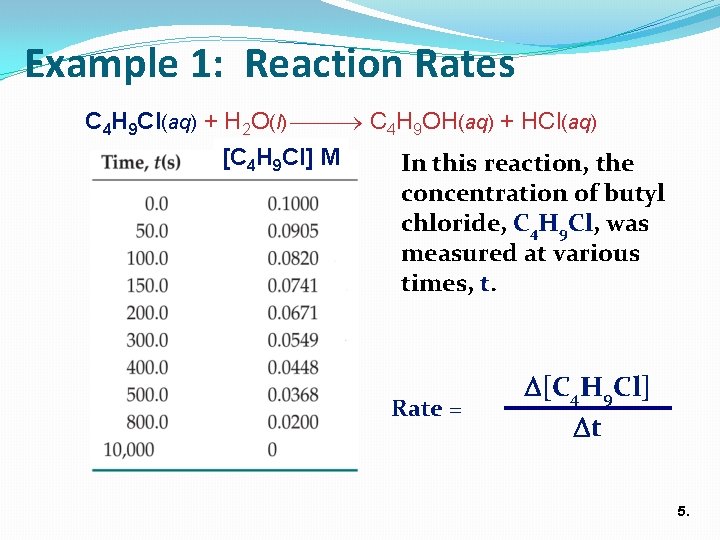
Example 1: Reaction Rates C 4 H 9 Cl(aq) + H 2 O(l) C 4 H 9 OH(aq) + HCl(aq) [C 4 H 9 Cl] M In this reaction, the concentration of butyl chloride, C 4 H 9 Cl, was measured at various times, t. Rate = [C 4 H 9 Cl] t 5.
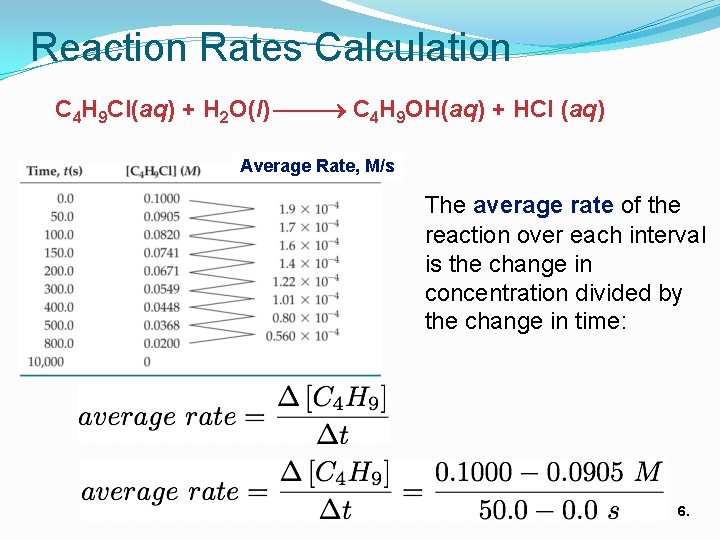
Reaction Rates Calculation C 4 H 9 Cl(aq) + H 2 O(l) C 4 H 9 OH(aq) + HCl (aq) Average Rate, M/s The average rate of the reaction over each interval is the change in concentration divided by the change in time: 6.
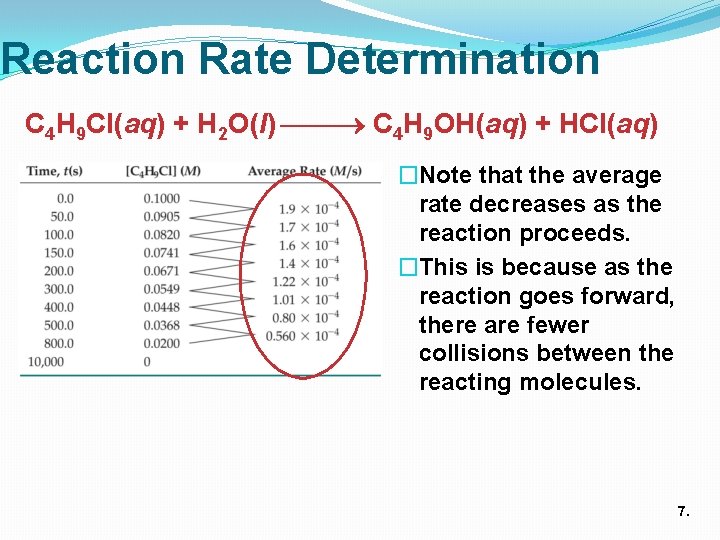
Reaction Rate Determination C 4 H 9 Cl(aq) + H 2 O(l) C 4 H 9 OH(aq) + HCl(aq) �Note that the average rate decreases as the reaction proceeds. �This is because as the reaction goes forward, there are fewer collisions between the reacting molecules. 7.
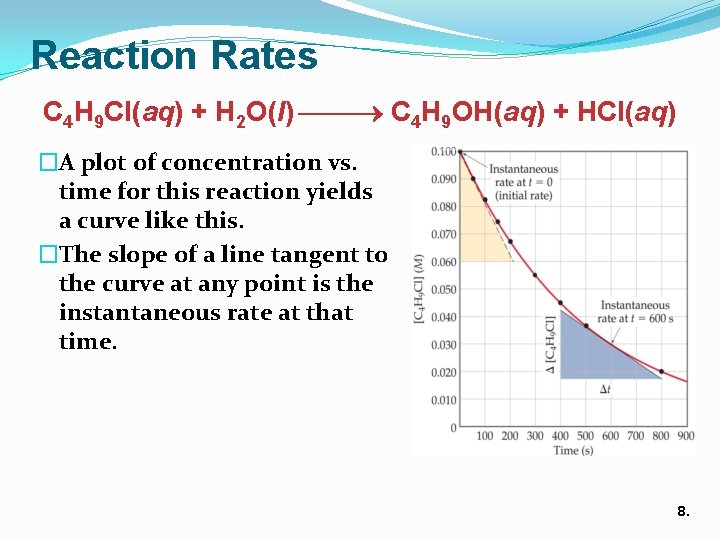
Reaction Rates C 4 H 9 Cl(aq) + H 2 O(l) C 4 H 9 OH(aq) + HCl(aq) �A plot of concentration vs. time for this reaction yields a curve like this. �The slope of a line tangent to the curve at any point is the instantaneous rate at that time. 8.
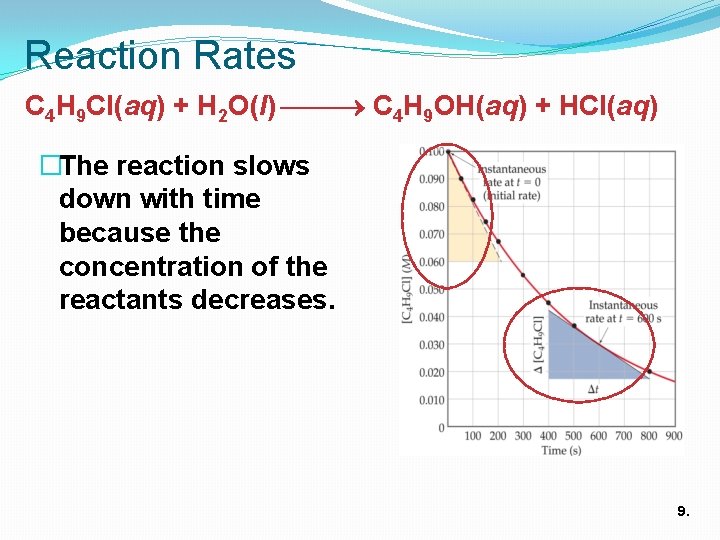
Reaction Rates C 4 H 9 Cl(aq) + H 2 O(l) C 4 H 9 OH(aq) + HCl(aq) �The reaction slows down with time because the concentration of the reactants decreases. 9.
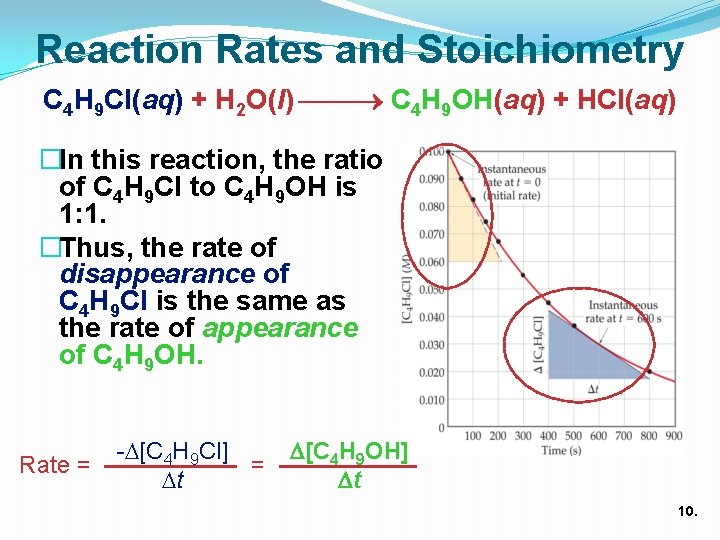
Reaction Rates and Stoichiometry C 4 H 9 Cl(aq) + H 2 O(l) C 4 H 9 OH(aq) + HCl(aq) �In this reaction, the ratio of C 4 H 9 Cl to C 4 H 9 OH is 1: 1. �Thus, the rate of disappearance of C 4 H 9 Cl is the same as the rate of appearance of C 4 H 9 OH. Rate = - [C 4 H 9 Cl] = t [C 4 H 9 OH] t 10.
The Collision Model �In a chemical reaction, bonds are broken and new bonds are formed. �Molecules can only react if they collide with each other. 11
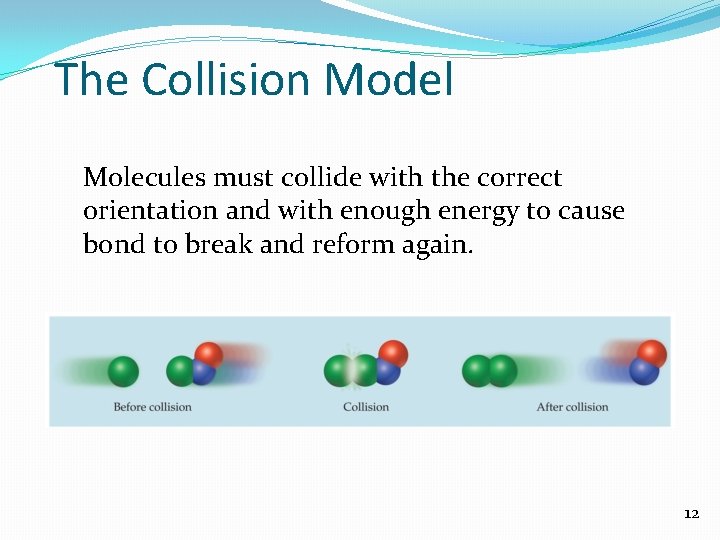
The Collision Model Molecules must collide with the correct orientation and with enough energy to cause bond to break and reform again. 12
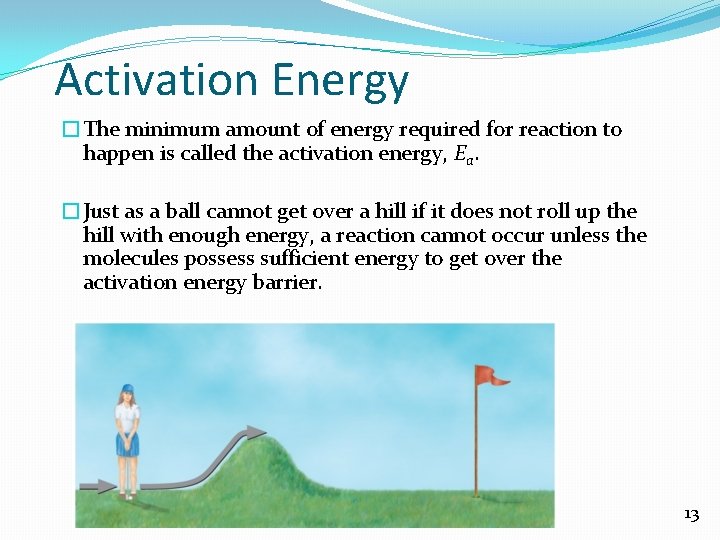
Activation Energy �The minimum amount of energy required for reaction to happen is called the activation energy, Ea. �Just as a ball cannot get over a hill if it does not roll up the hill with enough energy, a reaction cannot occur unless the molecules possess sufficient energy to get over the activation energy barrier. 13
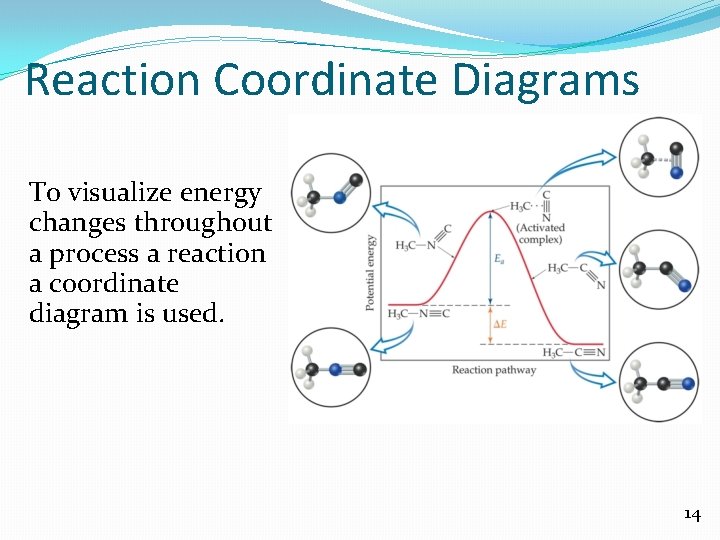
Reaction Coordinate Diagrams To visualize energy changes throughout a process a reaction a coordinate diagram is used. 14
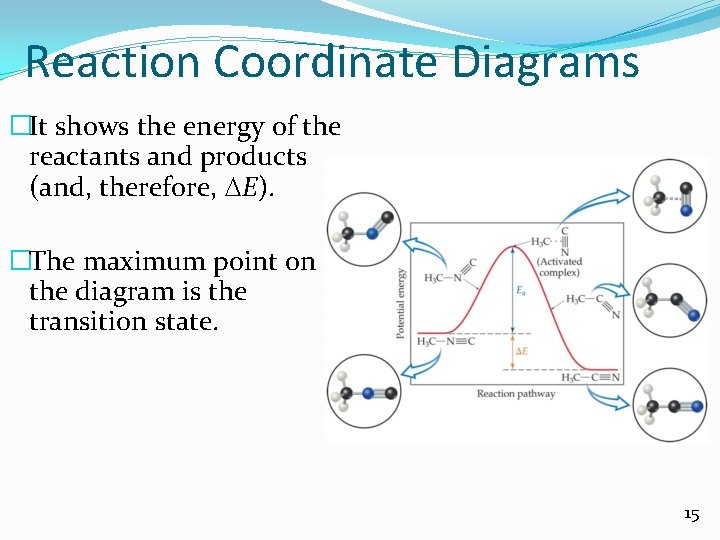
Reaction Coordinate Diagrams �It shows the energy of the reactants and products (and, therefore, E). �The maximum point on the diagram is the transition state. 15
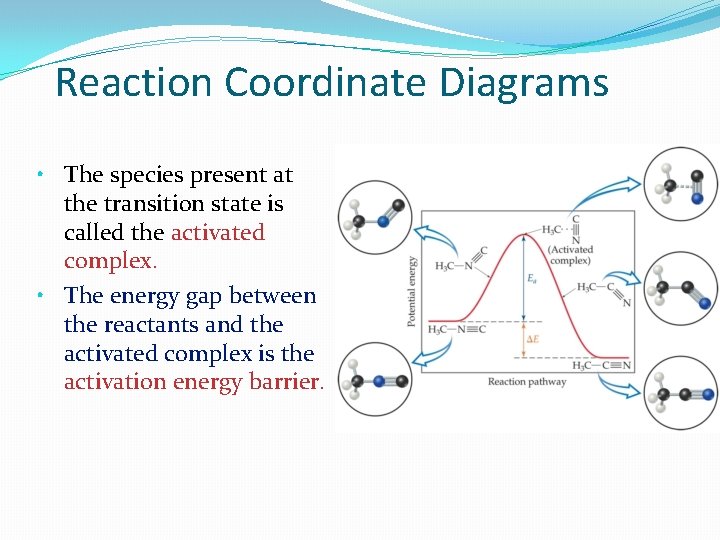
Reaction Coordinate Diagrams • The species present at the transition state is called the activated complex. • The energy gap between the reactants and the activated complex is the activation energy barrier.
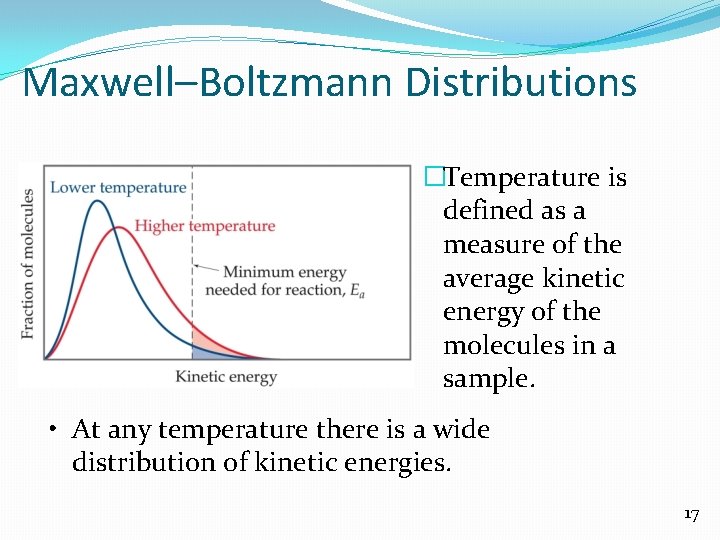
Maxwell–Boltzmann Distributions �Temperature is defined as a measure of the average kinetic energy of the molecules in a sample. • At any temperature there is a wide distribution of kinetic energies. 17
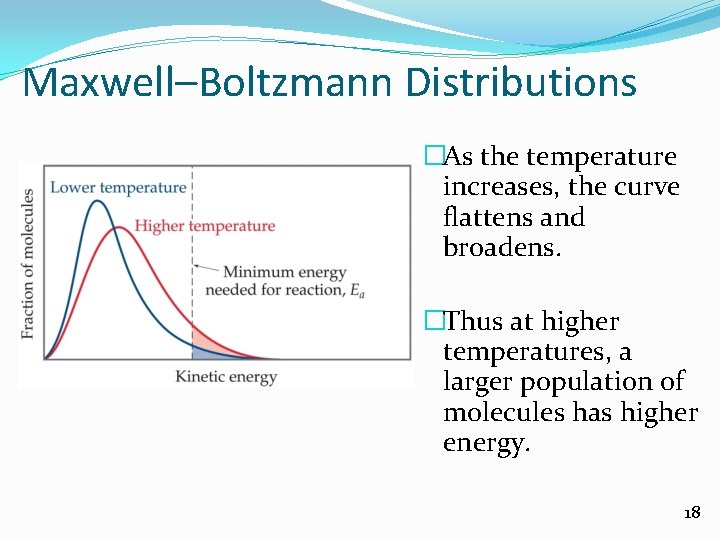
Maxwell–Boltzmann Distributions �As the temperature increases, the curve flattens and broadens. �Thus at higher temperatures, a larger population of molecules has higher energy. 18
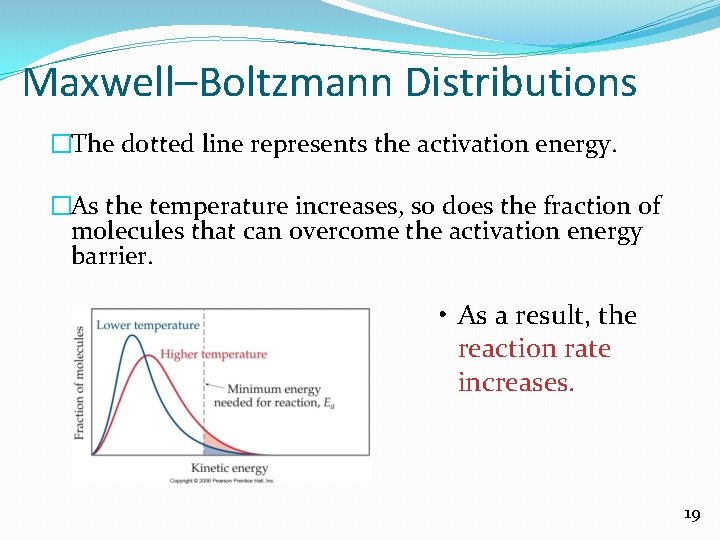
Maxwell–Boltzmann Distributions �The dotted line represents the activation energy. �As the temperature increases, so does the fraction of molecules that can overcome the activation energy barrier. • As a result, the reaction rate increases. 19
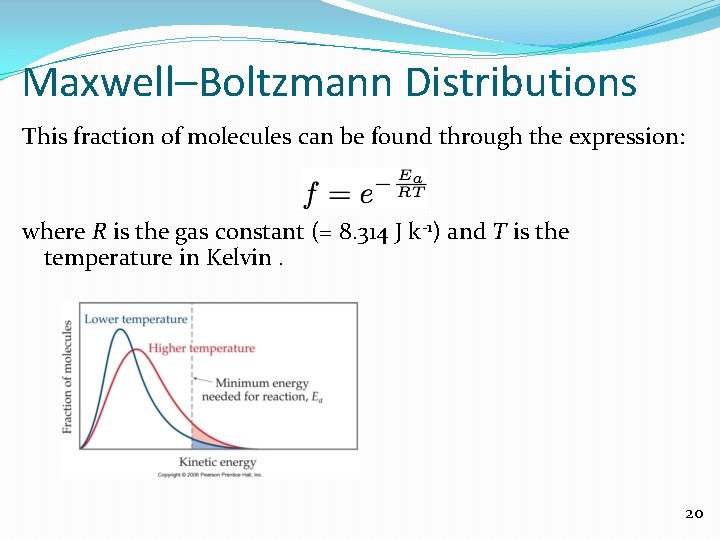
Maxwell–Boltzmann Distributions This fraction of molecules can be found through the expression: where R is the gas constant (= 8. 314 J k-1) and T is the temperature in Kelvin. 20
End
Bibliography �http: //chemwiki. ucdavis. edu/Physical_Chemistry/Kin etics/Rate_Laws/Gas_Phase_Kinetics/Collision_Theor y_I �http: //www. saskschools. ca/curr_content/chem 30_05/ 2_kinetics/kinetics 2_1. htm �Geoffrey Neuss. Chemistry course companion. Bell and Bain Ltd. Glascow, 2007.
- Slides: 22