
Kinetic theory Thermodynamics Boltzmann Maxwell Particles 1895 1900
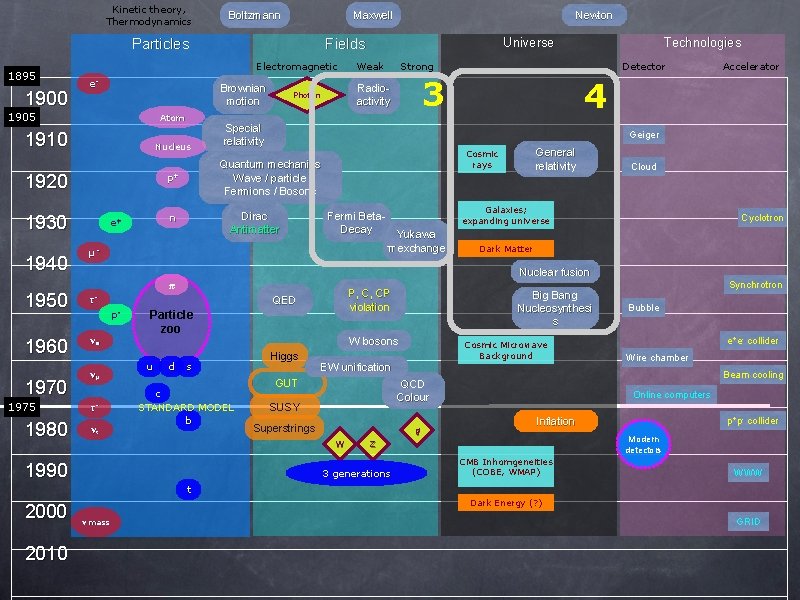
Kinetic theory, Thermodynamics Boltzmann Maxwell Particles 1895 1900 Brownian motion 1905 Atom 1910 Nucleus 1920 1930 1940 4 Geiger General relativity Cosmic rays Fermi Beta. Decay Yukawa π exchange π 1960 νe 1980 3 Accelerator Cloud Galaxies; expanding universe Cyclotron Dark Matter Nuclear fusion 1950 1975 Detector Special relativity Dirac Antimatter n Technologies Strong Radioactivity Photon μ- τ- 1970 Weak Quantum mechanics Wave / particle Fermions / Bosons p+ e+ Universe Fields Electromagnetic e- Newton QED p- νμ τντ P, C, CP violation Particle zoo u d s c STANDARD MODEL b W bosons Higgs Cosmic Microwave Background EW unification GUT SUSY Superstrings g Bubble e+e- collider Wire chamber Online computers p+p- collider Inflation Modern detectors Z 3 generations Synchrotron Beam cooling QCD Colour W 1990 Big Bang Nucleosynthesi s CMB Inhomgeneities (COBE, WMAP) WWW t 2000 2010 Dark Energy (? ) ν mass GRID
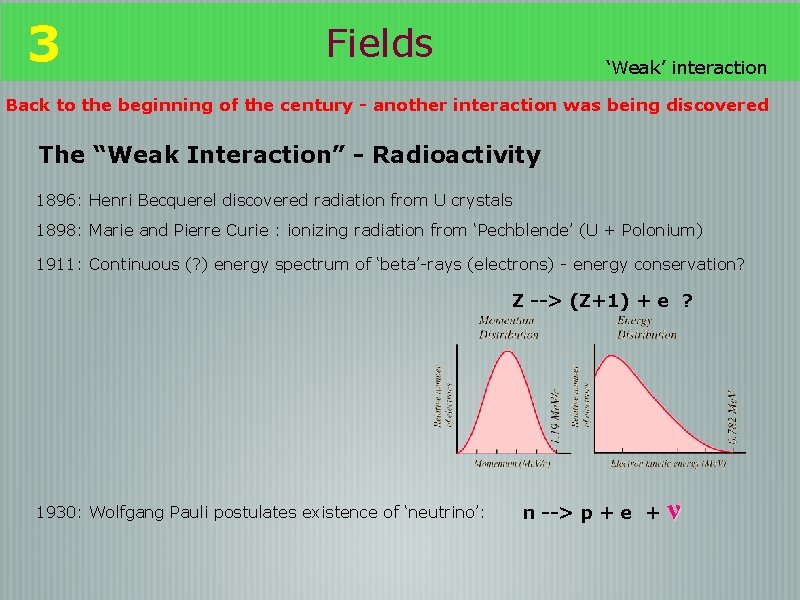
3 Fields ‘Weak’ interaction Back to the beginning of the century - another interaction was being discovered The “Weak Interaction” - Radioactivity 1896: Henri Becquerel discovered radiation from U crystals 1898: Marie and Pierre Curie : ionizing radiation from ‘Pechblende’ (U + Polonium) 1911: Continuous (? ) energy spectrum of ‘beta’-rays (electrons) - energy conservation? Z --> (Z+1) + e ? 1930: Wolfgang Pauli postulates existence of ‘neutrino’: n --> p + e + ν
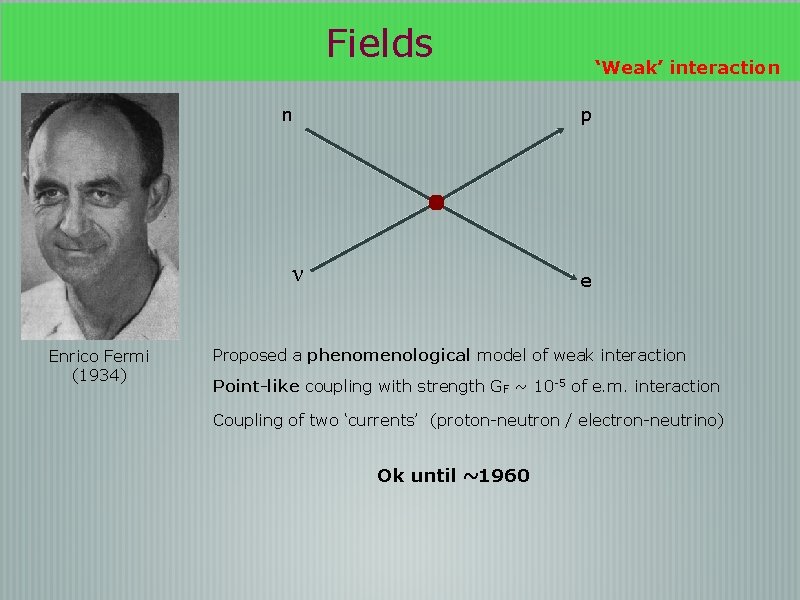
Fields n p ν Enrico Fermi (1934) ‘Weak’ interaction e Proposed a phenomenological model of weak interaction Point-like coupling with strength GF ~ 10 -5 of e. m. interaction Coupling of two ‘currents’ (proton-neutron / electron-neutrino) Ok until ~1960
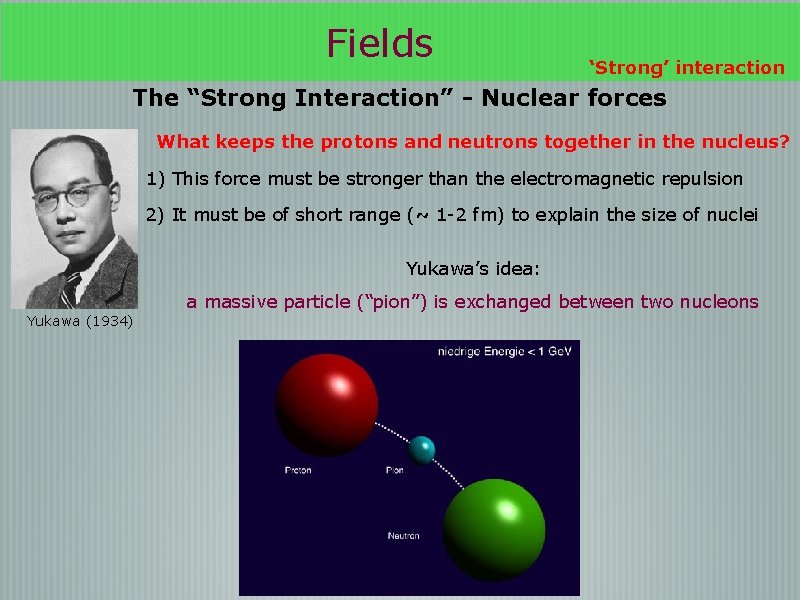
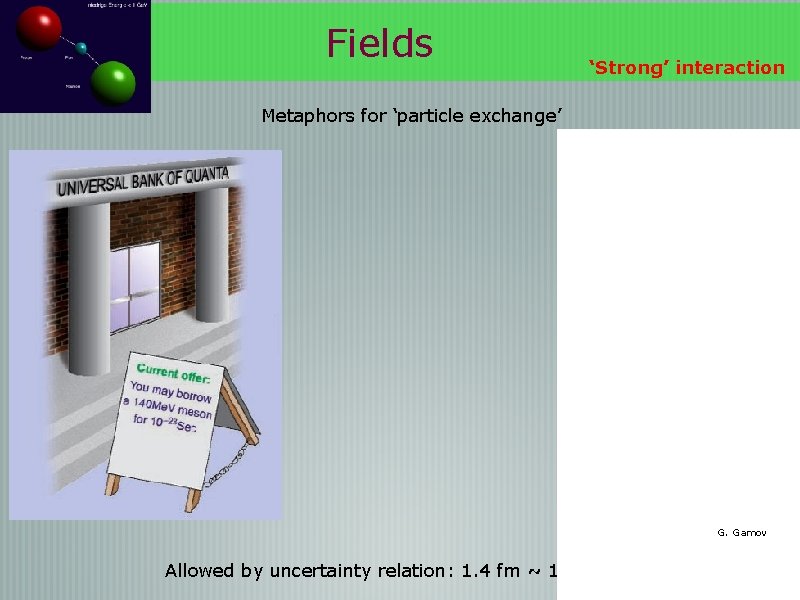
Fields ‘Strong’ interaction The “Strong Interaction” - Nuclear forces What keeps the protons and neutrons together in the nucleus? 1) This force must be stronger than the electromagnetic repulsion 2) It must be of short range (~ 1 -2 fm) to explain the size of nuclei Yukawa’s idea: a massive particle (“pion”) is exchanged between two nucleons Yukawa (1934)
Electromagnetic Coulomb law vs Nuclear Yukawa potential ~ Modified “Coulomb” law
Fields ‘Strong’ interaction Metaphors for ‘particle exchange’ G. Gamov Allowed by uncertainty relation: 1. 4 fm ~ 140 Me. V
4 The Universe Before the 20 th century, the Universe was a quiet place. Not much seem to happen. Most physicists assumed the Universe to be infinite in space and time. However, there was a strange observational fact: It is dark at night. This could not be explained with an eternal and infinite universe
Universe Olber’s "Paradox" Heinrich Wilhelm Olbers (1823) If the universe is endless and uniformly populated with luminous stars, then every line of sight must eventually terminate at the surface of a star. Formally: Each shell contributes ~ r 2 The light decreases with ~1/r 2 Light contribution from each shell = constant Consequence: The Universe did not exist forever, or. . . The Universe has a finite size, or. . . Both 1823
Universe Equivalence Principle Acceleration (inertial mass) is indistinguishable from gravitation (gravitational mass) "The happiest thought of my life" (Albert Einstein) 1907
Universe 1915 Light rays define the shortest path in space. Accelerated elevator: light follows a parabolic path Gravitational field: light path must be bent ! Space and time must be curved Albert Einstein (1912 -15) : General Relativity Matter tells Space how to curve Space tells Matter how to move George Lemaitre (1927) The whole Universe expands
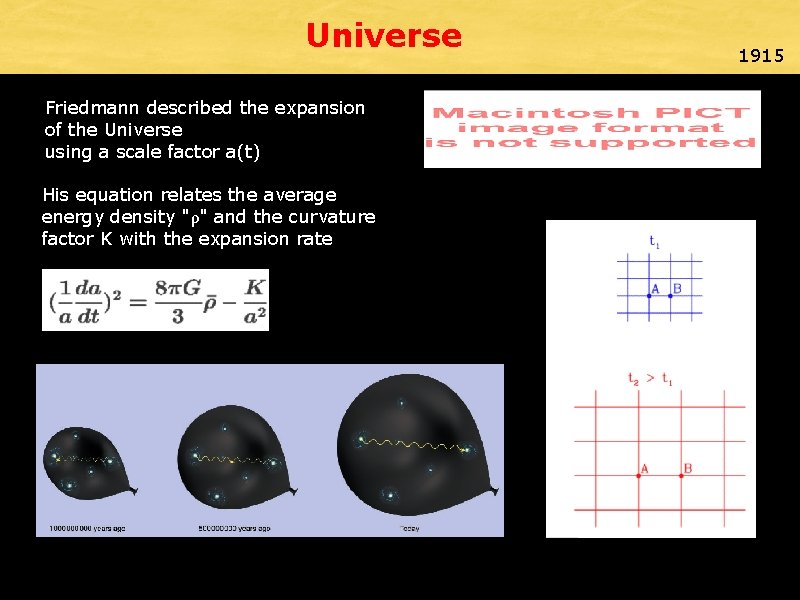
Universe Friedmann described the expansion of the Universe using a scale factor a(t) His equation relates the average energy density "ρ" and the curvature factor K with the expansion rate 1915
Universe The crucial question was the mass of the Universe. In principle, it could be anything. However - there is a 'critical energy density'. If the average energy density is larger, the Universe will stop expanding and fall back into a big crunch one day ('deceleration' parameter)
Universe Einstein did not like the idea of a 'dynamic' Universe. He believed in an eternal and static Universe. But his own equations predicted something else. Therefore he decided to tinker with them, by adding a term named 'cosmological constant'
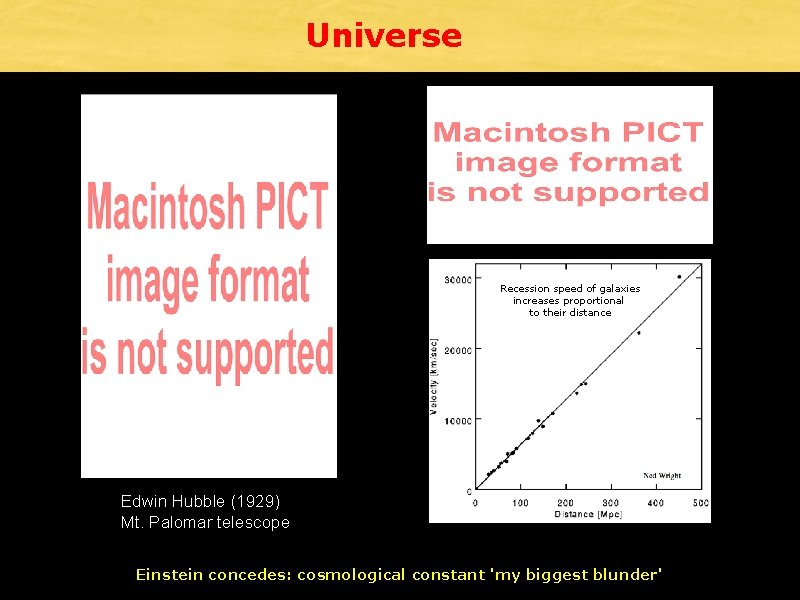
Universe Recession speed of galaxies increases proportional to their distance Edwin Hubble (1929) Mt. Palomar telescope Einstein concedes: cosmological constant 'my biggest blunder'
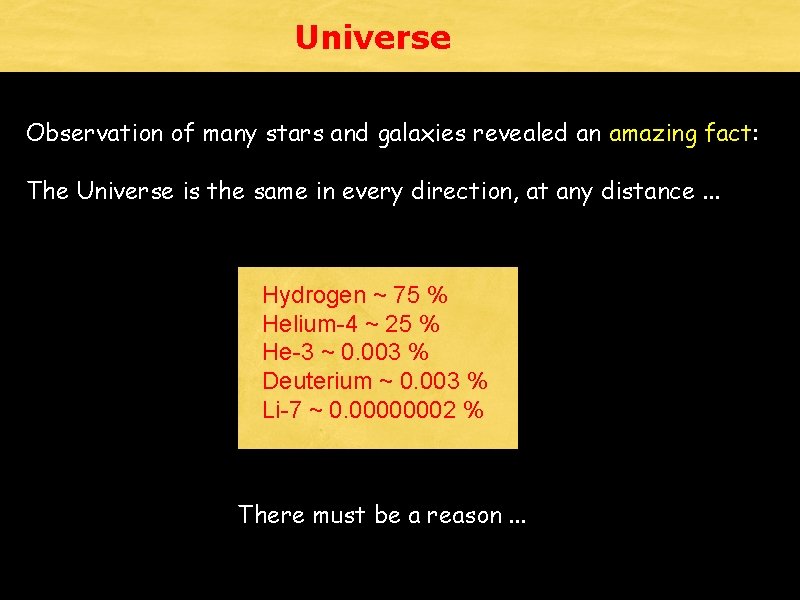
Universe Observation of many stars and galaxies revealed an amazing fact: The Universe is the same in every direction, at any distance. . . Hydrogen ~ 75 % Helium-4 ~ 25 % He-3 ~ 0. 003 % Deuterium ~ 0. 003 % Li-7 ~ 0. 00000002 % There must be a reason. . .
Universe 1948 11948: The 'Big Bang' model* of the beginning of the Universe The Universe started from an extremely hot initial state Then it expanded rapidly, while cooling down In very early times, the Universe was mostly radiation George Gamov Radiation produced particles (protons, neutrons, electrons) • In the first few minutes, there was just enough time to create the lightest elements • There should be an ‘echo’ in form of a uniform black-body radiation (T ~ 5 K) * The name 'Big Bang' was used by Fred Hoyle to ridicule Gamov's idea. Later Fred Hoyle was ridiculed.
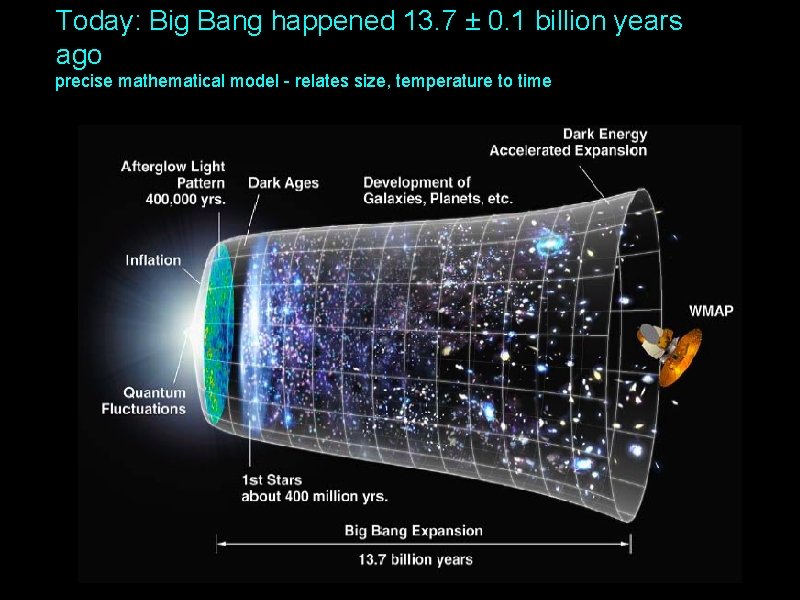
Today: Big Bang happened 13. 7 ± 0. 1 billion years ago precise mathematical model - relates size, temperature to time
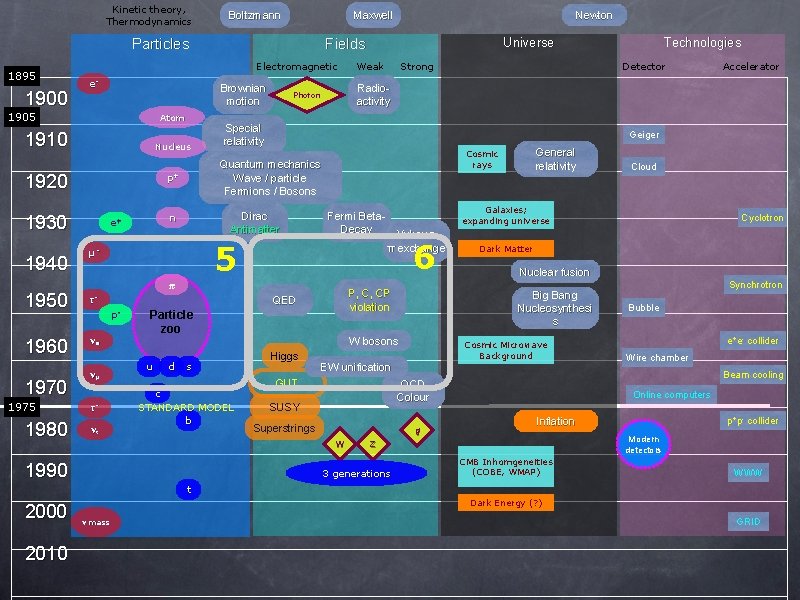
Kinetic theory, Thermodynamics Boltzmann Maxwell Particles 1895 1900 Brownian motion 1905 Atom 1910 Nucleus 1920 1930 1940 1960 νe 1970 1975 1980 Fermi Beta. Decay Yukawa π exchange 6 νμ τντ P, C, CP violation QED d s c STANDARD MODEL b GUT Superstrings g W 1990 Nuclear fusion Bubble e+e- collider Wire chamber Online computers p+p- collider Inflation Modern detectors Z 3 generations Synchrotron Beam cooling QCD Colour SUSY Cyclotron Dark Matter Cosmic Microwave Background EW unification Cloud Galaxies; expanding universe Big Bang Nucleosynthesi s W bosons Higgs General relativity Cosmic rays Particle zoo u Accelerator Geiger 5 p- Detector Special relativity π 1950 Strong Technologies Radioactivity Photon Dirac Antimatter n μ- τ- Weak Quantum mechanics Wave / particle Fermions / Bosons p+ e+ Universe Fields Electromagnetic e- Newton CMB Inhomgeneities (COBE, WMAP) WWW t 2000 2010 Dark Energy (? ) ν mass GRID
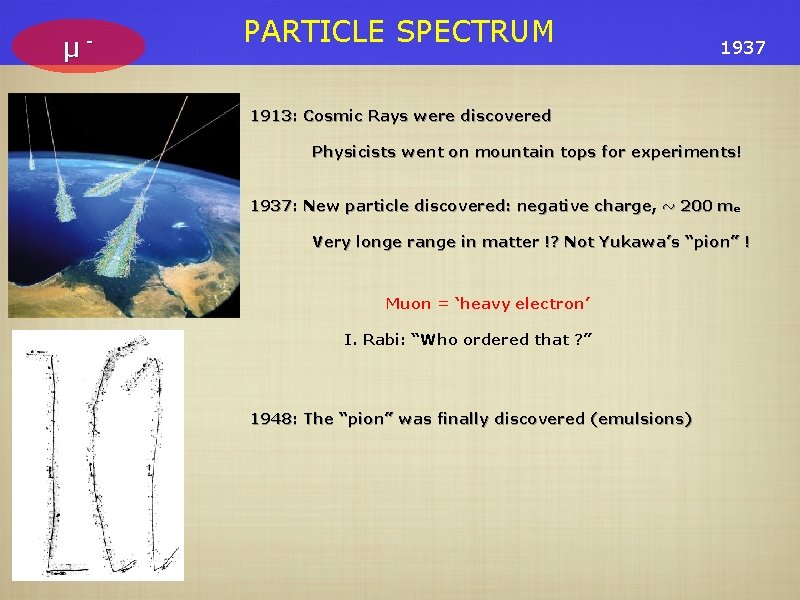
μ - PARTICLE SPECTRUM 1937 1913: Cosmic Rays were discovered Physicists went on mountain tops for experiments! 1937: New particle discovered: negative charge, ~ 200 me Very longe range in matter !? Not Yukawa’s “pion” ! Muon = ‘heavy electron’ I. Rabi: “Who ordered that ? ” 1948: The “pion” was finally discovered (emulsions)
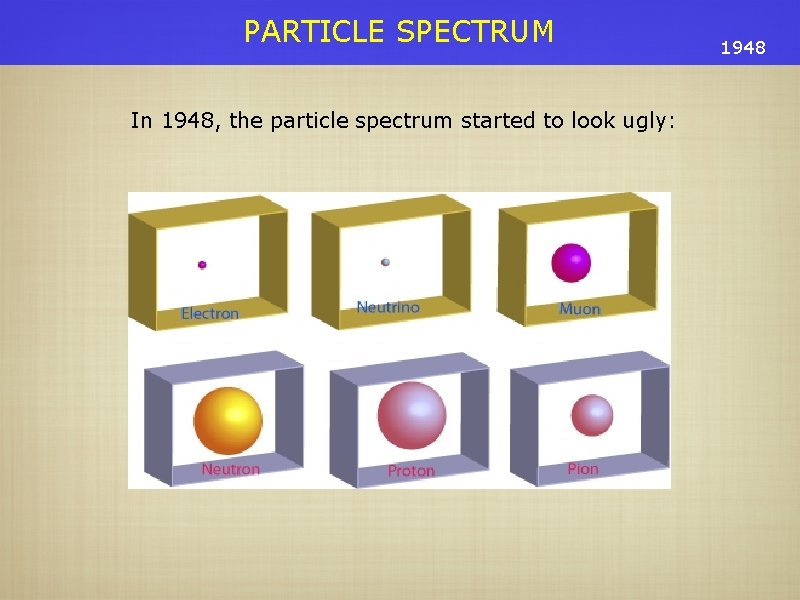
PARTICLE SPECTRUM In 1948, the particle spectrum started to look ugly: 1948
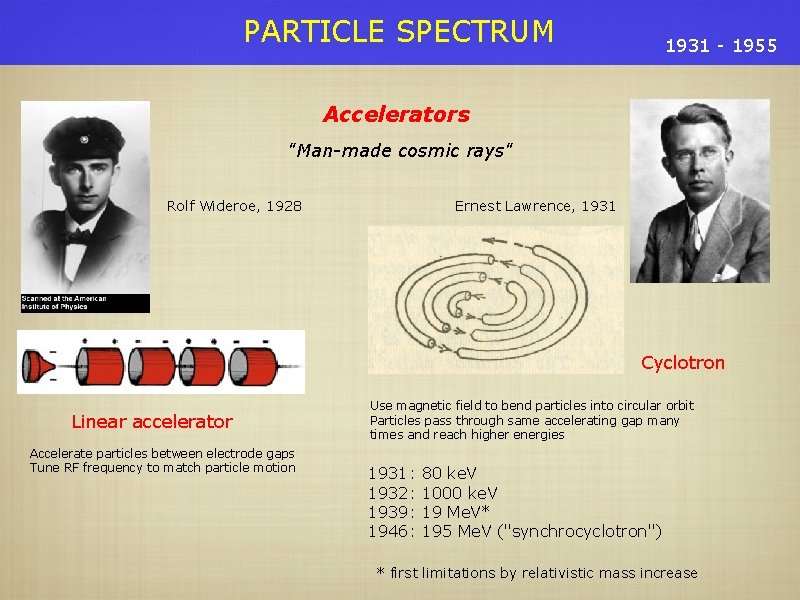
PARTICLE SPECTRUM 1931 - 1955 Accelerators "Man-made cosmic rays" Rolf Wideroe, 1928 Ernest Lawrence, 1931 Cyclotron Linear accelerator Accelerate particles between electrode gaps Tune RF frequency to match particle motion Use magnetic field to bend particles into circular orbit Particles pass through same accelerating gap many times and reach higher energies 1931: 1932: 1939: 1946: 80 ke. V 1000 ke. V 19 Me. V* 195 Me. V ("synchrocyclotron") * first limitations by relativistic mass increase
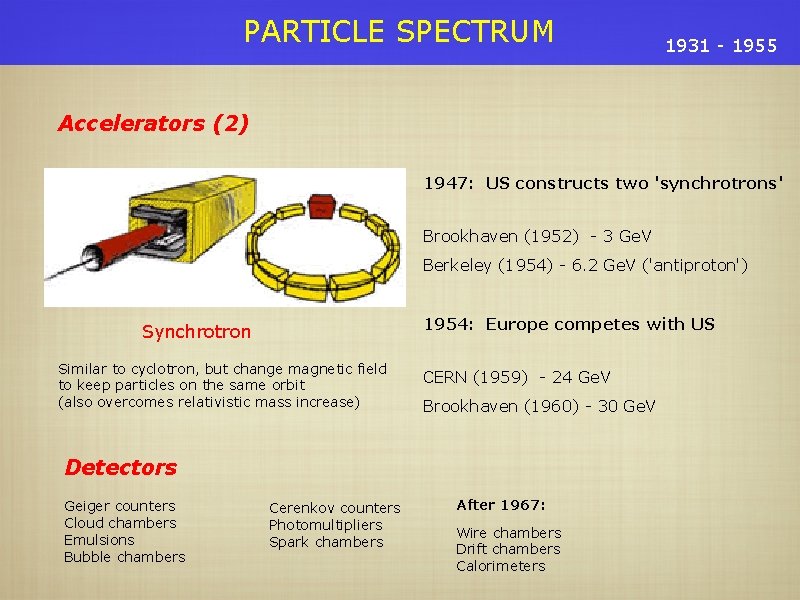
PARTICLE SPECTRUM 1931 - 1955 Accelerators (2) 1947: US constructs two 'synchrotrons' Brookhaven (1952) - 3 Ge. V Berkeley (1954) - 6. 2 Ge. V ('antiproton') 1954: Europe competes with US Synchrotron Similar to cyclotron, but change magnetic field to keep particles on the same orbit (also overcomes relativistic mass increase) CERN (1959) - 24 Ge. V Brookhaven (1960) - 30 Ge. V Detectors Geiger counters Cloud chambers Emulsions Bubble chambers Cerenkov counters Photomultipliers Spark chambers After 1967: Wire chambers Drift chambers Calorimeters
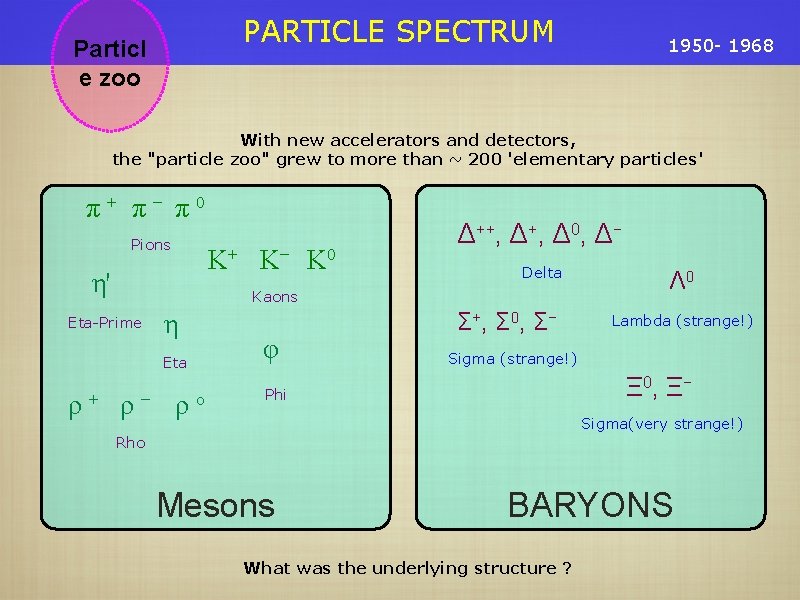
PARTICLE SPECTRUM Particl e zoo 1950 - 1968 With new accelerators and detectors, the "particle zoo" grew to more than ~ 200 'elementary particles' π+ π− π0 Pions η' K+ K− K 0 Δ++, Δ 0, Δ− Delta Kaons Eta-Prime η Eta ρ+ ρ− ρo φ Σ + , Σ 0, Σ − Λ 0 Lambda (strange!) Sigma (strange!) Ξ 0, Ξ − Phi Sigma(very strange!) Rho Mesons BARYONS What was the underlying structure ?
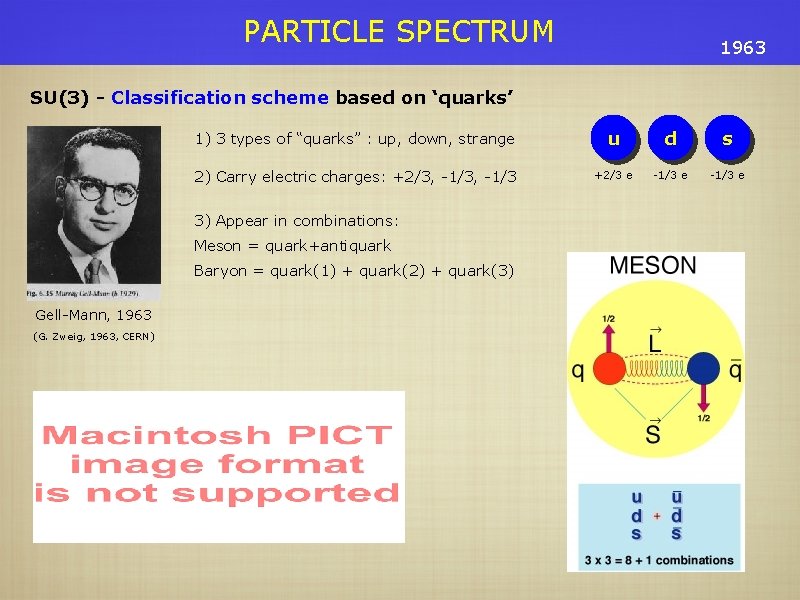
PARTICLE SPECTRUM 1963 SU(3) - Classification scheme based on ‘quarks’ 1) 3 types of “quarks” : up, down, strange u d s 2) Carry electric charges: +2/3, -1/3 +2/3 e -1/3 e 3) Appear in combinations: Meson = quark+antiquark Baryon = quark(1) + quark(2) + quark(3) Gell-Mann, 1963 (G. Zweig, 1963, CERN)
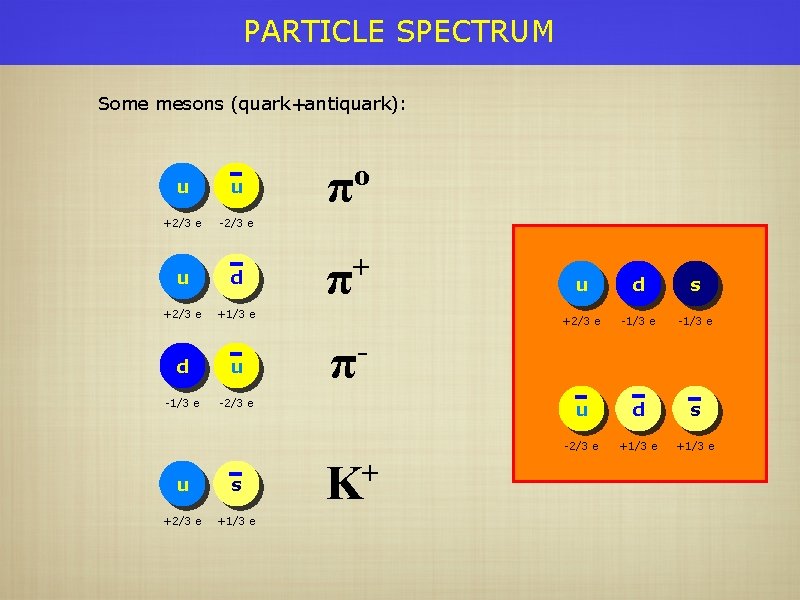
PARTICLE SPECTRUM Some mesons (quark+antiquark): u u +2/3 e -2/3 e u d +2/3 e +1/3 e d u -1/3 e -2/3 e u s +2/3 e +1/3 e o π + π u d s +2/3 e -1/3 e u d s -2/3 e +1/3 e π + K
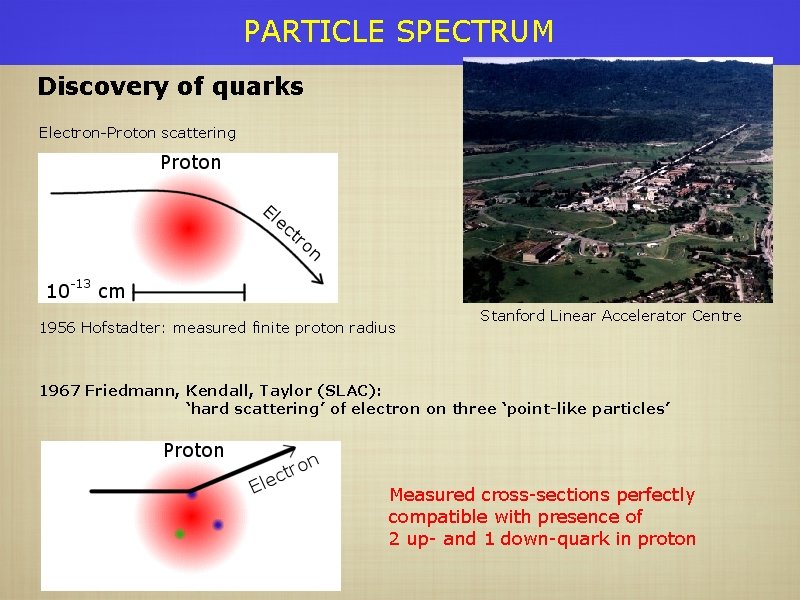
PARTICLE SPECTRUM Discovery of quarks Electron-Proton scattering 1956 Hofstadter: measured finite proton radius Stanford Linear Accelerator Centre 1967 Friedmann, Kendall, Taylor (SLAC): ‘hard scattering’ of electron on three ‘point-like particles’ Measured cross-sections perfectly compatible with presence of 2 up- and 1 down-quark in proton
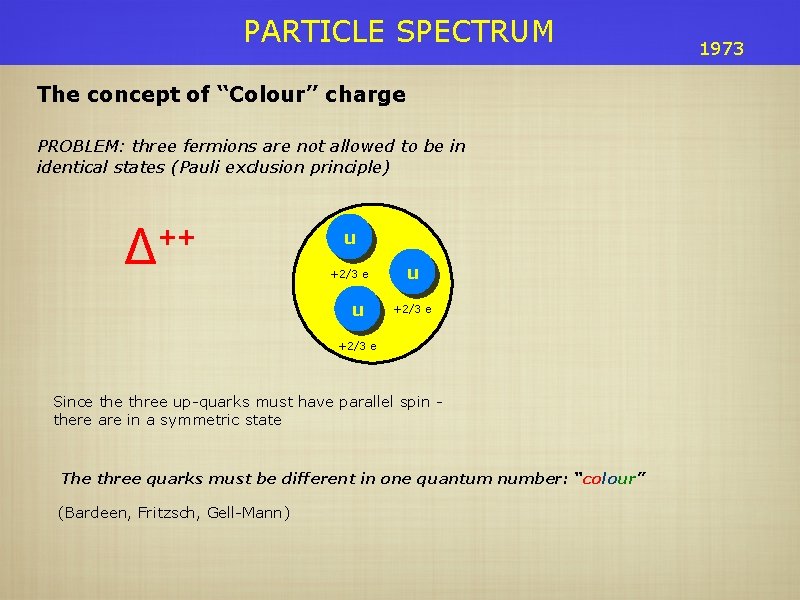
PARTICLE SPECTRUM The concept of “Colour” charge PROBLEM: three fermions are not allowed to be in identical states (Pauli exclusion principle) ++ Δ u +2/3 e u u +2/3 e Since three up-quarks must have parallel spin there are in a symmetric state The three quarks must be different in one quantum number: “colour” (Bardeen, Fritzsch, Gell-Mann) 1973
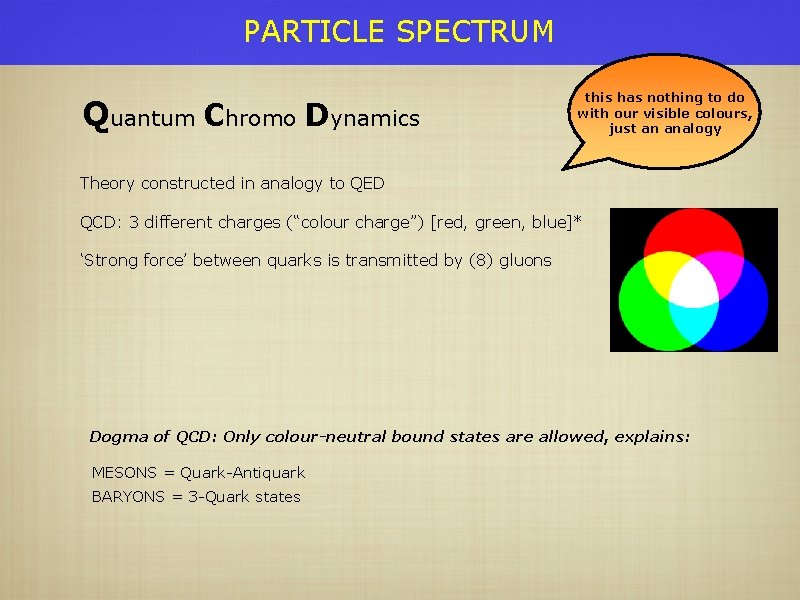
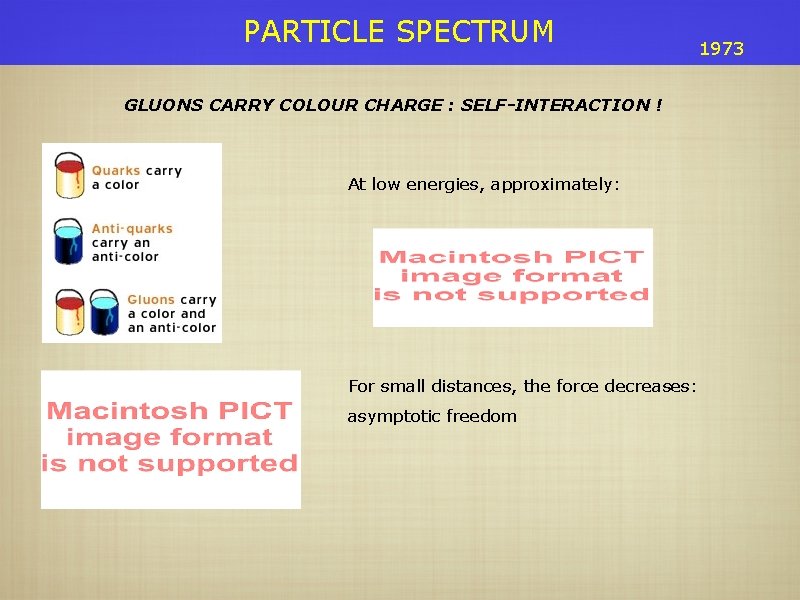
PARTICLE SPECTRUM Quantum Chromo Dynamics this has nothing to do with our visible colours, just an analogy Theory constructed in analogy to QED QCD: 3 different charges (“colour charge”) [red, green, blue]* ‘Strong force’ between quarks is transmitted by (8) gluons Dogma of QCD: Only colour-neutral bound states are allowed, explains: MESONS = Quark-Antiquark BARYONS = 3 -Quark states
PARTICLE SPECTRUM GLUONS CARRY COLOUR CHARGE : SELF-INTERACTION ! At low energies, approximately: For small distances, the force decreases: asymptotic freedom 1973
- Slides: 29