
KINETIC THEORY OF MATTER 3 STATES OF MATTER

- Slides: 22
KINETIC THEORY OF MATTER
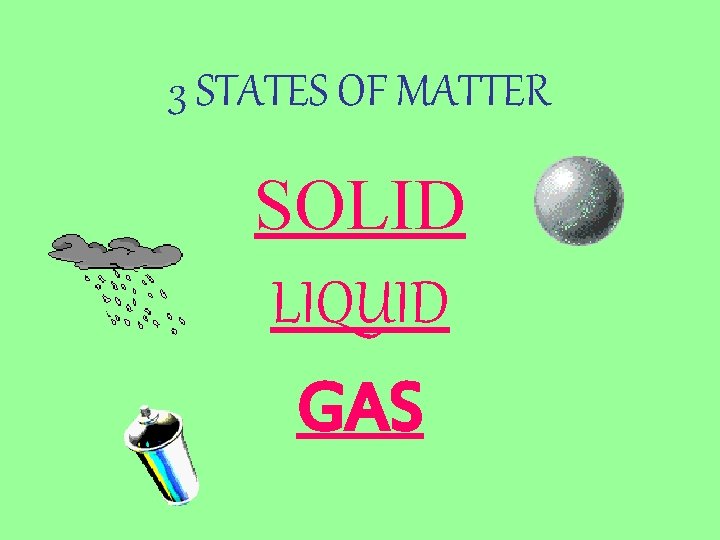
3 STATES OF MATTER SOLID LIQUID GAS
SOLIDS • Fixed shape and volume • Normally hard and rigid • Large force needed to change shape • High density • Incompressible
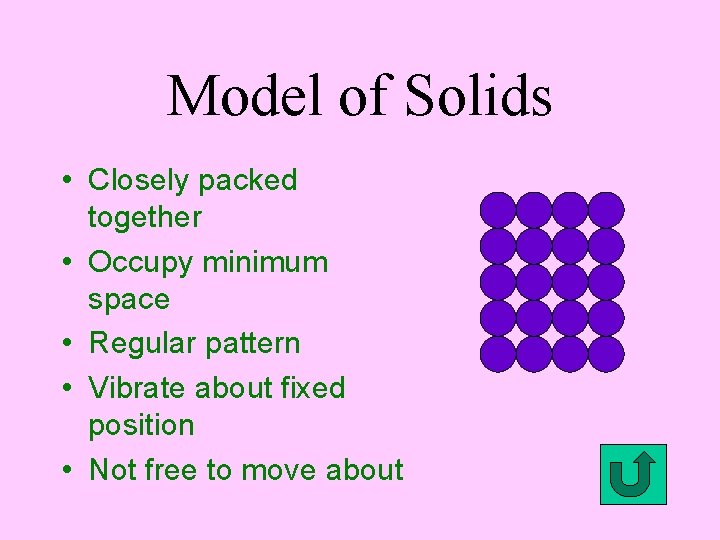
Model of Solids • Closely packed together • Occupy minimum space • Regular pattern • Vibrate about fixed position • Not free to move about
LIQUIDS • Fixed volume but no fixed shape • High density • Not compressible
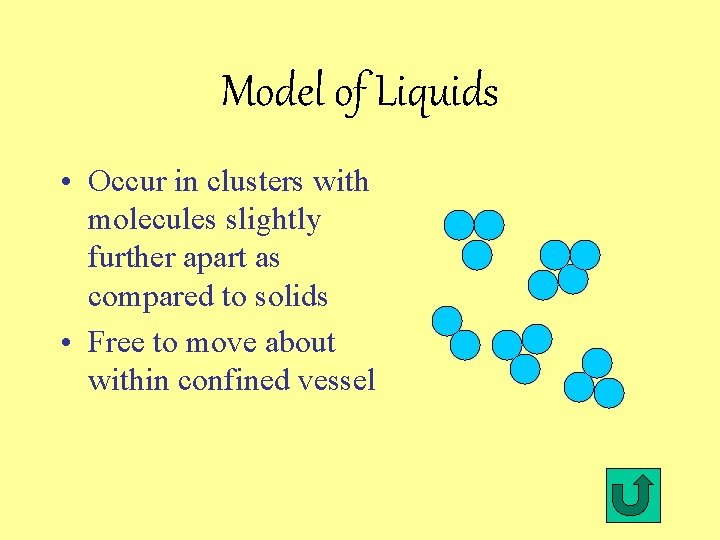
Model of Liquids • Occur in clusters with molecules slightly further apart as compared to solids • Free to move about within confined vessel
GASES • No fixed shape or volume • Low density • Compressible
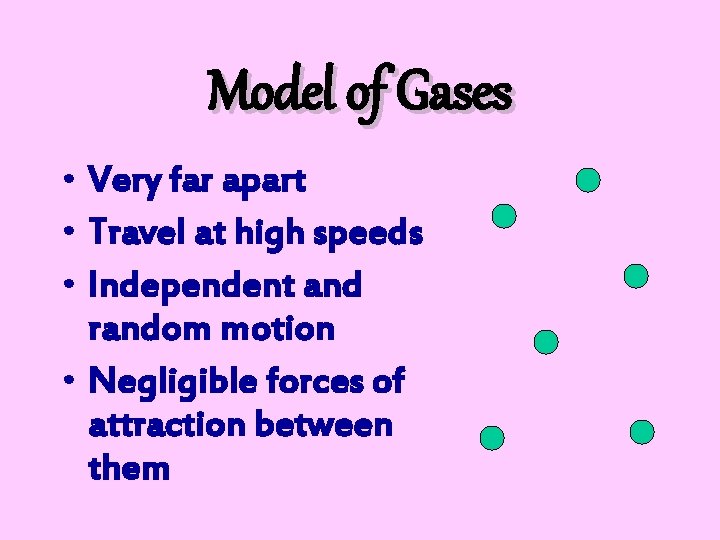
Model of Gases • Very far apart • Travel at high speeds • Independent and random motion • Negligible forces of attraction between them
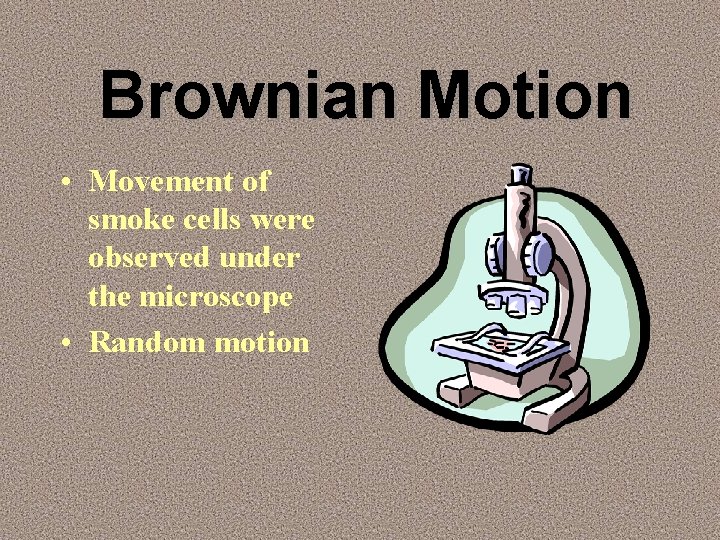
Brownian Motion • Movement of smoke cells were observed under the microscope • Random motion
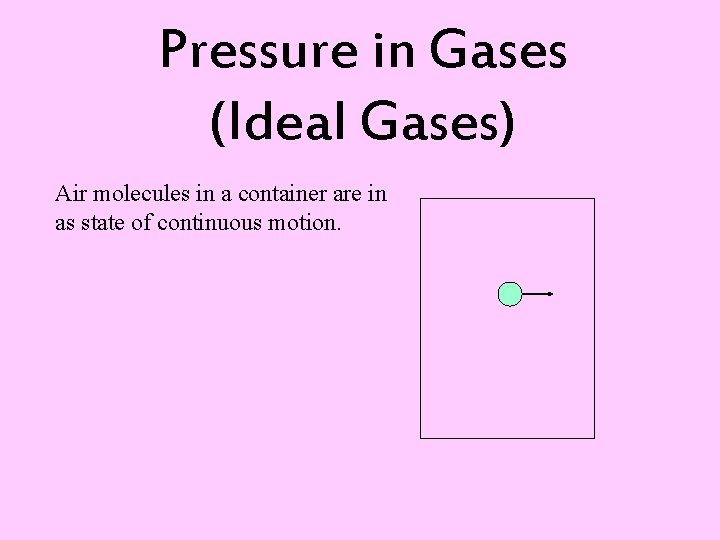
Pressure in Gases (Ideal Gases) Air molecules in a container are in as state of continuous motion.
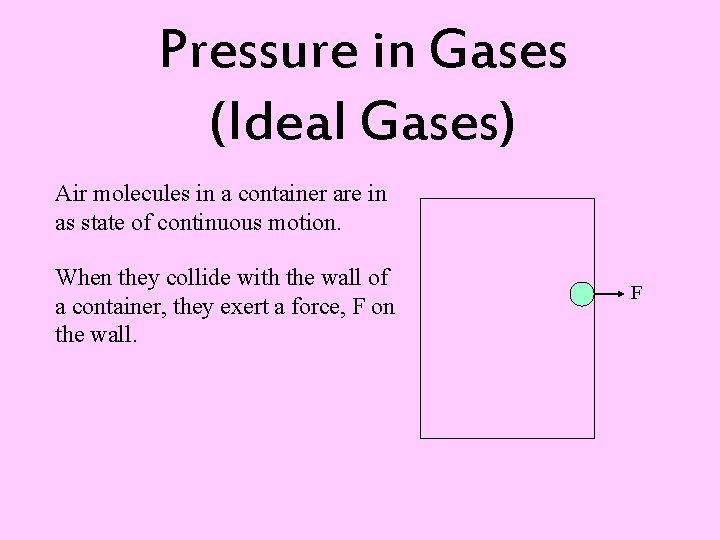
Pressure in Gases (Ideal Gases) Air molecules in a container are in as state of continuous motion. When they collide with the wall of a container, they exert a force, F on the wall. F
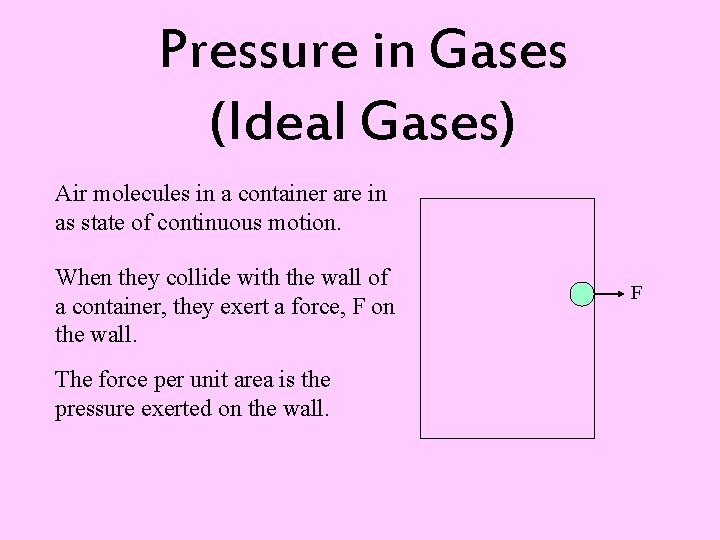
Pressure in Gases (Ideal Gases) Air molecules in a container are in as state of continuous motion. When they collide with the wall of a container, they exert a force, F on the wall. The force per unit area is the pressure exerted on the wall. F
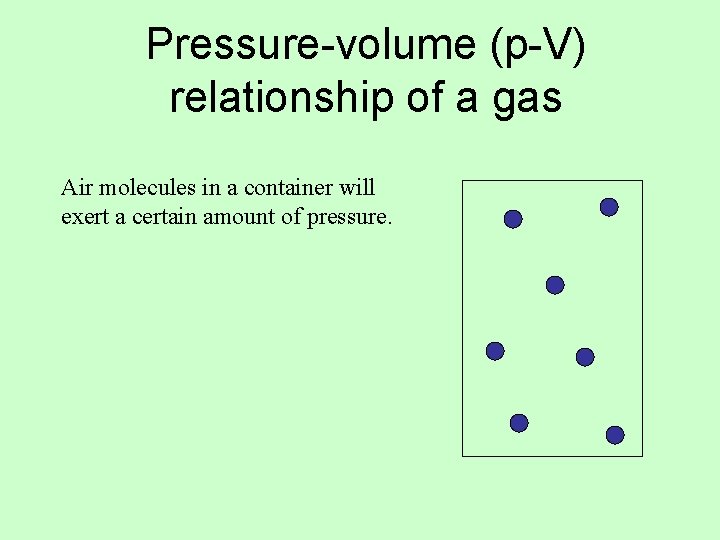
Pressure-volume (p-V) relationship of a gas Air molecules in a container will exert a certain amount of pressure.
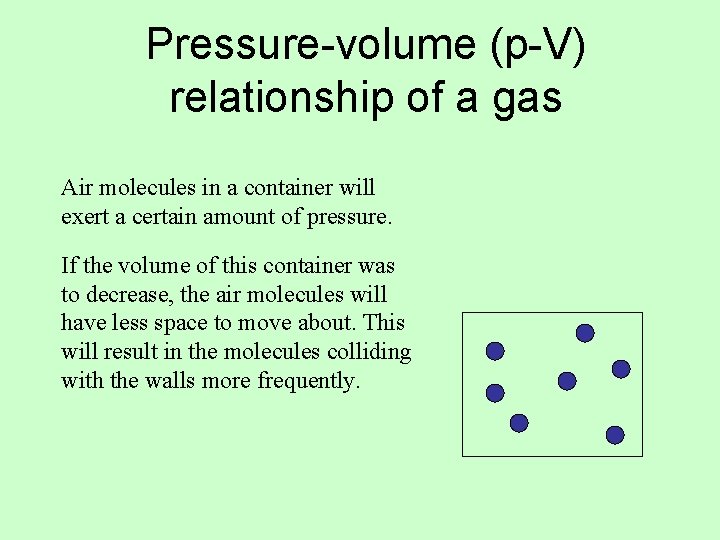
Pressure-volume (p-V) relationship of a gas Air molecules in a container will exert a certain amount of pressure. If the volume of this container was to decrease, the air molecules will have less space to move about. This will result in the molecules colliding with the walls more frequently.
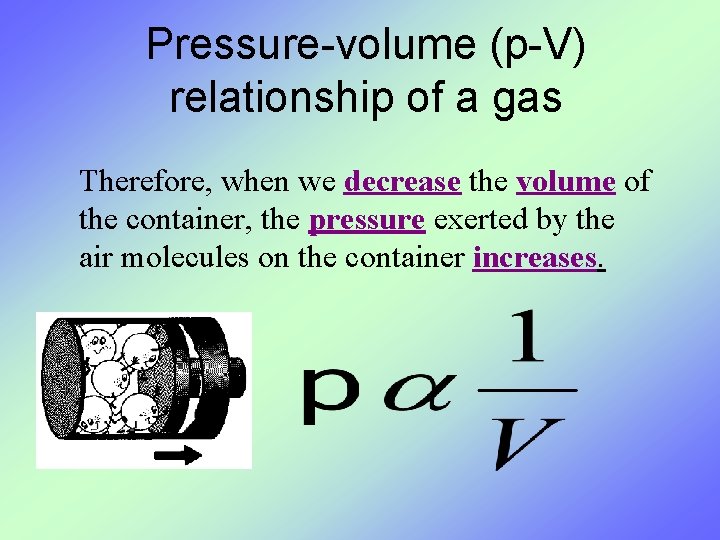
Pressure-volume (p-V) relationship of a gas Therefore, when we decrease the volume of the container, the pressure exerted by the air molecules on the container increases.
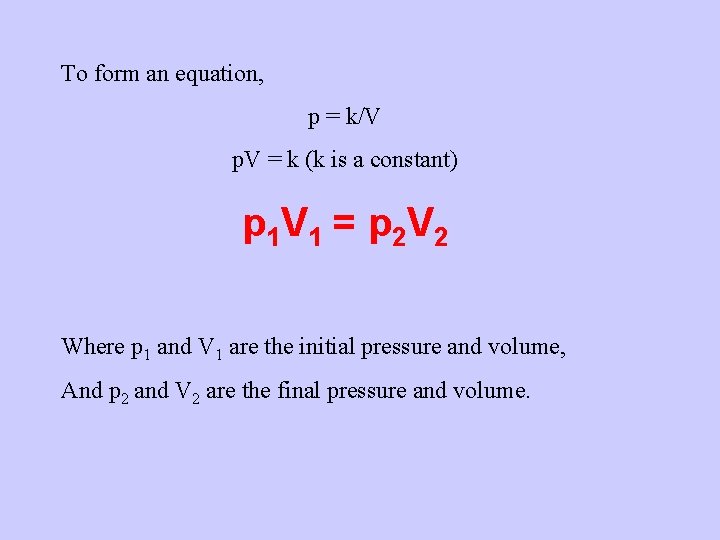
To form an equation, p = k/V p. V = k (k is a constant) p 1 V 1 = p 2 V 2 Where p 1 and V 1 are the initial pressure and volume, And p 2 and V 2 are the final pressure and volume.
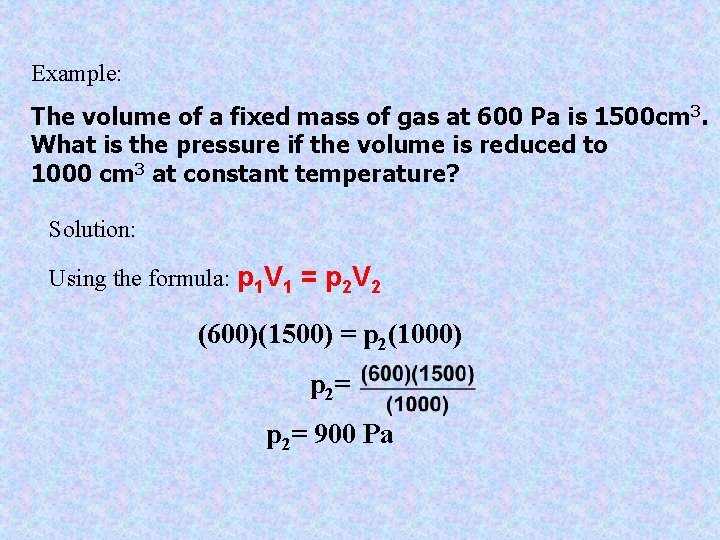
Example: The volume of a fixed mass of gas at 600 Pa is 1500 cm 3. What is the pressure if the volume is reduced to 1000 cm 3 at constant temperature? Solution: Using the formula: p 1 V 1 = p 2 V 2 (600)(1500) = p 2(1000) p 2= 900 Pa
P-T Relationship Now we will keep the volume of the container constant. We will investigate to see how the pressure will vary with temperature of the gas.
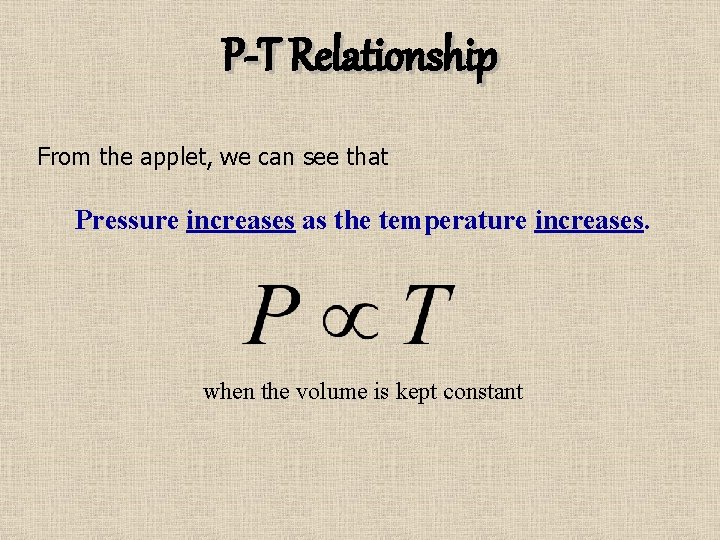
P-T Relationship From the applet, we can see that Pressure increases as the temperature increases. when the volume is kept constant
Example Air is being trapped in a container of fixed volume. At room temperature of 300 K, the pressure exerted by the gas is 100 Pa. If the air in the container was heated to 600 K, what is the new pressure exerted by the gas now? Solution: Since pressure is proportional to temperature, when temperature increases, pressure should also increase. Temperature increases by 2 times, so pressure should increase by 2 times. New pressure = 100 x 2 = 200 Pa
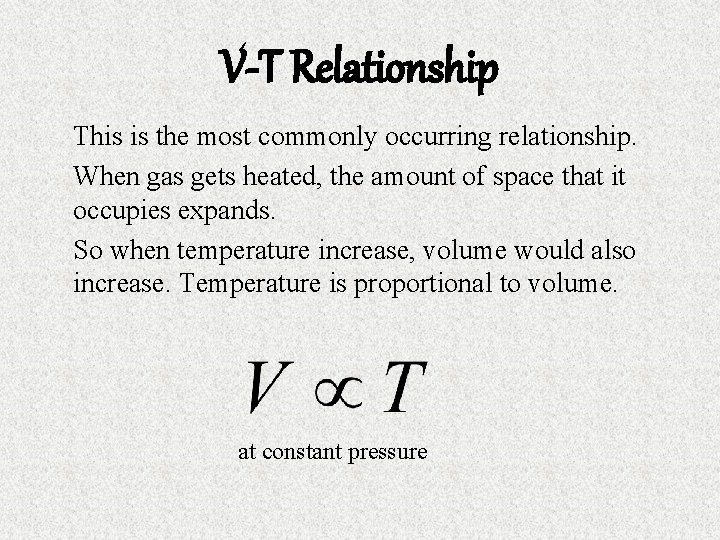
V-T Relationship This is the most commonly occurring relationship. When gas gets heated, the amount of space that it occupies expands. So when temperature increase, volume would also increase. Temperature is proportional to volume. at constant pressure
Example A balloon is filled with gas, at a temperature of 300 K, to a volume of 50 cm 3. If I want to expand the balloon to a volume of 150 cm 3, what is the temperature of the gas now? Assuming that the pressure exerted by the gas does not change. Solution: Volume is proportional to temperature. Since the volume has to be increased by 3 times, the volume should also be increased accordingly. Required temperature = 300 x 3 = 900 K