
Kinetic Molecular Theory Gases and their Properties Mrs
- Slides: 9
Kinetic Molecular Theory: Gases and their Properties Mrs. Nielsen Honors Chemistry
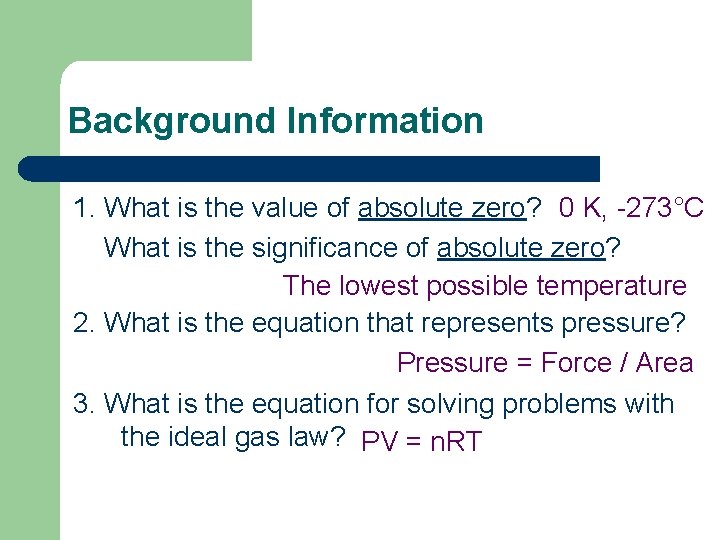
Background Information 1. What is the value of absolute zero? 0 K, -273°C What is the significance of absolute zero? The lowest possible temperature 2. What is the equation that represents pressure? Pressure = Force / Area 3. What is the equation for solving problems with the ideal gas law? PV = n. RT
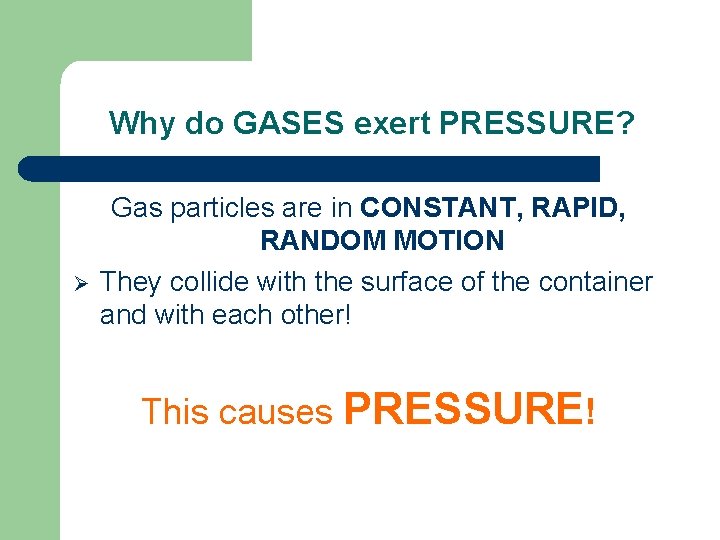
Why do GASES exert PRESSURE? Ø Gas particles are in CONSTANT, RAPID, RANDOM MOTION They collide with the surface of the container and with each other! This causes PRESSURE!
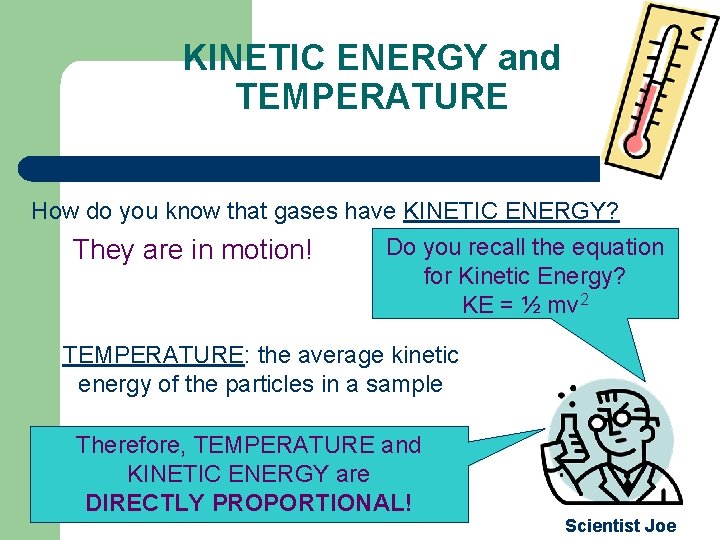
KINETIC ENERGY and TEMPERATURE How do you know that gases have KINETIC ENERGY? Do you recall the equation They are in motion! for Kinetic Energy? KE = ½ mv 2 TEMPERATURE: the average kinetic energy of the particles in a sample Therefore, TEMPERATURE and KINETIC ENERGY are DIRECTLY PROPORTIONAL! Scientist Joe
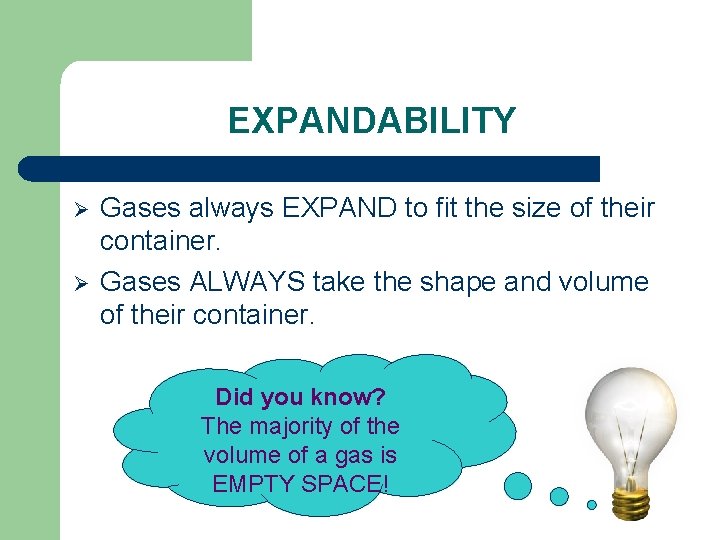
EXPANDABILITY Ø Ø Gases always EXPAND to fit the size of their container. Gases ALWAYS take the shape and volume of their container. Did you know? The majority of the volume of a gas is EMPTY SPACE!
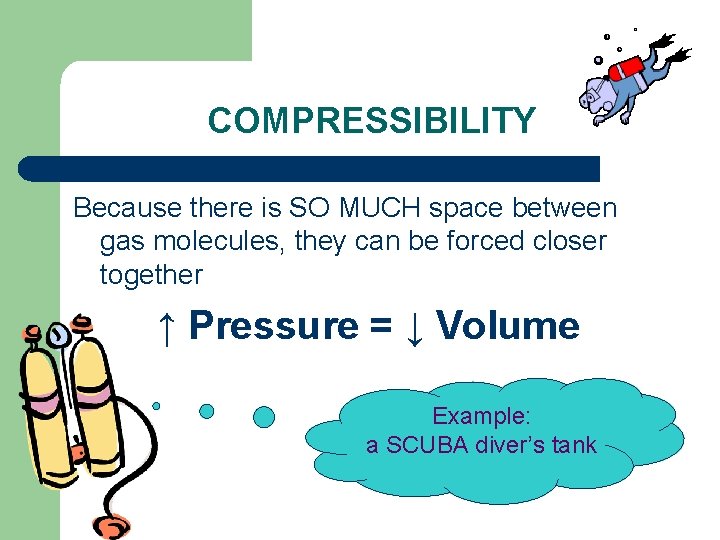
COMPRESSIBILITY Because there is SO MUCH space between gas molecules, they can be forced closer together ↑ Pressure = ↓ Volume Example: a SCUBA diver’s tank
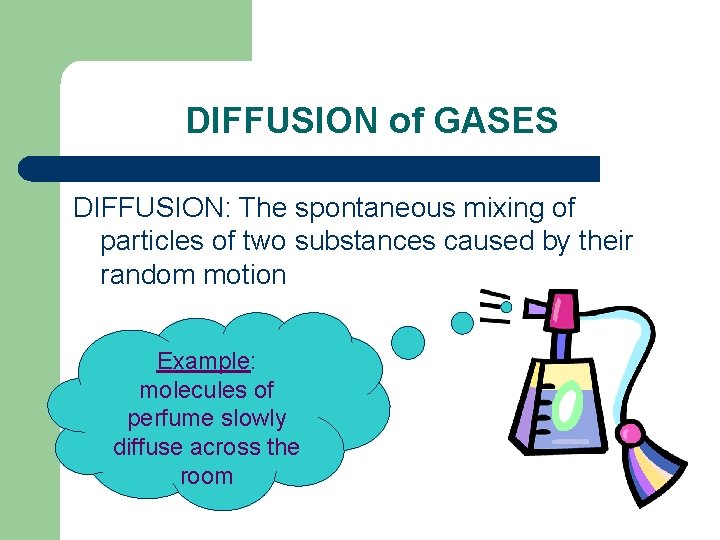
DIFFUSION of GASES DIFFUSION: The spontaneous mixing of particles of two substances caused by their random motion Example: molecules of perfume slowly diffuse across the room
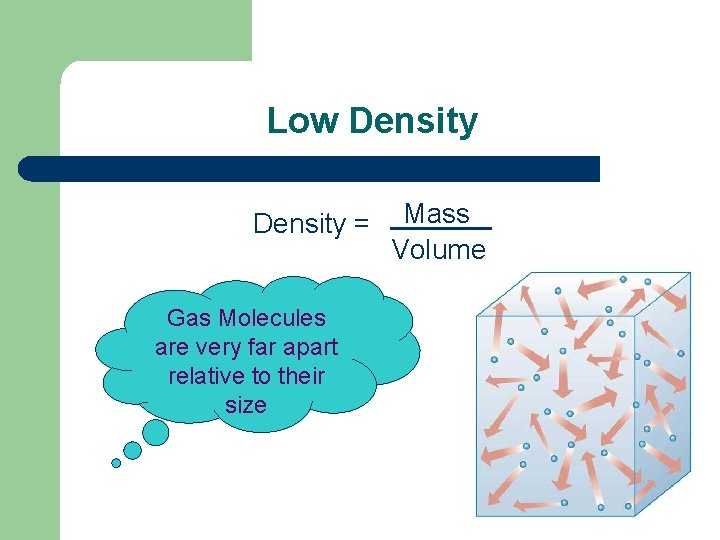
Low Density = Gas Molecules are very far apart relative to their size Mass Volume
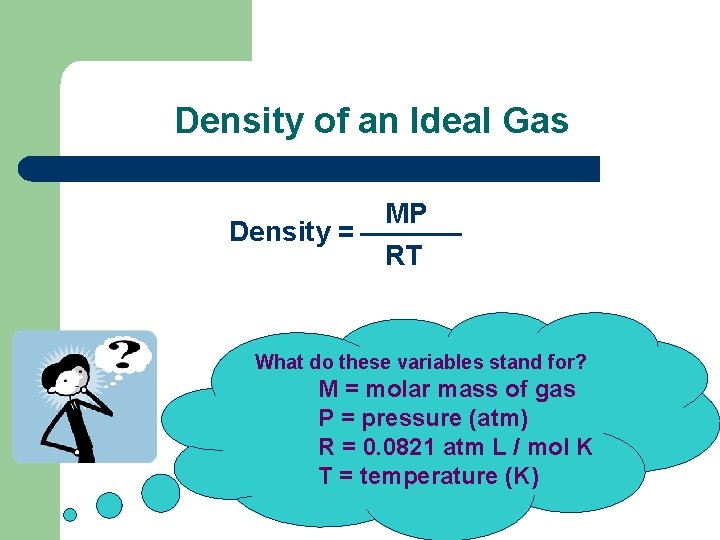
Density of an Ideal Gas Density = MP RT What do these variables stand for? M = molar mass of gas P = pressure (atm) R = 0. 0821 atm L / mol K T = temperature (K)