
Kinetic Energy Energy an object possesses when in

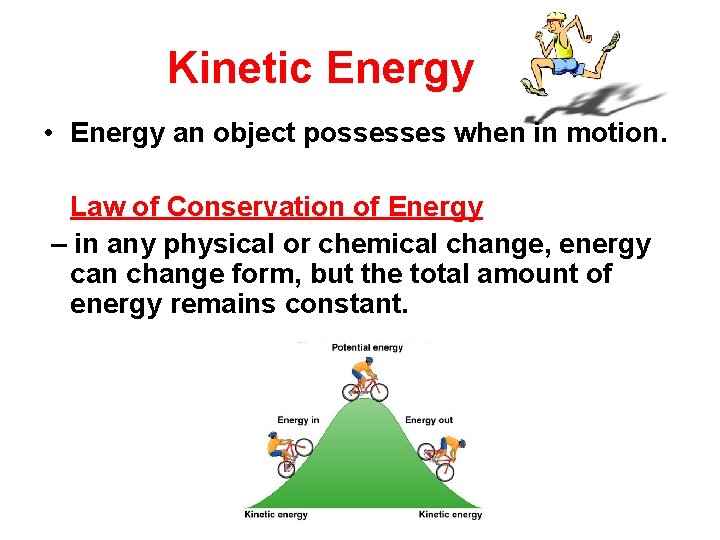
Kinetic Energy • Energy an object possesses when in motion. Law of Conservation of Energy – in any physical or chemical change, energy can change form, but the total amount of energy remains constant.
HEAT • Energy in a system can be transferred as heat. • Heat – the sum total of kinetic energy of the particles in a sample of matter.
Temperature • A measure of the average kinetic energy of particles in a sample of matter. • Temperature is used to measure changes in heat energy
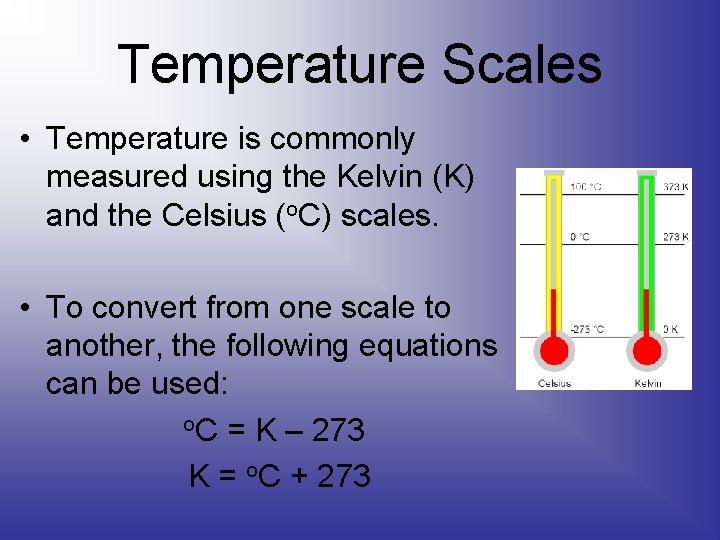
Temperature Scales • Temperature is commonly measured using the Kelvin (K) and the Celsius (o. C) scales. • To convert from one scale to another, the following equations can be used: o. C = K – 273 K = o. C + 273

Temperature Practice! 1) Write down the two equations for converting between Kelvin and Celsius. Convert the following: Write problems and answers for full credit! 2) 300 K = ______ºC 8) 0ºC = _______ K 3) 215 K = ______ºC 9) 173 K = ______ºC 4) 81 ºC = _____K 10) 84ºC = _______ K 5) 32 ºC = _____K 11) -20ºC = ______K 6) 0 K = ______ ºC 12) -100ºC = _____ K 7) 100 ºC = _____ K
Specific Heat • Not all substances will experience the same changes in temp with equal additions of heat energy. This is due to a substance’s specific heat capacity. (Cp) • Cp – the amount of energy required to raise the temp of 1 gram of a substance by 1 degree Kelvin.
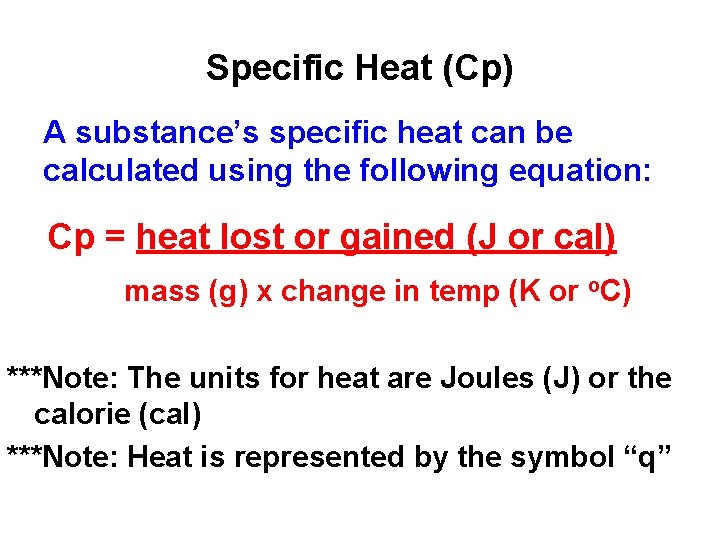
Specific Heat (Cp) A substance’s specific heat can be calculated using the following equation: Cp = heat lost or gained (J or cal) mass (g) x change in temp (K or o. C) ***Note: The units for heat are Joules (J) or the calorie (cal) ***Note: Heat is represented by the symbol “q”
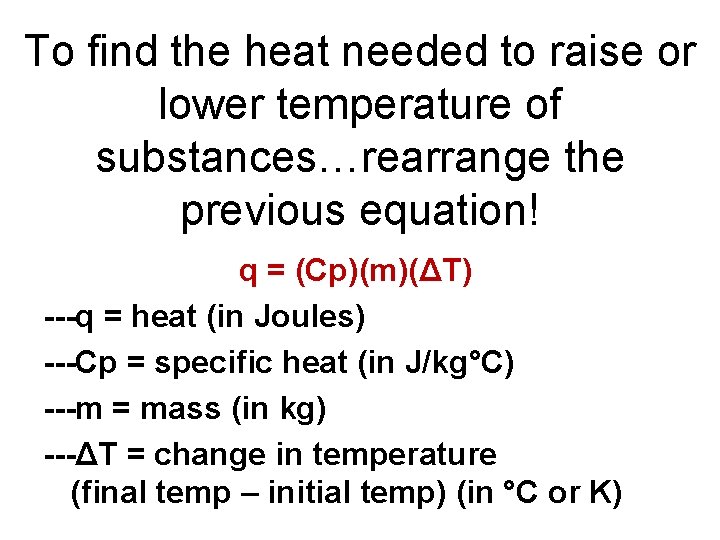
To find the heat needed to raise or lower temperature of substances…rearrange the previous equation! q = (Cp)(m)(ΔT) ---q = heat (in Joules) ---Cp = specific heat (in J/kg°C) ---m = mass (in kg) ---ΔT = change in temperature (final temp – initial temp) (in °C or K)
- Slides: 9