
Kinetic Analysis of Tyrosinase Enzyme Experiment 5 Enzymes
![Enzyme Kinetics Michealis-Menten equation vo = Vmax [S] Km + [S] Vmax= the rate](https://slidetodoc.com/presentation_image_h/a72f3849302e28e9b8f2e5961bce7550/image-9.jpg "Enzyme Kinetics Michealis-Menten equation vo = Vmax [S] Km + [S] Vmax= the rate")


![Data Analysis Use the following formulas to calculate [S] and vo [S]mg/m. L =](https://slidetodoc.com/presentation_image_h/a72f3849302e28e9b8f2e5961bce7550/image-38.jpg "Data Analysis Use the following formulas to calculate [S] and vo [S]mg/m. L =")
- Slides: 39
Kinetic Analysis of Tyrosinase Enzyme Experiment #5
Enzymes as catalysts • It is necessary for biological reactions to occur much quicker than the ambient temperature and prevailing conditions would allow – “catalyst” a substance that when added to a chemical reaction, speeds it up without altering the final products or without itself being consumed. – Enzymes are biological catalysts
Enzyme Benefits • Enzymes provide many medical benefits – – – key to understanding inborn errors of metabolism important in detoxification reactions targets of chemotherapy aid in diagnosis and monitoring therapy primary role of vitamins is as enzyme cofactors key to metabolic control and balance
Enzyme properties • All enzymes are proteins – Molecular Weight range: 15 kd-1000 kd – enzymes show the same physical and chemical properties as all proteins • denaturation • precipitation • sensitivity to proteases • Enzymes are efficient biological catalysts which must operate at 37 o C or below and at p. H values found in living cells
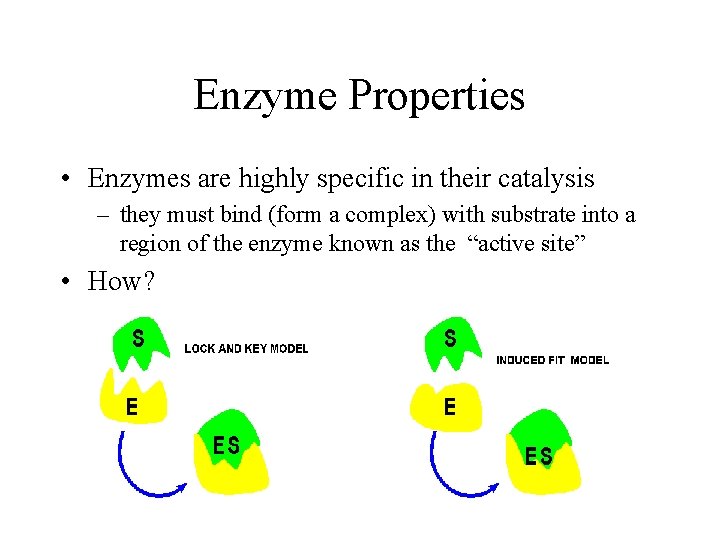
Enzyme Properties • Enzymes are highly specific in their catalysis – they must bind (form a complex) with substrate into a region of the enzyme known as the “active site” • How?
Enzyme Properties • Enzymes also allow the regulation of reactions through activation or inhibition of the enzyme by effectors – ** Virtually all biological reactions are found to be enzyme catalyzed**
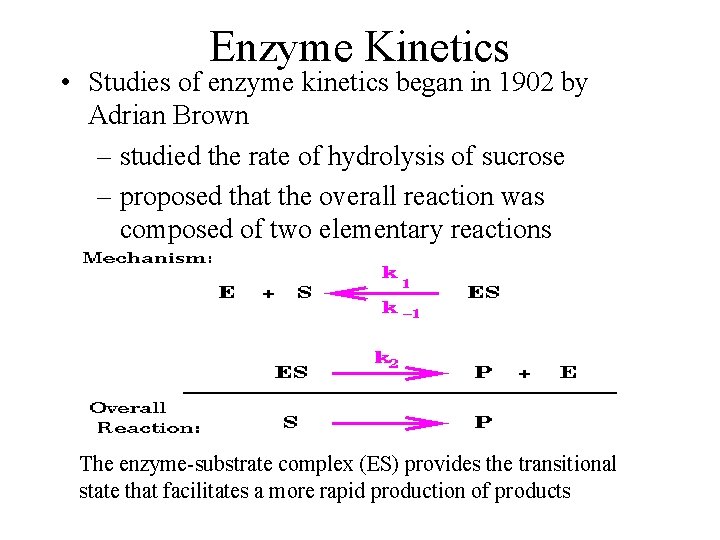
Enzyme Kinetics • Studies of enzyme kinetics began in 1902 by Adrian Brown – studied the rate of hydrolysis of sucrose – proposed that the overall reaction was composed of two elementary reactions The enzyme-substrate complex (ES) provides the transitional state that facilitates a more rapid production of products
Enzyme Kinetics • In 1913, Lenor Michaelis and Maude Menten made the assumption that the reversible step in the mechanism does achieve equilibrium • Therefore, rewriting the law of chemical equilibrium for the reversible step and equating the ratio of the forward to reverse rate constants and making substitutions….
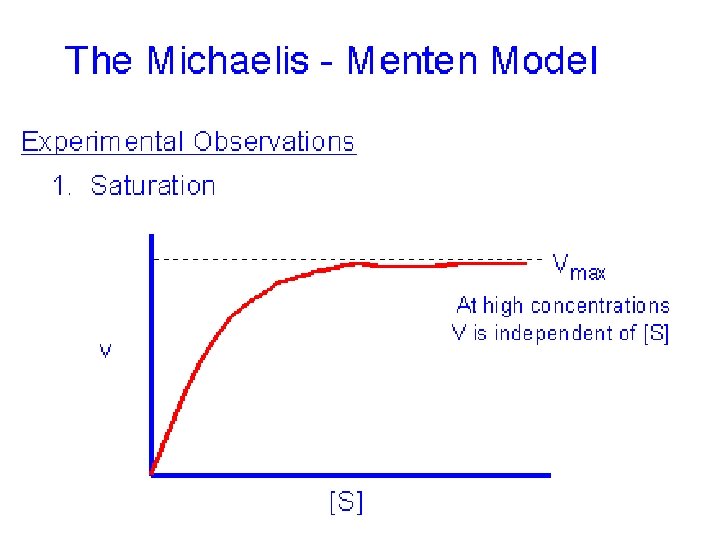
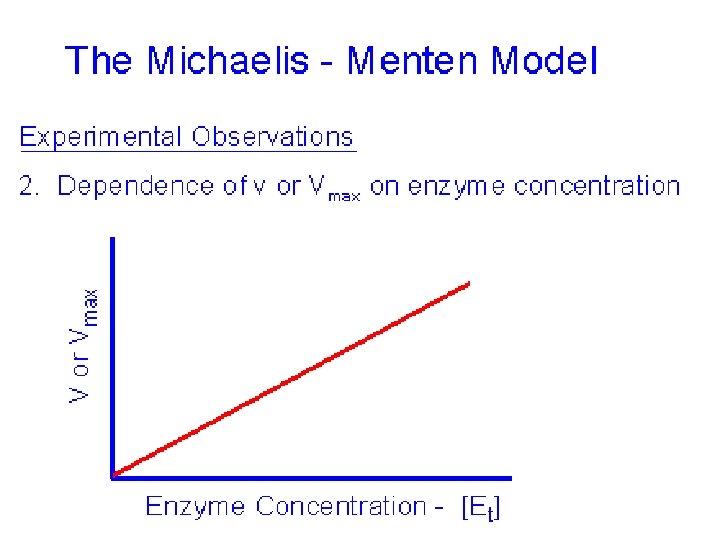
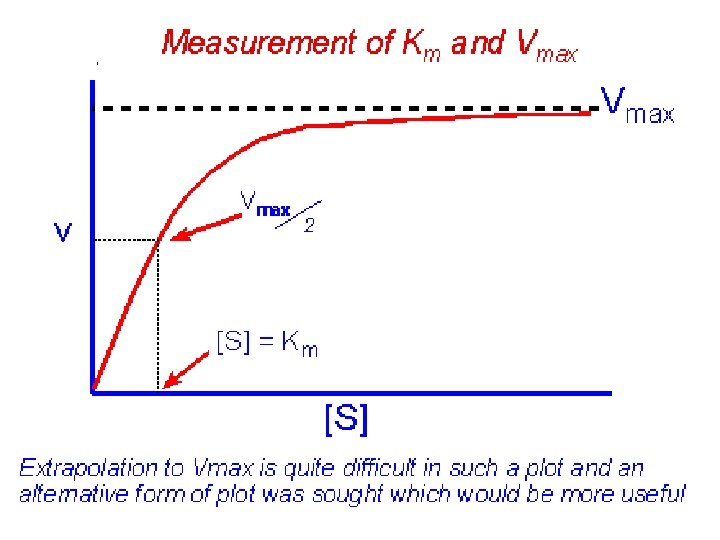
Enzyme Kinetics Michealis-Menten equation vo = Vmax [S] Km + [S] Vmax= the rate of reaction in which all of the active sites of the enzyme are consumed by substrate Km= a ratio of all rate constants involved. Km also represents the substrate concentration at which the reaction rate is 1/2 of Vmax [S] = the concentration of substrate binding to enzyme
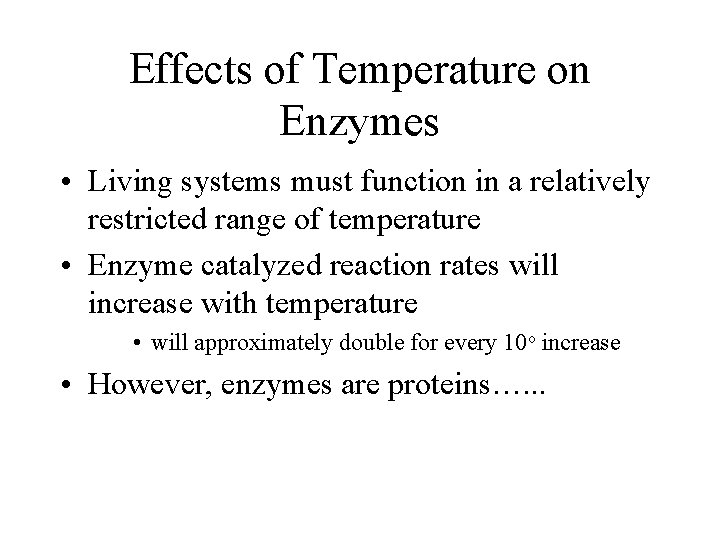
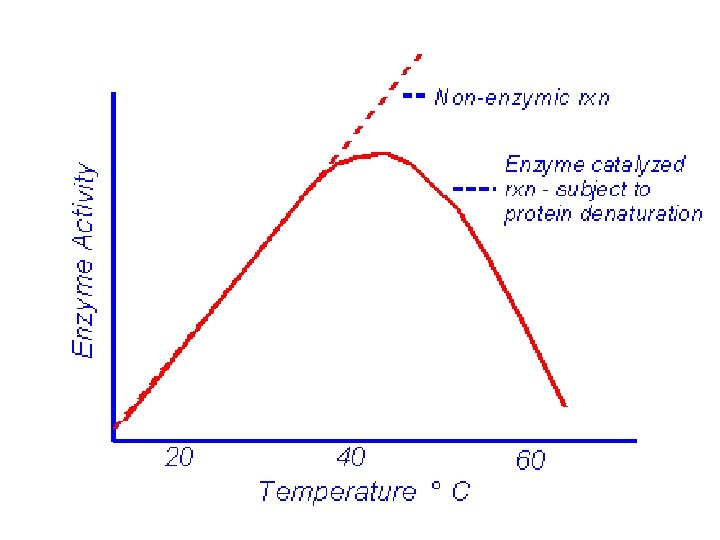
Effects of Temperature on Enzymes • Living systems must function in a relatively restricted range of temperature • Enzyme catalyzed reaction rates will increase with temperature • will approximately double for every 10 o increase • However, enzymes are proteins…. . .
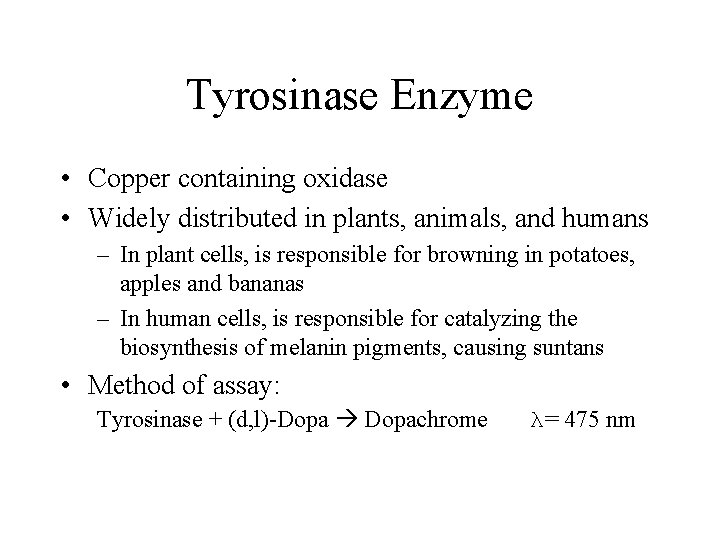
Tyrosinase Enzyme • Copper containing oxidase • Widely distributed in plants, animals, and humans – In plant cells, is responsible for browning in potatoes, apples and bananas – In human cells, is responsible for catalyzing the biosynthesis of melanin pigments, causing suntans • Method of assay: Tyrosinase + (d, l)-Dopa Dopachrome λ= 475 nm
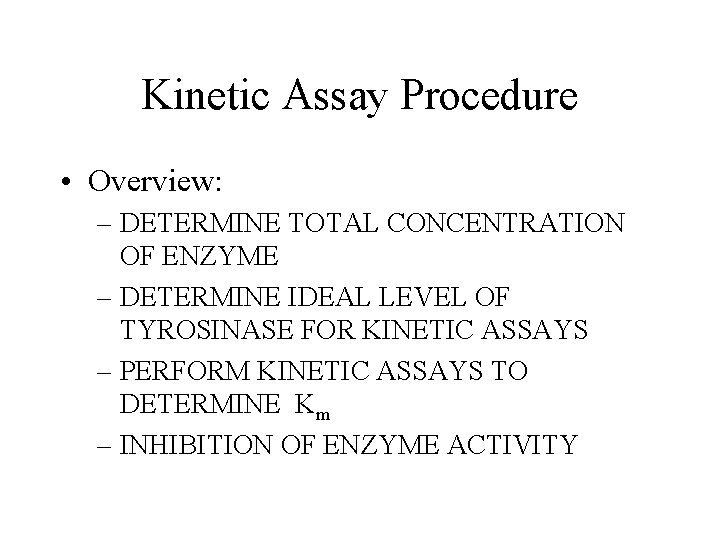
Kinetic Assay Procedure • Overview: – DETERMINE TOTAL CONCENTRATION OF ENZYME – DETERMINE IDEAL LEVEL OF TYROSINASE FOR KINETIC ASSAYS – PERFORM KINETIC ASSAYS TO DETERMINE Km – INHIBITION OF ENZYME ACTIVITY
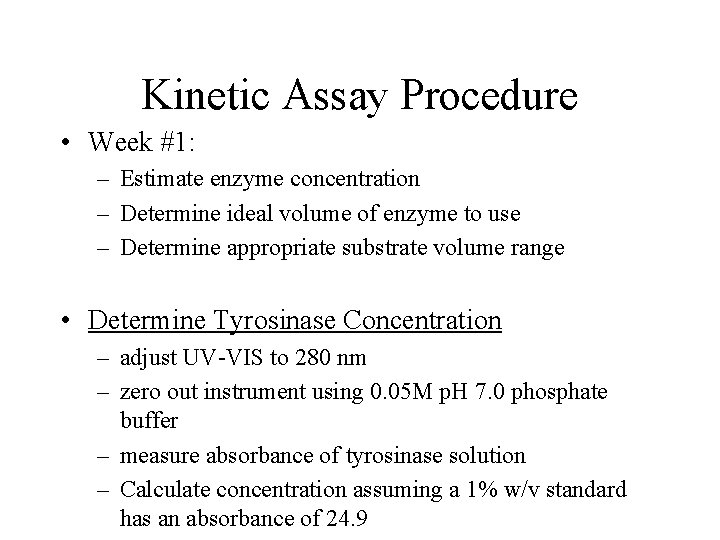
Kinetic Assay Procedure • Week #1: – Estimate enzyme concentration – Determine ideal volume of enzyme to use – Determine appropriate substrate volume range • Determine Tyrosinase Concentration – adjust UV-VIS to 280 nm – zero out instrument using 0. 05 M p. H 7. 0 phosphate buffer – measure absorbance of tyrosinase solution – Calculate concentration assuming a 1% w/v standard has an absorbance of 24. 9
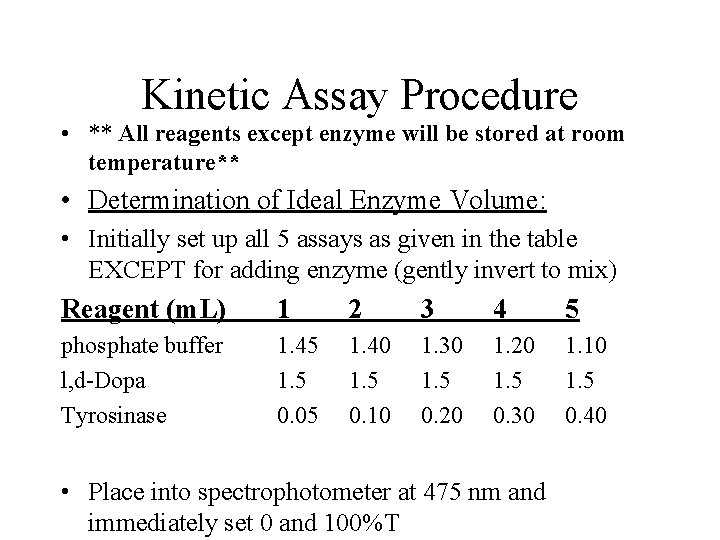
Kinetic Assay Procedure • ** All reagents except enzyme will be stored at room temperature** • Determination of Ideal Enzyme Volume: • Initially set up all 5 assays as given in the table EXCEPT for adding enzyme (gently invert to mix) Reagent (m. L) 1 2 3 4 5 phosphate buffer l, d-Dopa Tyrosinase 1. 45 1. 5 0. 05 1. 40 1. 5 0. 10 1. 30 1. 5 0. 20 1. 5 0. 30 1. 10 1. 5 0. 40 • Place into spectrophotometer at 475 nm and immediately set 0 and 100%T
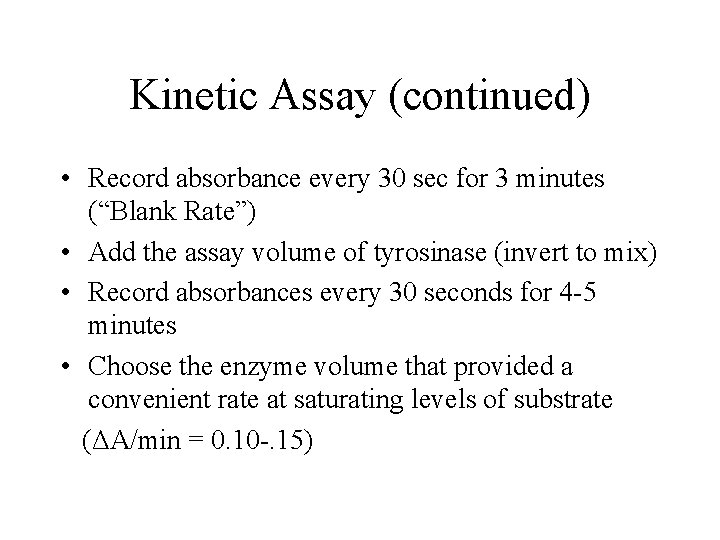
Kinetic Assay (continued) • Record absorbance every 30 sec for 3 minutes (“Blank Rate”) • Add the assay volume of tyrosinase (invert to mix) • Record absorbances every 30 seconds for 4 -5 minutes • Choose the enzyme volume that provided a convenient rate at saturating levels of substrate (ΔA/min = 0. 10 -. 15)
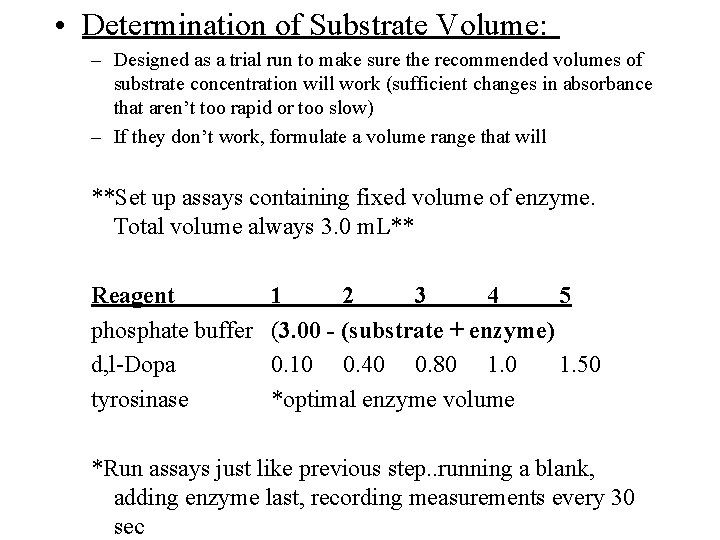
• Determination of Substrate Volume: – Designed as a trial run to make sure the recommended volumes of substrate concentration will work (sufficient changes in absorbance that aren’t too rapid or too slow) – If they don’t work, formulate a volume range that will **Set up assays containing fixed volume of enzyme. Total volume always 3. 0 m. L** Reagent phosphate buffer d, l-Dopa tyrosinase 1 2 3 4 5 (3. 00 - (substrate + enzyme) 0. 10 0. 40 0. 80 1. 50 *optimal enzyme volume *Run assays just like previous step. . running a blank, adding enzyme last, recording measurements every 30 sec
Kinetic Analysis of Tyrosinase Enzyme Experiment #5 Week#2: Determination of Km Inhibition
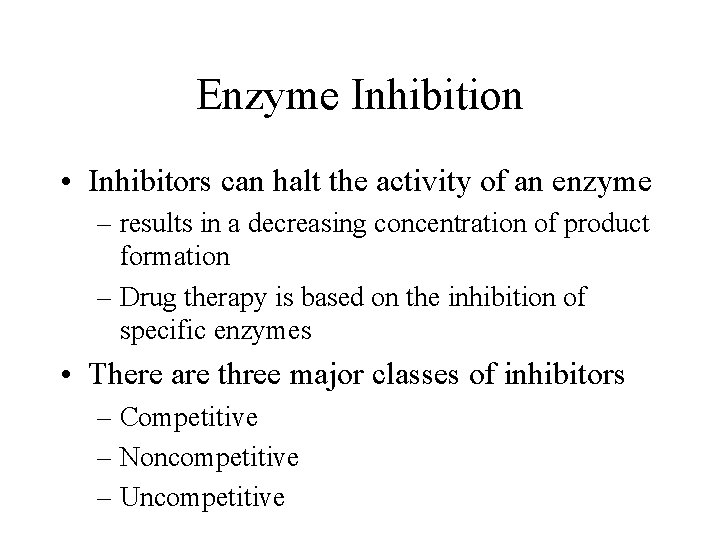
Enzyme Inhibition • Inhibitors can halt the activity of an enzyme – results in a decreasing concentration of product formation – Drug therapy is based on the inhibition of specific enzymes • There are three major classes of inhibitors – Competitive – Noncompetitive – Uncompetitive
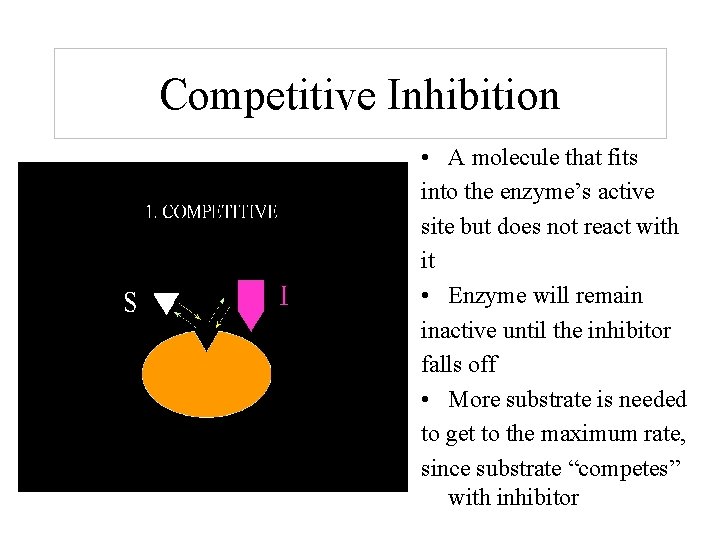
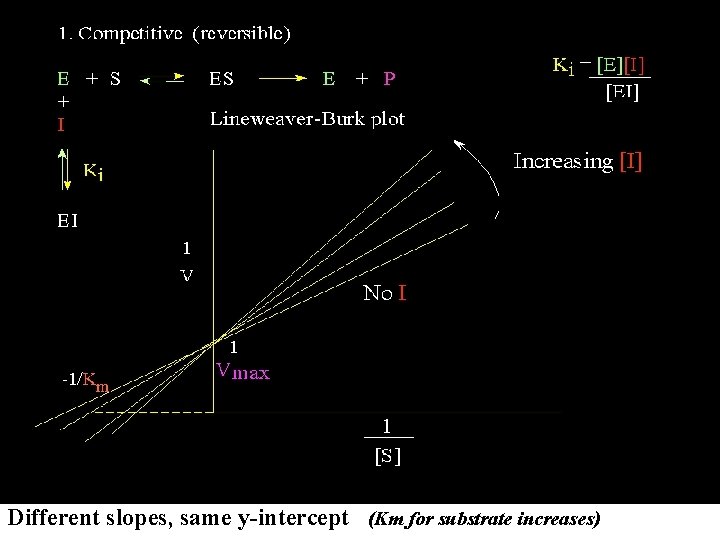
Competitive Inhibition • A molecule that fits into the enzyme’s active site but does not react with it • Enzyme will remain inactive until the inhibitor falls off • More substrate is needed to get to the maximum rate, since substrate “competes” with inhibitor
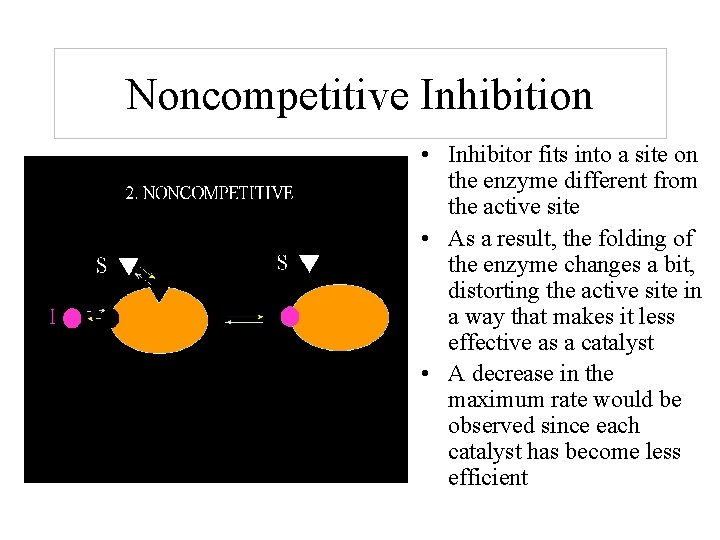
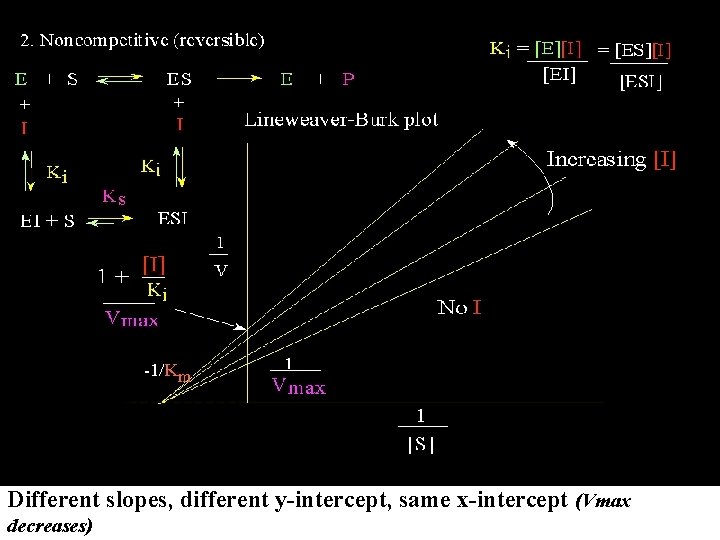
Noncompetitive Inhibition • Inhibitor fits into a site on the enzyme different from the active site • As a result, the folding of the enzyme changes a bit, distorting the active site in a way that makes it less effective as a catalyst • A decrease in the maximum rate would be observed since each catalyst has become less efficient
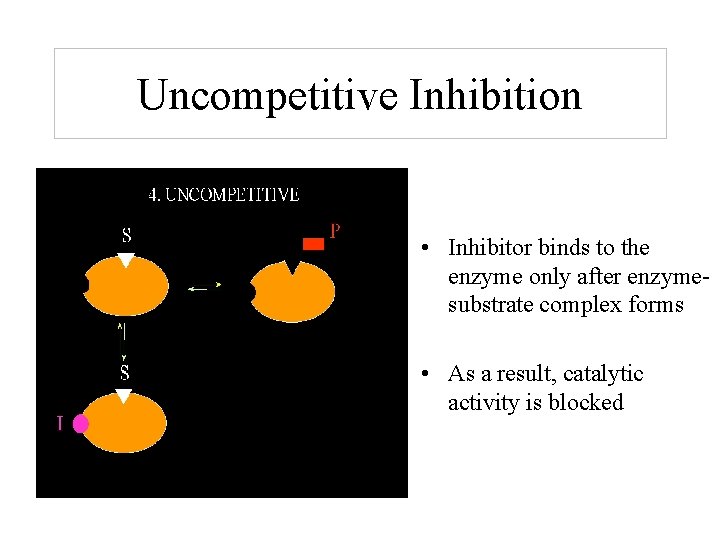
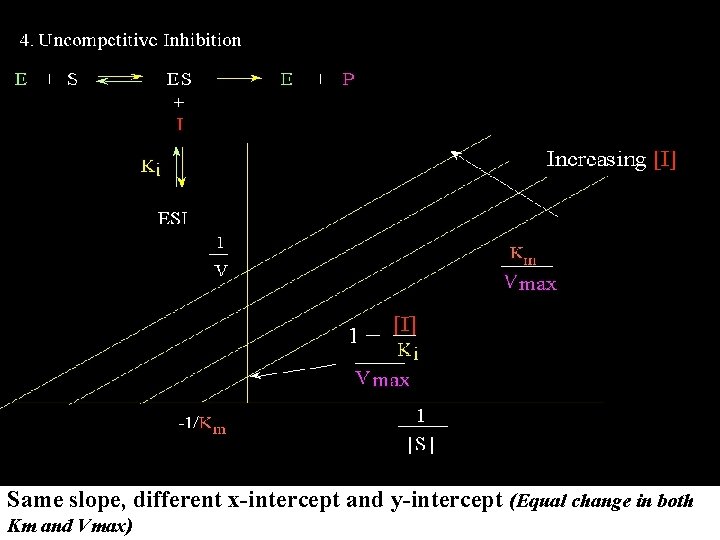
Uncompetitive Inhibition • Inhibitor binds to the enzyme only after enzymesubstrate complex forms • As a result, catalytic activity is blocked
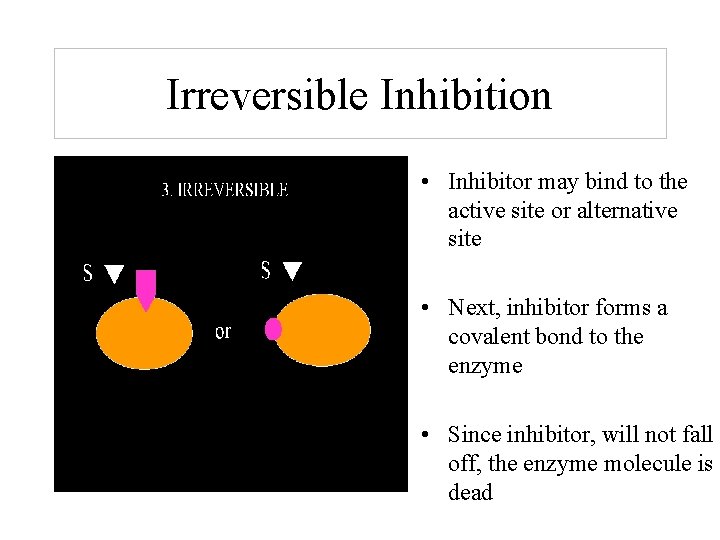
Irreversible Inhibition • Inhibitor may bind to the active site or alternative site • Next, inhibitor forms a covalent bond to the enzyme • Since inhibitor, will not fall off, the enzyme molecule is dead
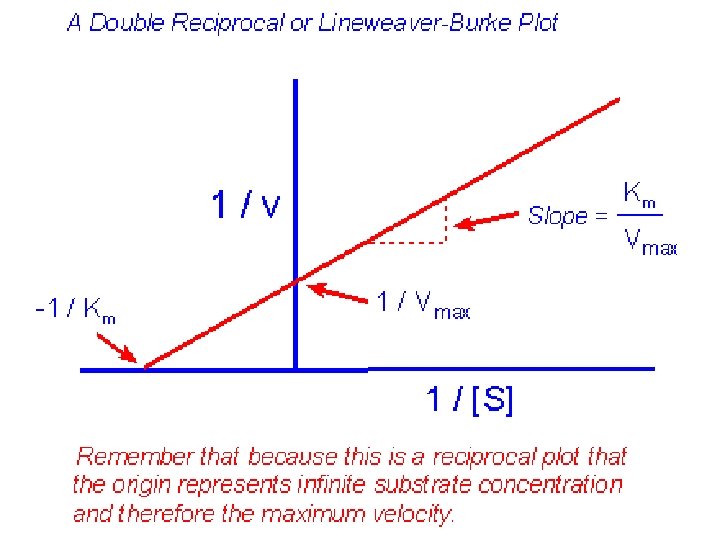
Different slopes, same y-intercept (Km for substrate increases)
Different slopes, different y-intercept, same x-intercept (Vmax decreases)
Same slope, different x-intercept and y-intercept (Equal change in both Km and Vmax)
Inhibitors to tyrosinase • Several compounds act as inhibitors to tyrosinase enzyme…. . We will examine: – Thiourea – Cinnamic Acid “Cinnamic acid was found to be effective in apple juice, especially when used in combination with ascorbic acid (Walker, 1976: Sapers et al. , 1989 b). This inhibitor was also effective when applied to cut surfaces of apples, but induced browning under some circumstances. Carbon monoxide has been proposed as a browning inhibitor for mushrooms (Albisu et al. , 1989). ”
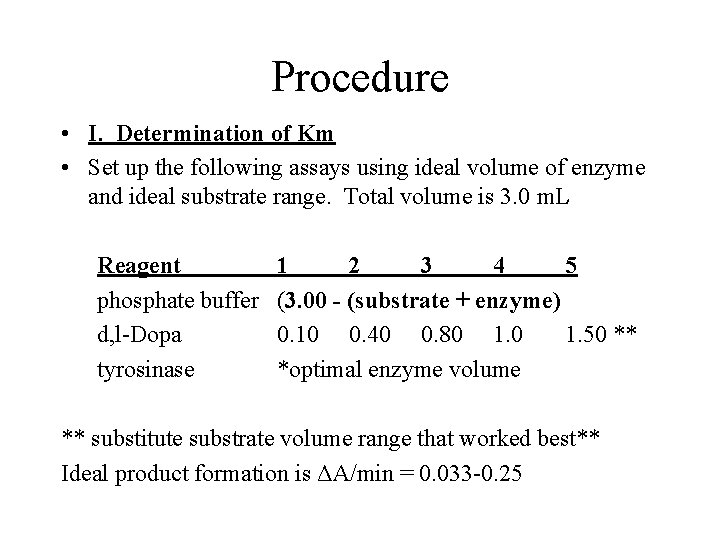
Procedure • I. Determination of Km • Set up the following assays using ideal volume of enzyme and ideal substrate range. Total volume is 3. 0 m. L Reagent phosphate buffer d, l-Dopa tyrosinase 1 2 3 4 5 (3. 00 - (substrate + enzyme) 0. 10 0. 40 0. 80 1. 50 ** *optimal enzyme volume ** substitute substrate volume range that worked best** Ideal product formation is ΔA/min = 0. 033 -0. 25
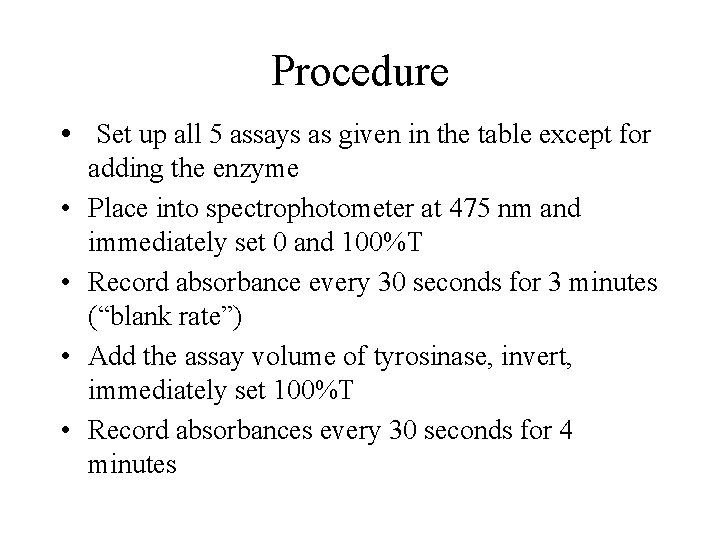
Procedure • Set up all 5 assays as given in the table except for • • adding the enzyme Place into spectrophotometer at 475 nm and immediately set 0 and 100%T Record absorbance every 30 seconds for 3 minutes (“blank rate”) Add the assay volume of tyrosinase, invert, immediately set 100%T Record absorbances every 30 seconds for 4 minutes
Procedure • II. Inhibition • Choose one of the three inhibitors • Choose a constant level of inhibitor that results in at least 20 -30% decrease in rate (for an intermediate concentration of substrate) Reagent phosphate buffer d, l-Dopa inhibitor 1 2 3 4 5 (3. 00 m. L - (substrate + inhibitor + enzyme)) 0. 10 0. 40 0. 80 1. 50 ** determined by trial and error tyrosinase *optimal enzyme volume Run assays just like in Km determination (set up blank rate with buffer, substrate, and inhibitor)
Data Analysis
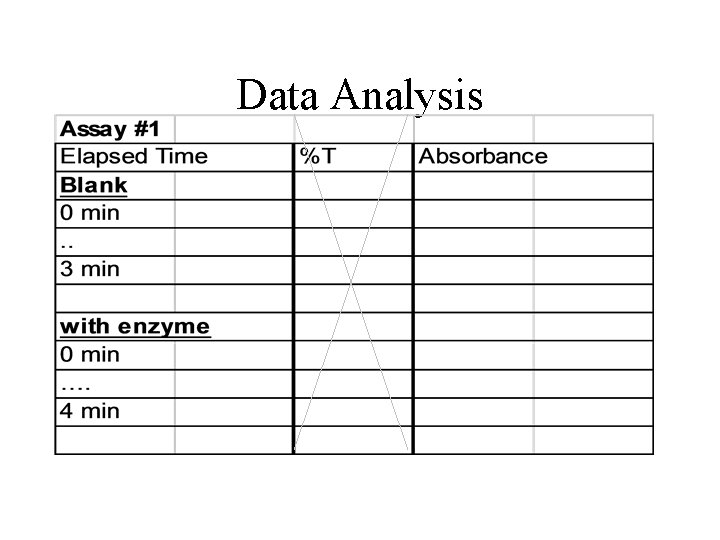
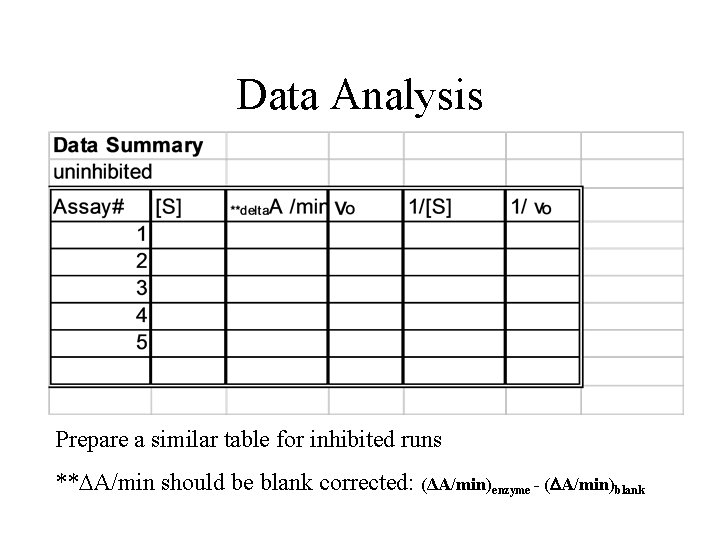
Data Analysis Prepare a similar table for inhibited runs ** A/min should be blank corrected: (ΔA/min)enzyme - ( A/min)blank
Data Analysis Use the following formulas to calculate [S] and vo [S]mg/m. L = (volume used in assay)(“Stock conc. ” mg/m. L) 3. 0 m. L [S] mol/L = Smg/m. L x 1 197. 2 The rate of reaction is dependent on production of Dopachrome molar absorptivity constant of dopachrome = 3600 mol/Lcm Δc = ΔA/min 3600 x 1 cm (Δmol/Lmin ) (Δc )(. 003 L)(106 ) = vo (umol/min)
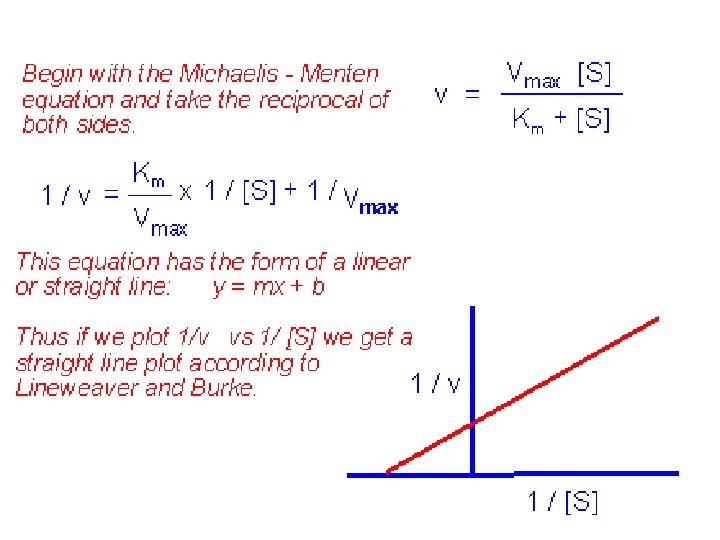
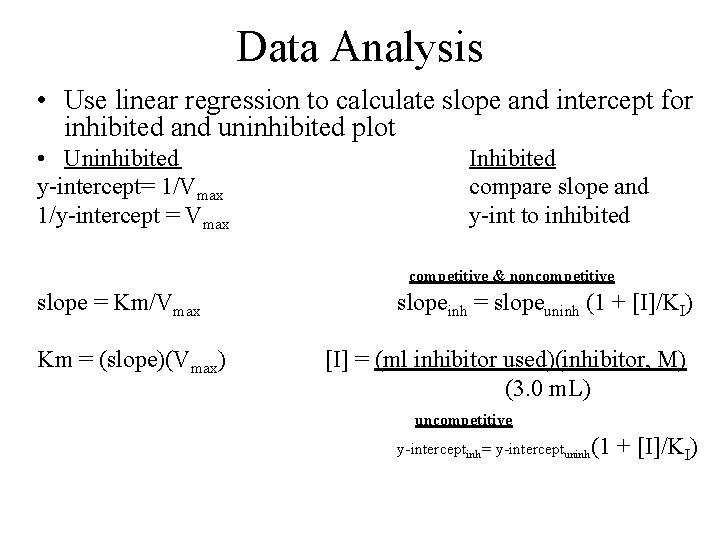
Data Analysis • Use linear regression to calculate slope and intercept for inhibited and uninhibited plot • Uninhibited y-intercept= 1/Vmax 1/y-intercept = Vmax Inhibited compare slope and y-int to inhibited competitive & noncompetitive slope = Km/Vmax Km = (slope)(Vmax) slopeinh = slopeuninh (1 + [I]/KI) [I] = (ml inhibitor used)(inhibitor, M) (3. 0 m. L) uncompetitive y-interceptinh = y-interceptuninh (1 + [I]/KI)