
Kinesiology Chapter 3 Osteology Shapes of Bones Long
Kinesiology Chapter 3: Osteology
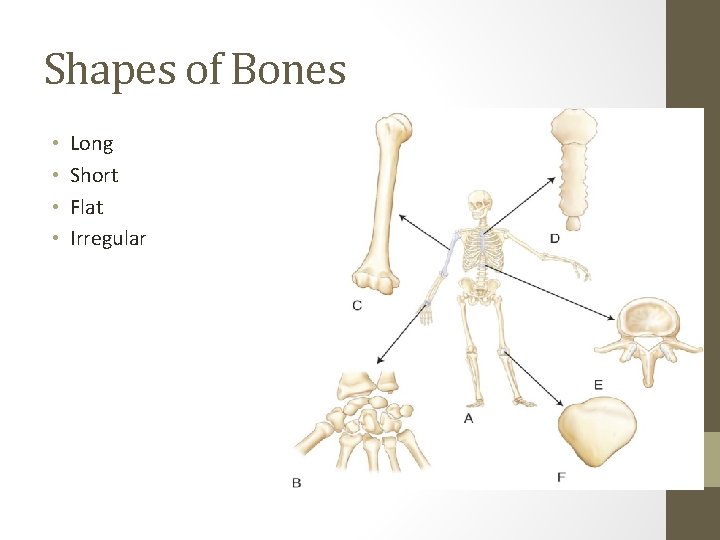
Shapes of Bones • • Long Short Flat Irregular
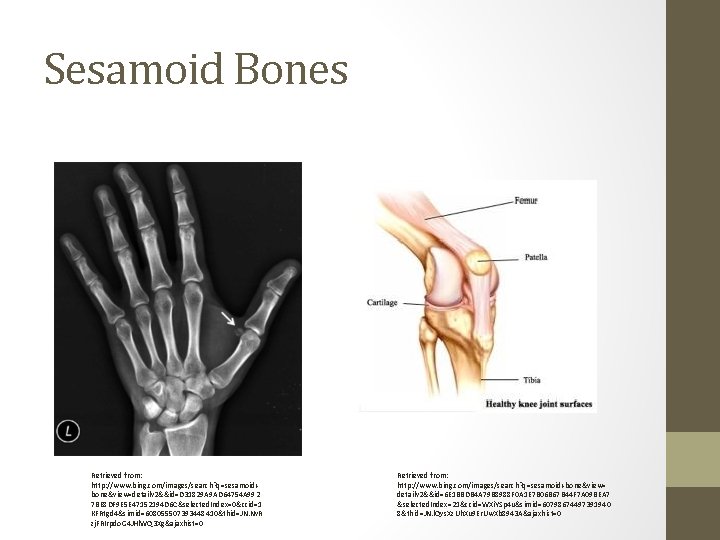
Sesamoid Bones Retrieved from: http: //www. bing. com/images/search? q=sesamoid+ bone&view=detailv 2&&id=D 31829 A 9 AD 64754 A 992 7 BE 8 DF 9 E 5 E 47152194 D 6 C&selected. Index=0&ccid=1 KFRtgd 4&simid=608055507393448410&thid=JN. Nv. R zj. FRIrpdo. G 4 JHl. WQ 3 Xg&ajaxhist=0 Retrieved from: http: //www. bing. com/images/search? q=sesamoid+bone&view= detailv 2&&id=6 E 1 BBDB 4 A 79 B 8988 F 0 A 1 E 7 B 06 B 67 B 44 F 7 A 09 BEA 7 &selected. Index=21&ccid=WXi. YSp 4 u&simid=60798674497391940 8&thid=JN. l. Qvs. Xz. Uh. Xu 9 Er. Uw. Xb 8943 A&ajaxhist=0
Parts of a Long Bone • Diaphysis- shaft of a long bone; its shape is that of a hollow cylindric tube. • Epiphysis- expanded end of a long bone found at each end of the diaphysis. • Articular Cartilage- covers the articular surfaces (i. e. , joint surfaces) of a bone. • Periosteum- thin dense fibrous membrane which surrounds the entire bone, except for the articular surfaces, which are covered with articular cartilage. • Medullary Cavity- tubelike cavity located within the diaphysis of a long bone • Endosteum - thin membrane that lines the inner surface of the bone within the medullary cavity. (Muscolino 36 -37) Muscolino, Joseph E. Kinesiology: The Skeletal System and Muscle Function, 2 nd Edition. Mosby, 2011. Vital. Book file.
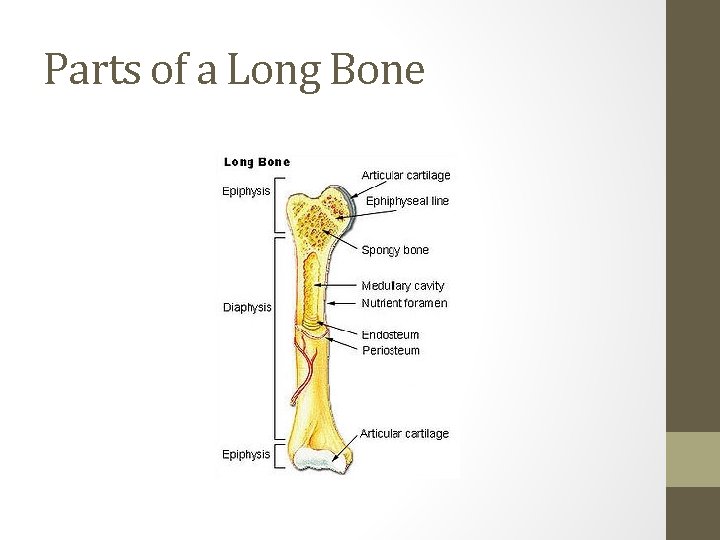
Parts of a Long Bone
Functions of Bones • • • Structural support of the body Provide levers for body movements Protection of underlying structures Blood cell formation Storage reservoir for calcium
Levers • http: //www. enchantedlearning. com/physics/machines/Levers. shtml • Leverage= angle of pull of the muscle at its bony attachment • Longer levers produce more force • First-class lever- triceps acting on ulna • Second-class lever- forearm and brachialis muscle • Third-class lever-most common in the body Considered force reducers Muscle forces > resistance or load Create wide ranges of motion and high-velocity movements Small muscular forces can create large movements of long bony segments • Biceps brachii, deltoid, extensor carpi radialis • •
Calcium • Critical to functioning of the human body • Conducts impulses in the nervous system • Contracts muscles • Clots blood
Bone Cells Osteoblasts: Osteoblasts build up bone tissue by secreting matrix tissue of the bone. Osteocytes: Once osteoblasts are fully surrounded by the matrix of bone and lie within small chambers (lacunae) within the bony matrix, they are called osteocytes. Osteoclasts: Osteoclasts break down bone tissue by breaking down the matrix tissue of the bone. (Muscolino 40) Muscolino, Joseph E. Kinesiology: The Skeletal System and Muscle Function, 2 nd Edition. Mosby, 2011. Vital. Book file.
Organic/Inorganic Matrix • Osteoid Tissue (organic) -Gel-like -Adds to the resiliency of the bone -Contains Proteoglycans (trap fluid so bone does not become too dry or brittle) • Collagen Fibers (organic) -Add to bone’s tensile strength • Hydroxyapatite Crystals (inorganic) - Mineral content - Calcium-phosphate salts - Gives bone its rigidity
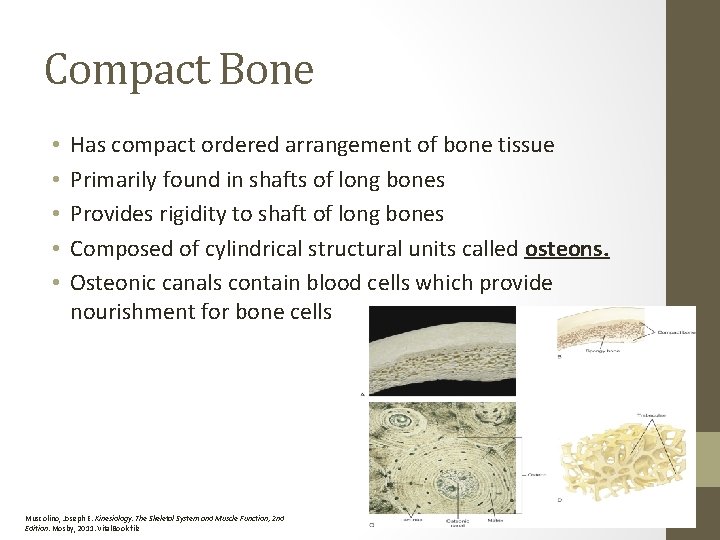
Compact Bone • • • Has compact ordered arrangement of bone tissue Primarily found in shafts of long bones Provides rigidity to shaft of long bones Composed of cylindrical structural units called osteons. Osteonic canals contain blood cells which provide nourishment for bone cells Muscolino, Joseph E. Kinesiology: The Skeletal System and Muscle Function, 2 nd Edition. Mosby, 2011. Vital. Book file
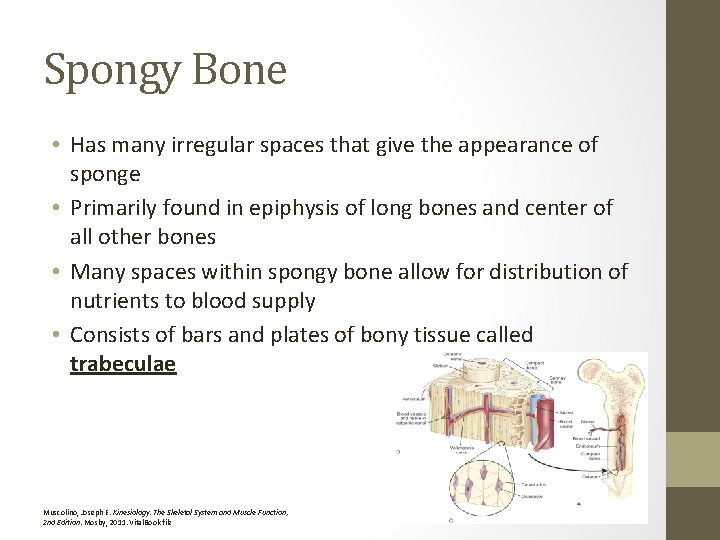
Spongy Bone • Has many irregular spaces that give the appearance of sponge • Primarily found in epiphysis of long bones and center of all other bones • Many spaces within spongy bone allow for distribution of nutrients to blood supply • Consists of bars and plates of bony tissue called trabeculae Muscolino, Joseph E. Kinesiology: The Skeletal System and Muscle Function, 2 nd Edition. Mosby, 2011. Vital. Book file
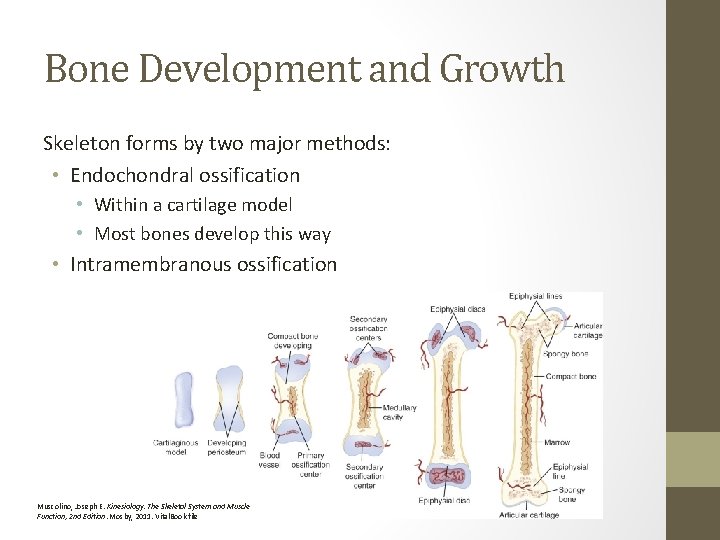
Bone Development and Growth Skeleton forms by two major methods: • Endochondral ossification • Within a cartilage model • Most bones develop this way • Intramembranous ossification Muscolino, Joseph E. Kinesiology: The Skeletal System and Muscle Function, 2 nd Edition. Mosby, 2011. Vital. Book file
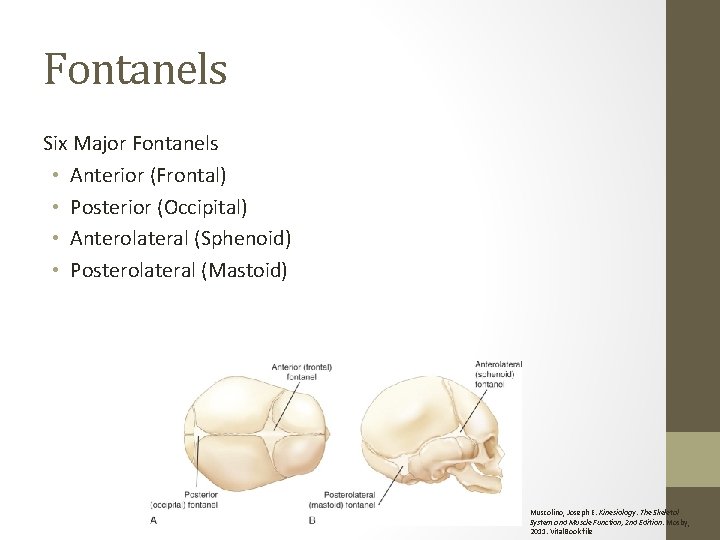
Fontanels Six Major Fontanels • Anterior (Frontal) • Posterior (Occipital) • Anterolateral (Sphenoid) • Posterolateral (Mastoid) Muscolino, Joseph E. Kinesiology: The Skeletal System and Muscle Function, 2 nd Edition. Mosby, 2011. Vital. Book file
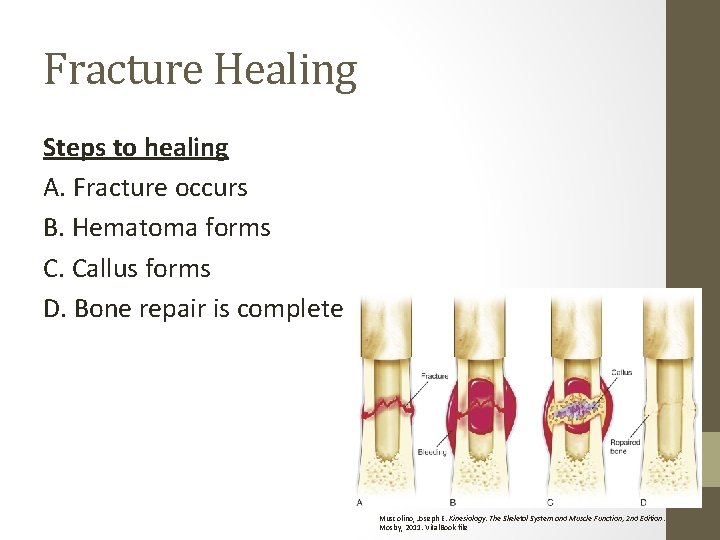
Fracture Healing Steps to healing A. Fracture occurs B. Hematoma forms C. Callus forms D. Bone repair is complete Muscolino, Joseph E. Kinesiology: The Skeletal System and Muscle Function, 2 nd Edition. Mosby, 2011. Vital. Book file
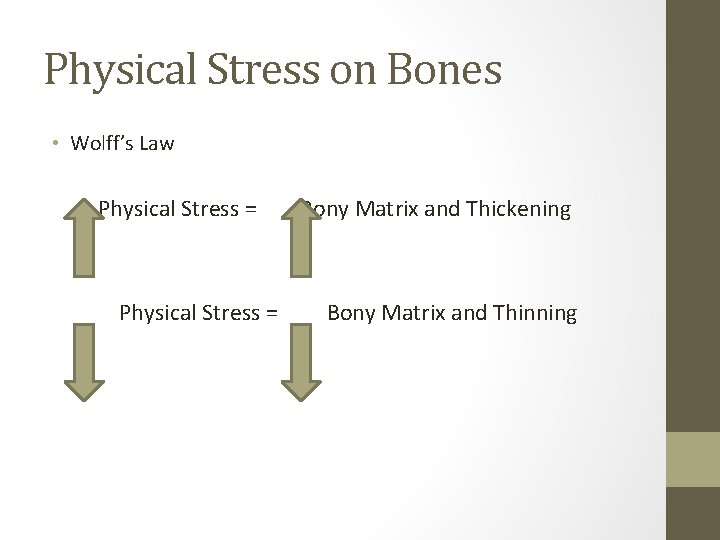
Physical Stress on Bones • Wolff’s Law Physical Stress = Bony Matrix and Thickening Bony Matrix and Thinning
Piezoelectric Effect Pressure on tissue = electric charge in tissue • Osteoclasts are unable to break down peizoelectrically charged tissue • Bones remodel and change their shape in response to forces places on them • Explains why exercise is so important to healthy skeleton
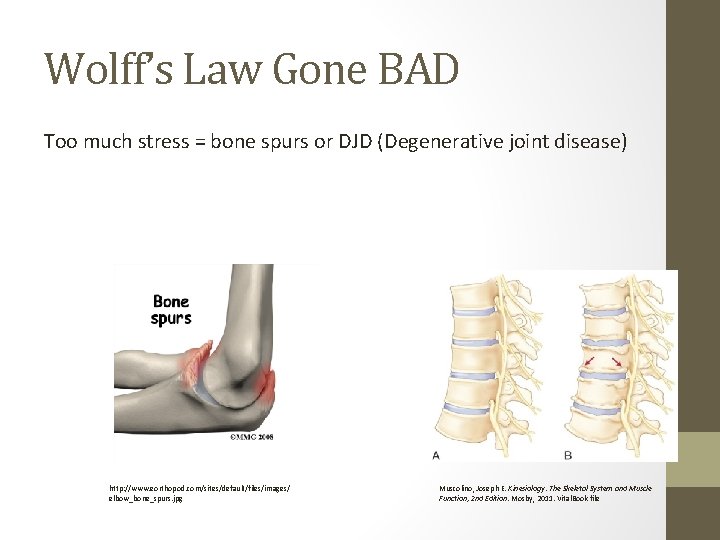
Wolff’s Law Gone BAD Too much stress = bone spurs or DJD (Degenerative joint disease) http: //www. eorthopod. com/sites/default/files/images/ elbow_bone_spurs. jpg Muscolino, Joseph E. Kinesiology: The Skeletal System and Muscle Function, 2 nd Edition. Mosby, 2011. Vital. Book file
Cartilage Tissue Unites bones of cartilaginous joints Caps joints (articular) surfaces of bones of synovial joints Intra-articular disks composed of cartilage Provides framework for developing bones during process of endochondral ossification • Two types of cartilage cells: Chondroblasts and Chondrocytes • •
Cartilage Tissue • Dense and firm even though classified as soft tissue • Very poor blood supply which results in poor healing • Blood supplied by blood vessels located in perichondrium, a fibrous connective tissue that covers cartilage • Like bone tissue, is a connective tissue and composed of cartilage cells and matrix
3 Types of Cartilage 1. ) Hyaline • Most common • Caps articular surfaces of bones of synovial joints • Role is to absorb compressive shock • Found in epiphysial plate of growing bones • Forms the soft part of the nose • Located within the rings of the respiratory passage
3 Types of Cartilage 2. ) Fibrocartilage • Contains greater density of fibrous collagen fibers • Toughest form of cartilaginous tissue • Forms the union of most cartilaginous joints (disk joints of the spine, symphysis pubis joint of the pelvis) • Intra-articular disks, found in sternoclavicular, wrist, and knee joints are made of fibrocartilage
3 Types of Cartilage 3. ) Elastic • Contains collagen and elastic fibers • Best suited for structures that require the firmness of cartilage but also require a great degree of elasticity • Gives form to the external ear and epiglottis
Fascia • • • Wraps around and connects structures Two main types: Fibrous and Loose Composed of cells, fibers, and ground substance Most common cell found is fibroblast Three types of fibers are found: Collagen, elastin, and reticular fibers
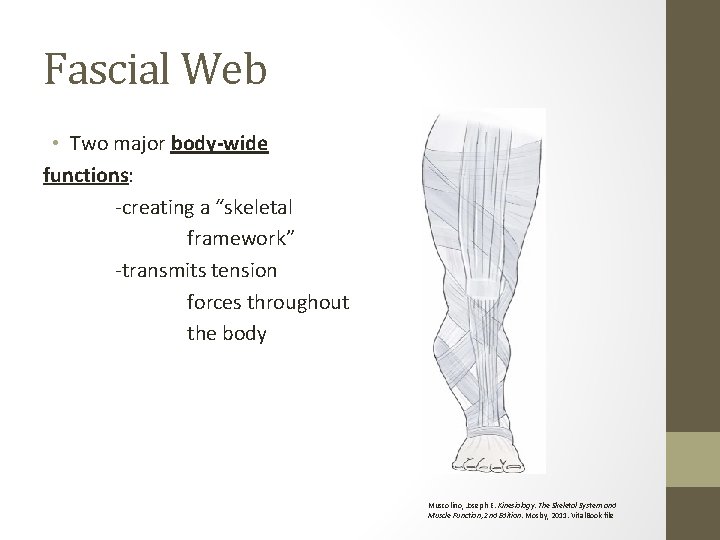
Fascial Web • Two major body-wide functions: -creating a “skeletal framework” -transmits tension forces throughout the body Muscolino, Joseph E. Kinesiology: The Skeletal System and Muscle Function, 2 nd Edition. Mosby, 2011. Vital. Book file
Fascial Response to Physical Stress • Responds to physical stress by laying down increased collagen fibers and forming cells called myofibroblasts • Piezoelectric Effect occurs when pressure is placed on fascia • WHY IS THIS IMPORTANT TO REMEMBER? ?
Tendons and Ligaments Tendons • Connects a muscle to a bone • Shape is round and cordlike • Transmits pulling force to create movement Ligaments • Connects a bone to a bone • Creates stability at a joint by holding bones of the joint together
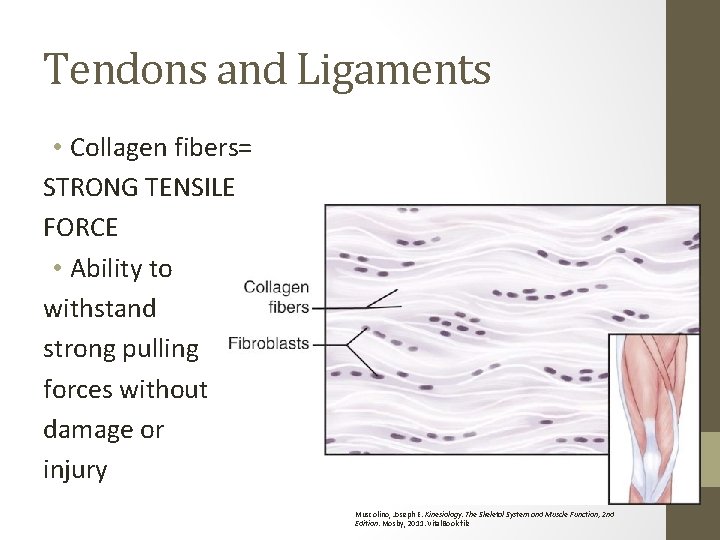
Tendons and Ligaments • Collagen fibers= STRONG TENSILE FORCE • Ability to withstand strong pulling forces without damage or injury Muscolino, Joseph E. Kinesiology: The Skeletal System and Muscle Function, 2 nd Edition. Mosby, 2011. Vital. Book file
Bursae and Tendon Sheaths Bursae • Flattened sac of synovial membrane • Contains synovial fluid • Often found between tendon and bone Tendon Sheath • Sheathlike bursae that envelops a tendon • Commonly found in hands and feet where tendons rub against an adjacent structure
Retinaculum • Thin sheet of fibrous connective tissue that holds down and stabilizes a structure • Commonly found retaining tendons that cross into hands and feet • Tendon sheaths are located in these regions to minimize friction between tendons and retinacula
Properties of Skeletal Tissues Stretch- ability to become longer Contractility- ability to shorten Weight Bearing- ability to bear compressive force Tensile strength- ability to withstand a pulling force Elasticity- ability to return to its normal length after being stretched Plasticity- ability to have its shape molded or altered and remain the new shape • Creep- gradual change in the shape of tissue when subjected to a force that is applied in slow or sustained manner • Thixotropy- ability of a soft tissue of the body to change from a more rigid gel state to a softer more hydrated state (increased blood and nutrient flow) • Hysteresis- tissue exhibits fluid loss and minute structural damage as a result of friction and heat build up • • •
- Slides: 31