
Kinematics of Particles Plane Curvilinear Motion Lesson 3
- Slides: 24
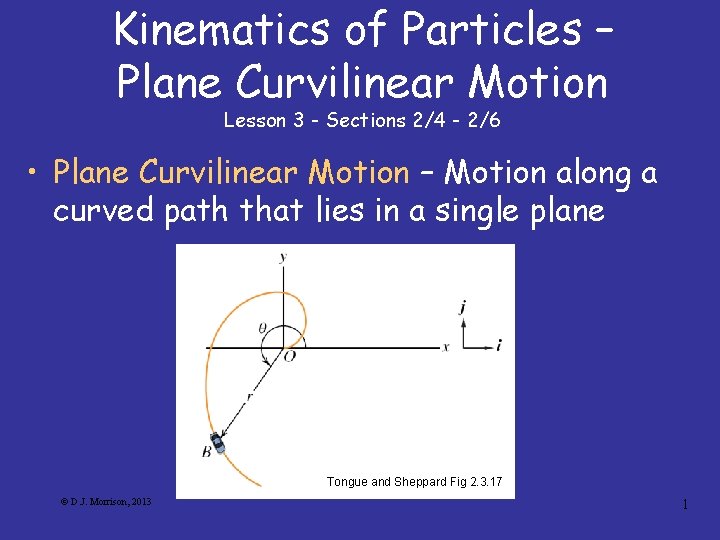
Kinematics of Particles – Plane Curvilinear Motion Lesson 3 - Sections 2/4 - 2/6 • Plane Curvilinear Motion – Motion along a curved path that lies in a single plane Tongue and Sheppard Fig 2. 3. 17 © D. J. Morrison, 2013 1
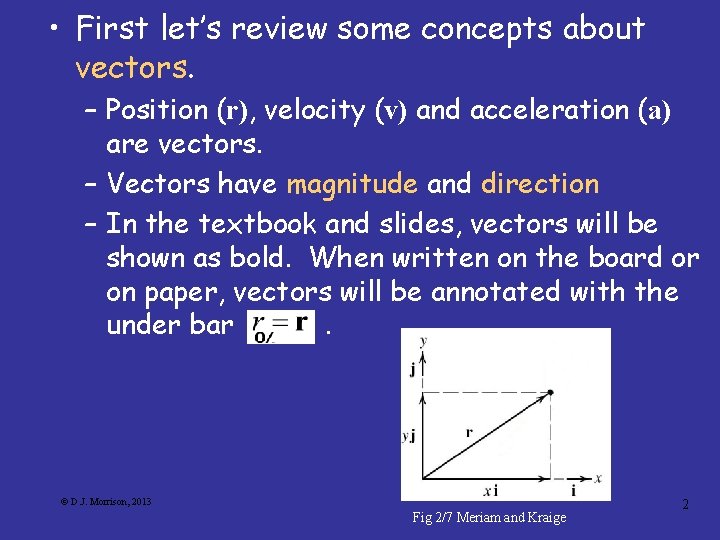
• First let’s review some concepts about vectors. – Position (r), velocity (v) and acceleration (a) are vectors. – Vectors have magnitude and direction – In the textbook and slides, vectors will be shown as bold. When written on the board or on paper, vectors will be annotated with the under bar. © D. J. Morrison, 2013 Fig 2/7 Meriam and Kraige 2
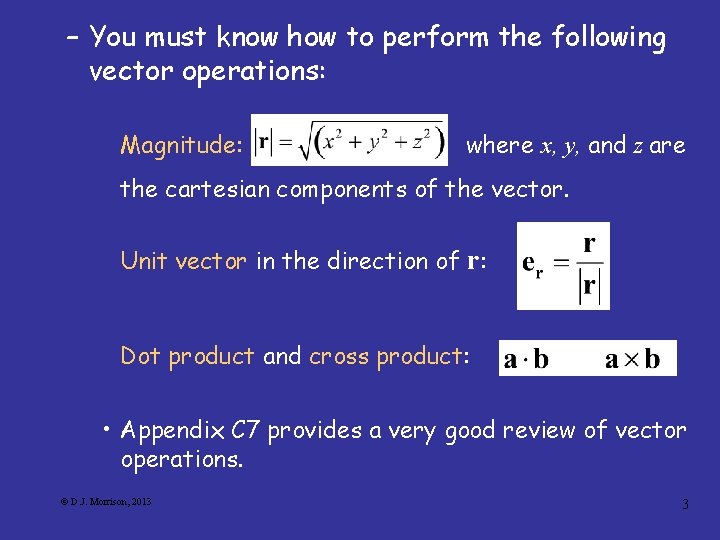
– You must know how to perform the following vector operations: Magnitude: where x, y, and z are the cartesian components of the vector. Unit vector in the direction of r: Dot product and cross product: • Appendix C 7 provides a very good review of vector operations. © D. J. Morrison, 2013 3
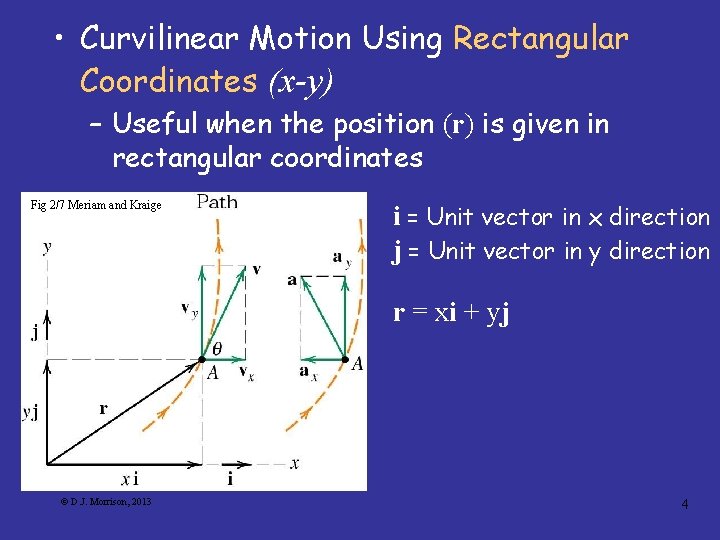
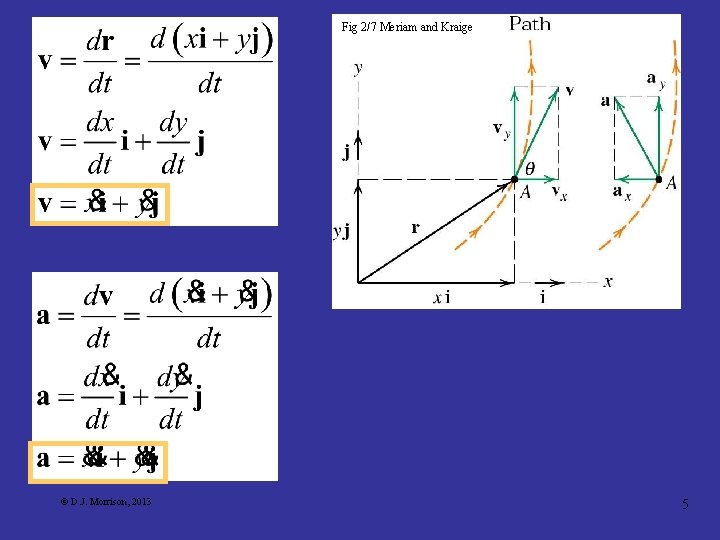
• Curvilinear Motion Using Rectangular Coordinates (x-y) – Useful when the position (r) is given in rectangular coordinates Fig 2/7 Meriam and Kraige i = Unit vector in x direction j = Unit vector in y direction r = xi + yj © D. J. Morrison, 2013 4
Fig 2/7 Meriam and Kraige © D. J. Morrison, 2013 5
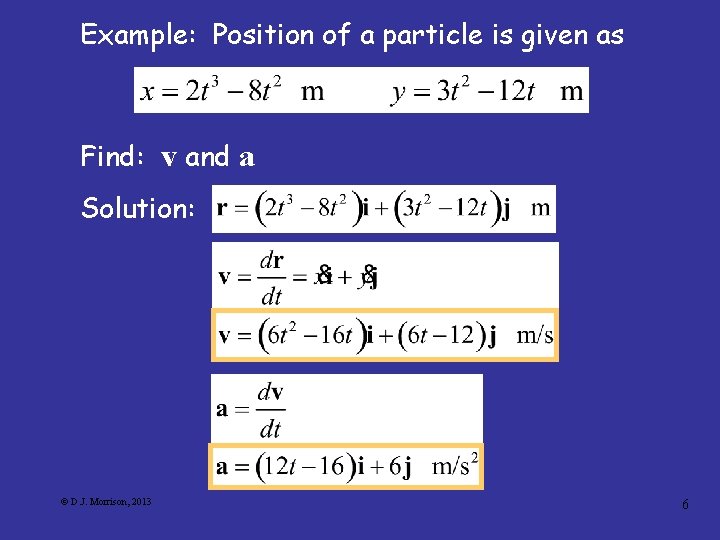
Example: Position of a particle is given as Find: v and a Solution: © D. J. Morrison, 2013 6
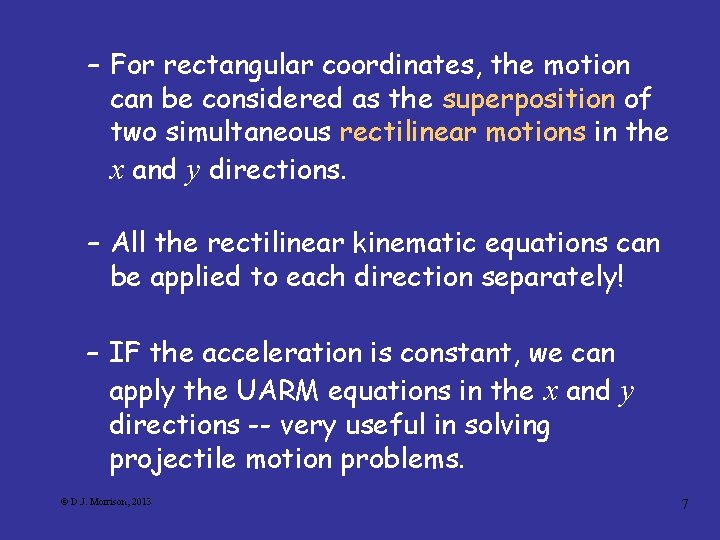
– For rectangular coordinates, the motion can be considered as the superposition of two simultaneous rectilinear motions in the x and y directions. – All the rectilinear kinematic equations can be applied to each direction separately! – IF the acceleration is constant, we can apply the UARM equations in the x and y directions -- very useful in solving projectile motion problems. © D. J. Morrison, 2013 7
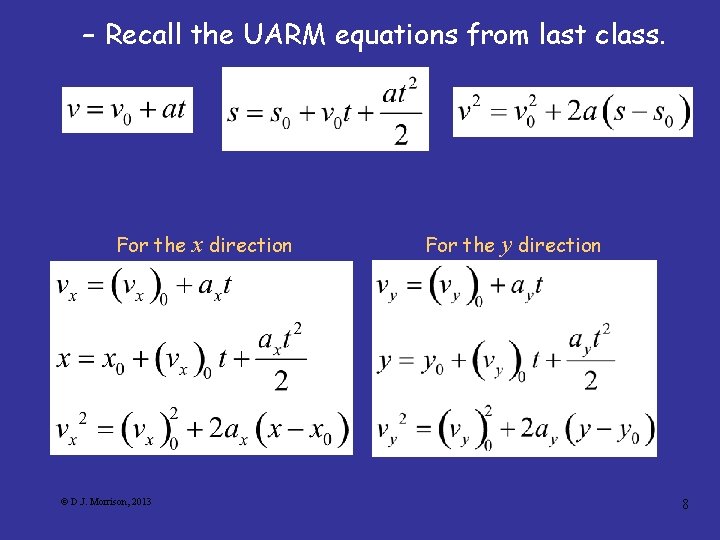
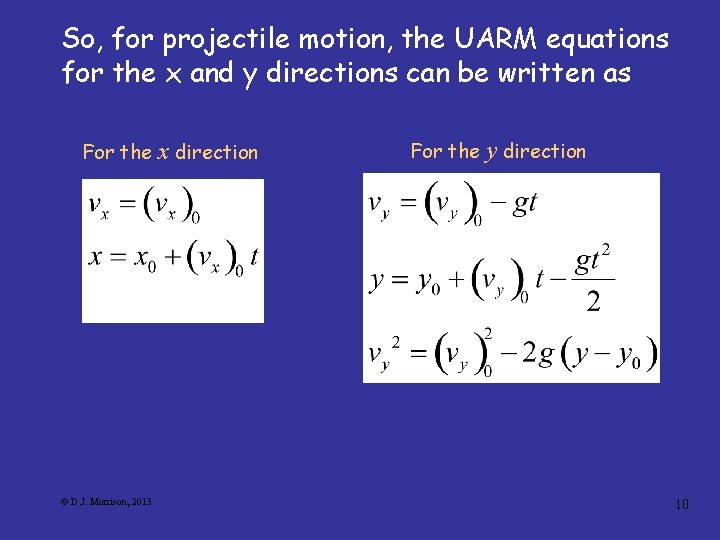
– Recall the UARM equations from last class. For the © D. J. Morrison, 2013 x direction For the y direction 8
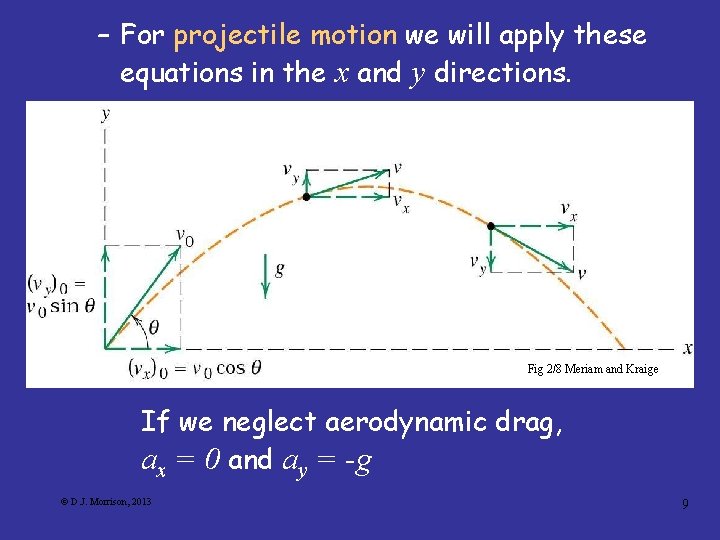
– For projectile motion we will apply these equations in the x and y directions. Fig 2/8 Meriam and Kraige If we neglect aerodynamic drag, ax = 0 and ay = -g © D. J. Morrison, 2013 9
So, for projectile motion, the UARM equations for the x and y directions can be written as For the © D. J. Morrison, 2013 x direction For the y direction 10
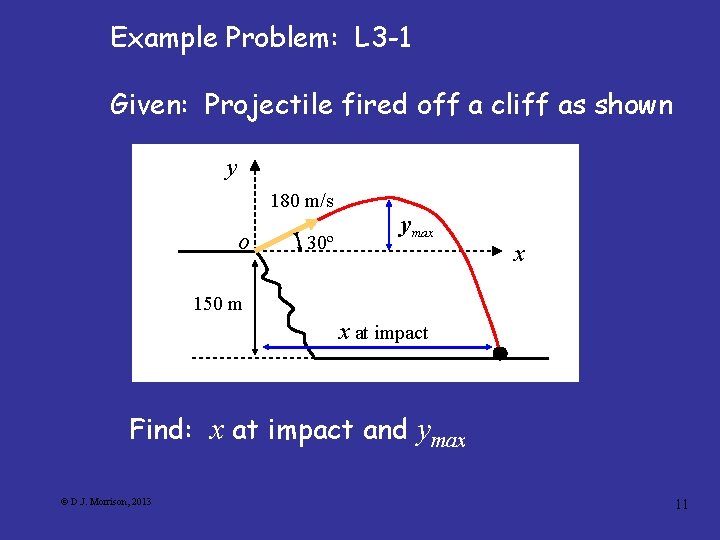
Example Problem: L 3 -1 Given: Projectile fired off a cliff as shown y 180 m/s o 30º ymax x 150 m x at impact Find: x at impact and ymax © D. J. Morrison, 2013 11
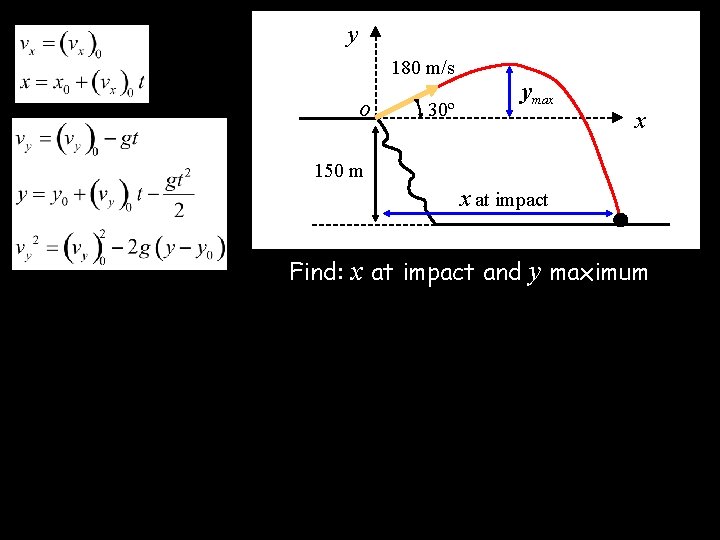
y 180 m/s o 30º ymax x 150 m x at impact Find: x at impact and y maximum © D. J. Morrison, 2013 12
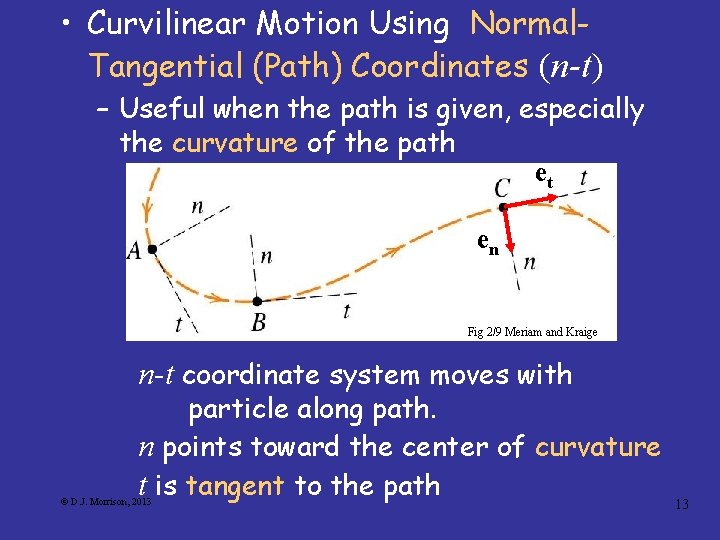
• Curvilinear Motion Using Normal. Tangential (Path) Coordinates (n-t) – Useful when the path is given, especially the curvature of the path et en Fig 2/9 Meriam and Kraige n-t coordinate system moves with particle along path. n points toward the center of curvature t is tangent to the path © D. J. Morrison, 2013 13
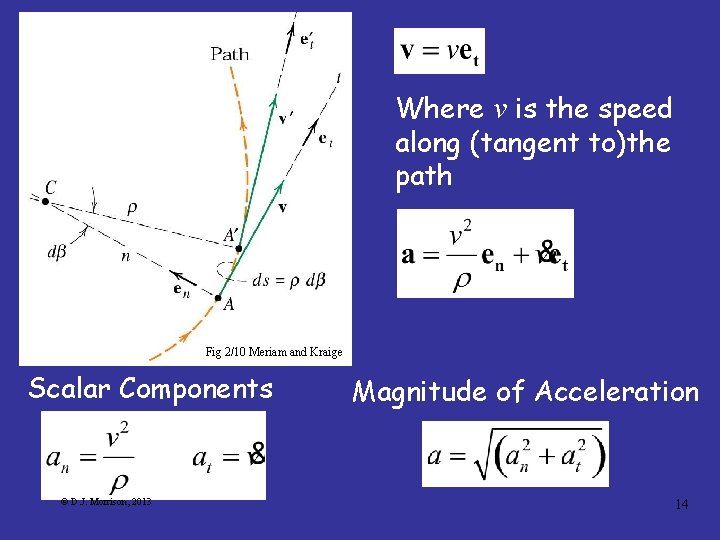
Where v is the speed along (tangent to)the path Fig 2/10 Meriam and Kraige Scalar Components © D. J. Morrison, 2013 Magnitude of Acceleration 14
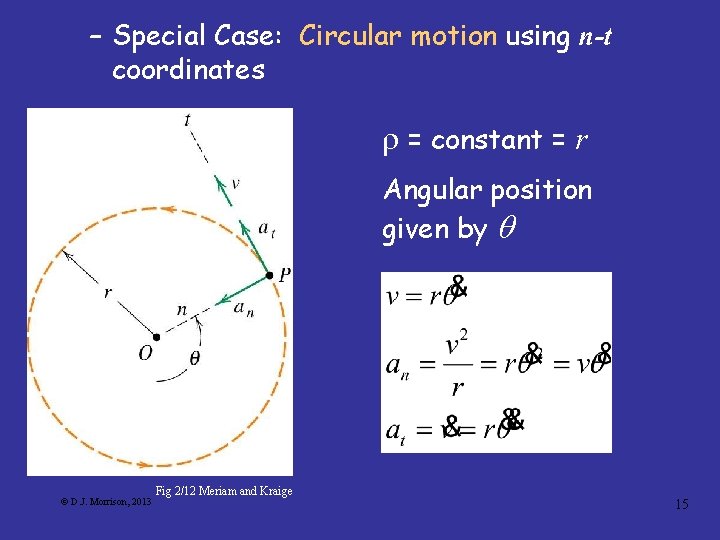
– Special Case: Circular motion using n-t coordinates = constant = r Angular position given by © D. J. Morrison, 2013 Fig 2/12 Meriam and Kraige 15
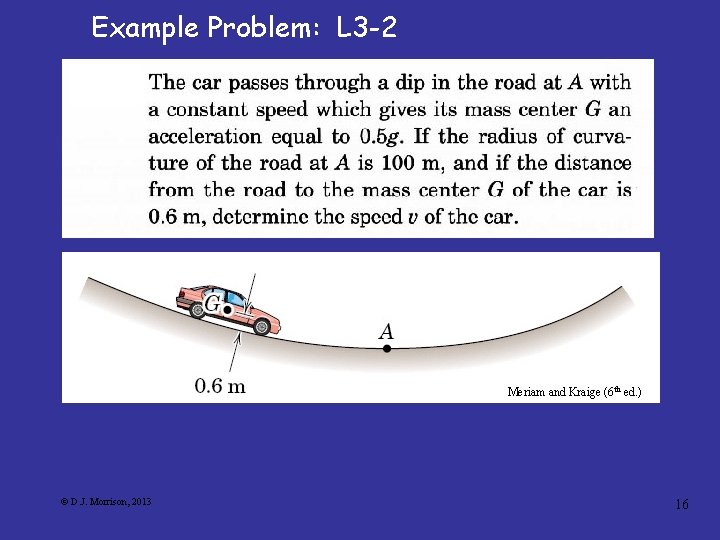
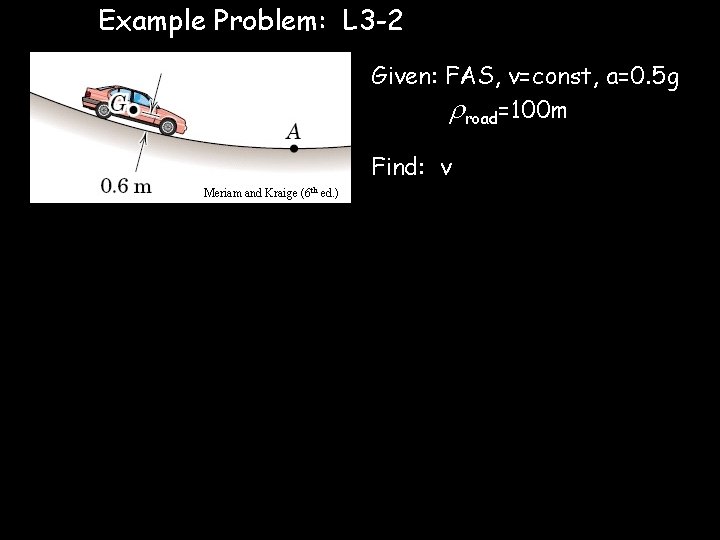
Example Problem: L 3 -2 Meriam and Kraige (6 th ed. ) © D. J. Morrison, 2013 16
Example Problem: L 3 -2 Given: FAS, v=const, a=0. 5 g road=100 m Find: v Meriam and Kraige (6 th ed. ) © D. J. Morrison, 2013 17
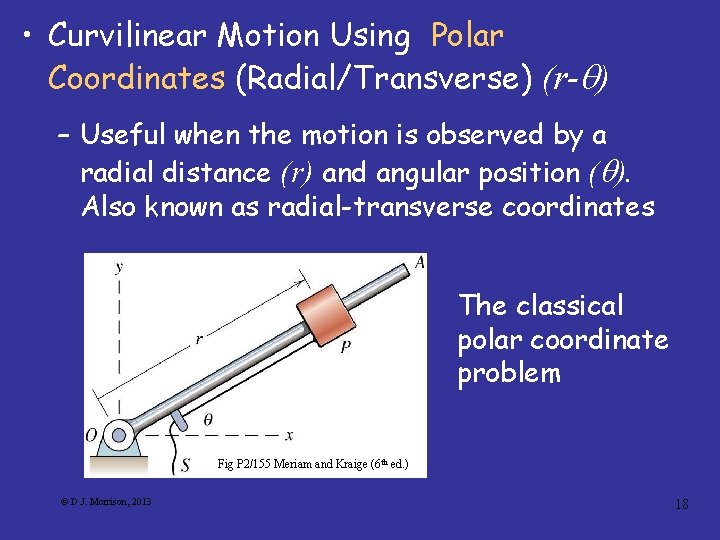
• Curvilinear Motion Using Polar Coordinates (Radial/Transverse) (r- ) – Useful when the motion is observed by a radial distance (r) and angular position ( ). Also known as radial-transverse coordinates The classical polar coordinate problem Fig P 2/155 Meriam and Kraige (6 th ed. ) © D. J. Morrison, 2013 18
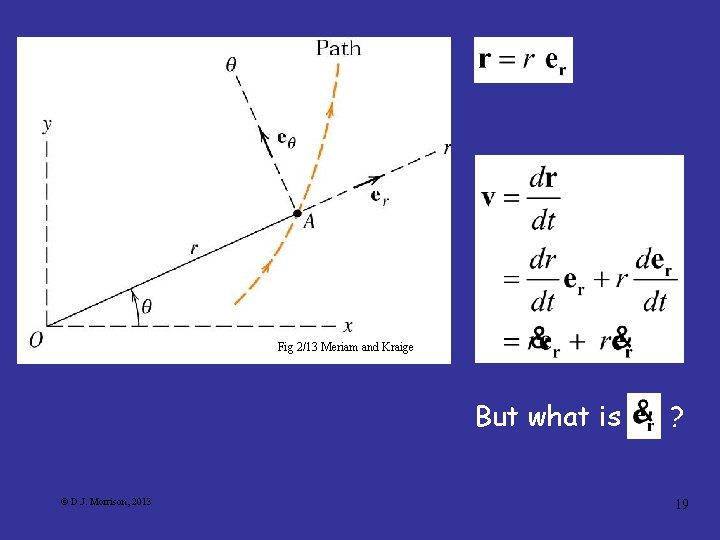
Fig 2/13 Meriam and Kraige But what is © D. J. Morrison, 2013 ? 19
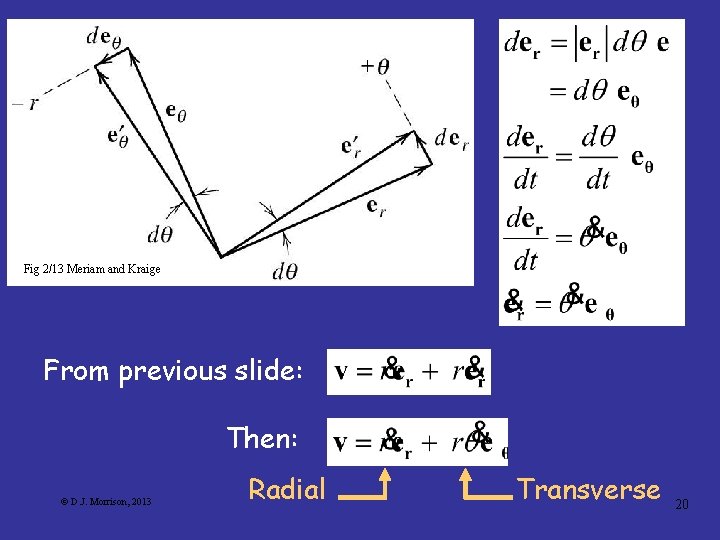
Fig 2/13 Meriam and Kraige From previous slide: Then: © D. J. Morrison, 2013 Radial Transverse 20
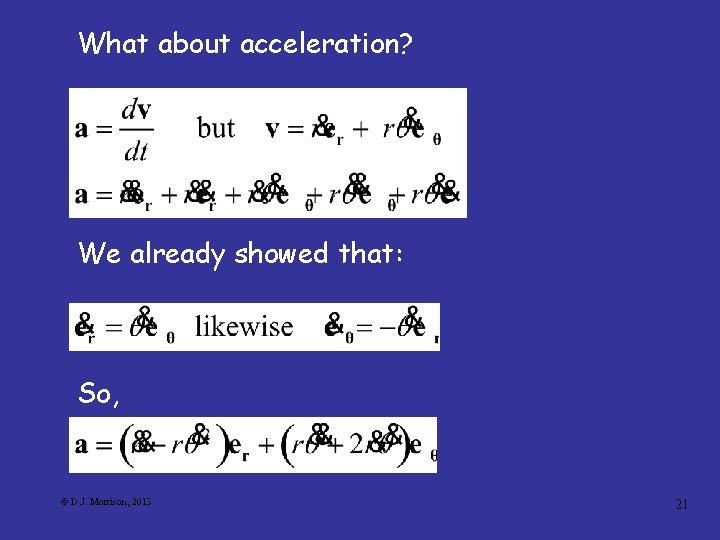
What about acceleration? We already showed that: So, © D. J. Morrison, 2013 21
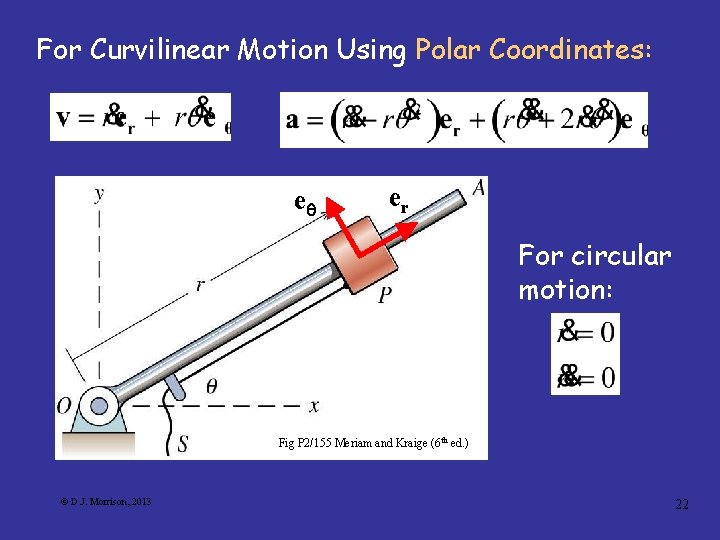
For Curvilinear Motion Using Polar Coordinates: e er For circular motion: Fig P 2/155 Meriam and Kraige (6 th ed. ) © D. J. Morrison, 2013 22
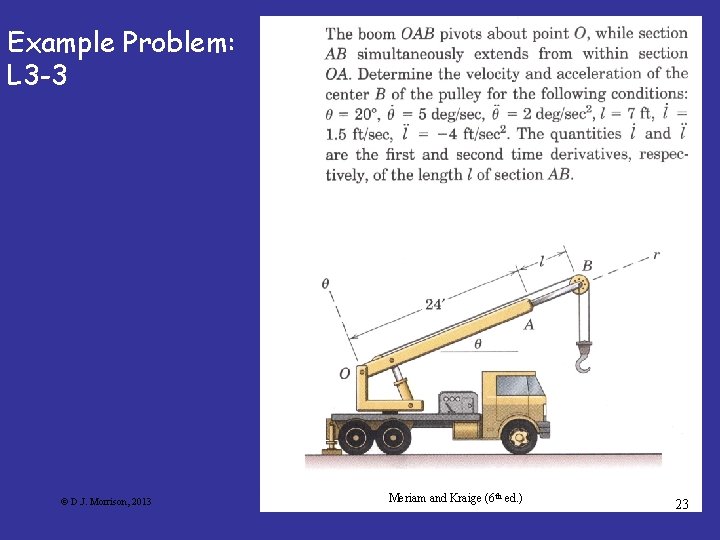
Example Problem: L 3 -3 © D. J. Morrison, 2013 Meriam and Kraige (6 th ed. ) 23
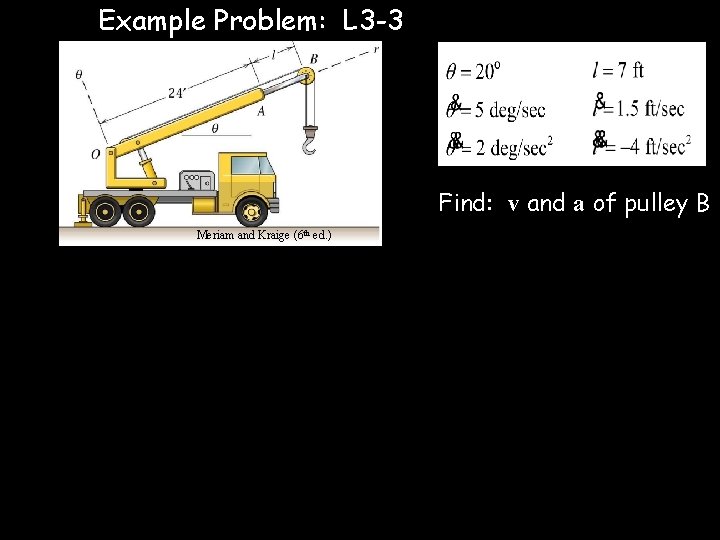
Example Problem: L 3 -3 Find: v and a of pulley B Meriam and Kraige (6 th ed. ) © D. J. Morrison, 2013 24