
Kinematics Newtons laws of motion 1 Every object
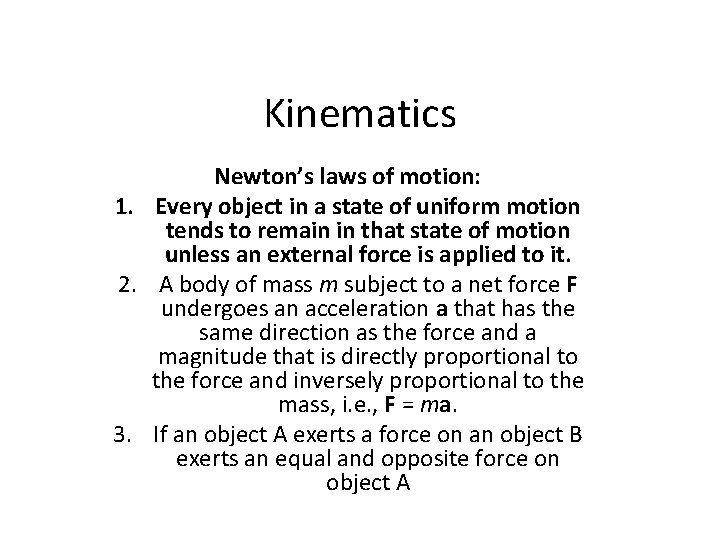
Kinematics Newton’s laws of motion: 1. Every object in a state of uniform motion tends to remain in that state of motion unless an external force is applied to it. 2. A body of mass m subject to a net force F undergoes an acceleration a that has the same direction as the force and a magnitude that is directly proportional to the force and inversely proportional to the mass, i. e. , F = ma. 3. If an object A exerts a force on an object B exerts an equal and opposite force on object A
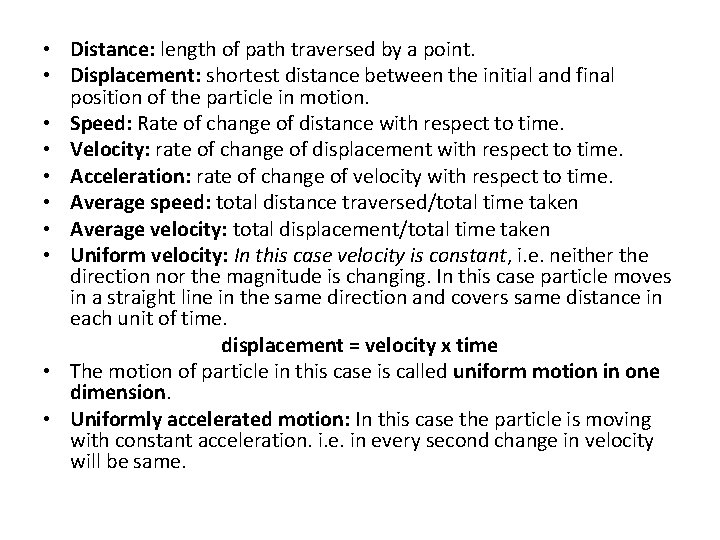
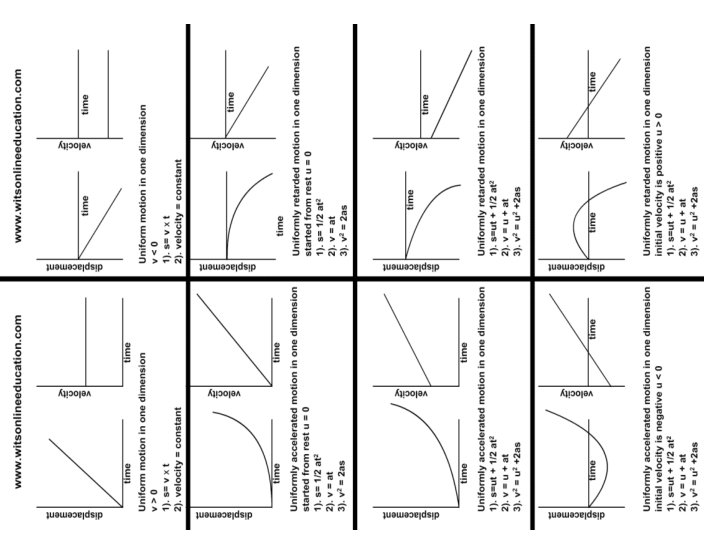
• Distance: length of path traversed by a point. • Displacement: shortest distance between the initial and final position of the particle in motion. • Speed: Rate of change of distance with respect to time. • Velocity: rate of change of displacement with respect to time. • Acceleration: rate of change of velocity with respect to time. • Average speed: total distance traversed/total time taken • Average velocity: total displacement/total time taken • Uniform velocity: In this case velocity is constant, i. e. neither the direction nor the magnitude is changing. In this case particle moves in a straight line in the same direction and covers same distance in each unit of time. displacement = velocity x time • The motion of particle in this case is called uniform motion in one dimension. • Uniformly accelerated motion: In this case the particle is moving with constant acceleration. i. e. in every second change in velocity will be same.
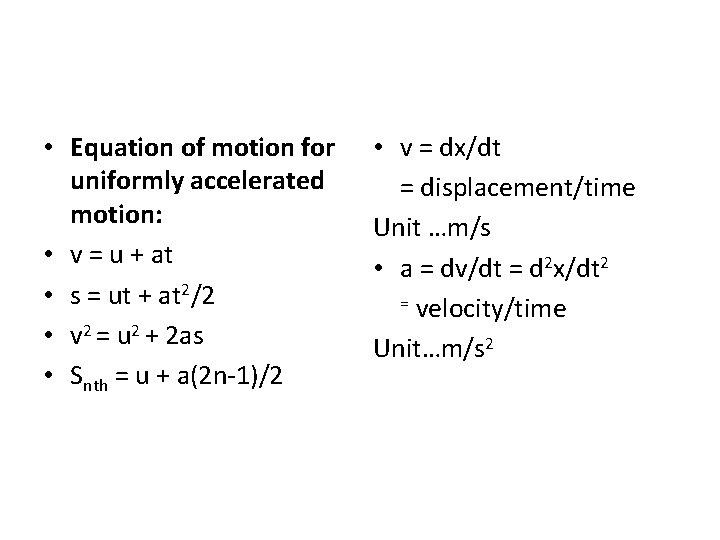
• Equation of motion for uniformly accelerated motion: • v = u + at • s = ut + at 2/2 • v 2 = u 2 + 2 as • Snth = u + a(2 n-1)/2 • v = dx/dt = displacement/time Unit …m/s • a = dv/dt = d 2 x/dt 2 = velocity/time Unit…m/s 2
- Slides: 4