
Kinematics Equations Vocabulary kinematics Pure Motion You can

Kinematics Equations Vocabulary: • kinematics Pure Motion You can find this information in your book on pp. 51 -58. “The Gallop” (1887) - Eadweard Muybridge
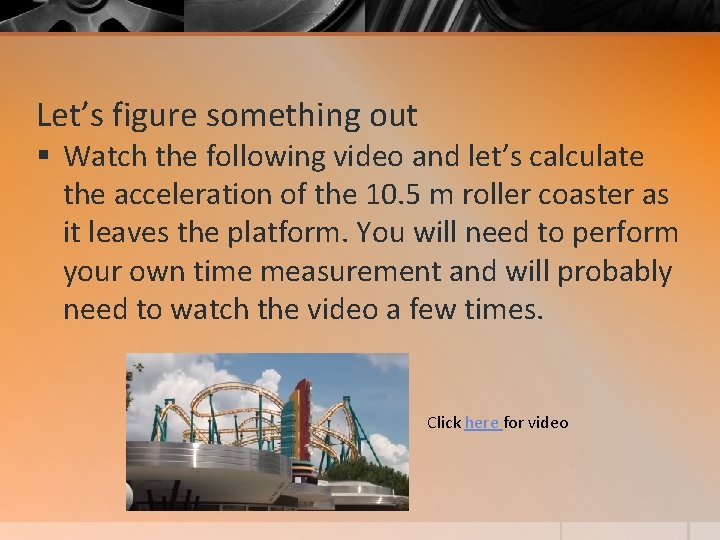
Let’s figure something out § Watch the following video and let’s calculate the acceleration of the 10. 5 m roller coaster as it leaves the platform. You will need to perform your own time measurement and will probably need to watch the video a few times. Click here for video
How are we going to calculate this? § Using kinematics! § Kinematics: the branch of mechanics concerned with the motion of objects without reference to the forces that cause the motion. § The kinematics equations are simply cleverly rearranged and combined versions of motion equations you have already learned. § (We’ll get back to the roller coaster problem in a bit. )

Kinematics equation #1 Let’s start with an equation you know: the definition of acceleration. And let’s do some simple algebraic rearrangement. This is the first of the 5 kinematics equations.
Practice #1 § Rex Easley was stopped at a stop sign. He then accelerated to 15. 4 m/s in 8. 0 s. What was Rex’s acceleration? G vf = 15. 4 m/s t = 8. 0 s vi = 0 m/s U a=? E S S a = 1. 9 m/s 2 15. 4 m/s = 0 m/s + a(8. 0 s)

Kinematics equation #2 Let’s start with an equation you know: the definition of average velocity. And let’s do some simple substitution. * This is the second of the 5 kinematics equations. *This is only true if the acceleration is constant.
Practice #2 § G. Owen Pharr was traveling at 32 m/s in his car when he decided to pass someone. He accelerated to 41 m/s in 10. 0 s. How far did G. Owen travel during this acceleration? G vi = 32 m/s vf = 41 m/s t = 10. 0 s U Δx = ? E S S Δx = 370 m Δx = ½ (32 m/s + 41 m/s) x 10. 0 s

Kinematics equation #3 Let’s start with an equation you know: the 2 nd kinematics equation. And let’s do some simple substitution. This is the third of the 5 kinematics equations.
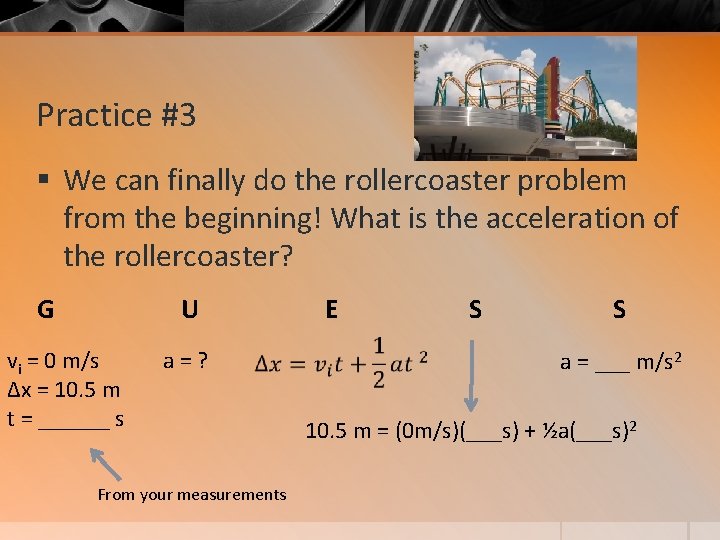
Practice #3 § We can finally do the rollercoaster problem from the beginning! What is the acceleration of the rollercoaster? G U vi = 0 m/s Δx = 10. 5 m t = ______ s a=? From your measurements E S S a = ___ m/s 2 10. 5 m = (0 m/s)(___s) + ½a(___s)2
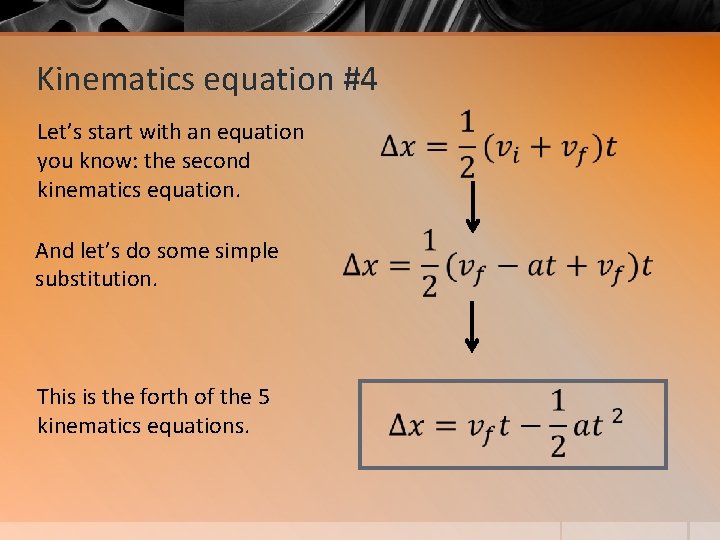
Kinematics equation #4 Let’s start with an equation you know: the second kinematics equation. And let’s do some simple substitution. This is the forth of the 5 kinematics equations.
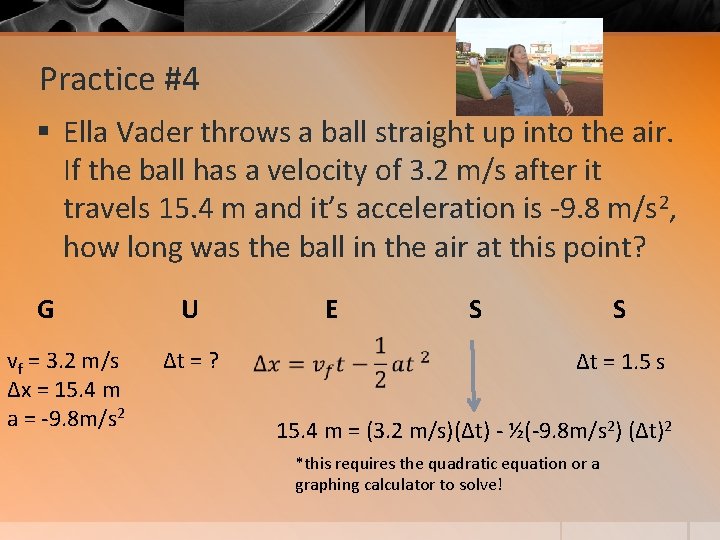
Practice #4 § Ella Vader throws a ball straight up into the air. If the ball has a velocity of 3. 2 m/s after it travels 15. 4 m and it’s acceleration is -9. 8 m/s 2, how long was the ball in the air at this point? G vf = 3. 2 m/s Δx = 15. 4 m a = -9. 8 m/s 2 U Δt = ? E S S Δt = 1. 5 s 15. 4 m = (3. 2 m/s)(Δt) - ½(-9. 8 m/s 2) (Δt)2 *this requires the quadratic equation or a graphing calculator to solve!
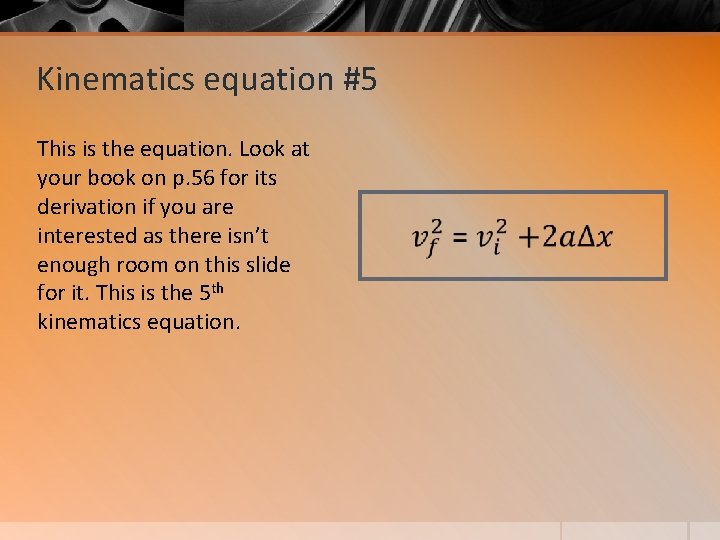
Kinematics equation #5 This is the equation. Look at your book on p. 56 for its derivation if you are interested as there isn’t enough room on this slide for it. This is the 5 th kinematics equation.
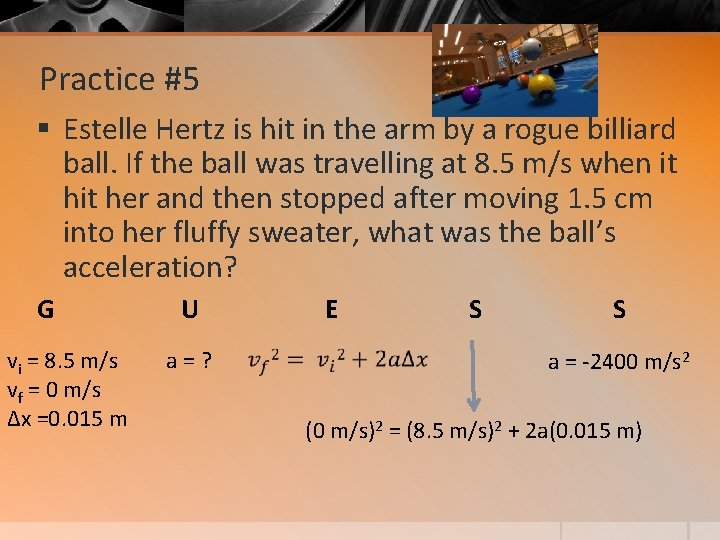
Practice #5 § Estelle Hertz is hit in the arm by a rogue billiard ball. If the ball was travelling at 8. 5 m/s when it her and then stopped after moving 1. 5 cm into her fluffy sweater, what was the ball’s acceleration? G vi = 8. 5 m/s vf = 0 m/s Δx =0. 015 m U a=? E S S a = -2400 m/s 2 (0 m/s)2 = (8. 5 m/s)2 + 2 a(0. 015 m)
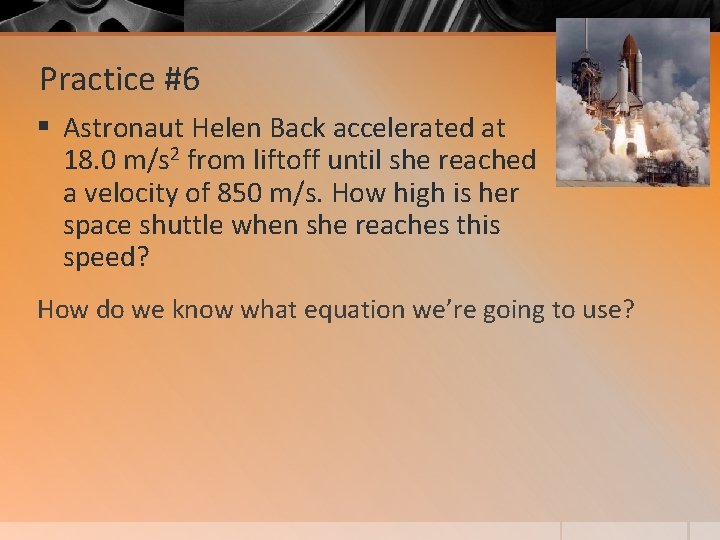
Practice #6 § Astronaut Helen Back accelerated at 18. 0 m/s 2 from liftoff until she reached a velocity of 850 m/s. How high is her space shuttle when she reaches this speed? How do we know what equation we’re going to use?
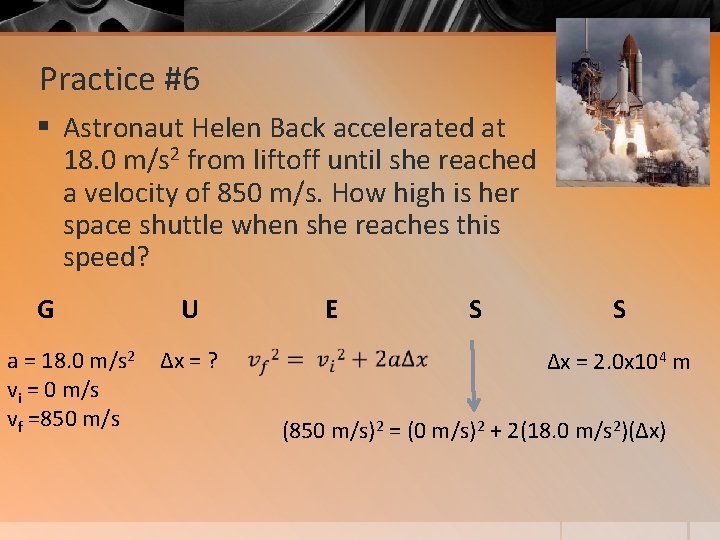
Practice #6 § Astronaut Helen Back accelerated at 18. 0 m/s 2 from liftoff until she reached a velocity of 850 m/s. How high is her space shuttle when she reaches this speed? G a = 18. 0 m/s 2 vi = 0 m/s vf =850 m/s U Δx = ? E S S Δx = 2. 0 x 104 m (850 m/s)2 = (0 m/s)2 + 2(18. 0 m/s 2)(Δx)
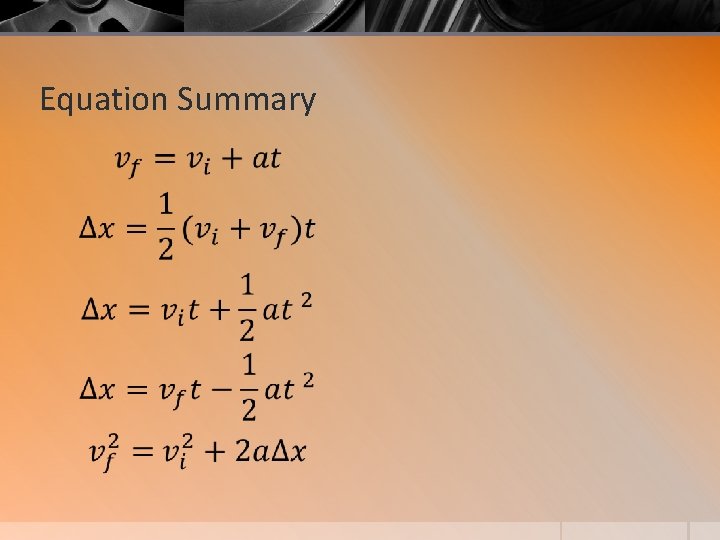
Equation Summary
- Slides: 16