
Kinematics Describing Motion Motion a change of position
Kinematics: Describing Motion
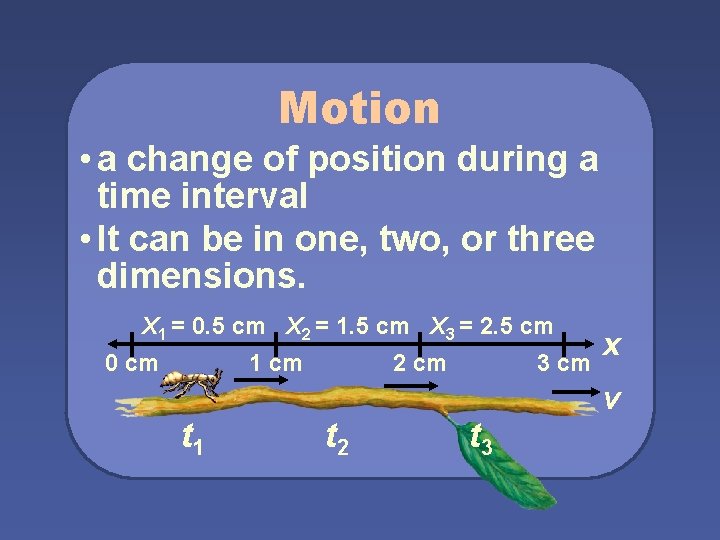
Motion • a change of position during a time interval • It can be in one, two, or three dimensions. X 1 = 0. 5 cm X 2 = 1. 5 cm X 3 = 2. 5 cm 0 cm 1 cm 2 cm 3 cm x v t 1 t 2 t 3
Distance a positive scalar quantity that indicates how far an object has traveled during a time interval
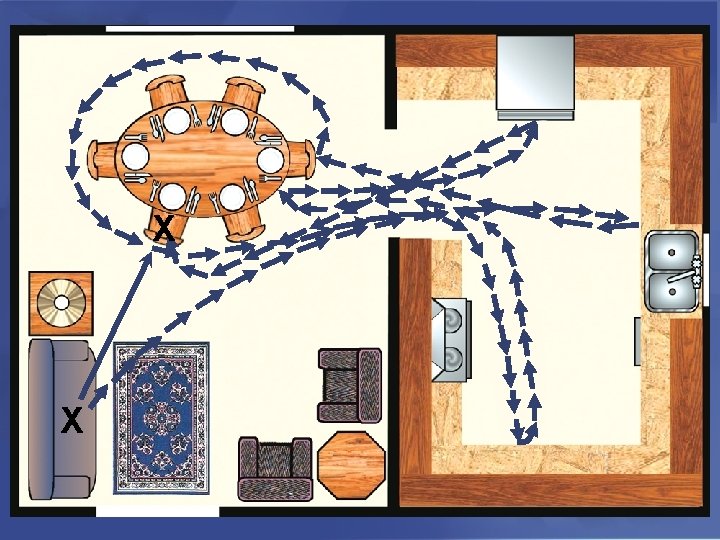
Displacement the overall change in position during a time interval (how much it moved)
Displacement • Displacement is a vector quantity. • The distance is the magnitude of the displacement vector.
X X
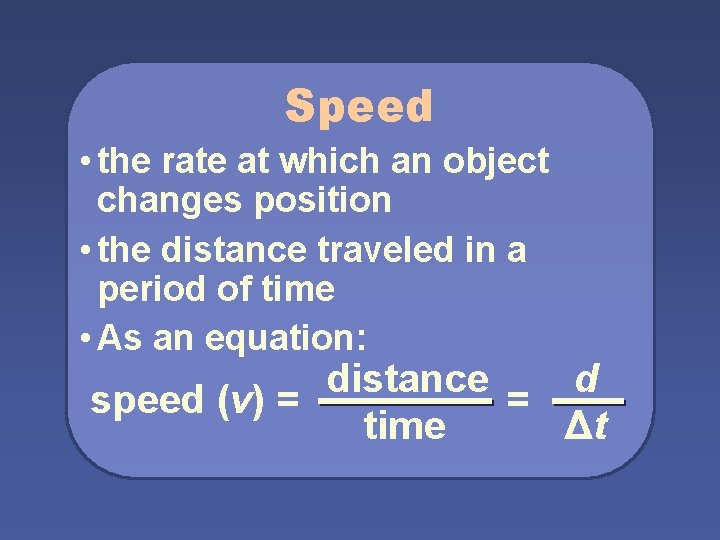
Speed • the rate at which an object changes position • the distance traveled in a period of time • As an equation: distance d speed (v) = = time Δt
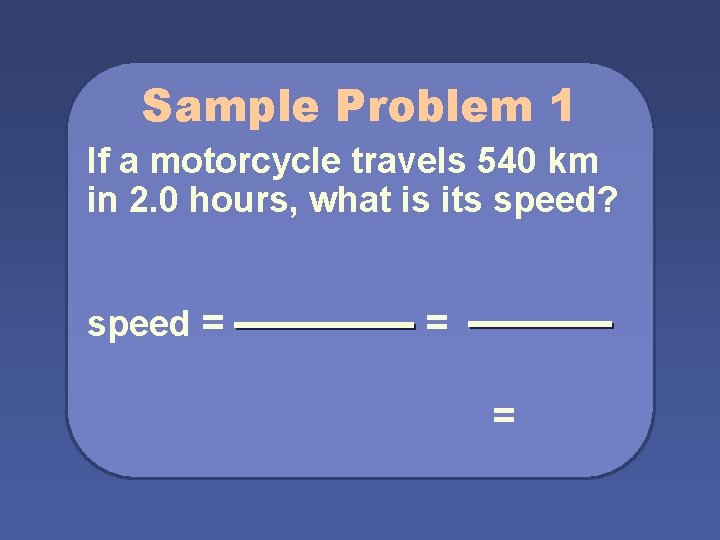
Sample Problem 1 If a motorcycle travels 540 km in 2. 0 hours, what is its speed? speed = = =
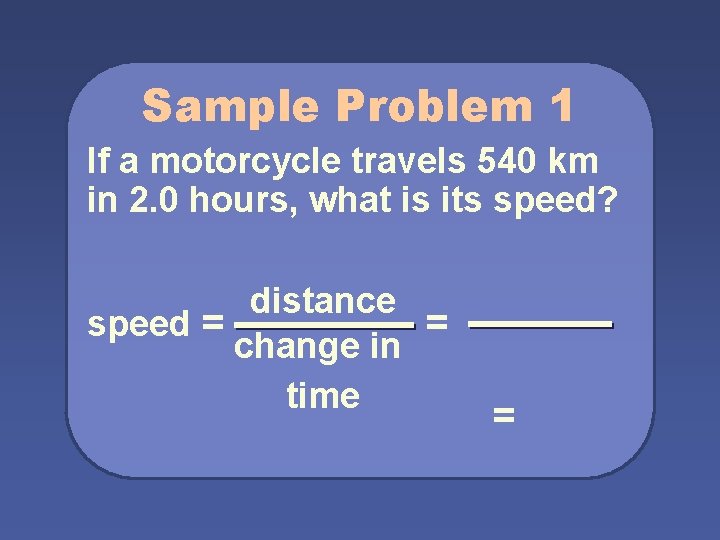
Sample Problem 1 If a motorcycle travels 540 km in 2. 0 hours, what is its speed? distance speed = = change in time =
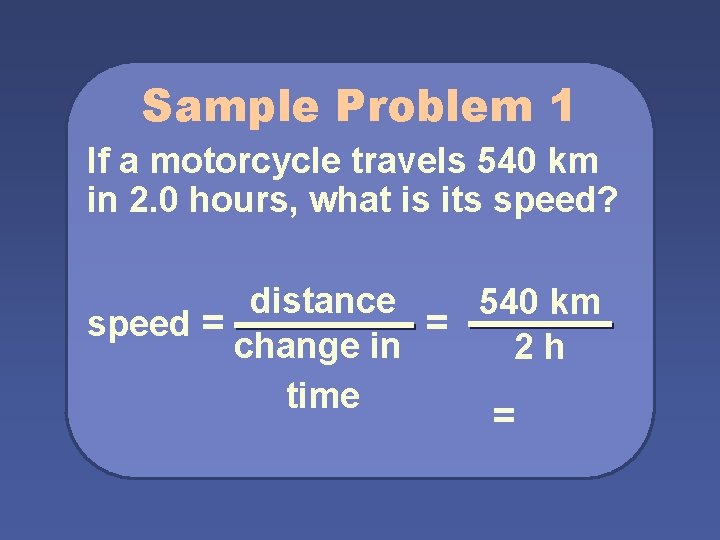
Sample Problem 1 If a motorcycle travels 540 km in 2. 0 hours, what is its speed? distance 540 km speed = = change in 2 h time =
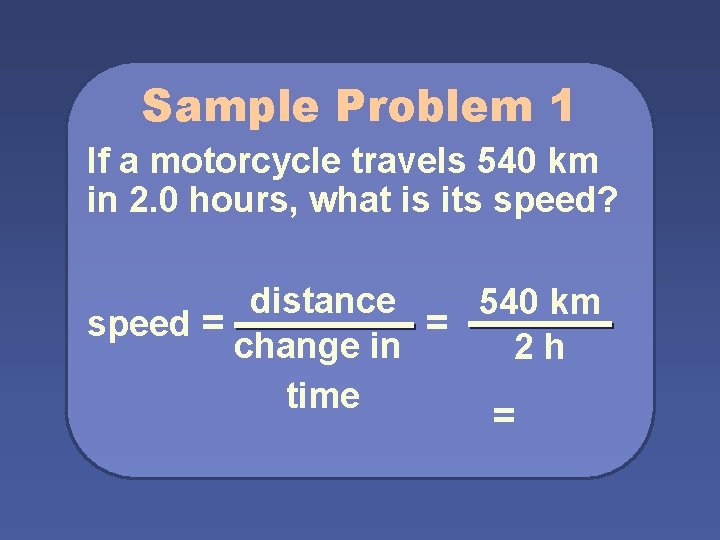
Sample Problem 1 If a motorcycle travels 540 km in 2. 0 hours, what is its speed? distance 540 km speed = = change in 2 h time =
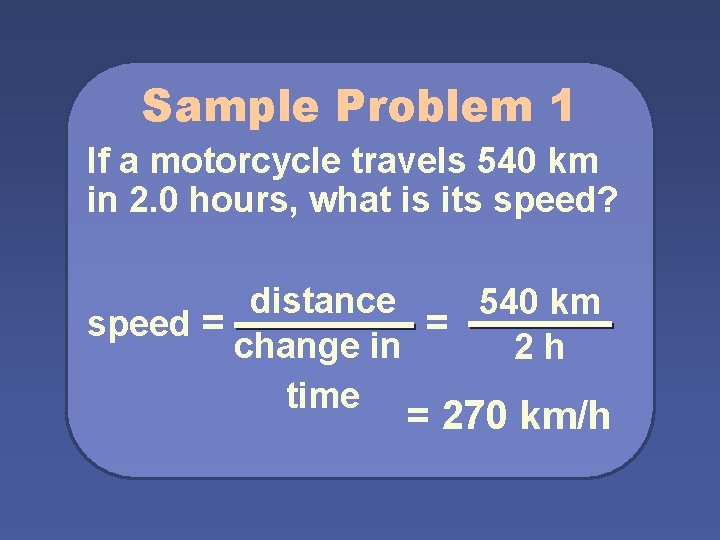
Sample Problem 1 If a motorcycle travels 540 km in 2. 0 hours, what is its speed? distance 540 km speed = = change in 2 h time = 270 km/h

What does speed equal? 1. time / distance 2. the rate at which an object changes time 3. the amount of time traveled over a distance 4. distance / time Question
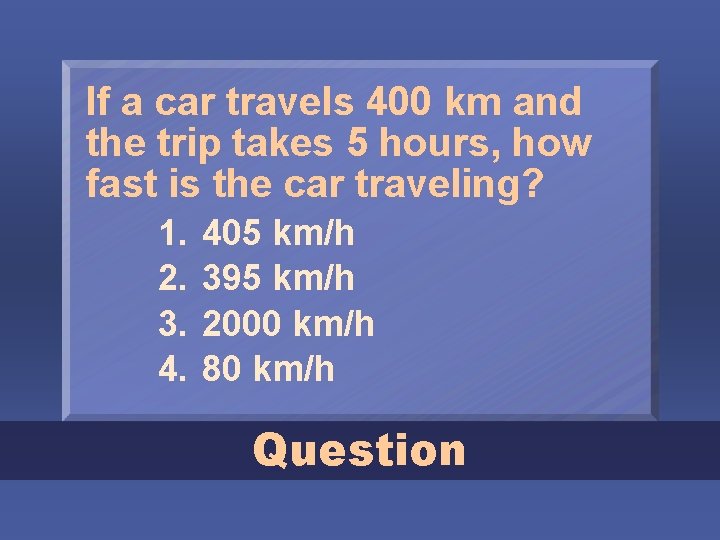
If a car travels 400 km and the trip takes 5 hours, how fast is the car traveling? 1. 2. 3. 4. 405 km/h 395 km/h 2000 km/h 80 km/h Question
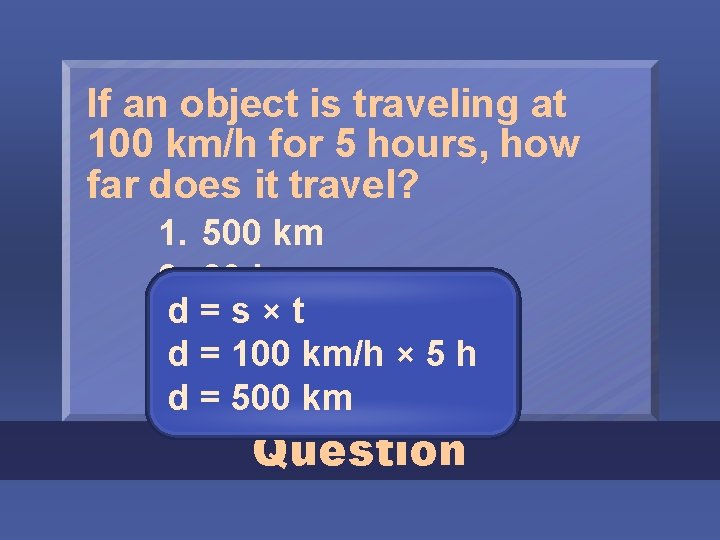
If an object is traveling at 100 km/h for 5 hours, how far does it travel? 1. 500 km 2. 20 km d= s ×km t 3. 105 d = 100 km/h × 5 h 4. 95 km d = 500 km Question
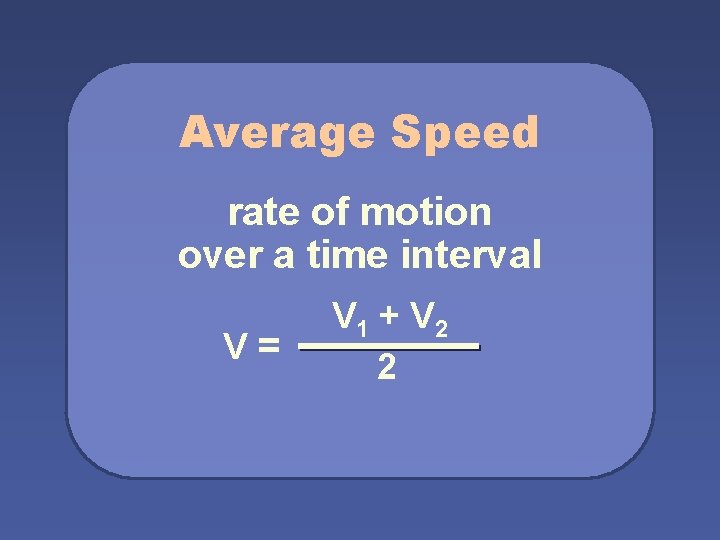
Average Speed rate of motion over a time interval V= V 1 + V 2 2
Instantaneous Speed rate of motion at a specific time

Sample Problem 2
Sample Problem 2 It takes a fast cyclist 0. 35 h (20. 85 min) to cover the 19 km stage of a European biking race. What is his average speed in km/h?

Sample Problem 2 Known: Unknown:
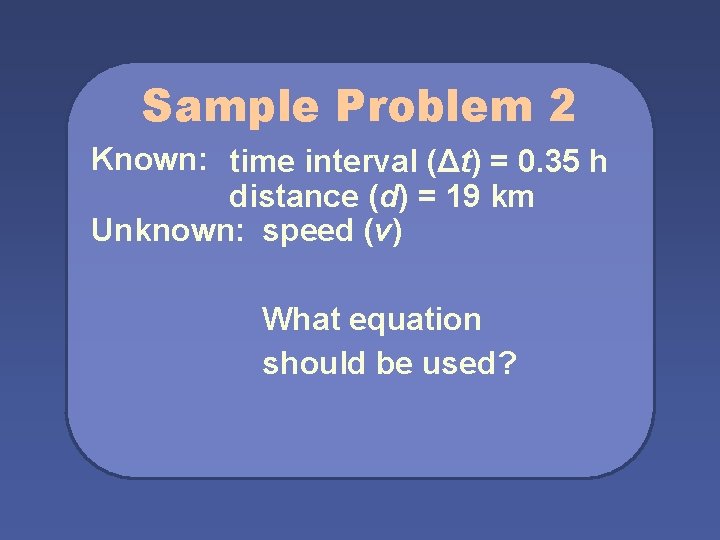
Sample Problem 2 Known: time interval (Δt) = 0. 35 h distance (d) = 19 km Unknown: speed (v) What equation should be used?
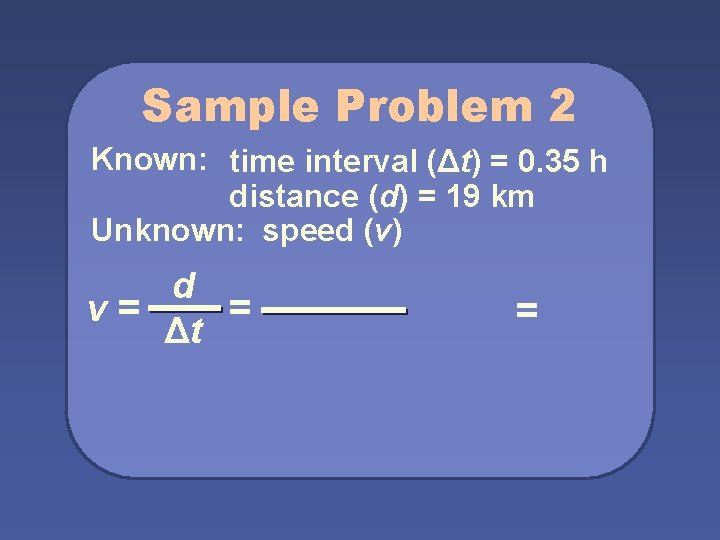
Sample Problem 2 Known: time interval (Δt) = 0. 35 h distance (d) = 19 km Unknown: speed (v) d v= = Δt =
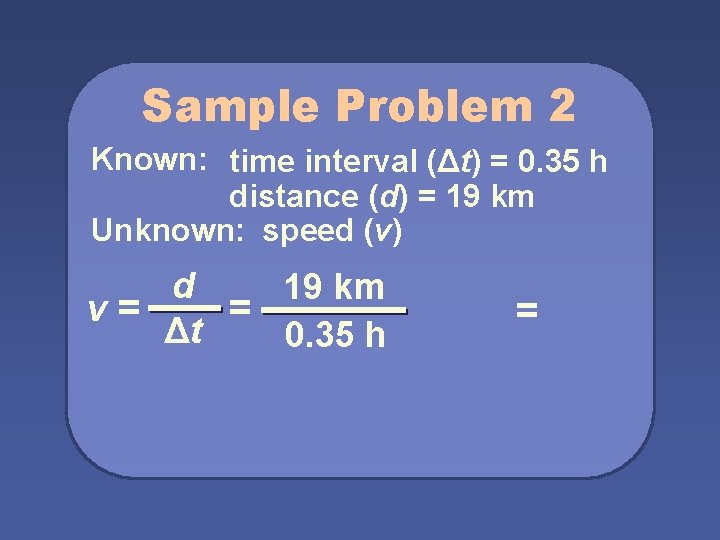
Sample Problem 2 Known: time interval (Δt) = 0. 35 h distance (d) = 19 km Unknown: speed (v) d 19 km v= = Δt 0. 35 h =
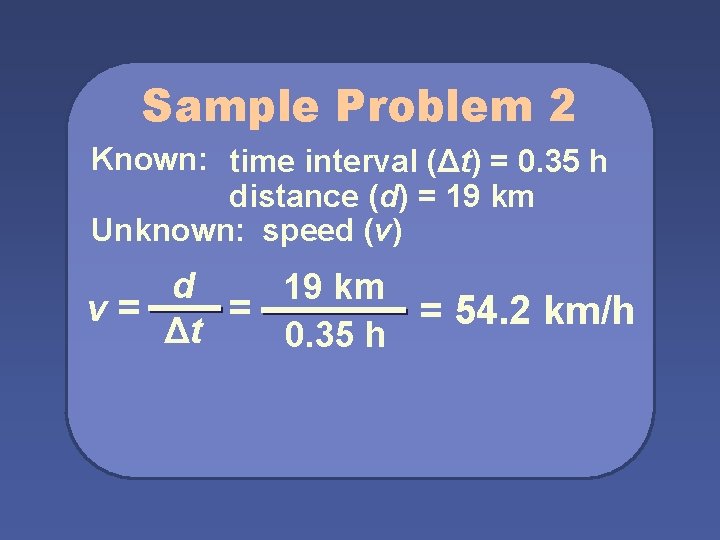
Sample Problem 2 Known: time interval (Δt) = 0. 35 h distance (d) = 19 km Unknown: speed (v) d 19 km v= = = 54. 2 km/h Δt 0. 35 h
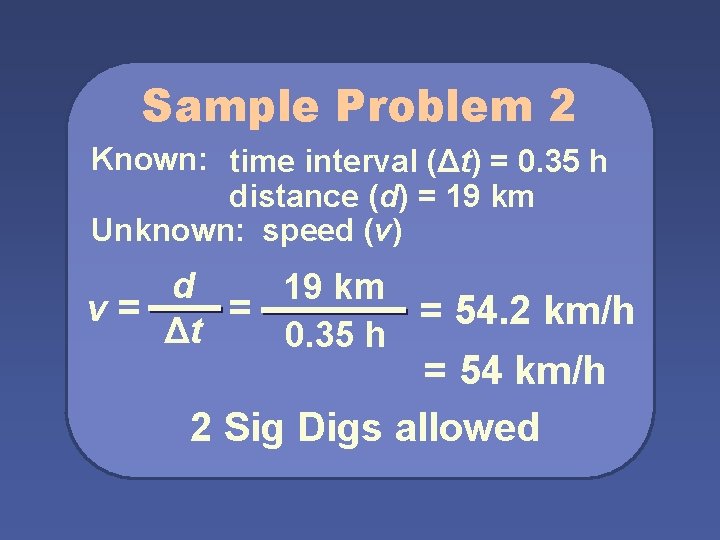
Sample Problem 2 Known: time interval (Δt) = 0. 35 h distance (d) = 19 km Unknown: speed (v) d 19 km v= = = 54. 2 km/h Δt 0. 35 h = 54 km/h 2 Sig Digs allowed
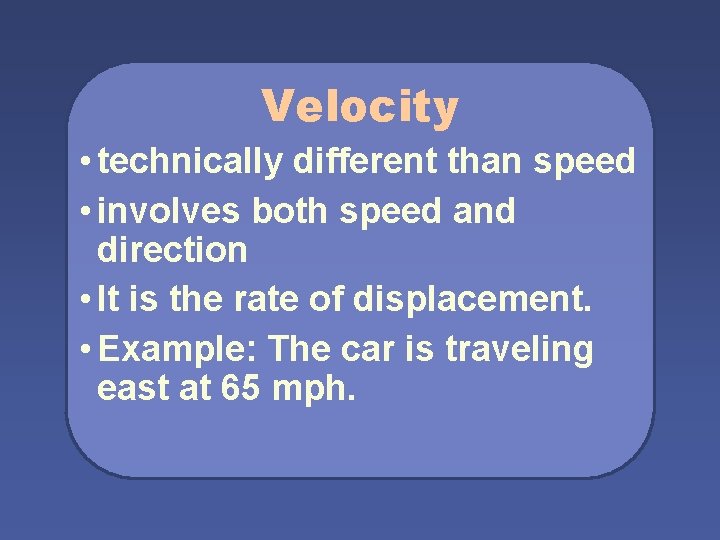
Velocity • technically different than speed • involves both speed and direction • It is the rate of displacement. • Example: The car is traveling east at 65 mph.
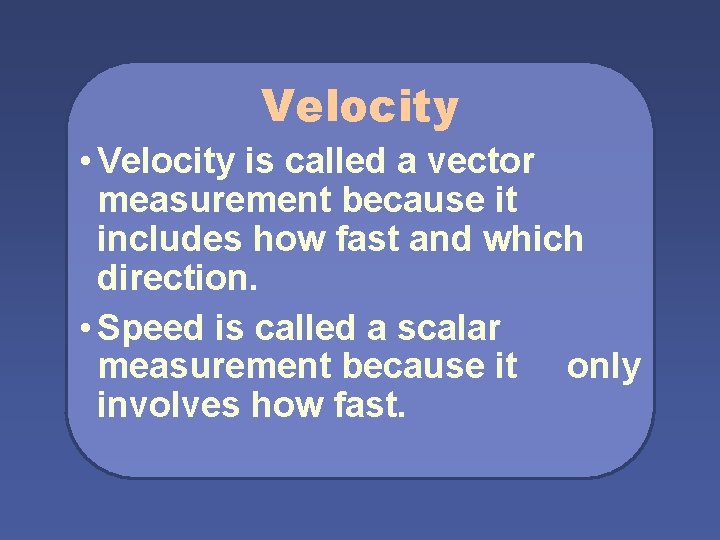
Velocity • Velocity is called a vector measurement because it includes how fast and which direction. • Speed is called a scalar measurement because it only involves how fast.
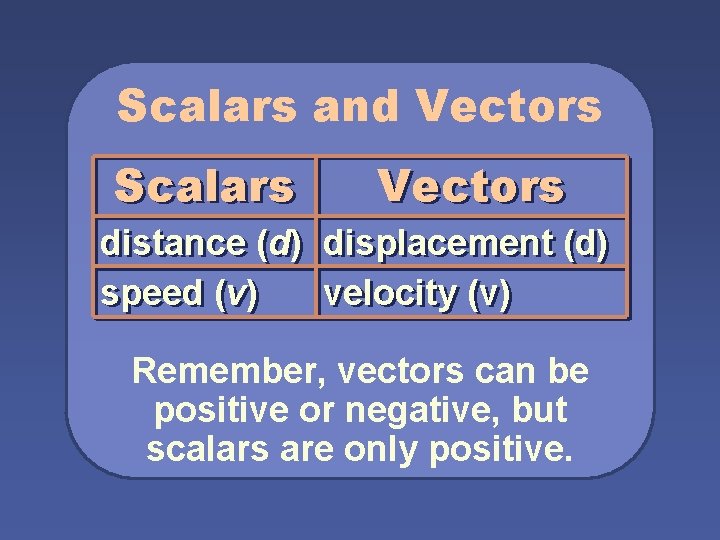
Scalars and Vectors Scalars Vectors distance (d) displacement (d) speed (v) velocity (v) Remember, vectors can be positive or negative, but scalars are only positive.
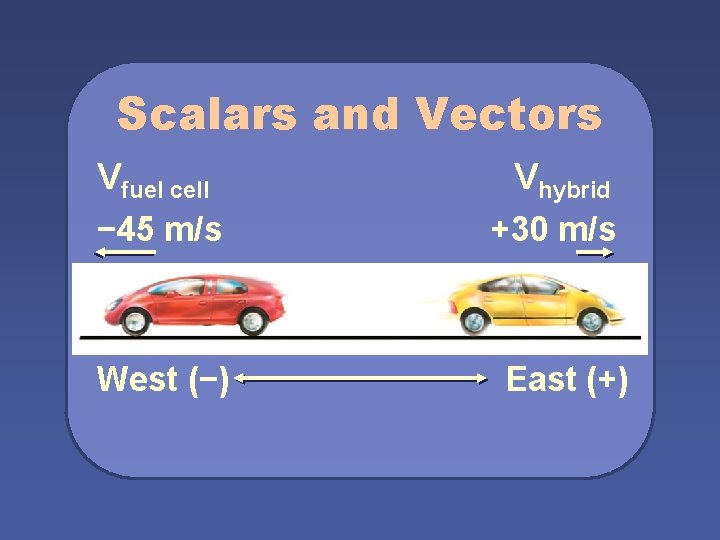
Scalars and Vectors Vfuel cell Vhybrid − 45 m/s +30 m/s West (−) East (+)
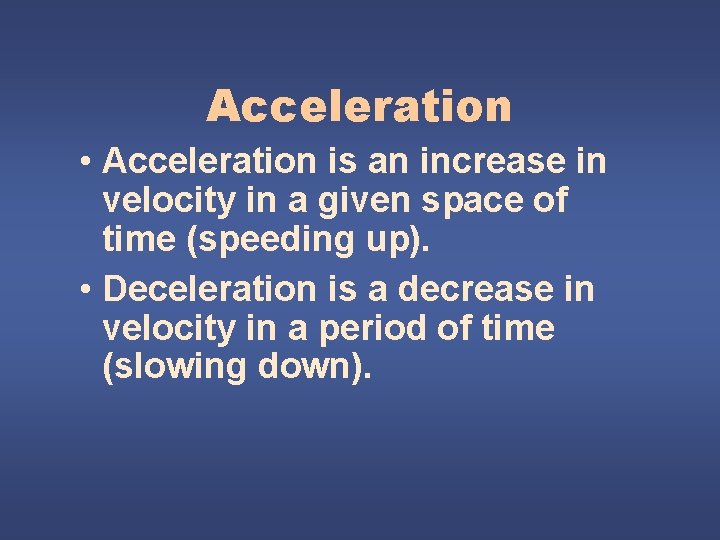
Acceleration • Acceleration is an increase in velocity in a given space of time (speeding up). • Deceleration is a decrease in velocity in a period of time (slowing down).
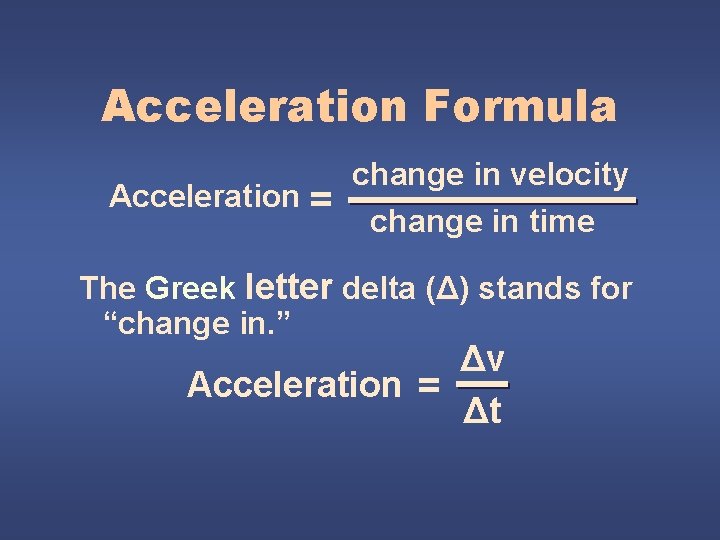
Acceleration Formula Acceleration = change in velocity change in time The Greek letter delta (Δ) stands for “change in. ” Δv Acceleration = Δt
Acceleration Units • The units for velocity are distance/time. • Since acceleration is velocity/time, the units must be distance/time.
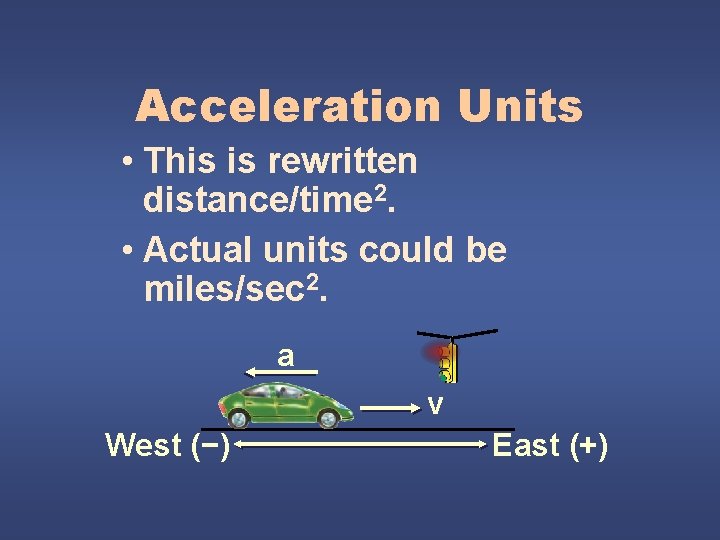
Acceleration Units • This is rewritten distance/time 2. • Actual units could be miles/sec 2. a v West (−) East (+)
Sample Problem 3 A car moving at +5. 0 m/s smoothly accelerates to +20. 0 m/s in 5. 0 s. Calculate the car’s acceleration. North is positive. Known: Unknown:
Sample Problem 3 A car moving at +5. 0 m/s smoothly accelerates to +20. 0 m/s in 5. 0 s. Calculate the car’s acceleration. North is positive. Known: car’s vi = car’s vf = time interval (Δt) = Unknown: acceleration (a)
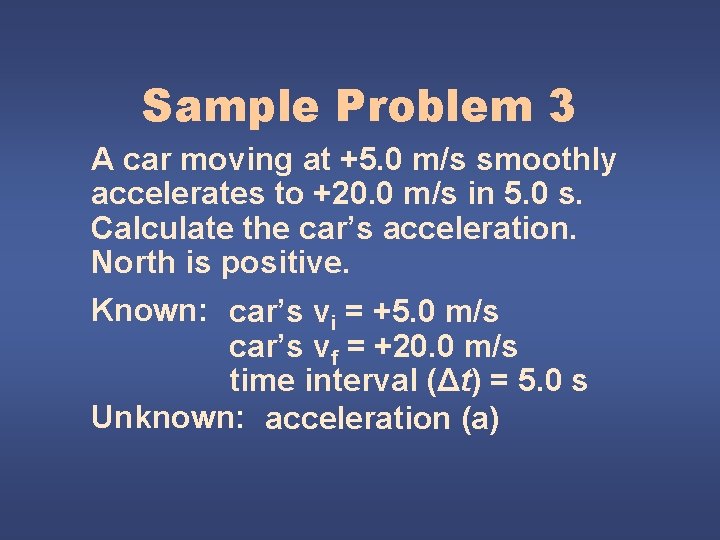
Sample Problem 3 A car moving at +5. 0 m/s smoothly accelerates to +20. 0 m/s in 5. 0 s. Calculate the car’s acceleration. North is positive. Known: car’s vi = +5. 0 m/s car’s vf = +20. 0 m/s time interval (Δt) = 5. 0 s Unknown: acceleration (a)
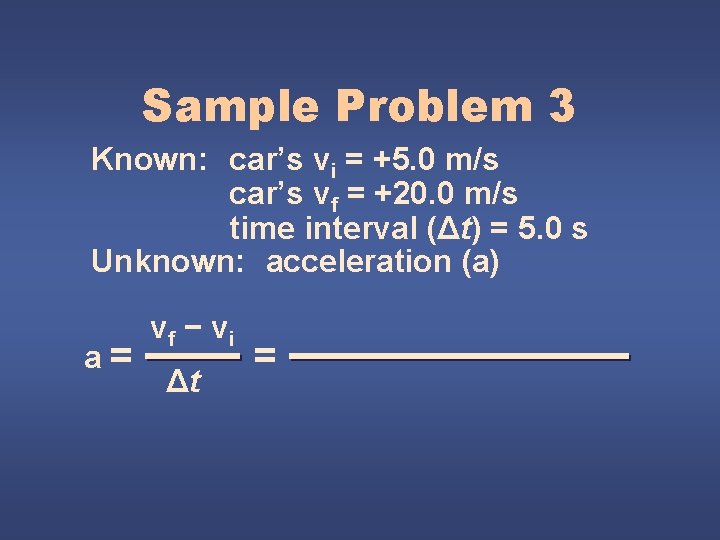
Sample Problem 3 Known: car’s vi = +5. 0 m/s car’s vf = +20. 0 m/s time interval (Δt) = 5. 0 s Unknown: acceleration (a) a= vf − v i Δt =
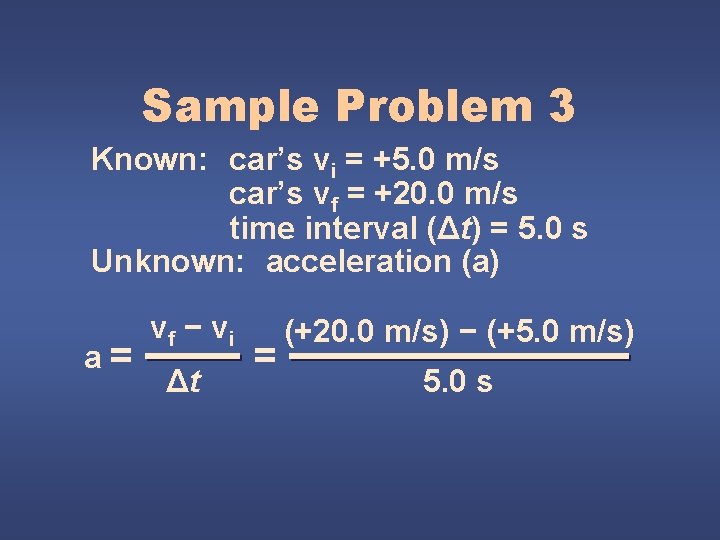
Sample Problem 3 Known: car’s vi = +5. 0 m/s car’s vf = +20. 0 m/s time interval (Δt) = 5. 0 s Unknown: acceleration (a) a= vf − v i Δt = (+20. 0 m/s) − (+5. 0 m/s) 5. 0 s
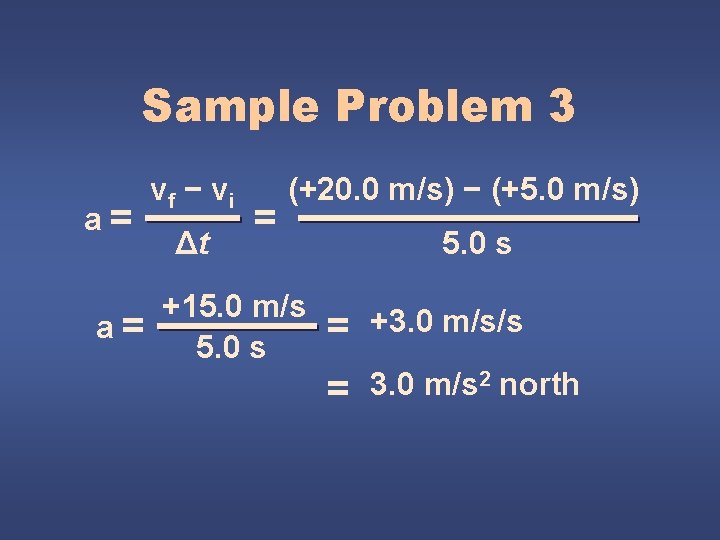
Sample Problem 3 a= a= vf − v i Δt = (+20. 0 m/s) − (+5. 0 m/s) +15. 0 m/s 5. 0 s = +3. 0 m/s/s = 3. 0 m/s 2 north
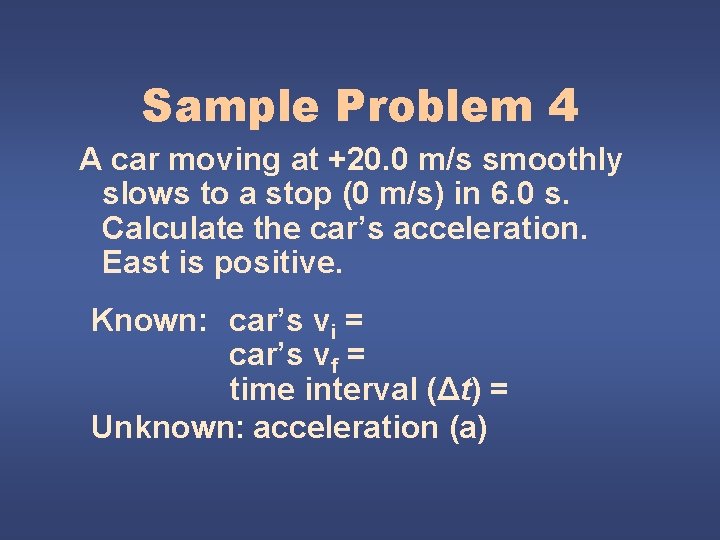
Sample Problem 4 A car moving at +20. 0 m/s smoothly slows to a stop (0 m/s) in 6. 0 s. Calculate the car’s acceleration. East is positive. Known: car’s vi = car’s vf = time interval (Δt) = Unknown: acceleration (a)
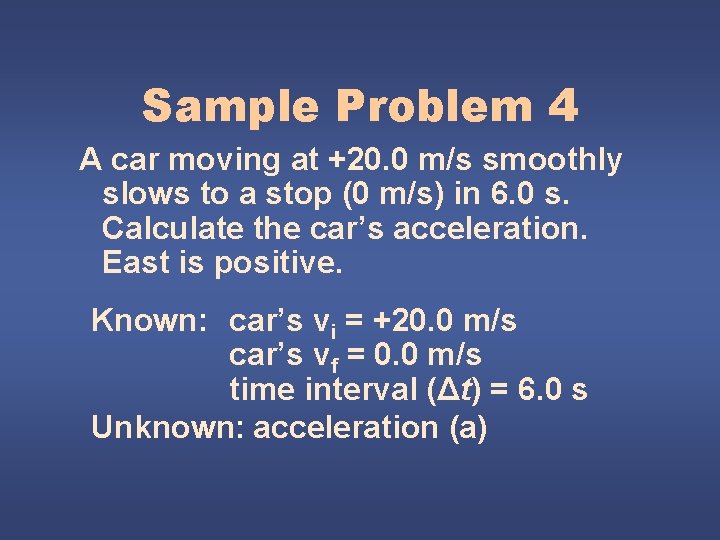
Sample Problem 4 A car moving at +20. 0 m/s smoothly slows to a stop (0 m/s) in 6. 0 s. Calculate the car’s acceleration. East is positive. Known: car’s vi = +20. 0 m/s car’s vf = 0. 0 m/s time interval (Δt) = 6. 0 s Unknown: acceleration (a)
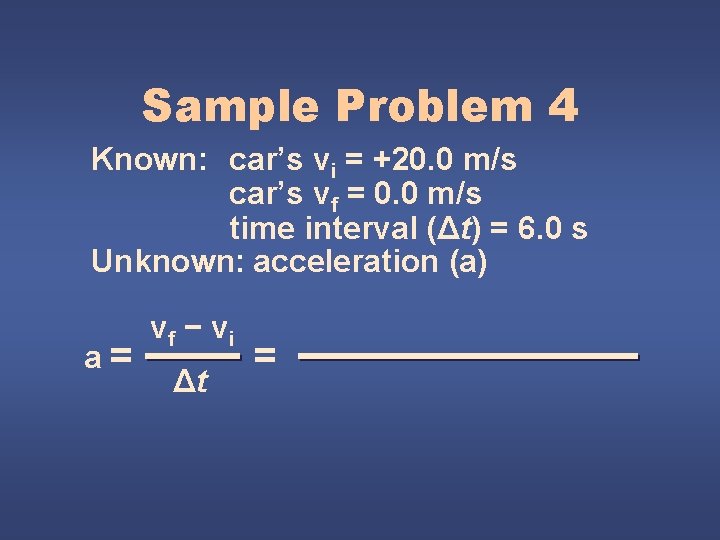
Sample Problem 4 Known: car’s vi = +20. 0 m/s car’s vf = 0. 0 m/s time interval (Δt) = 6. 0 s Unknown: acceleration (a) a= vf − v i Δt =
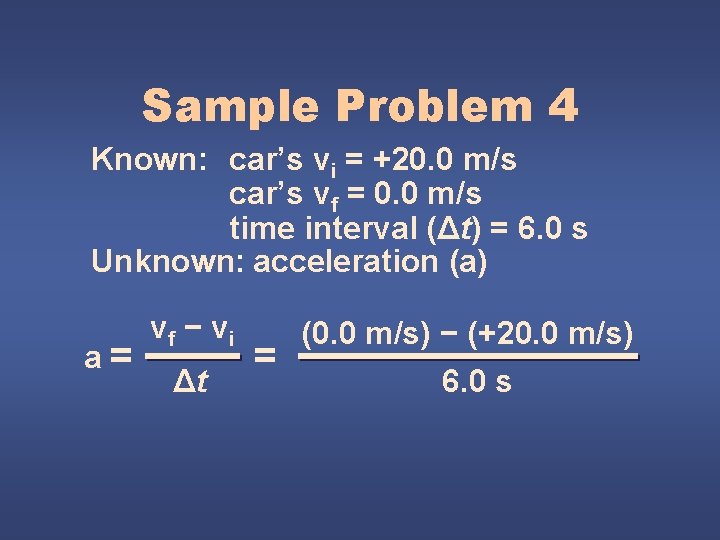
Sample Problem 4 Known: car’s vi = +20. 0 m/s car’s vf = 0. 0 m/s time interval (Δt) = 6. 0 s Unknown: acceleration (a) a= vf − v i Δt = (0. 0 m/s) − (+20. 0 m/s) 6. 0 s
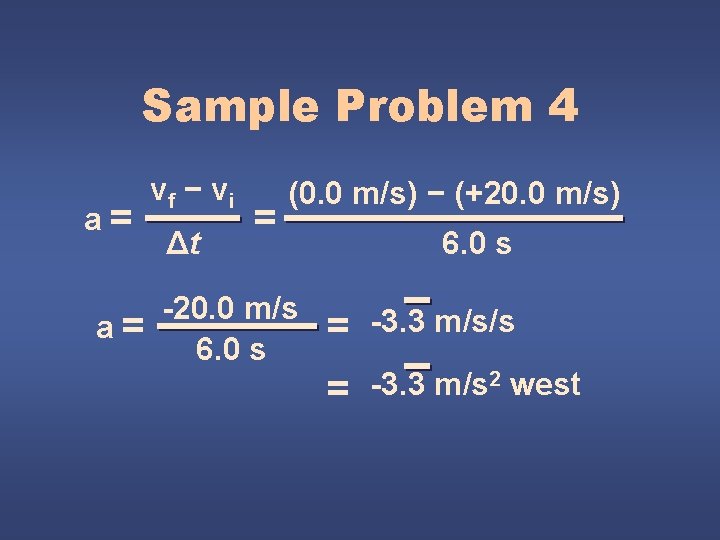
Sample Problem 4 a= a= vf − v i Δt = (0. 0 m/s) − (+20. 0 m/s) -20. 0 m/s 6. 0 s = -3. 3 m/s/s = -3. 3 m/s 2 west
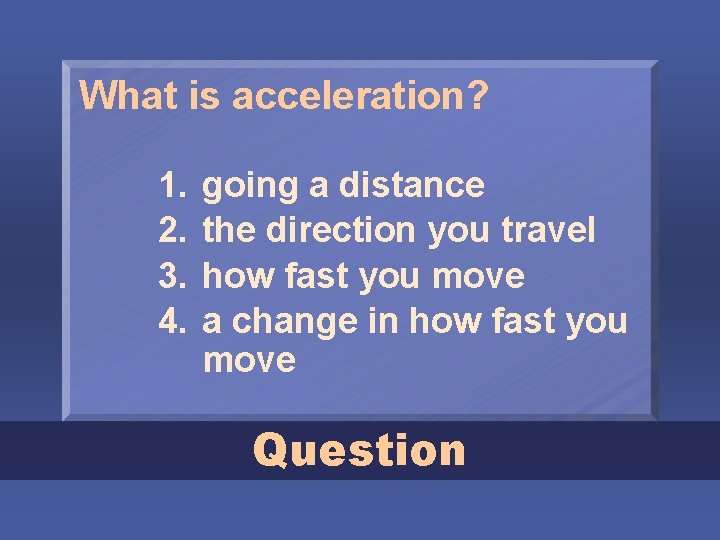
What is acceleration? 1. 2. 3. 4. going a distance the direction you travel how fast you move a change in how fast you move Question
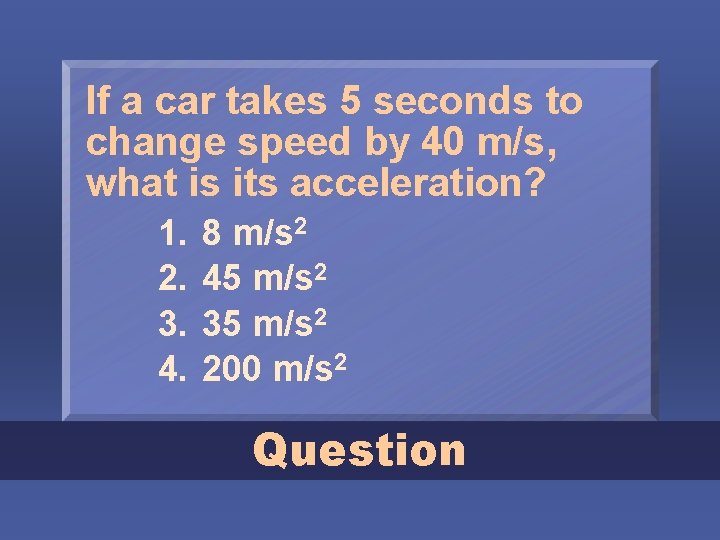
If a car takes 5 seconds to change speed by 40 m/s, what is its acceleration? 1. 2. 3. 4. 8 m/s 2 45 m/s 2 35 m/s 2 200 m/s 2 Question
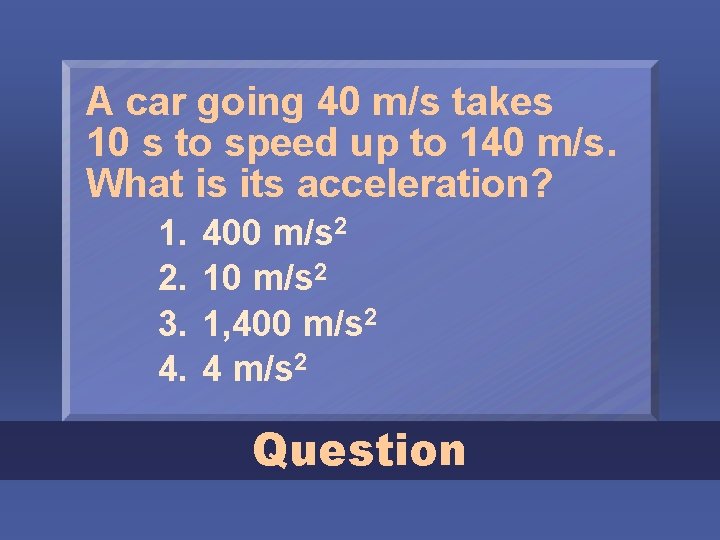
A car going 40 m/s takes 10 s to speed up to 140 m/s. What is its acceleration? 1. 2. 3. 4. 400 m/s 2 1, 400 m/s 2 4 m/s 2 Question
Which of the following are possible units of acceleration? 1. 2. 3. 4. seconds feet / second 2 Question
Two and Three Dimensional Motion • These examples had motion in only one dimension. • Two dimensional motion is common also. • An example is a car rounding a corner.
Two and Three Dimensional Motion • Three dimensional motion is not unusual. • An example is a car rounding a corner on a hill. • This type of motion uses “spatial” dimensions, so called because 3 dimensions enclose a volume or space.
Two and Three Dimensional Motion • A car rounding a corner is changing its direction. • Direction is part of velocity, so the car is accelerating even if its speed is constant.
Two and Three Dimensional Motion When a car repeatedly comes to a stop from the same speed—as in a busy downtown with red lights—its acceleration is closer to zero if it takes longer to stop.
- Slides: 52