
Kinematics and One Dimensional Motion NonConstant Acceleration 8


- Slides: 23
Kinematics and One Dimensional Motion: Non-Constant Acceleration 8. 01 W 01 D 3
Today’s Reading Assignment: W 02 D 1 Young and Freedman: Sections 2. 1 -2. 6
Kinematics and One Dimensional Motion
Kinematics Vocabulary • Kinema means movement in Greek • Mathematical description of motion – Position – Time Interval – Displacement – Velocity; absolute value: speed – Acceleration – Averages of the latter two quantities.
Coordinate System in One Dimension Used to describe the position of a point in space A coordinate system consists of: 1. 2. 3. 4. An origin at a particular point in space A set of coordinate axes with scales and labels Choice of positive direction for each axis: unit vectors Choice of type: Cartesian or Polar or Spherical Example: Cartesian One-Dimensional Coordinate System
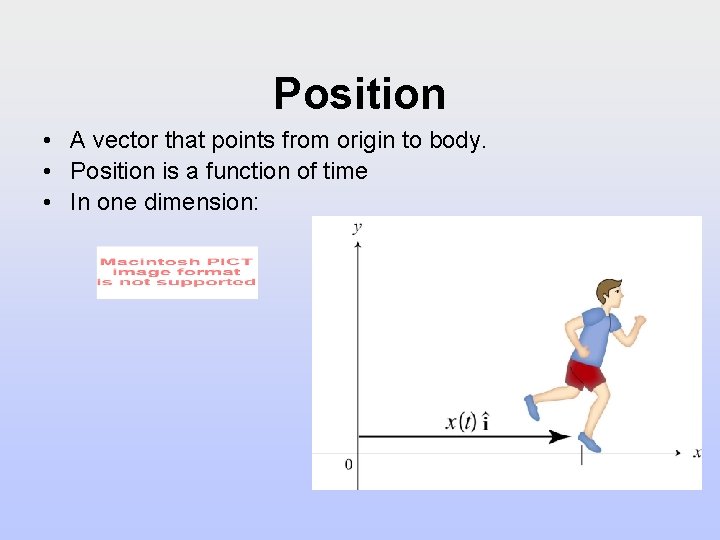
Position • A vector that points from origin to body. • Position is a function of time • In one dimension:
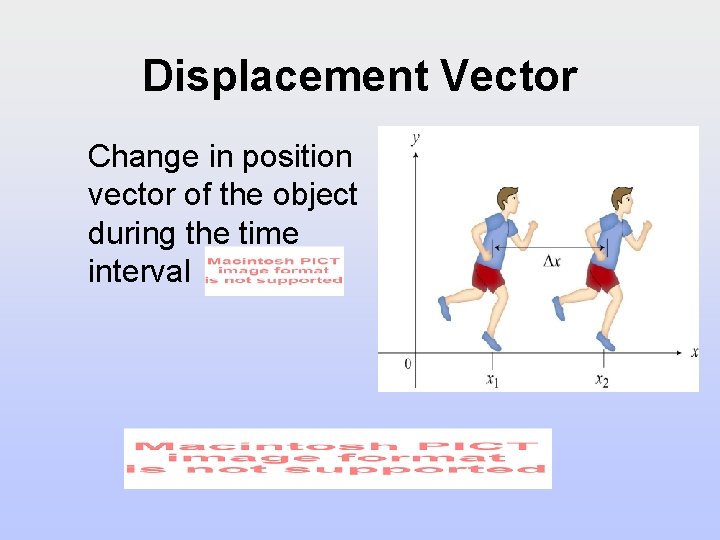
Displacement Vector Change in position vector of the object during the time interval
Concept Question: Displacement An object goes from one point in space to another. After the object arrives at its destination, the magnitude of its displacement is: 1) either greater than or equal to 2) always greater than 3) always equal to 4) either smaller than or equal to 5) always smaller than 6) either smaller or larger than the distance it traveled.
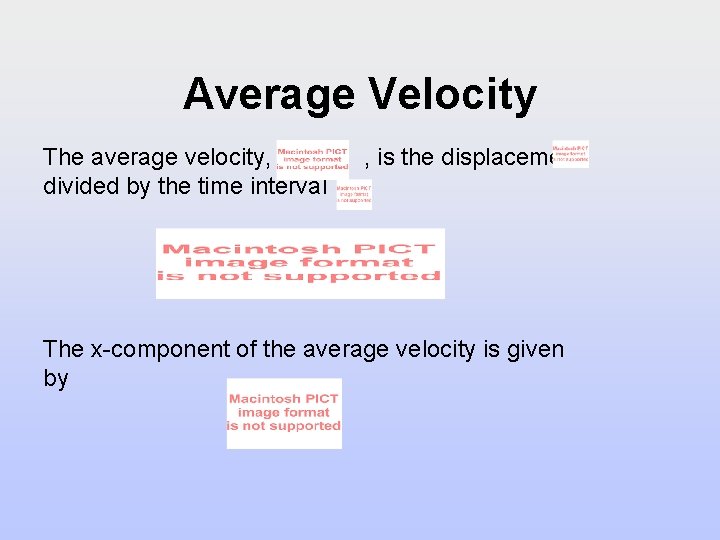
Average Velocity The average velocity, , is the displacement divided by the time interval The x-component of the average velocity is given by
Instantaneous Velocity and Differentiation • For each time interval , calculate the xcomponent of the average velocity • Take limit as sequence of the x-component average velocities • The limiting value of this sequence is x-component of the instantaneous velocity at the time t .
Instantaneous Velocity x-component of the velocity is equal to the slope of the tangent line of the graph of x-component of position vs. time at time t
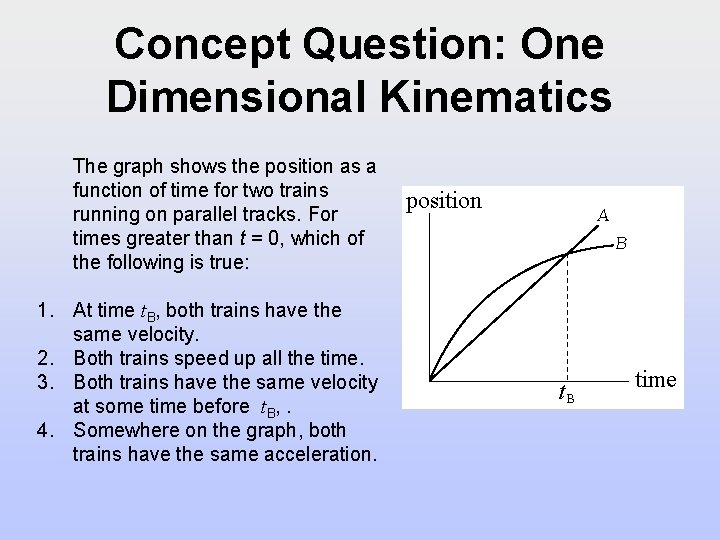
Concept Question: One Dimensional Kinematics The graph shows the position as a function of time for two trains running on parallel tracks. For times greater than t = 0, which of the following is true: 1. At time t. B, both trains have the same velocity. 2. Both trains speed up all the time. 3. Both trains have the same velocity at some time before t. B, . 4. Somewhere on the graph, both trains have the same acceleration.
Average Acceleration Change in instantaneous velocity divided by the time interval The x-component of the average acceleration
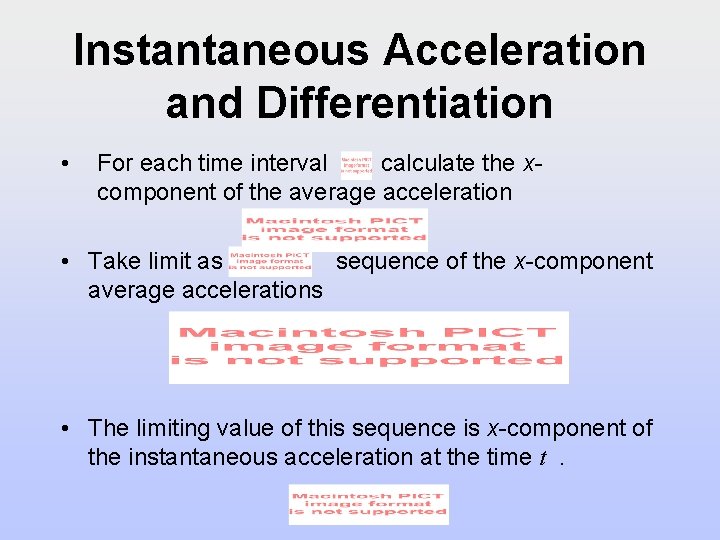
Instantaneous Acceleration and Differentiation • For each time interval , calculate the xcomponent of the average acceleration • Take limit as sequence of the x-component average accelerations • The limiting value of this sequence is x-component of the instantaneous acceleration at the time t .
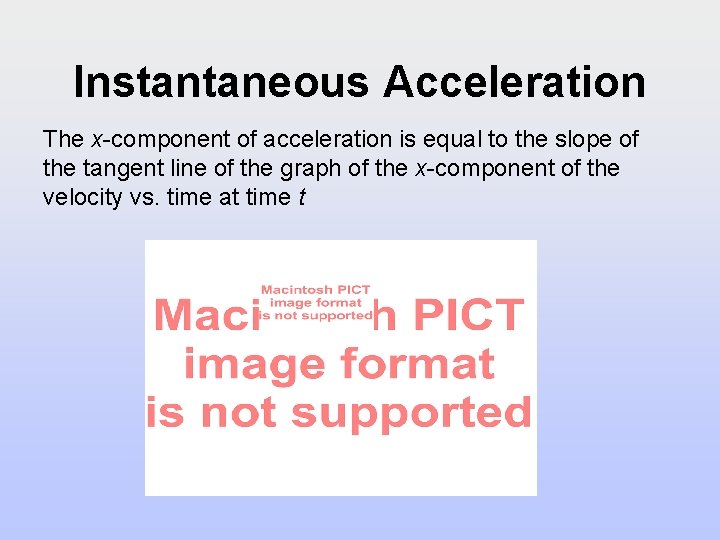
Instantaneous Acceleration The x-component of acceleration is equal to the slope of the tangent line of the graph of the x-component of the velocity vs. time at time t
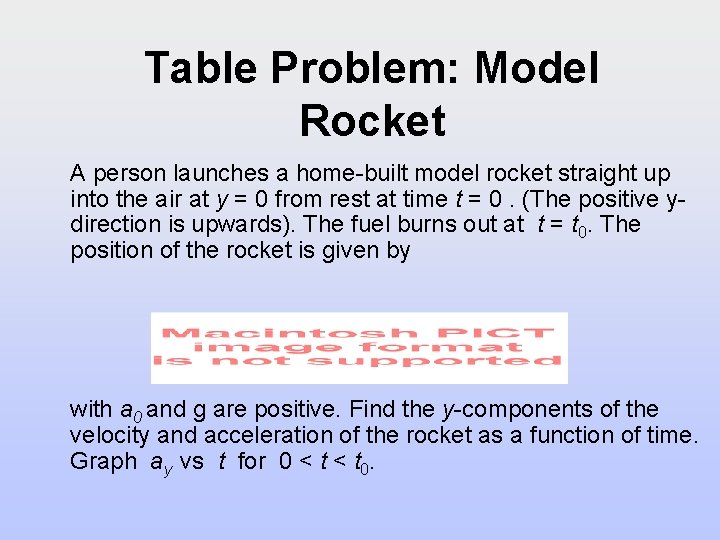
Table Problem: Model Rocket A person launches a home-built model rocket straight up into the air at y = 0 from rest at time t = 0. (The positive ydirection is upwards). The fuel burns out at t = t 0. The position of the rocket is given by with a 0 and g are positive. Find the y-components of the velocity and acceleration of the rocket as a function of time. Graph ay vs t for 0 < t 0.
Non-Constant Acceleration and Integration
Velocity as the Integral of Acceleration The area under the graph of the x-component of the acceleration vs. time is the change in velocity
Position as the Integral of Velocity Area under the graph of x-component of the velocity vs. time is the displacement Ei is the error in the approximation for each interval
Summary: Time-Dependent Acceleration • Acceleration is a nonconstant function of time • Change in velocity • Change in position
Table Problem: Sports Car At t = 0 , a sports car starting at rest at x = 0 accelerates with an x-component of acceleration given by and zero afterwards with • Find expressions for the velocity and position vectors of the sports as functions of time for t >0. (2) Sketch graphs of the x-component of the position, velocity and acceleration of the sports car as a function of time for t >0
Concept Question A particle, starting at rest at t = 0, experiences a nonconstant acceleration ax(t). It’s change of position can be found by 1. Differentiating ax(t) twice. • Integrating ax(t) twice. • (1/2) ax(t) times t 2. • None of the above. • Two of the above.
Next Reading Assignment: Young and Freedman: Sections 3. 1 -3. 3, 3. 5